Loading page, please wait…
Nicobar Port From No-Go Zone to Permitted Area - UPSC Environment And Ecology
What is Nicobar Port From No-Go Zone to Permitted Area in UPSC Environment And Ecology?
Nicobar Port From No-Go Zone to Permitted Area is a key topic under Environment And Ecology for UPSC Civil Services Examination. Key points include: The Great Nicobar 'Holistic Development' Project, spearheaded by NITI Aayog, involves a port, airport, power plant, and township.. It proposes converting parts of the ecologically sensitive Great Nicobar Island, historically a 'no-go zone', into a permitted area.. The project is strategically important for India's maritime trade and 'Act East' policy in the Indo-Pacific.. Understanding this topic is essential for both UPSC Prelims and Mains preparation.
Why is Nicobar Port From No-Go Zone to Permitted Area important for UPSC exam?
Nicobar Port From No-Go Zone to Permitted Area is a Medium-level topic in UPSC Environment And Ecology. It is tested in both Prelims (factual MCQs) and Mains (analytical answer writing). Previous year UPSC questions have frequently covered aspects of Nicobar Port From No-Go Zone to Permitted Area, making it essential for comprehensive IAS preparation.
How to prepare Nicobar Port From No-Go Zone to Permitted Area for UPSC?
To prepare Nicobar Port From No-Go Zone to Permitted Area for UPSC: (1) Study the comprehensive notes covering all key concepts on Vaidra. (2) Practice previous year questions on this topic. (3) Connect it with current affairs using daily updates. (4) Revise using key takeaways and mind maps available for Environment And Ecology. (5) Write practice answers linking Nicobar Port From No-Go Zone to Permitted Area to related GS Paper topics.
Key takeaways of Nicobar Port From No-Go Zone to Permitted Area for UPSC
- The Great Nicobar 'Holistic Development' Project, spearheaded by NITI Aayog, involves a port, airport, power plant, and township.
- It proposes converting parts of the ecologically sensitive Great Nicobar Island, historically a 'no-go zone', into a permitted area.
- The project is strategically important for India's maritime trade and 'Act East' policy in the Indo-Pacific.
- Significant environmental concerns exist regarding the island's unique biodiversity and fragile ecosystems.
- Concerns also include the potential impact on indigenous tribes, particularly the Shompen (PVTG) and Nicobarese.
- The project highlights the ongoing conflict between economic development, strategic interests, and environmental conservation in India.
Nicobar Port From No-Go Zone to Permitted Area
Medium⏱️ 10 min read
environment and ecology
📖 Introduction
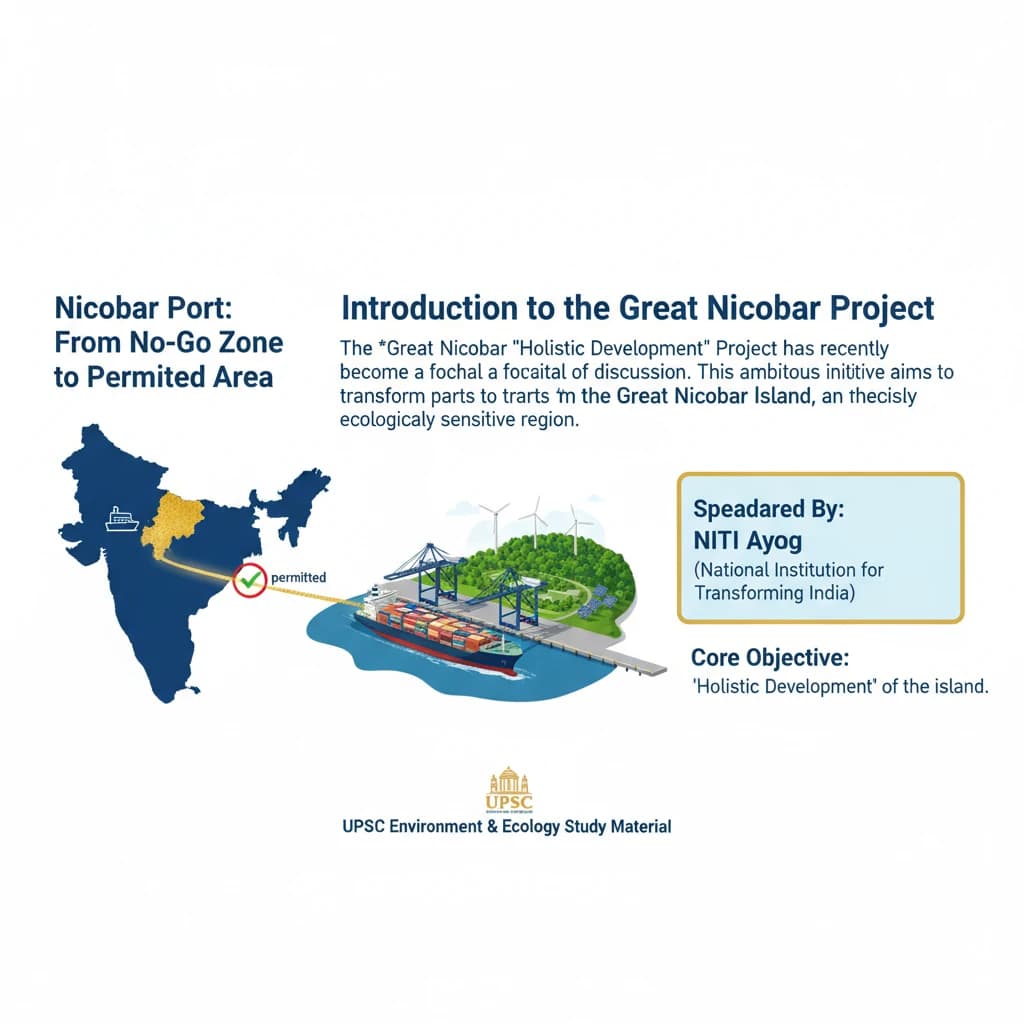
Introduction to the Great Nicobar Project
The Great Nicobar 'Holistic Development' Project has recently become a focal point of discussion. This ambitious initiative aims to transform parts of the Great Nicobar Island, an ecologically sensitive region.
Spearheaded By: NITI Aayog (National Institution for Transforming India)
Core Objective: 'Holistic Development' of the island, including infrastructure and economic growth.
The Shift from 'No-Go Zone' Status
Historically, certain areas within the Nicobar Islands have been designated as 'no-go zones' due to their extreme ecological fragility and the presence of indigenous tribes. The current project proposes significant changes, potentially altering this status for development purposes.
The term 'no-go zone' typically refers to areas where development activities are severely restricted or prohibited to protect critical ecosystems and vulnerable communities, such as the Shompen and Nicobarese tribes.
Components of the Development Project
The proposed development plan for Great Nicobar includes several large-scale infrastructure components. These are designed to boost the island's strategic and economic potential.
- International Container Trans-shipment Port: A major port facility envisioned at Galathea Bay.
- Greenfield International Airport: Planned to enhance connectivity and tourism.
- Power Plant: A gas/solar-based power plant to meet energy demands.
- Township Development: Creation of urban settlements to support the new infrastructure and population.
Environmental and Social Concerns
The project has generated considerable debate due to its potential impact on the island's unique biodiversity and indigenous populations. Environmental activists and tribal rights groups have raised significant concerns.
UPSC Relevance: This project is crucial for GS Paper 3 (Environment & Ecology, Infrastructure) and GS Paper 1 (Geography, Society), highlighting the conflict between development and conservation. Questions often focus on Environmental Impact Assessments (EIAs) and tribal rights.
💡 Key Takeaways
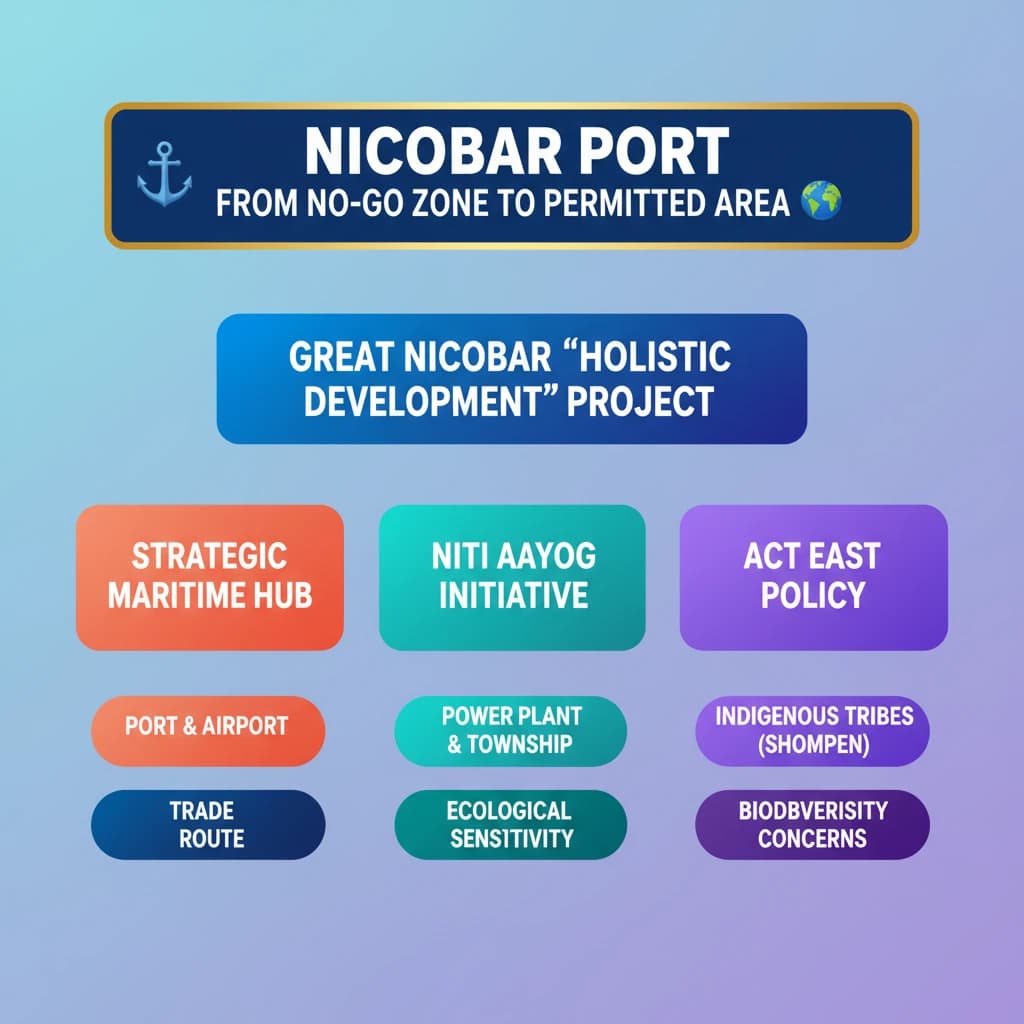
- •The Great Nicobar 'Holistic Development' Project, spearheaded by NITI Aayog, involves a port, airport, power plant, and township.
- •It proposes converting parts of the ecologically sensitive Great Nicobar Island, historically a 'no-go zone', into a permitted area.
- •The project is strategically important for India's maritime trade and 'Act East' policy in the Indo-Pacific.
- •Significant environmental concerns exist regarding the island's unique biodiversity and fragile ecosystems.
- •Concerns also include the potential impact on indigenous tribes, particularly the Shompen (PVTG) and Nicobarese.
- •The project highlights the ongoing conflict between economic development, strategic interests, and environmental conservation in India.
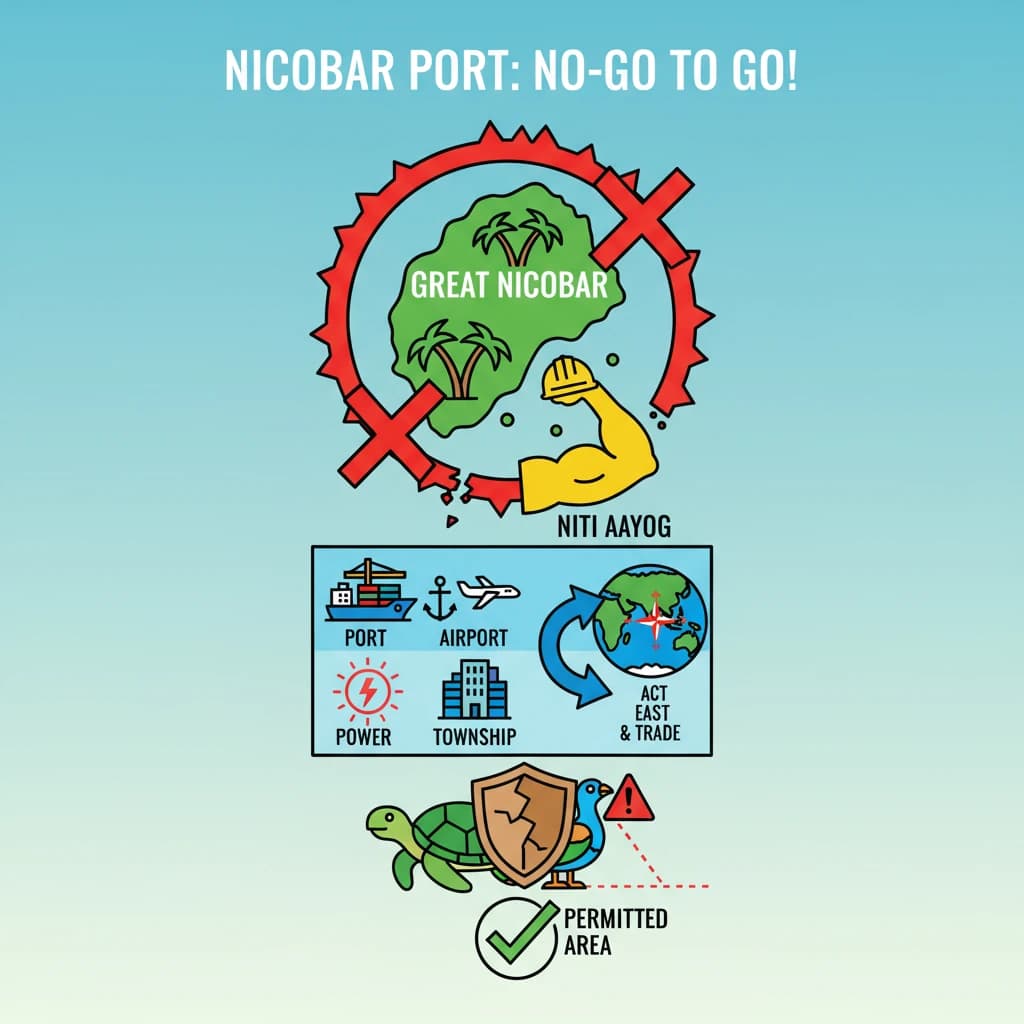
🧠 Memory Techniques
95% Verified Content
📚 Reference Sources
•Ministry of Environment, Forest and Climate Change (MoEFCC) reports and environmental clearances
•The Hindu, Indian Express, Down To Earth (reputable news and environmental journals)
•Reports by environmental NGOs and tribal rights organizations