Loading page, please wait…
Nitrogen Pollution: Impacts on Environment, Health, and Eutrophication - UPSC Environment And Ecology
What is Nitrogen Pollution: Impacts on Environment, Health, and Eutrophication in UPSC Environment And Ecology?
Nitrogen Pollution: Impacts on Environment, Health, and Eutrophication is a key topic under Environment And Ecology for UPSC Civil Services Examination. Key points include: Nitrogen pollution causes eutrophication, leading to oxygen-depleted 'dead zones' in aquatic ecosystems.. It severely impacts human health, causing respiratory issues from NO2 and 'blue baby syndrome' from nitrate contamination.. Nitrous oxide (N2O) depletes the stratospheric ozone layer and contributes to ground-level tropospheric ozone.. Understanding this topic is essential for both UPSC Prelims and Mains preparation.
Why is Nitrogen Pollution: Impacts on Environment, Health, and Eutrophication important for UPSC exam?
Nitrogen Pollution: Impacts on Environment, Health, and Eutrophication is a Medium-level topic in UPSC Environment And Ecology. It is tested in both Prelims (factual MCQs) and Mains (analytical answer writing). Previous year UPSC questions have frequently covered aspects of Nitrogen Pollution: Impacts on Environment, Health, and Eutrophication, making it essential for comprehensive IAS preparation.
How to prepare Nitrogen Pollution: Impacts on Environment, Health, and Eutrophication for UPSC?
To prepare Nitrogen Pollution: Impacts on Environment, Health, and Eutrophication for UPSC: (1) Study the comprehensive notes covering all key concepts on Vaidra. (2) Practice previous year questions on this topic. (3) Connect it with current affairs using daily updates. (4) Revise using key takeaways and mind maps available for Environment And Ecology. (5) Write practice answers linking Nitrogen Pollution: Impacts on Environment, Health, and Eutrophication to related GS Paper topics.
Key takeaways of Nitrogen Pollution: Impacts on Environment, Health, and Eutrophication for UPSC
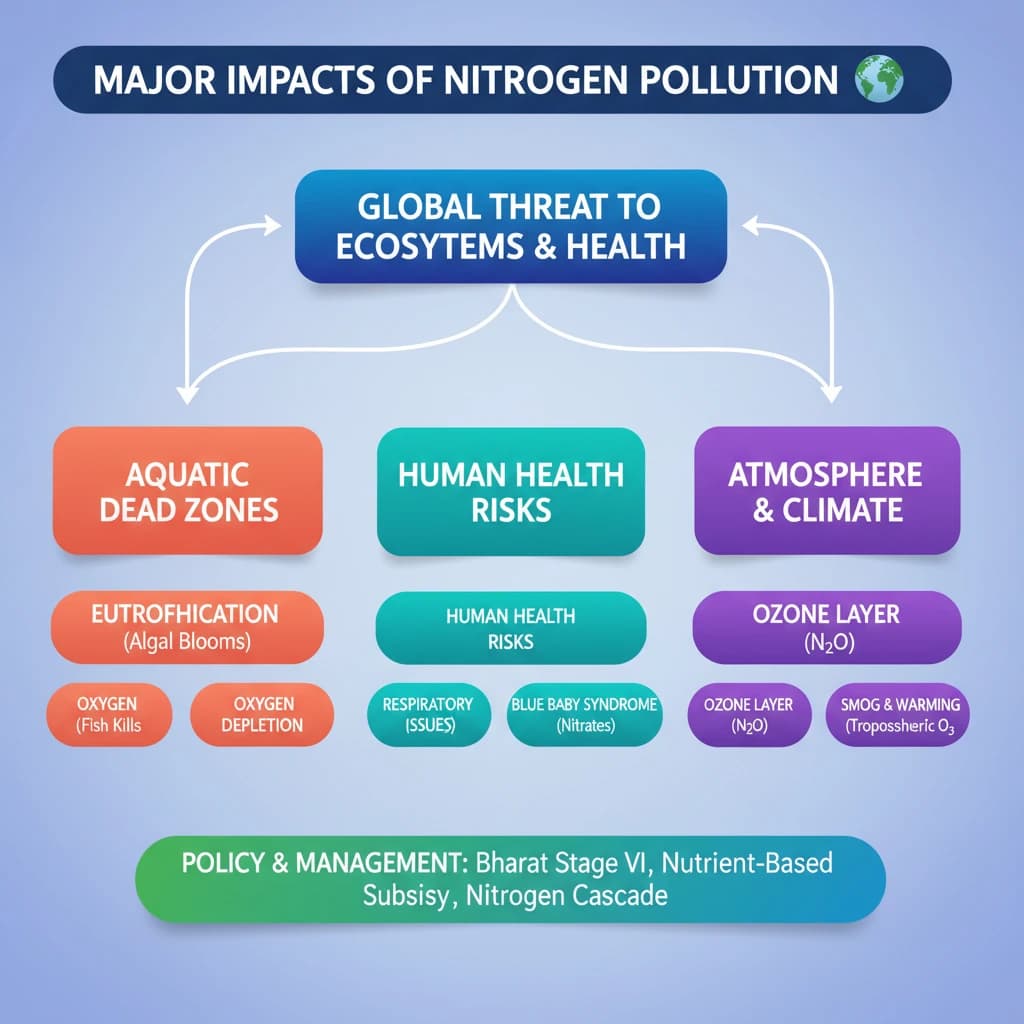
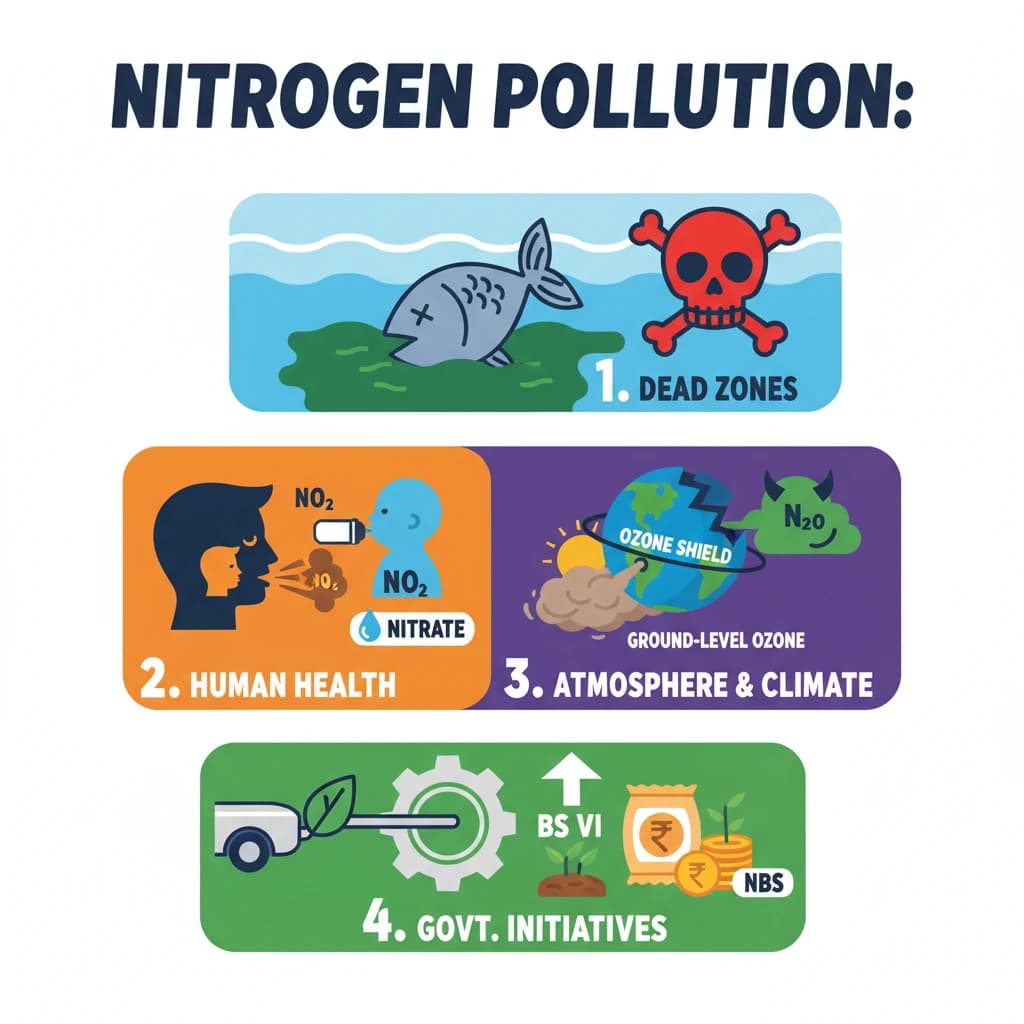
- Nitrogen pollution causes eutrophication, leading to oxygen-depleted 'dead zones' in aquatic ecosystems.
- It severely impacts human health, causing respiratory issues from NO2 and 'blue baby syndrome' from nitrate contamination.
- Nitrous oxide (N2O) depletes the stratospheric ozone layer and contributes to ground-level tropospheric ozone.
- Government initiatives like Bharat Stage (BS VI) emission standards and Nutrient-Based Subsidy (NBS) aim to mitigate nitrogen emissions.
- Managing the 'nitrogen cascade' is crucial for environmental sustainability, biodiversity, and public health.
Nitrogen Pollution: Impacts on Environment, Health, and Eutrophication
Medium⏱️ 8 min read
environment and ecology
📖 Introduction
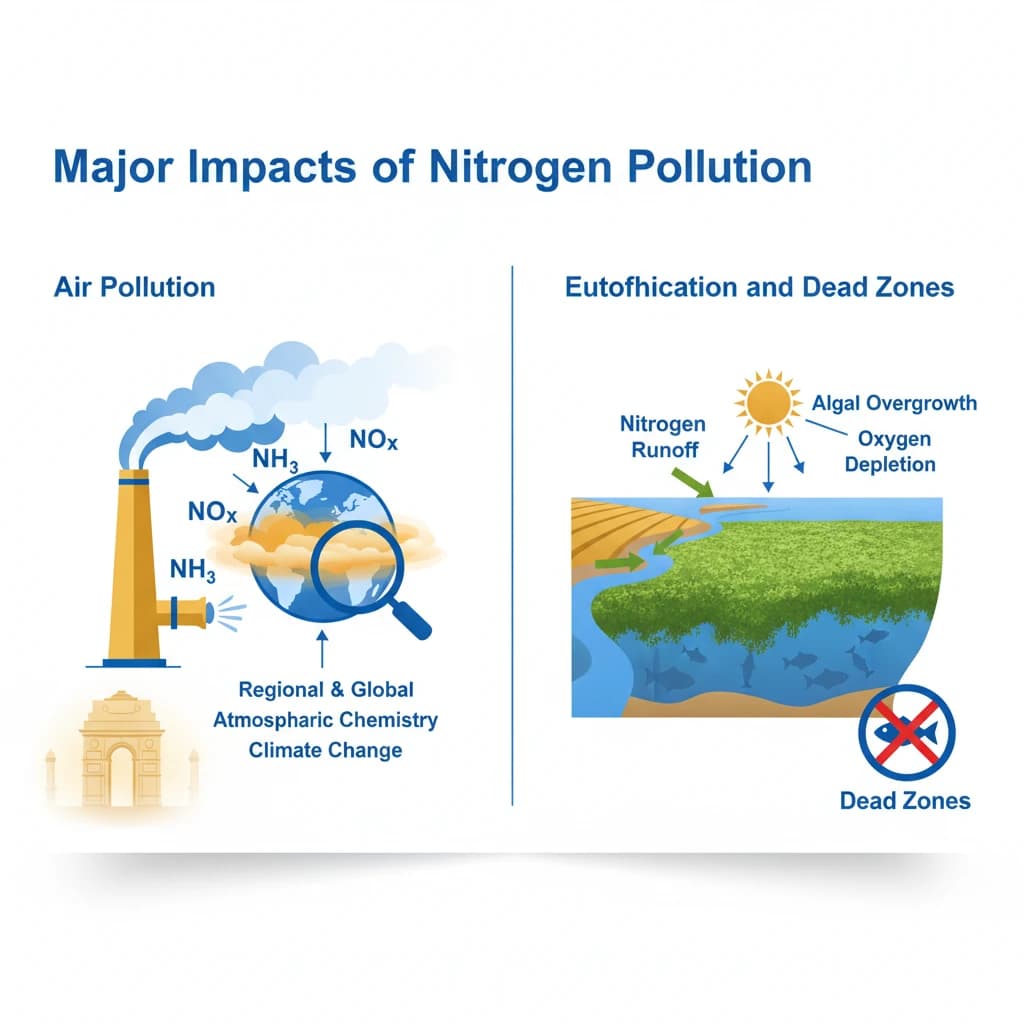
Major Impacts of Nitrogen Pollution
Emissions of reactive nitrogen compounds significantly contribute to air pollution, causing both regional and global impacts on atmospheric chemistry and climate.
Eutrophication and Dead Zones
Eutrophication occurs when excess nitrogen acts as a nutrient fertilizer for aquatic plants, leading to an overgrowth of algae and other aquatic vegetation.
This phenomenon is widely known as algal blooming, which can cover vast areas of water bodies.
Algal blooming subsequently creates oxygen-depleted zones, often referred to as "dead zones". In these areas, aquatic life suffocates and dies due to the severe lack of oxygen.
Human Health Impacts
Nitrogen pollution exerts direct and indirect detrimental effects on human health.
High concentrations of nitrogen dioxide (NO2) in the air can exacerbate existing respiratory conditions such as asthma and elevate the risk of respiratory infections.
It is estimated that 77% of people globally breathe annual average concentrations of nitrogen dioxide that exceed safe levels.
Furthermore, nitrate contamination of drinking water can pose serious health risks, particularly to infants.
This contamination can lead to methemoglobinemia, commonly known as “blue baby syndrome”, a condition that impairs the blood's ability to carry oxygen.
Ozone Depletion and Tropospheric Ozone
Nitrous oxide (N2O), when released into the atmosphere, contributes to the depletion of the stratospheric ozone layer.
The stratospheric ozone layer is vital as it shields Earth from harmful ultraviolet (UV) radiation.
Depletion of this protective layer increases the risk of skin cancer, cataracts, and other health problems in humans, while also harming marine ecosystems and agricultural crops.
Additionally, nitrogen oxides contribute to the formation of tropospheric ozone (ground-level ozone), which is a pollutant that causes further respiratory illnesses.
Related Government Initiatives
To combat nitrogen pollution, several government initiatives have been implemented:
- Bharat Stage (BS VI) Emission Standards: These are stricter emission standards for vehicles and industries, specifically designed to curb the release of nitrogen oxides and particulate matter, which are precursors to both air and water pollution.
- Nutrient-Based Subsidy (NBS): This policy incentivizes the use of controlled-release fertilizers, thereby encouraging more efficient nutrient management in agriculture and reducing environmental nitrogen loads.
💡 Key Takeaways
- •Nitrogen pollution causes eutrophication, leading to oxygen-depleted 'dead zones' in aquatic ecosystems.
- •It severely impacts human health, causing respiratory issues from NO2 and 'blue baby syndrome' from nitrate contamination.
- •Nitrous oxide (N2O) depletes the stratospheric ozone layer and contributes to ground-level tropospheric ozone.
- •Government initiatives like Bharat Stage (BS VI) emission standards and Nutrient-Based Subsidy (NBS) aim to mitigate nitrogen emissions.
- •Managing the 'nitrogen cascade' is crucial for environmental sustainability, biodiversity, and public health.
🧠 Memory Techniques
98% Verified Content
📚 Reference Sources
•General environmental science textbooks and reports on nitrogen cycle and pollution
•Reports from environmental agencies (e.g., EPA, UNEP) on dead zones and air quality