Loading page, please wait…
Protecting Sacred Groves - UPSC Environment And Ecology
What is Protecting Sacred Groves in UPSC Environment And Ecology?
Protecting Sacred Groves is a key topic under Environment And Ecology for UPSC Civil Services Examination. Key points include: Sacred Groves are virgin forest tracts protected by local communities due to cultural and religious beliefs.. The Supreme Court recently directed the Union government to create a comprehensive policy for their protection.. The Piplantri Model (Rajasthan) served as an inspiration for the Supreme Court's judgment.. Understanding this topic is essential for both UPSC Prelims and Mains preparation.
Why is Protecting Sacred Groves important for UPSC exam?
Protecting Sacred Groves is a Medium-level topic in UPSC Environment And Ecology. It is tested in both Prelims (factual MCQs) and Mains (analytical answer writing). Previous year UPSC questions have frequently covered aspects of Protecting Sacred Groves, making it essential for comprehensive IAS preparation.
How to prepare Protecting Sacred Groves for UPSC?
To prepare Protecting Sacred Groves for UPSC: (1) Study the comprehensive notes covering all key concepts on Vaidra. (2) Practice previous year questions on this topic. (3) Connect it with current affairs using daily updates. (4) Revise using key takeaways and mind maps available for Environment And Ecology. (5) Write practice answers linking Protecting Sacred Groves to related GS Paper topics.
Key takeaways of Protecting Sacred Groves for UPSC
- Sacred Groves are virgin forest tracts protected by local communities due to cultural and religious beliefs.
- The Supreme Court recently directed the Union government to create a comprehensive policy for their protection.
- The Piplantri Model (Rajasthan) served as an inspiration for the Supreme Court's judgment.
- India hosts over 100,000 Sacred Groves, serving as relic vegetation and biodiversity hotspots.
- They are legally supported by the Wild Life (Protection) Act, 1972 (Community Reserves) and the National Forest Policy, 1988.
Protecting Sacred Groves
Medium⏱️ 6 min read
environment and ecology
📖 Introduction
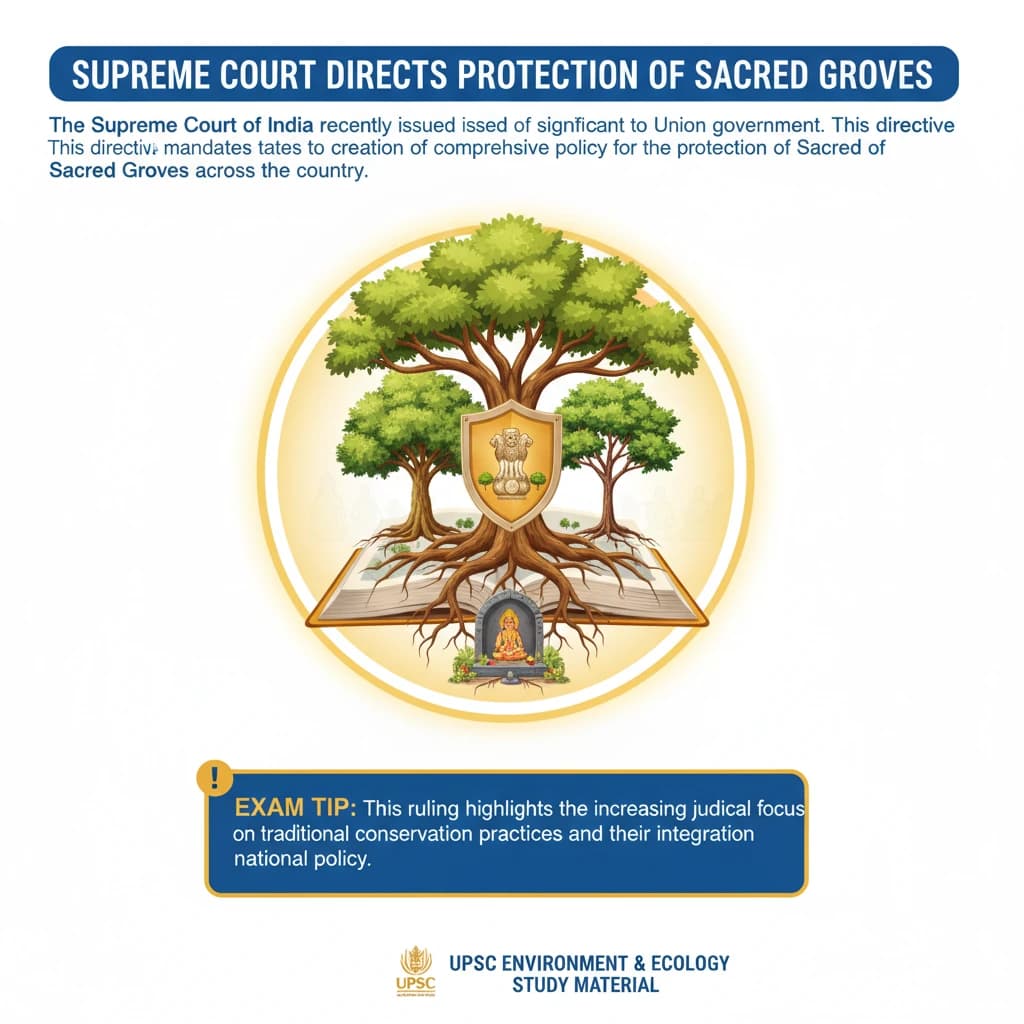
Supreme Court Directs Protection of Sacred Groves
The Supreme Court of India recently issued a significant directive to the Union government.
This directive mandates the creation of a comprehensive policy for the protection of Sacred Groves across the country.
This ruling highlights the increasing judicial focus on traditional conservation practices and their integration into national policy. It is highly relevant for GS-III Environment and Ecology.
Inspiration: The Piplantri Model
The Supreme Court's judgment drew inspiration from the successful Piplantri Model.
The Piplantri village in Rajasthan's Rajsamand district is renowned for its unique initiative where 111 trees are planted every time a girl child is born. This model combines social welfare with environmental conservation.
Understanding Sacred Groves
Sacred Groves are defined as tracts of virgin forests that remain untouched by local inhabitants.
These areas are protected primarily due to the cultural and religious beliefs of the local communities.
They represent relic vegetation, serving as remnants of once dominant flora in a particular region.
Presence and Distribution in India
India is home to a vast number of these ecologically and culturally significant sites.
- Over 1 million sacred forests exist across the nation.
- There are an estimated 100,000 to 150,000 individual sacred groves.
These groves are particularly prominent in states like Maharashtra, Karnataka, Kerala, Tamil Nadu, and Uttarakhand.
Statutory and Policy Framework for Protection
Several legal and policy instruments support the protection of Sacred Groves in India.
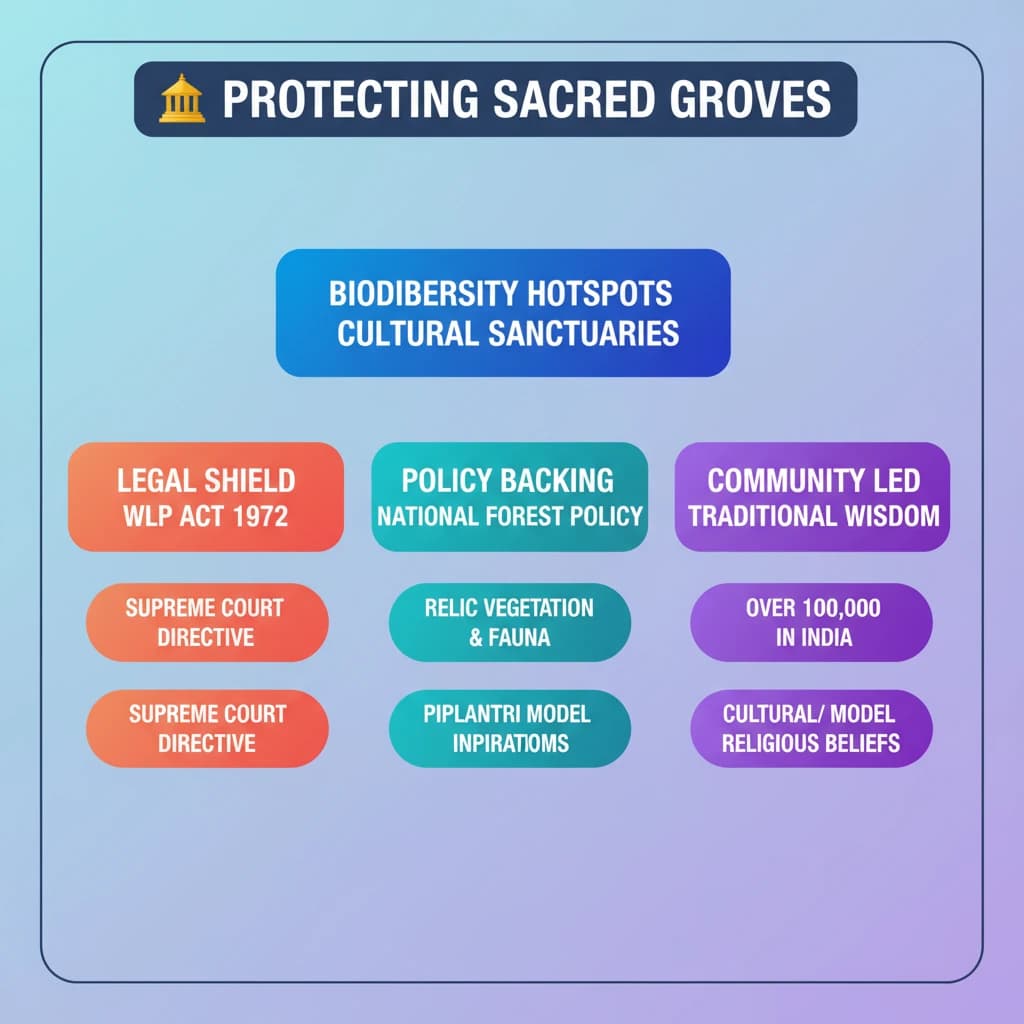
- Wild Life (Protection) Act, 1972: This Act empowers State Governments to declare any private or community land as a Community Reserve. Sacred Groves can be designated as such under this provision.
- National Forest Policy, 1988: This policy encourages communities with customary rights to protect and improve forest patches, recognizing their dependence on these areas.
- Godavarman Case, 1996: This landmark Supreme Court judgment further reinforced the importance of forest protection and community involvement.
💡 Key Takeaways
- •Sacred Groves are virgin forest tracts protected by local communities due to cultural and religious beliefs.
- •The Supreme Court recently directed the Union government to create a comprehensive policy for their protection.
- •The Piplantri Model (Rajasthan) served as an inspiration for the Supreme Court's judgment.
- •India hosts over 100,000 Sacred Groves, serving as relic vegetation and biodiversity hotspots.
- •They are legally supported by the Wild Life (Protection) Act, 1972 (Community Reserves) and the National Forest Policy, 1988.
🧠 Memory Techniques

95% Verified Content