Loading page, please wait…
Salt Pan Lands: Redevelopment Project, Ecological Concerns, and CRZ Status - UPSC Environment And Ecology
What is Salt Pan Lands: Redevelopment Project, Ecological Concerns, and CRZ Status in UPSC Environment And Ecology?
Salt Pan Lands: Redevelopment Project, Ecological Concerns, and CRZ Status is a key topic under Environment And Ecology for UPSC Civil Services Examination. Key points include: Salt pan lands are low-lying coastal areas where seawater evaporates, leaving salt and minerals.. They are ecologically sensitive, classified as CRZ-1B under CRZ Notification 2011, restricting most economic activities.. They play a critical role in coastal ecosystem balance, supporting unique biodiversity and acting as natural buffers.. Understanding this topic is essential for both UPSC Prelims and Mains preparation.
Why is Salt Pan Lands: Redevelopment Project, Ecological Concerns, and CRZ Status important for UPSC exam?
Salt Pan Lands: Redevelopment Project, Ecological Concerns, and CRZ Status is a Medium-level topic in UPSC Environment And Ecology. It is tested in both Prelims (factual MCQs) and Mains (analytical answer writing). Previous year UPSC questions have frequently covered aspects of Salt Pan Lands: Redevelopment Project, Ecological Concerns, and CRZ Status, making it essential for comprehensive IAS preparation.
How to prepare Salt Pan Lands: Redevelopment Project, Ecological Concerns, and CRZ Status for UPSC?
To prepare Salt Pan Lands: Redevelopment Project, Ecological Concerns, and CRZ Status for UPSC: (1) Study the comprehensive notes covering all key concepts on Vaidra. (2) Practice previous year questions on this topic. (3) Connect it with current affairs using daily updates. (4) Revise using key takeaways and mind maps available for Environment And Ecology. (5) Write practice answers linking Salt Pan Lands: Redevelopment Project, Ecological Concerns, and CRZ Status to related GS Paper topics.
Key takeaways of Salt Pan Lands: Redevelopment Project, Ecological Concerns, and CRZ Status for UPSC
- Salt pan lands are low-lying coastal areas where seawater evaporates, leaving salt and minerals.
- They are ecologically sensitive, classified as CRZ-1B under CRZ Notification 2011, restricting most economic activities.
- They play a critical role in coastal ecosystem balance, supporting unique biodiversity and acting as natural buffers.
- Recent transfer of Mumbai's salt pan land for Dharavi redevelopment highlights development vs. environment conflict.
- India has ~60,000 acres of salt pans, with Andhra Pradesh, Tamil Nadu, and Maharashtra having the largest expanses.
Salt Pan Lands: Redevelopment Project, Ecological Concerns, and CRZ Status
Medium⏱️ 7 min read
environment and ecology
📖 Introduction
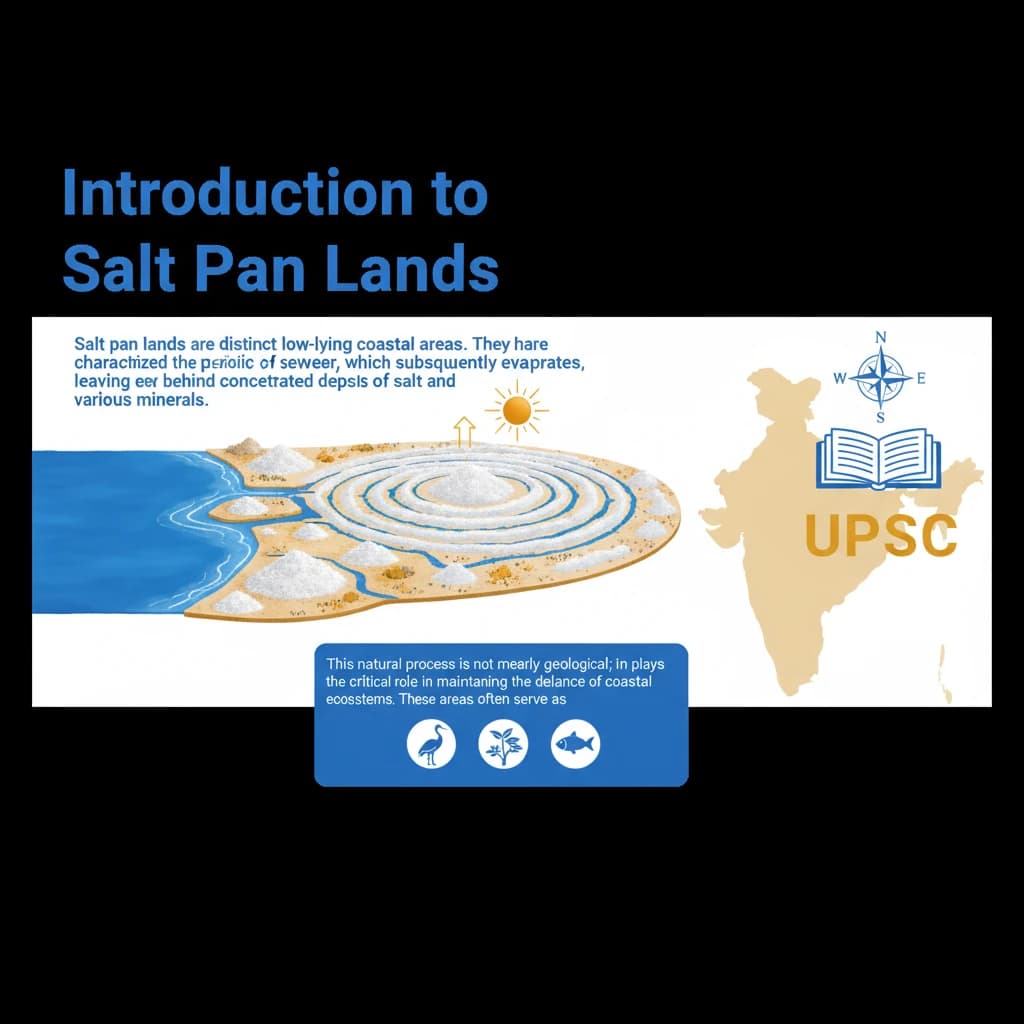
Introduction to Salt Pan Lands
Salt pan lands are distinct low-lying coastal areas. They are characterized by the periodic inflow of seawater, which subsequently evaporates, leaving behind concentrated deposits of salt and various minerals.
This natural process is not merely geological; it plays a critical role in maintaining the delicate balance of coastal ecosystems. These areas often serve as unique habitats for specialized flora and fauna.
Ecological Significance: Salt pan lands are vital for coastal biodiversity, acting as buffers against coastal erosion and supporting unique saline-tolerant species. They contribute significantly to the health of estuaries and mangroves.
Recent Developments and Concerns
Recently, the Centre approved the transfer of 256 acres of salt pan land in Mumbai. This land is designated for the Dharavi Redevelopment Project Pvt Ltd (DRPPL), intended for constructing rental housing for slum dwellers.
This decision has triggered significant ecological concerns among environmentalists. They argue against construction on these sensitive lands, highlighting potential irreversible damage to the coastal environment.
Protection Status and Regulations
Due to their ecological importance, salt pan lands are afforded special protection. Under the CRZ Notification of 2011, these areas are classified as ecologically sensitive areas.
CRZ-1B Classification: Salt pan lands fall under CRZ-1B, which imposes strict restrictions on economic activities. Permitted activities are generally limited to salt extraction and natural gas exploration, with other forms of development largely prohibited.
UPSC Insight: Understanding the CRZ Notification (2011) and its subsequent amendments (like CRZ 2018) is crucial. Questions often focus on classifications (CRZ-I, II, III, IV) and permissible activities within each zone, especially concerning ecologically sensitive areas like salt pans.
Distribution of Salt Pan Lands in India
India possesses a significant expanse of salt pan lands. In Mumbai alone, approximately 5,378 acres have been officially designated as such.
Nationally, around 60,000 acres of these unique lands have been identified. They are distributed across several coastal states, reflecting India's extensive coastline.
- Major States: Key states with significant salt pan areas include Maharashtra, Andhra Pradesh, Tamil Nadu, Odisha, Gujarat, and Karnataka.
- Largest Expanses: Andhra Pradesh leads with 20,716 acres, followed by Tamil Nadu (17,095 acres), and Maharashtra (12,662 acres).
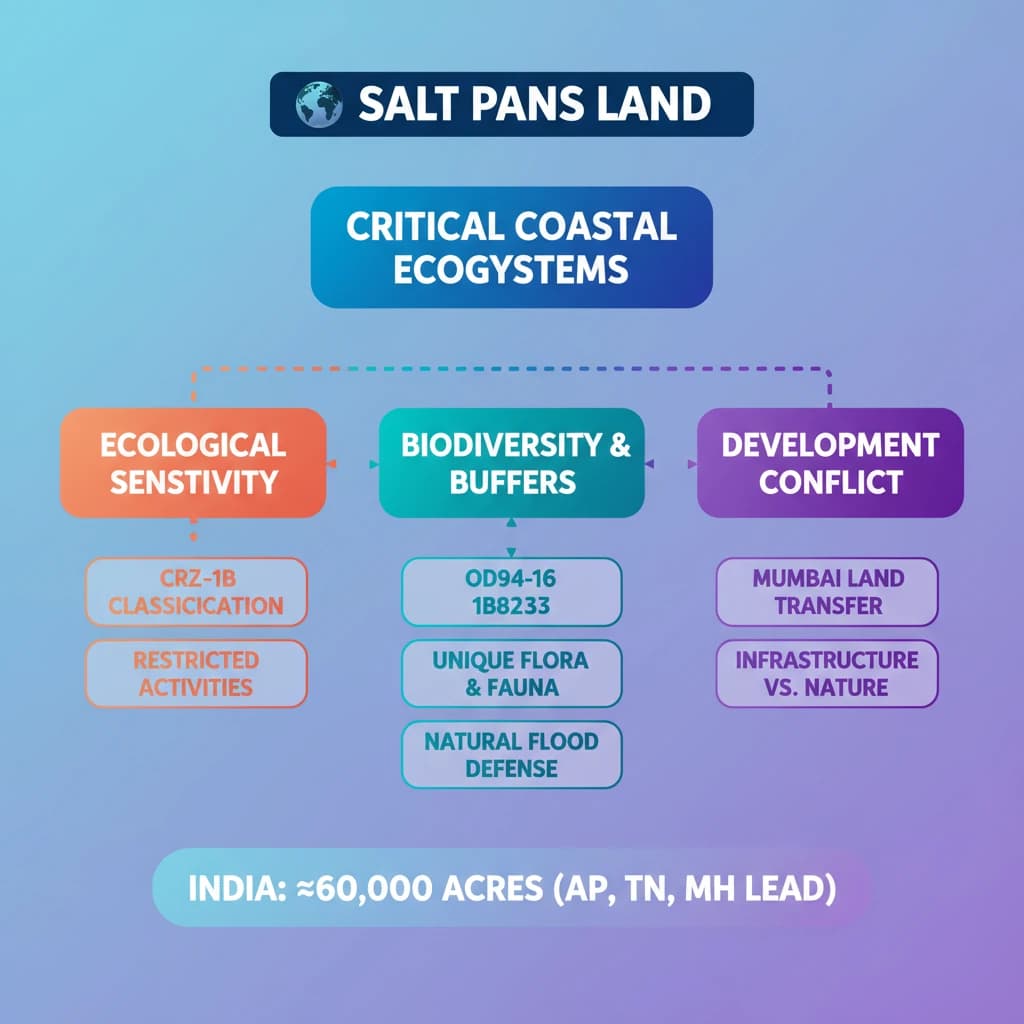
💡 Key Takeaways
- •Salt pan lands are low-lying coastal areas where seawater evaporates, leaving salt and minerals.
- •They are ecologically sensitive, classified as CRZ-1B under CRZ Notification 2011, restricting most economic activities.
- •They play a critical role in coastal ecosystem balance, supporting unique biodiversity and acting as natural buffers.
- •Recent transfer of Mumbai's salt pan land for Dharavi redevelopment highlights development vs. environment conflict.
- •India has ~60,000 acres of salt pans, with Andhra Pradesh, Tamil Nadu, and Maharashtra having the largest expanses.
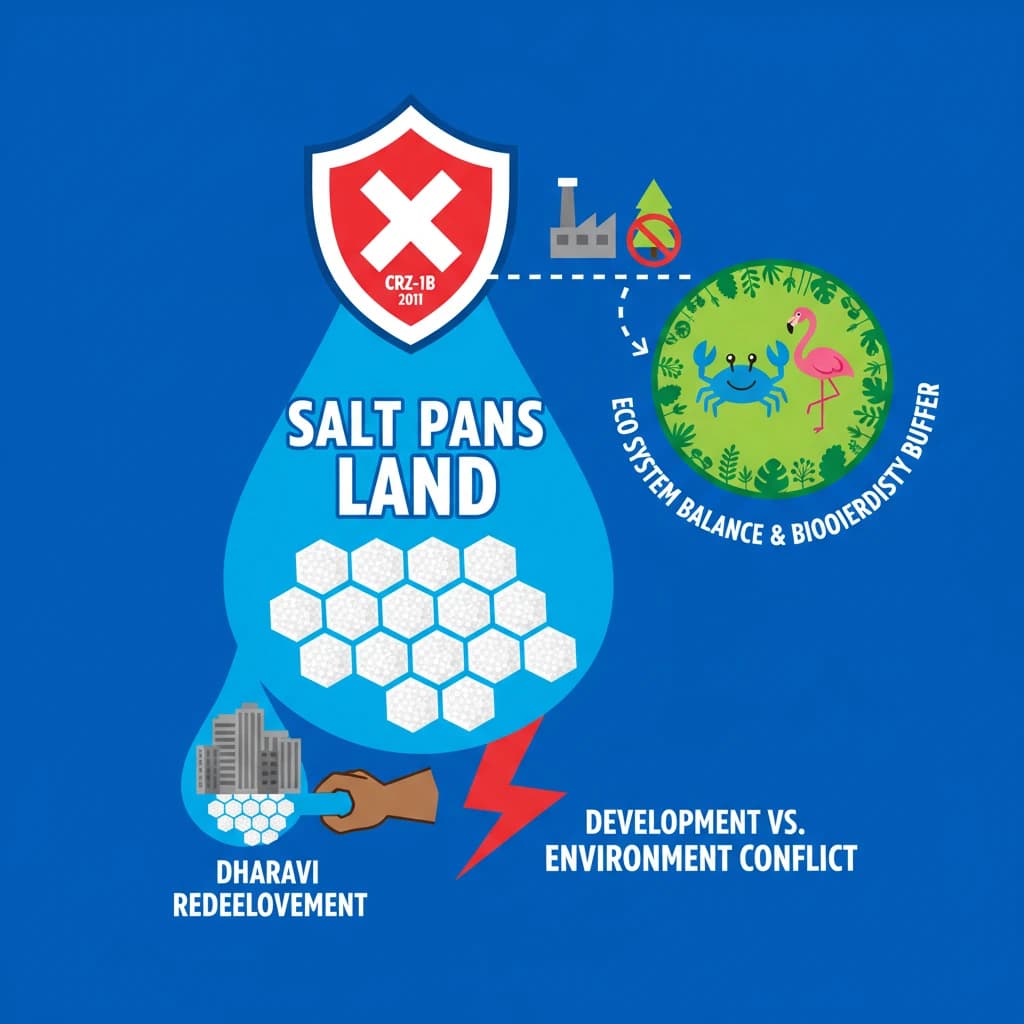
🧠 Memory Techniques
95% Verified Content
📚 Reference Sources
•Coastal Regulation Zone Notification, 2011 (and subsequent amendments)
•Reports on Dharavi Redevelopment Project