Loading page, please wait…
Turtle Excluder Devices (TEDs) - UPSC Environment And Ecology
What is Turtle Excluder Devices (TEDs) in UPSC Environment And Ecology?
Turtle Excluder Devices (TEDs) is a key topic under Environment And Ecology for UPSC Civil Services Examination. Key points include: Turtle Excluder Devices (TEDs) are crucial for preventing sea turtle bycatch in trawls.. Odisha mandates TEDs for fishing trawlers to protect Olive Ridley turtles.. Tagging programs track turtle movements and aid habitat protection.. Understanding this topic is essential for both UPSC Prelims and Mains preparation.
Why is Turtle Excluder Devices (TEDs) important for UPSC exam?
Turtle Excluder Devices (TEDs) is a Medium-level topic in UPSC Environment And Ecology. It is tested in both Prelims (factual MCQs) and Mains (analytical answer writing). Previous year UPSC questions have frequently covered aspects of Turtle Excluder Devices (TEDs), making it essential for comprehensive IAS preparation.
How to prepare Turtle Excluder Devices (TEDs) for UPSC?
To prepare Turtle Excluder Devices (TEDs) for UPSC: (1) Study the comprehensive notes covering all key concepts on Vaidra. (2) Practice previous year questions on this topic. (3) Connect it with current affairs using daily updates. (4) Revise using key takeaways and mind maps available for Environment And Ecology. (5) Write practice answers linking Turtle Excluder Devices (TEDs) to related GS Paper topics.
Key takeaways of Turtle Excluder Devices (TEDs) for UPSC
- Turtle Excluder Devices (TEDs) are crucial for preventing sea turtle bycatch in trawls.
- Odisha mandates TEDs for fishing trawlers to protect Olive Ridley turtles.
- Tagging programs track turtle movements and aid habitat protection.
- Rushikulya River in Odisha is a significant mass nesting site for Olive Ridley turtles.
- Indian biologist Shailendra Singh received the Behler Award for saving critically endangered turtle species.

Turtle Excluder Devices (TEDs)
Medium⏱️ 5 min read
environment and ecology
📖 Introduction
Introduction to Turtle Excluder Devices (TEDs)
Turtle Excluder Devices (TEDs) are specialized mechanisms designed to prevent the accidental capture and drowning of sea turtles in fishing nets, particularly trawls.
A trawl is a large, cone-shaped fishing net that is towed by a boat through the water, primarily used for catching fish.
Mandate in Odisha for Turtle Protection
The state of Odisha in India has taken a significant step by mandating the use of TEDs in all fishing trawls operating in its coastal waters.
This mandate aims to reduce the accidental deaths of sea turtles, especially the endangered Olive Ridley turtles, which are known to nest along the Odisha coast.
The implementation of TEDs is crucial for mitigating bycatch, which refers to the incidental capture of non-target species during fishing operations.
Turtle Tagging for Conservation Research
In addition to TEDs, conservation efforts include the tagging of sea turtles, particularly Olive Ridley turtles.
- These tags are made of non-corrosive metal to ensure durability in marine environments.
- The primary purpose of tagging is to track their movements and to safeguard their habitats, providing vital data for conservation strategies.
Rushikulya River: A Critical Olive Ridley Nesting Site
The Rushikulya River plays a pivotal role in the life cycle of Olive Ridley turtles, serving as one of the largest mass nesting sites globally.
- Origin: Rushyamala hills in the Eastern Ghats, Kandhamal district, Odisha.
- Flow: Southeast, discharging into the Bay of Bengal.
- Tributaries: Includes Padma, Boringanalla, Joro, Badanadi, Baghua, Dhanei, and Ghodhado.
- Delta: Notably, the river has no delta at its mouth.
Understanding the geography of key nesting sites like Rushikulya is important for questions related to biodiversity hotspots and conservation efforts in UPSC Prelims Geography and Environment sections.
Global Recognition for Indian Turtle Conservation
Indian biologist Shailendra Singh received the prestigious Behler Turtle Conservation Award, often referred to as the “Nobel Prize” of turtle conservation.
This award acknowledges his exceptional efforts in saving three critically endangered turtle species from extinction:
- Northern River Terrapin
- Red-crowned Roofed Turtle
- Black Softshell Turtle
This recognition highlights India's significant contributions to global turtle conservation and the dedication of its wildlife biologists.
💡 Key Takeaways
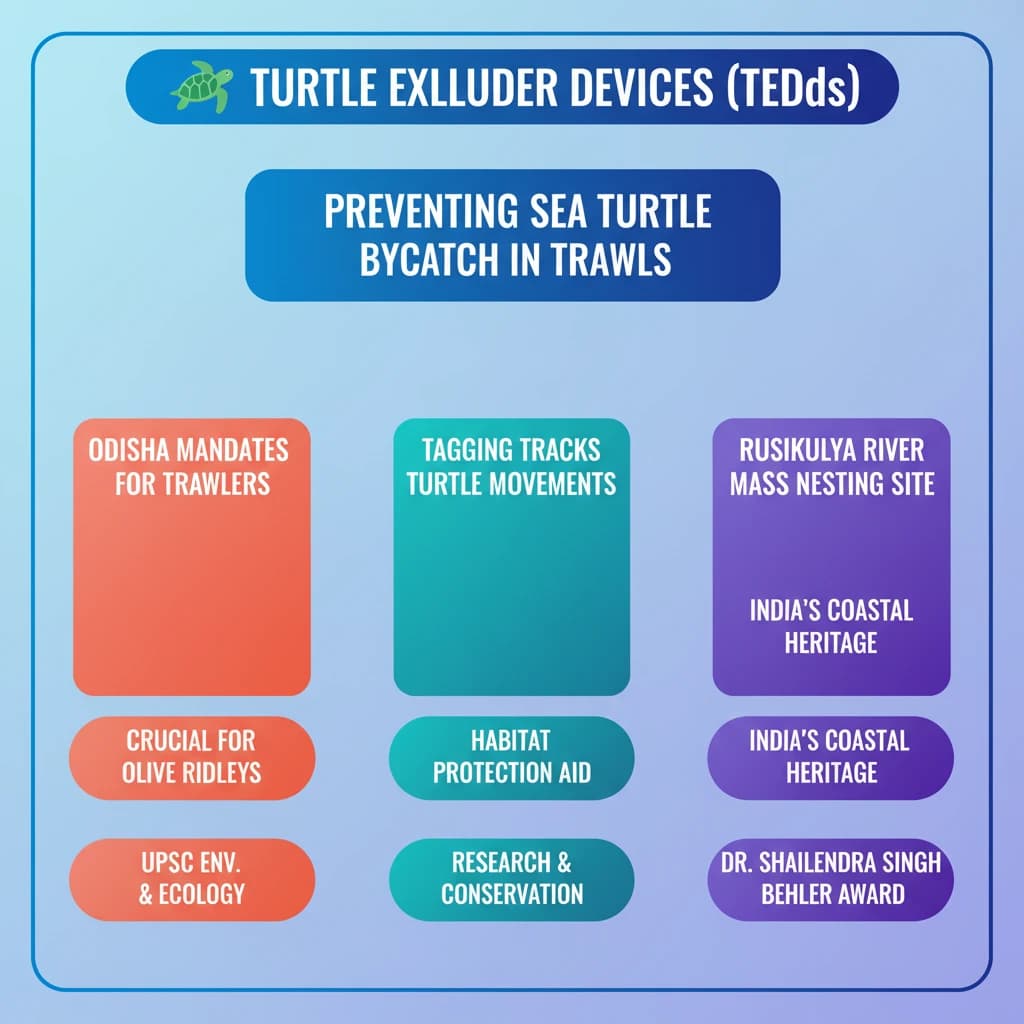
- •Turtle Excluder Devices (TEDs) are crucial for preventing sea turtle bycatch in trawls.
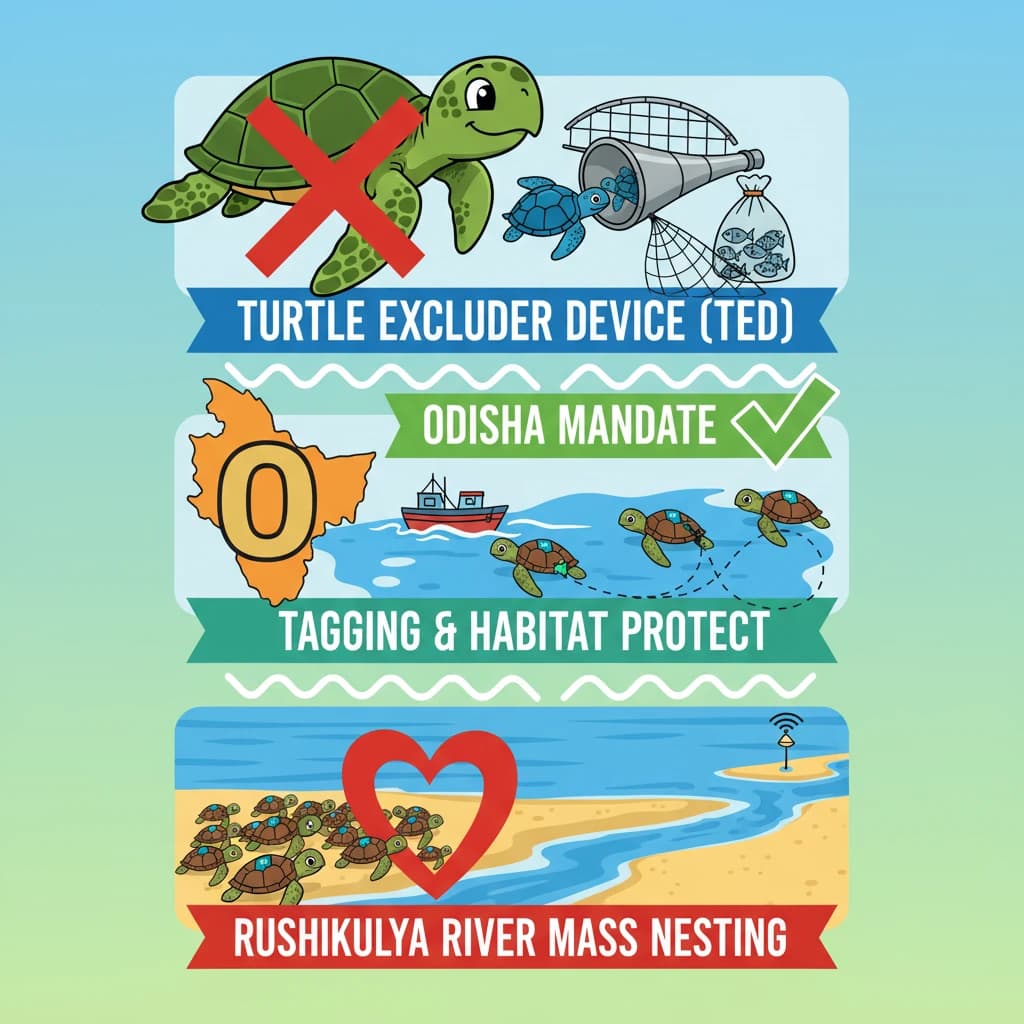
- •Odisha mandates TEDs for fishing trawlers to protect Olive Ridley turtles.
- •Tagging programs track turtle movements and aid habitat protection.
- •Rushikulya River in Odisha is a significant mass nesting site for Olive Ridley turtles.
- •Indian biologist Shailendra Singh received the Behler Award for saving critically endangered turtle species.
🧠 Memory Techniques
95% Verified Content