Loading page, please wait…
What are Key Facts about the Panama Canal? - UPSC Environment And Ecology
What is What are Key Facts about the Panama Canal? in UPSC Environment And Ecology?
What are Key Facts about the Panama Canal? is a key topic under Environment And Ecology for UPSC Civil Services Examination. Key points include: The Panama Canal is an 82 km artificial waterway connecting the Atlantic and Pacific Oceans.. It significantly shortens maritime routes, saving 12,600 km between New York and San Francisco.. The canal uses a sophisticated lock system to lift and lower ships due to differing ocean elevations.. Understanding this topic is essential for both UPSC Prelims and Mains preparation.
Why is What are Key Facts about the Panama Canal? important for UPSC exam?
What are Key Facts about the Panama Canal? is a Medium-level topic in UPSC Environment And Ecology. It is tested in both Prelims (factual MCQs) and Mains (analytical answer writing). Previous year UPSC questions have frequently covered aspects of What are Key Facts about the Panama Canal?, making it essential for comprehensive IAS preparation.
How to prepare What are Key Facts about the Panama Canal? for UPSC?
To prepare What are Key Facts about the Panama Canal? for UPSC: (1) Study the comprehensive notes covering all key concepts on Vaidra. (2) Practice previous year questions on this topic. (3) Connect it with current affairs using daily updates. (4) Revise using key takeaways and mind maps available for Environment And Ecology. (5) Write practice answers linking What are Key Facts about the Panama Canal? to related GS Paper topics.
Key takeaways of What are Key Facts about the Panama Canal? for UPSC
- The Panama Canal is an 82 km artificial waterway connecting the Atlantic and Pacific Oceans.
- It significantly shortens maritime routes, saving 12,600 km between New York and San Francisco.
- The canal uses a sophisticated lock system to lift and lower ships due to differing ocean elevations.
- Opened on August 15, 1914, it remains a critical conduit for global maritime trade.
- The system comprises 12 locks, fed by artificial lakes and channels.
What are Key Facts about the Panama Canal?
Medium⏱️ 7 min read
environment and ecology
📖 Introduction
Introduction to the Panama Canal
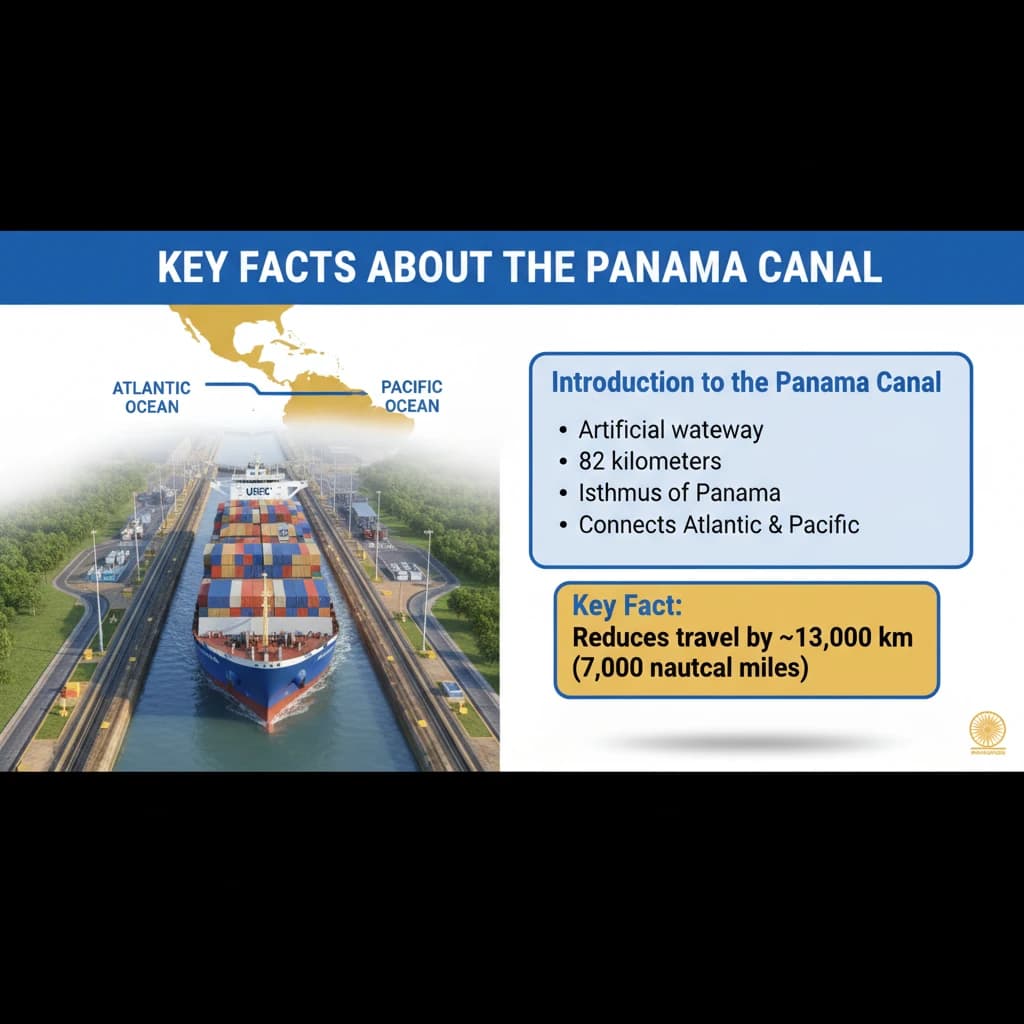
The Panama Canal is an artificial waterway, stretching approximately 82 kilometers across the Isthmus of Panama. It serves as a vital link, connecting the Atlantic Ocean with the Pacific Ocean.
Key Fact: This engineering marvel significantly reduces travel distances for maritime trade, saving approximately 12,600 km on a journey between New York and San Francisco.
Geographical Significance
Cutting across the narrow Isthmus of Panama, the canal acts as a crucial conduit for maritime trade. Its strategic location eliminates the need for ships to navigate the lengthy and often hazardous route around South America.
Historical Milestone
A pivotal moment in global shipping history occurred on August 15, 1914, when the first ship successfully traversed the Panama Canal. This marked the official opening and operationalization of the waterway.
Understanding the Canal's Functioning
The Panama Canal operates as a highly sophisticated and engineered system. Its primary mechanism involves a series of locks and elevators designed to facilitate the passage of ships between the two oceans.
The need for this intricate system arises because the Atlantic Ocean and Pacific Ocean do not lie at the same elevation, with the Pacific Ocean being slightly higher than the Atlantic.
The Lock System Explained
For a ship entering the canal from the Atlantic side, it must gain elevation to reach the level of the Pacific Ocean. Conversely, ships traveling from the Pacific must lose elevation.
This critical adjustment is achieved through the ingenious lock system, which effectively lifts and drops vessels to the required sea level at either end of the canal.
Mechanism of Locks: Water Elevators
Each lock chamber functions as a "water elevator." To lift a ship, the lock is flooded with water, raising the vessel's elevation. To lower a ship, water is drained from the lock, decreasing its elevation.
The entire system of the Panama Canal comprises a total of 12 locks. These locks are efficiently serviced and supplied with water through a network of artificial lakes and channels.
💡 Key Takeaways
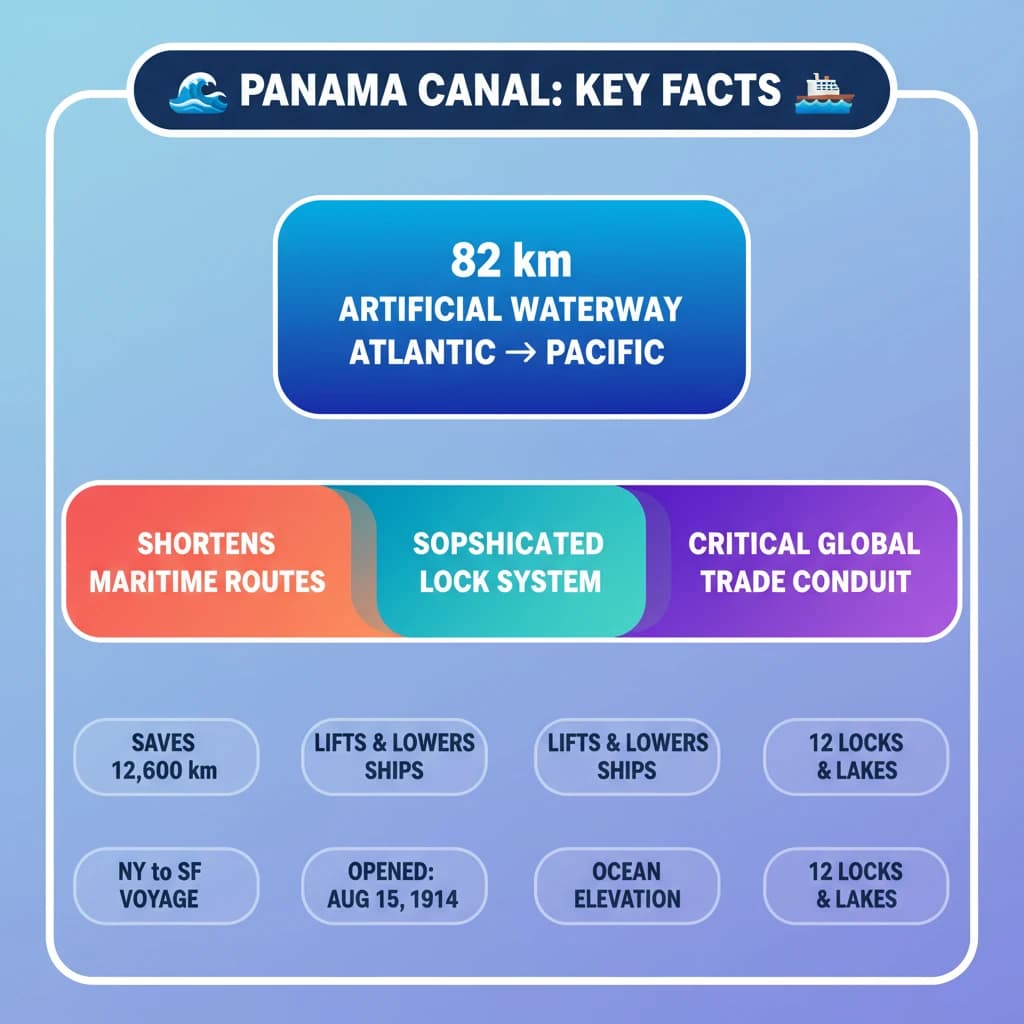
- •The Panama Canal is an 82 km artificial waterway connecting the Atlantic and Pacific Oceans.
- •It significantly shortens maritime routes, saving 12,600 km between New York and San Francisco.
- •The canal uses a sophisticated lock system to lift and lower ships due to differing ocean elevations.
- •Opened on August 15, 1914, it remains a critical conduit for global maritime trade.
- •The system comprises 12 locks, fed by artificial lakes and channels.
🧠 Memory Techniques

95% Verified Content