Loading page, please wait…
What are the Key Facts About Aravallis? - UPSC Environment And Ecology
What is What are the Key Facts About Aravallis? in UPSC Environment And Ecology?
What are the Key Facts About Aravallis? is a key topic under Environment And Ecology for UPSC Civil Services Examination. Key points include: The Aravalli Range is an ancient fold mountain system, 692 km long, extending from Gujarat to Delhi, with 80% in Rajasthan.. It is divided into Sambhar Sirohi and Sambhar Khetri Ranges in Rajasthan.. Functions as a natural green wall and an ecotone between the Thar Desert and Gangetic Plain.. Understanding this topic is essential for both UPSC Prelims and Mains preparation.
Why is What are the Key Facts About Aravallis? important for UPSC exam?
What are the Key Facts About Aravallis? is a Medium-level topic in UPSC Environment And Ecology. It is tested in both Prelims (factual MCQs) and Mains (analytical answer writing). Previous year UPSC questions have frequently covered aspects of What are the Key Facts About Aravallis?, making it essential for comprehensive IAS preparation.
How to prepare What are the Key Facts About Aravallis? for UPSC?
To prepare What are the Key Facts About Aravallis? for UPSC: (1) Study the comprehensive notes covering all key concepts on Vaidra. (2) Practice previous year questions on this topic. (3) Connect it with current affairs using daily updates. (4) Revise using key takeaways and mind maps available for Environment And Ecology. (5) Write practice answers linking What are the Key Facts About Aravallis? to related GS Paper topics.
Key takeaways of What are the Key Facts About Aravallis? for UPSC
- The Aravalli Range is an ancient fold mountain system, 692 km long, extending from Gujarat to Delhi, with 80% in Rajasthan.
- It is divided into Sambhar Sirohi and Sambhar Khetri Ranges in Rajasthan.
- Functions as a natural green wall and an ecotone between the Thar Desert and Gangetic Plain.
- Gurushikhar (1,722m) in Rajasthan is its highest peak.
- Prevents Thar Desert expansion, acts as a historical river catchment, and supports rich biodiversity (300 plant, 120 bird species, jackals, mongooses).
- Faces threats from mining and encroachment; crucial for regional water security and ecological balance.
What are the Key Facts About Aravallis?
Medium⏱️ 8 min read
environment and ecology
📖 Introduction
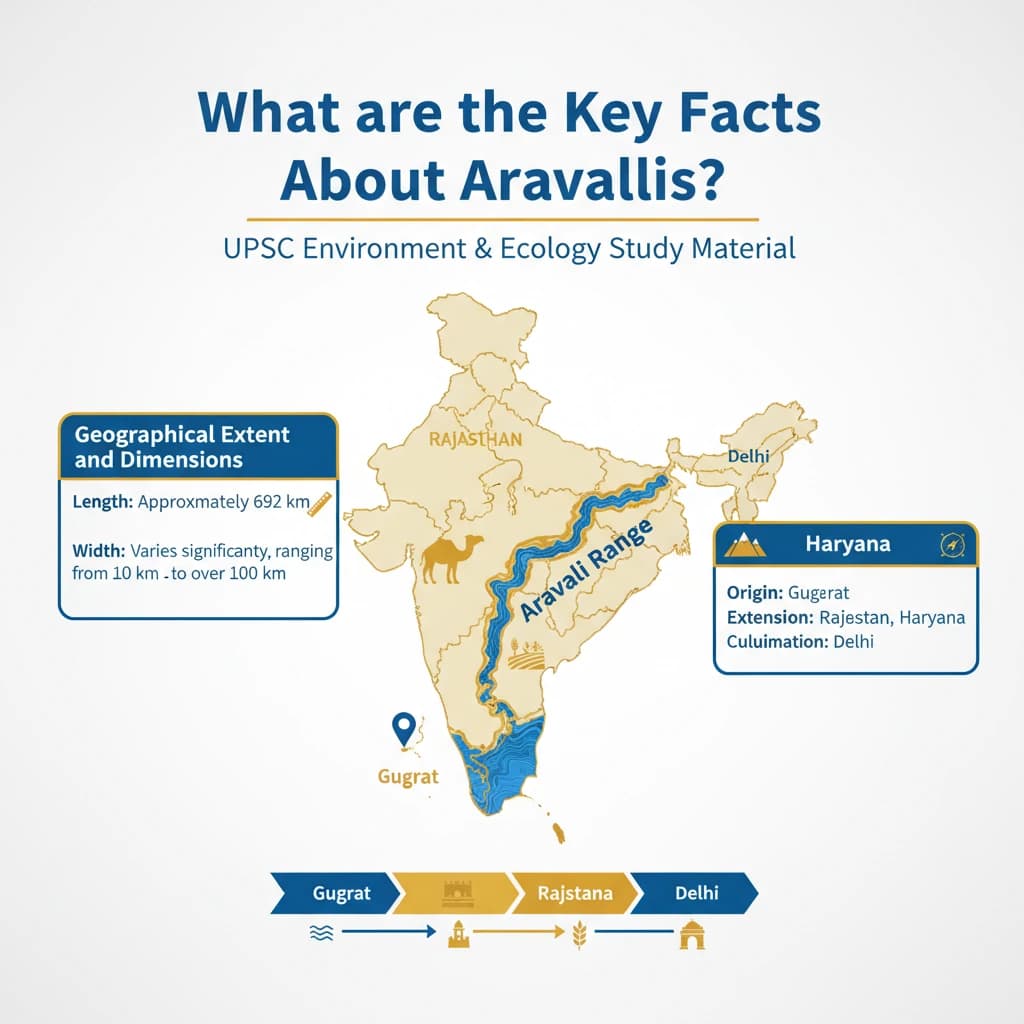
Geographical Extent and Dimensions
The Aravalli Range stretches across four Indian states, forming a significant geographical feature. It originates in Gujarat and extends through Rajasthan and Haryana, finally culminating in Delhi.
Length: Approximately 692 km
Width: Varies significantly, ranging from 10 km to 120 km
A substantial portion of the range lies within Rajasthan, accounting for about 80% of its total length. The remaining 20% is distributed across Haryana, Delhi, and Gujarat.
Divisions within Rajasthan
Within Rajasthan, where the range's extension is about 560 km, the Aravalli Mountains are broadly categorized into two primary ranges. These divisions help in understanding the regional variations of the mountain system.
- Sambhar Sirohi Range: One of the key segments of the Aravallis in Rajasthan.
- Sambhar Khetri Range: The other significant division, contributing to the range's extensive presence in the state.
Ecological Role: The Green Wall and Ecotone
The Aravalli Range functions as a vital natural green wall. This barrier is crucial for ecological balance, particularly in western India.
It acts as an ecotone, which is a transitional area between two distinct ecosystems. In this context, the Aravallis form a critical zone between the arid Thar Desert and the fertile Gangetic Plain.
Ecotone Definition: An ecotone is a region of transition between two or more diverse ecological communities, ecosystems, or biotic regions. It often exhibits characteristics of both adjacent communities and can be rich in biodiversity.
Highest Peak: Gurushikhar
The highest point of the Aravalli Range is Gurushikhar, located in Rajasthan. This peak is a prominent landmark and a significant geographical feature of the range.
Peak Name: Gurushikhar
Location: Rajasthan
Elevation: 1,722 meters above sea level
Significance of Aravallis
The range holds immense ecological and environmental significance, impacting regional climate, biodiversity, and water resources.
- Desert Encroachment Prevention: The Aravallis are instrumental in preventing the eastward expansion of the Thar Desert into the more fertile Indo-Gangetic plains. This protective barrier is crucial for agricultural productivity and ecological stability.
- Catchment Area: Historically, the range has served as an important catchment area for numerous rivers and plains, contributing to regional water security.
- Biodiversity Hotspot: The Aravallis support a rich variety of flora and fauna, making it a significant biodiversity zone.
- Plant Species: Home to approximately 300 native plant species.
- Bird Species: Supports around 120 bird species.
- Exclusive Animals: Provides habitat for unique animals such as jackals and mongooses.
The ecological significance of the Aravallis, especially its role as a barrier against desertification and a biodiversity hotspot, is a frequently tested concept in UPSC Prelims and Mains (GS Paper I & III). Remember to highlight its multi-faceted importance.
💡 Key Takeaways
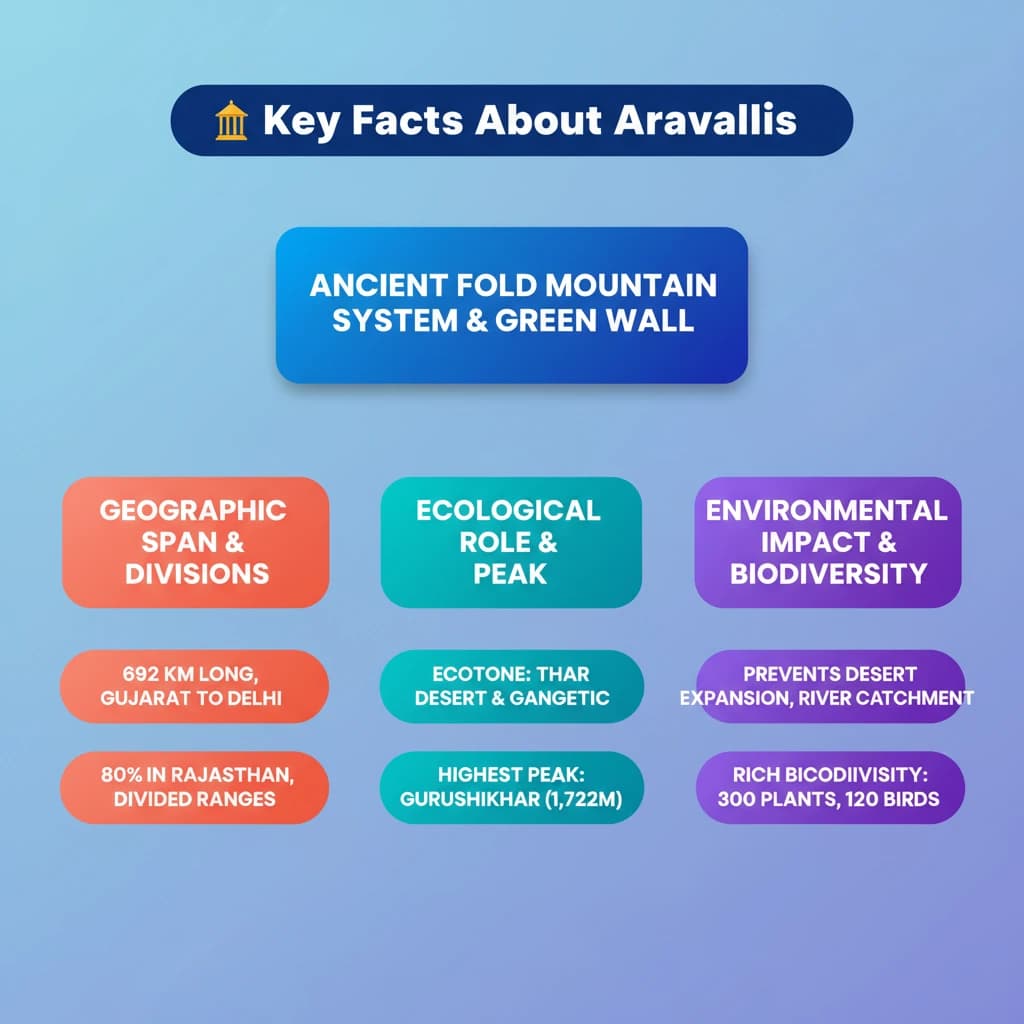
- •The Aravalli Range is an ancient fold mountain system, 692 km long, extending from Gujarat to Delhi, with 80% in Rajasthan.
- •It is divided into Sambhar Sirohi and Sambhar Khetri Ranges in Rajasthan.
- •Functions as a natural green wall and an ecotone between the Thar Desert and Gangetic Plain.
- •Gurushikhar (1,722m) in Rajasthan is its highest peak.
- •Prevents Thar Desert expansion, acts as a historical river catchment, and supports rich biodiversity (300 plant, 120 bird species, jackals, mongooses).
- •Faces threats from mining and encroachment; crucial for regional water security and ecological balance.
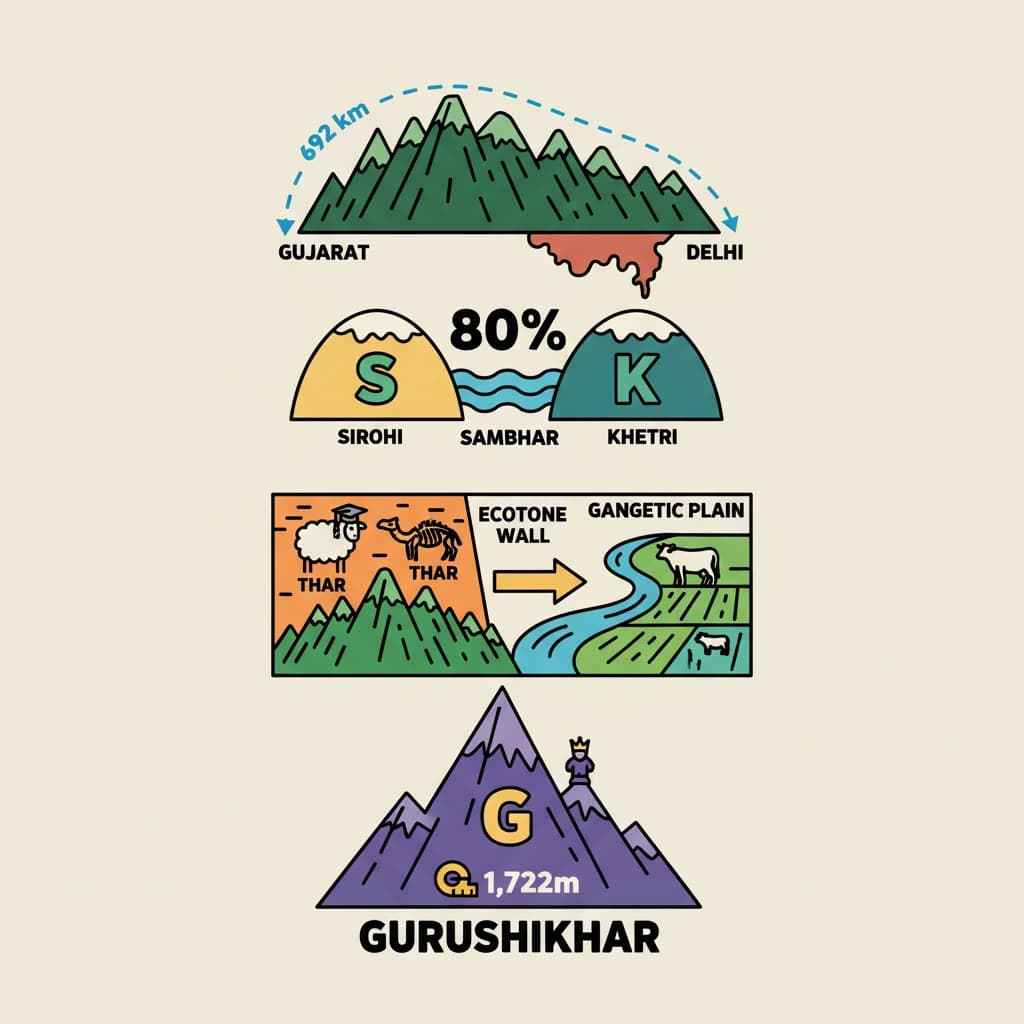
🧠 Memory Techniques
95% Verified Content
📚 Reference Sources
•National Green Tribunal (NGT) reports on Aravalli conservation
•Ministry of Environment, Forest and Climate Change (MoEFCC) publications on mountain ecosystems
•Geological Survey of India (GSI) data on ancient mountain ranges