Loading page, please wait…
What are the Key Facts About Pelagic Birds? - UPSC Environment And Ecology
What is What are the Key Facts About Pelagic Birds? in UPSC Environment And Ecology?
What are the Key Facts About Pelagic Birds? is a key topic under Environment And Ecology for UPSC Civil Services Examination. Key points include: Pelagic birds spend most of their lives on the open ocean, returning to land mainly for breeding.. They possess long, slender wings for extended flight and a unique salt gland to process seawater.. Their diet includes planktonic crustaceans, squid, and fish, hunted far offshore.. Understanding this topic is essential for both UPSC Prelims and Mains preparation.
Why is What are the Key Facts About Pelagic Birds? important for UPSC exam?
What are the Key Facts About Pelagic Birds? is a Easy-level topic in UPSC Environment And Ecology. It is tested in both Prelims (factual MCQs) and Mains (analytical answer writing). Previous year UPSC questions have frequently covered aspects of What are the Key Facts About Pelagic Birds?, making it essential for comprehensive IAS preparation.
How to prepare What are the Key Facts About Pelagic Birds? for UPSC?
To prepare What are the Key Facts About Pelagic Birds? for UPSC: (1) Study the comprehensive notes covering all key concepts on Vaidra. (2) Practice previous year questions on this topic. (3) Connect it with current affairs using daily updates. (4) Revise using key takeaways and mind maps available for Environment And Ecology. (5) Write practice answers linking What are the Key Facts About Pelagic Birds? to related GS Paper topics.
Key takeaways of What are the Key Facts About Pelagic Birds? for UPSC
- Pelagic birds spend most of their lives on the open ocean, returning to land mainly for breeding.
- They possess long, slender wings for extended flight and a unique salt gland to process seawater.
- Their diet includes planktonic crustaceans, squid, and fish, hunted far offshore.
- The Laysan Albatross is a prime example, breeding on Hawaiian Islands and foraging across the Pacific.
- Pelagic birds are crucial bioindicators of ocean health, facing threats from pollution and climate change.
What are the Key Facts About Pelagic Birds?
Easy⏱️ 6 min read
environment and ecology
📖 Introduction
Introduction to Pelagic Birds
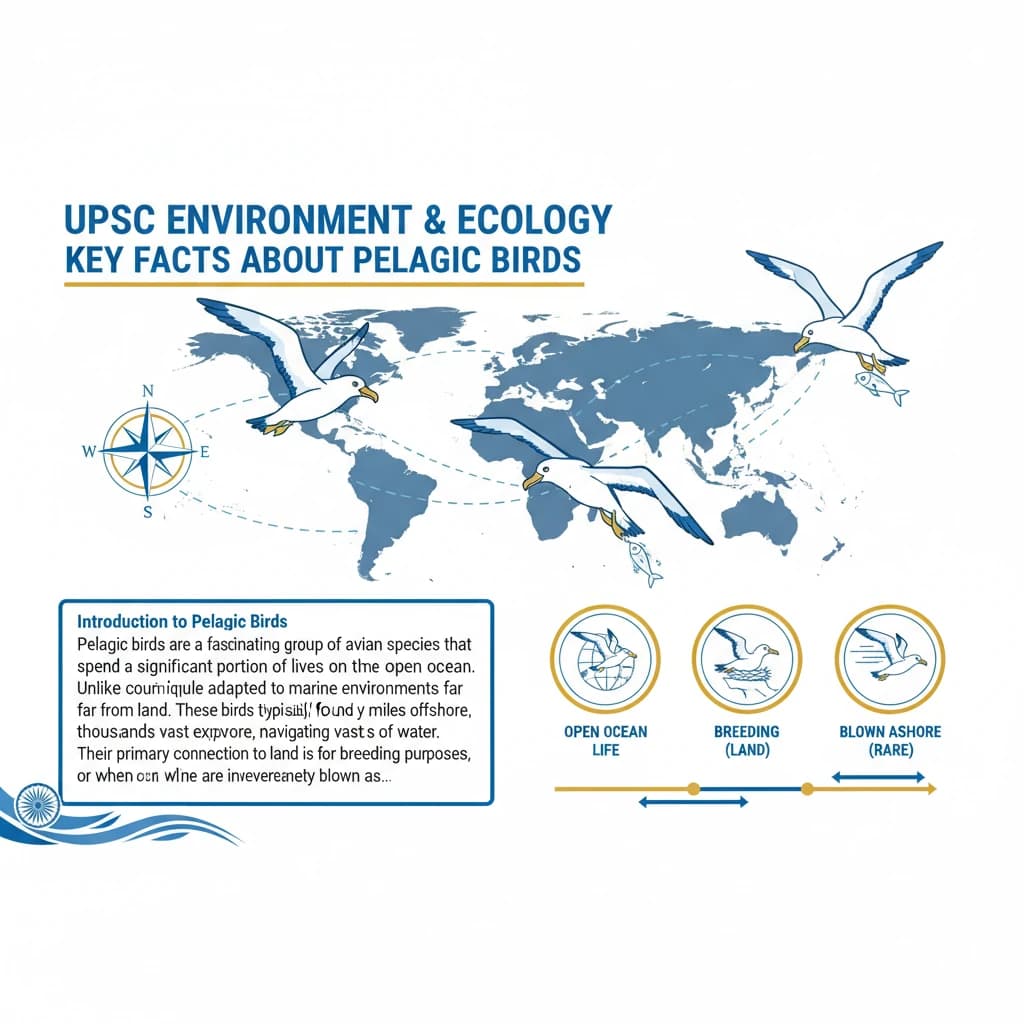
Pelagic birds are a fascinating group of avian species that spend a significant portion of their lives on the open ocean. Unlike coastal birds, they are uniquely adapted to marine environments far from land.
These birds are typically found thousands of miles offshore, navigating vast expanses of water. Their primary connection to land is for breeding purposes, or when they are inadvertently blown ashore during severe weather conditions like high winds and storms.
Definition: Pelagic birds are marine birds that inhabit the open sea, often far from coastlines, and return to land primarily for reproduction.
Key Characteristics of Pelagic Birds
While varying greatly in size and appearance, all pelagic birds share core adaptations for their oceanic lifestyle. They are exceptional swimmers and divers, perfectly suited for foraging in the open water.
Remarkable Flight Adaptations: These birds possess long, slender wings, which are crucial for extended, energy-efficient flights. Some species can remain airborne for days or even weeks without needing to rest, demonstrating incredible endurance.
A unique physiological feature of many pelagic birds is the presence of a specialized salt gland. This gland is vital for extracting excess salt from the seawater they ingest, preventing its accumulation to toxic levels within their bodies.
Diet and Foraging Habits
Their diet primarily consists of marine organisms found in the open ocean. They actively hunt for food far from coastal areas, utilizing their diving and swimming abilities.
- Planktonic crustaceans: These include small organisms related to shrimp and crabs, forming a significant part of their diet.
- Squid: Many species are adept at catching various types of squid in the open water.
- Fish: They also prey on different species of fish, often diving to considerable depths to secure their meals.
UPSC Insight: Understanding the adaptations of pelagic birds (e.g., salt glands, wing structure) can be relevant for questions on biodiversity, ecological adaptations, and environmental physiology in GS Paper III (Environment & Ecology).
💡 Key Takeaways
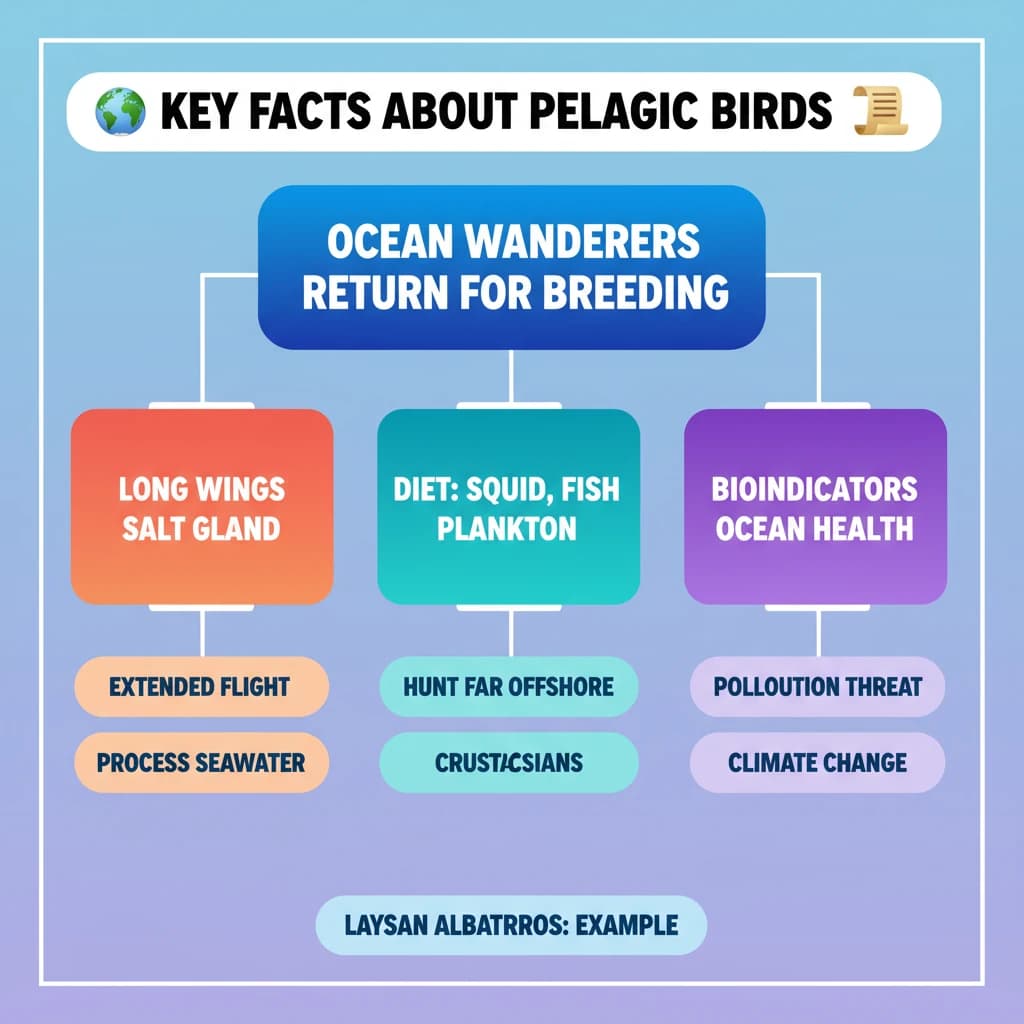
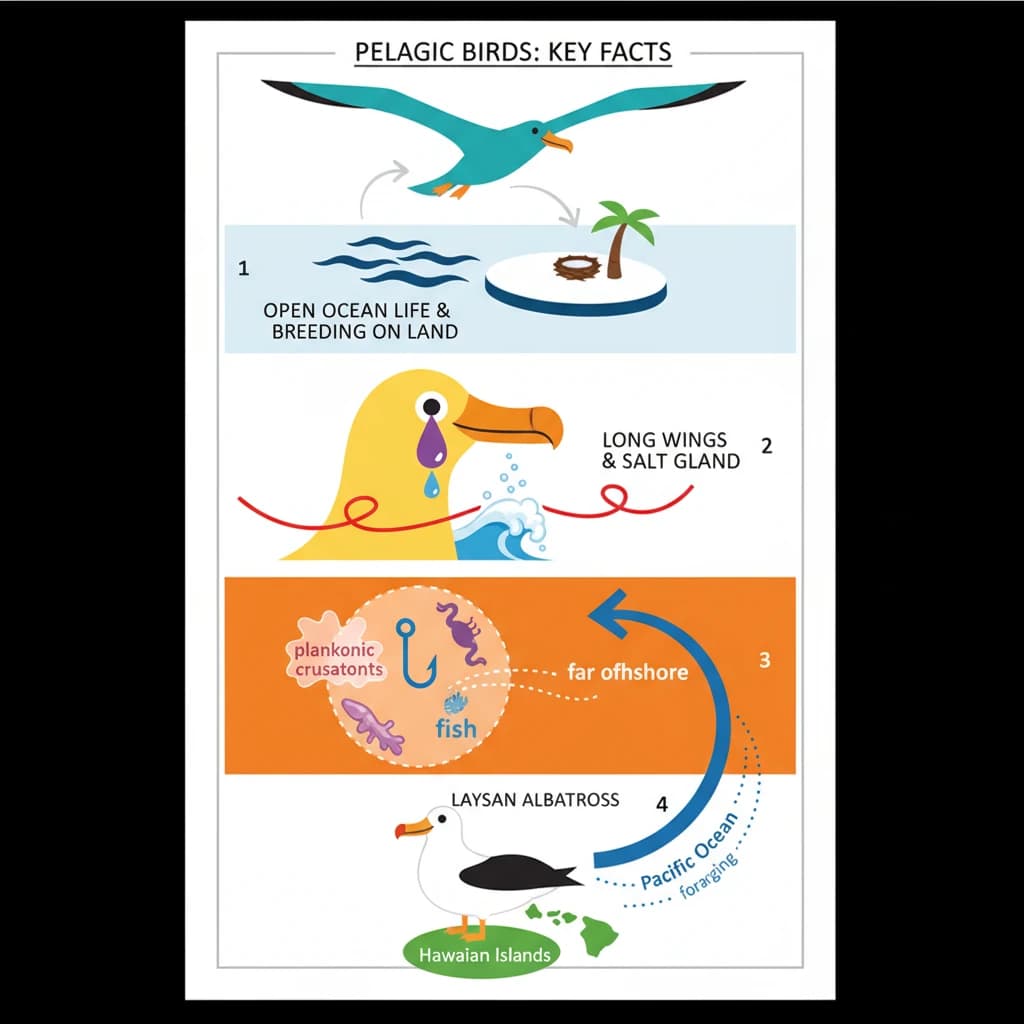
- •Pelagic birds spend most of their lives on the open ocean, returning to land mainly for breeding.
- •They possess long, slender wings for extended flight and a unique salt gland to process seawater.
- •Their diet includes planktonic crustaceans, squid, and fish, hunted far offshore.
- •The Laysan Albatross is a prime example, breeding on Hawaiian Islands and foraging across the Pacific.
- •Pelagic birds are crucial bioindicators of ocean health, facing threats from pollution and climate change.
🧠 Memory Techniques
95% Verified Content
📚 Reference Sources
•General Ornithology Texts (e.g., Cornell Lab of Ornithology)
•Marine Biology Resources (e.g., NOAA, IUCN Red List for specific species)