Loading page, please wait…
What are the Supreme Court’s Rulings and Legal Notifications on the Aravallis? - UPSC Environment And Ecology
What is What are the Supreme Court’s Rulings and Legal Notifications on the Aravallis? in UPSC Environment And Ecology?
What are the Supreme Court’s Rulings and Legal Notifications on the Aravallis? is a key topic under Environment And Ecology for UPSC Civil Services Examination. Key points include: Supreme Court actively protects Aravallis, notably with the 2018 Kant Enclave demolition order.. The Precautionary Principle (Vellore Citizens Welfare Forum case, 1996) is a cornerstone of Aravalli protection, adopted by NGT.. MoEFCC's 1992 notification restricts industries, mining, deforestation, and construction in Aravallis.. Understanding this topic is essential for both UPSC Prelims and Mains preparation.
Why is What are the Supreme Court’s Rulings and Legal Notifications on the Aravallis? important for UPSC exam?
What are the Supreme Court’s Rulings and Legal Notifications on the Aravallis? is a Medium-level topic in UPSC Environment And Ecology. It is tested in both Prelims (factual MCQs) and Mains (analytical answer writing). Previous year UPSC questions have frequently covered aspects of What are the Supreme Court’s Rulings and Legal Notifications on the Aravallis?, making it essential for comprehensive IAS preparation.
How to prepare What are the Supreme Court’s Rulings and Legal Notifications on the Aravallis? for UPSC?
To prepare What are the Supreme Court’s Rulings and Legal Notifications on the Aravallis? for UPSC: (1) Study the comprehensive notes covering all key concepts on Vaidra. (2) Practice previous year questions on this topic. (3) Connect it with current affairs using daily updates. (4) Revise using key takeaways and mind maps available for Environment And Ecology. (5) Write practice answers linking What are the Supreme Court’s Rulings and Legal Notifications on the Aravallis? to related GS Paper topics.
Key takeaways of What are the Supreme Court’s Rulings and Legal Notifications on the Aravallis? for UPSC
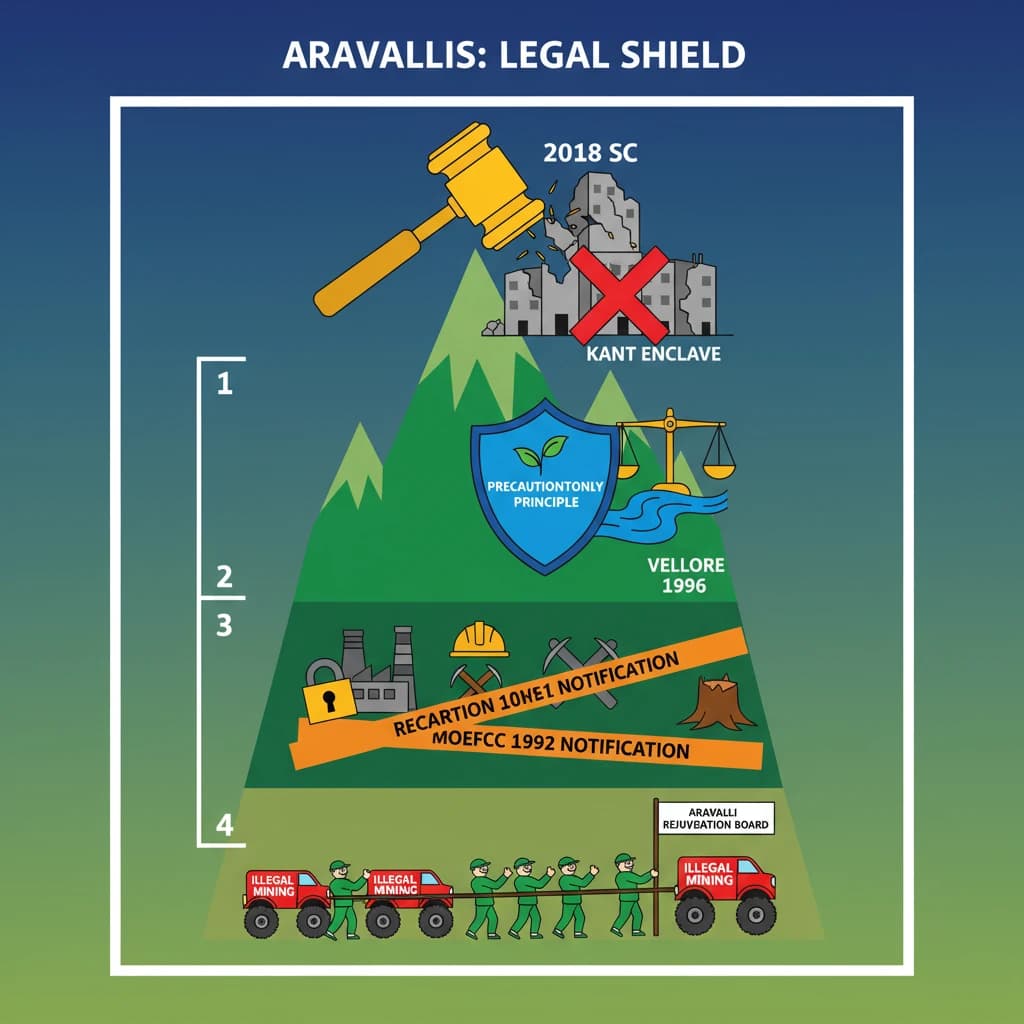
- Supreme Court actively protects Aravallis, notably with the 2018 Kant Enclave demolition order.
- The Precautionary Principle (Vellore Citizens Welfare Forum case, 1996) is a cornerstone of Aravalli protection, adopted by NGT.
- MoEFCC's 1992 notification restricts industries, mining, deforestation, and construction in Aravallis.
- Illegal mining remains a major threat, addressed by the new Aravalli Rejuvenation Board.
- Aravallis are vital for NCR's air quality, water security, and biodiversity, facing ongoing urbanization pressure.
What are the Supreme Court’s Rulings and Legal Notifications on the Aravallis?
Medium⏱️ 8 min read
environment and ecology
📖 Introduction
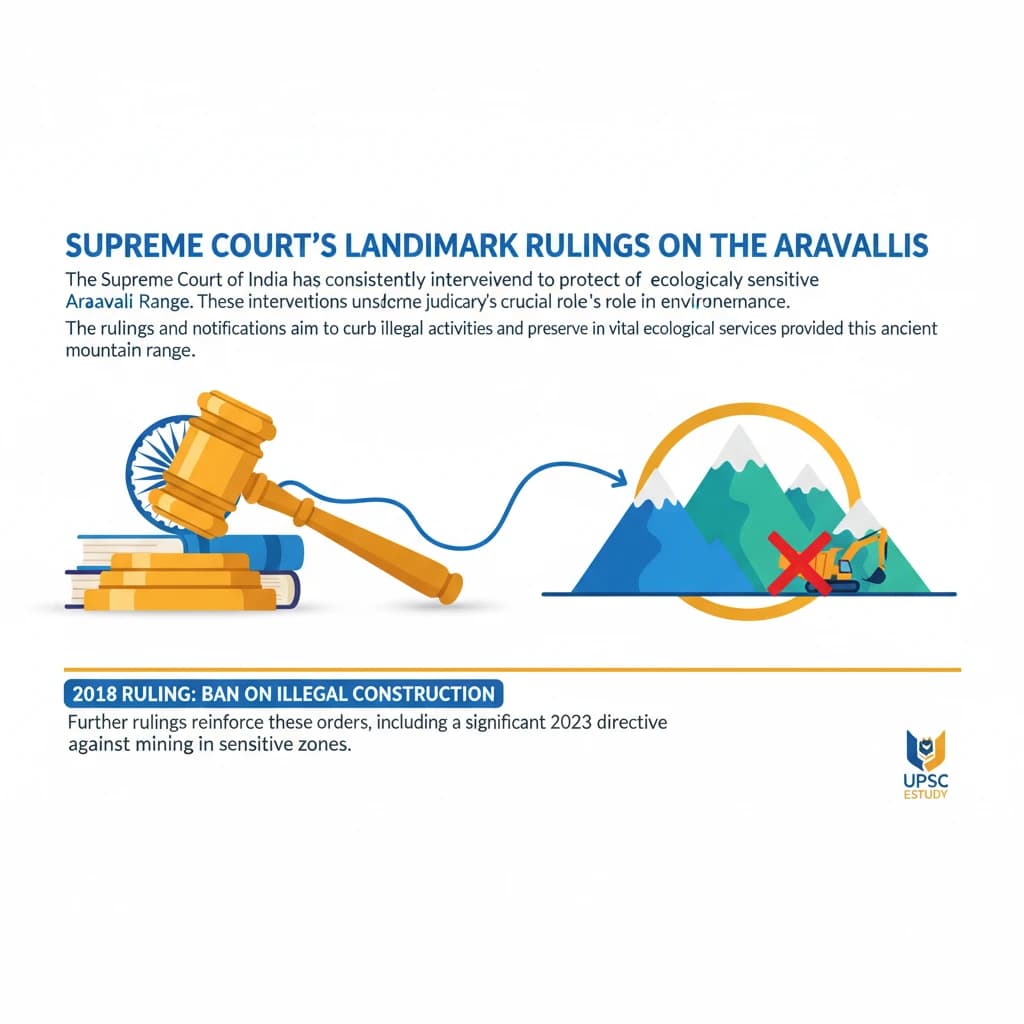
Supreme Court's Landmark Rulings on the Aravallis
The Supreme Court of India has consistently intervened to protect the ecologically sensitive Aravalli Range. These interventions underscore the judiciary's crucial role in environmental governance.
The rulings and notifications aim to curb illegal activities and preserve the vital ecological services provided by this ancient mountain range.
2018 Ruling: Ban on Illegal Construction
In 2018, the Supreme Court issued a significant ruling banning all illegal construction activities within the Aravalli range in Haryana.
This judgment specifically directed the demolition of the controversial Kant Enclave, an unauthorized residential complex. The court also mandated reimbursement to the investors affected by this illegal development.
Case Highlight: The Kant Enclave demolition order served as a strong deterrent against encroachment on ecologically fragile lands.
UPSC Insight: This ruling is crucial for questions on environmental jurisprudence, judicial activism, and sustainable development in GS Paper III (Environment).
The Precautionary Principle (1996)
The foundation for many environmental judgments, including those concerning the Aravallis, lies in the Precautionary Principle. This principle was established by the Supreme Court in 1996.
It states that governments must anticipate and prevent environmental degradation without waiting for conclusive scientific evidence of harm. This proactive approach is vital for safeguarding natural resources.
Key Principle: The Precautionary Principle shifts the burden of proof to those proposing potentially harmful activities, requiring them to demonstrate no significant environmental damage.
Landmark Case: The Precautionary Principle was articulated in the case of Vellore Citizens Welfare Forum v Union of India (1996).
National Green Tribunal (NGT) and the Precautionary Principle
The National Green Tribunal (NGT), established in 2010, plays a pivotal role in environmental justice. The NGT has explicitly adopted the Precautionary Principle for its environmental decisions.
This adoption is enshrined under Section 20 of the National Green Tribunal Act, 2010, reinforcing its application in India's environmental legal framework.
MoEFCC Notification of 1992
Even before many judicial interventions, the Ministry of Environment, Forest and Climate Change (MoEFCC) issued a significant notification in 1992.
This notification imposed strict prohibitions on various activities in the Aravalli range. It aimed to regulate development and protect the ecological integrity of the region.
Prohibited Activities (without prior MoEFCC permission):
- Establishment of new industries
- Undertaking mining activities
- Engaging in deforestation
- Initiating construction projects
Government Initiatives for Aravalli Protection
Beyond judicial rulings, the government has implemented several measures to protect the Aravallis and address related environmental challenges.
These initiatives reflect a multi-pronged approach to environmental conservation and sustainable management.
Commission for Air Quality Management (CAQM)
To tackle the severe air pollution menace in the region, the Commission for Air Quality Management (CAQM) was created for the National Capital Region (NCR) and adjoining areas.
While not exclusively for Aravallis, its mandate impacts the air quality in and around the range, which is crucial for overall ecological health.
Aravalli Rejuvenation Board
Addressing the pressing issue of illegal mining in the Aravallis, a dedicated body, the Aravalli Rejuvenation Board, has been established.
Board Details:
- Composition: Seven members
- Location: Gurugram
- Mandate: To combat illegal mining and facilitate the rejuvenation of the Aravalli ecosystem.
💡 Key Takeaways
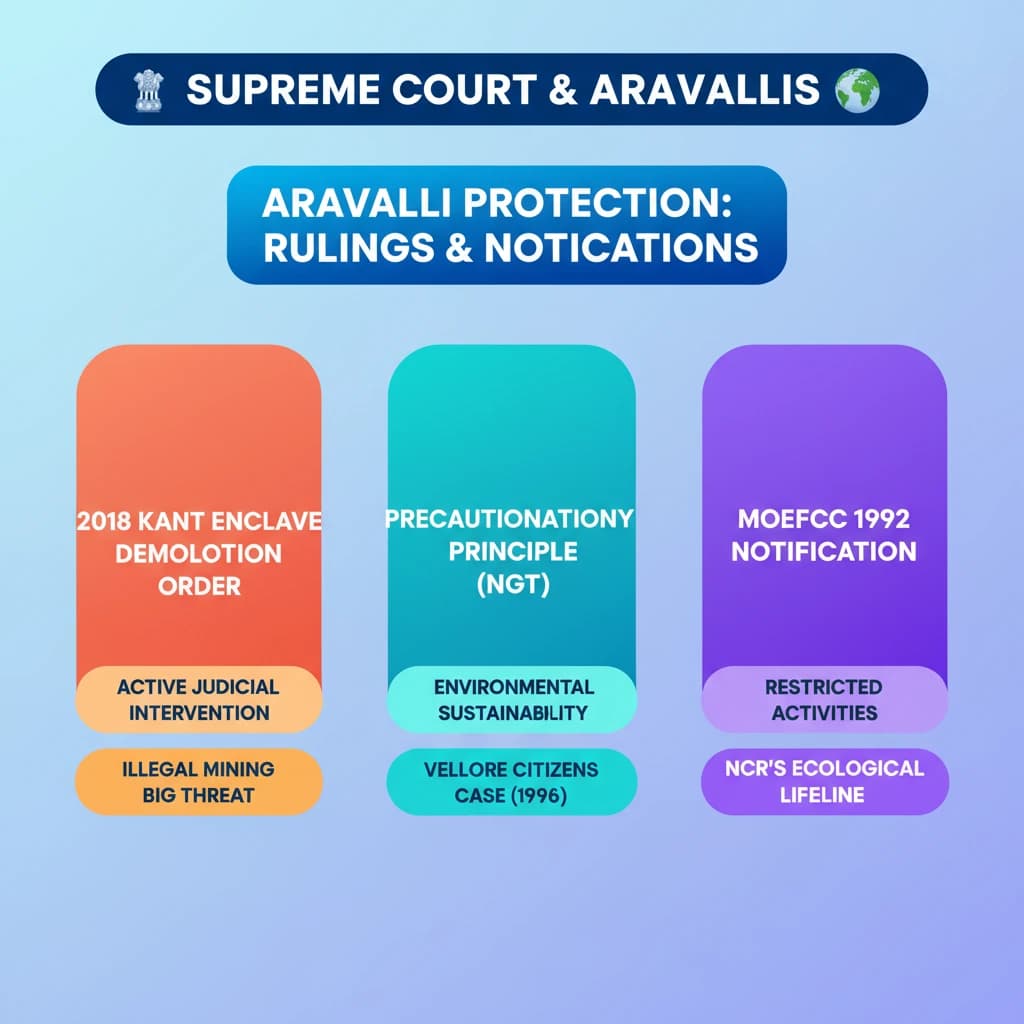
- •Supreme Court actively protects Aravallis, notably with the 2018 Kant Enclave demolition order.
- •The Precautionary Principle (Vellore Citizens Welfare Forum case, 1996) is a cornerstone of Aravalli protection, adopted by NGT.
- •MoEFCC's 1992 notification restricts industries, mining, deforestation, and construction in Aravallis.
- •Illegal mining remains a major threat, addressed by the new Aravalli Rejuvenation Board.
- •Aravallis are vital for NCR's air quality, water security, and biodiversity, facing ongoing urbanization pressure.
🧠 Memory Techniques
95% Verified Content