Loading page, please wait…
What are Welfare Schemes the Government Initiated for Salt Workers? - UPSC Environment And Ecology
What is What are Welfare Schemes the Government Initiated for Salt Workers? in UPSC Environment And Ecology?
What are Welfare Schemes the Government Initiated for Salt Workers? is a key topic under Environment And Ecology for UPSC Civil Services Examination. Key points include: Government has specific welfare schemes for salt workers focusing on their upliftment.. The 'Scheme for Grant of Rewards' supports educational development of children of salt laborers.. The 'Nanak Chandor Navas Yojana (NMAY)' provides housing and promotes cooperative societies.. Understanding this topic is essential for both UPSC Prelims and Mains preparation.
Why is What are Welfare Schemes the Government Initiated for Salt Workers? important for UPSC exam?
What are Welfare Schemes the Government Initiated for Salt Workers? is a Easy-level topic in UPSC Environment And Ecology. It is tested in both Prelims (factual MCQs) and Mains (analytical answer writing). Previous year UPSC questions have frequently covered aspects of What are Welfare Schemes the Government Initiated for Salt Workers?, making it essential for comprehensive IAS preparation.
How to prepare What are Welfare Schemes the Government Initiated for Salt Workers? for UPSC?
To prepare What are Welfare Schemes the Government Initiated for Salt Workers? for UPSC: (1) Study the comprehensive notes covering all key concepts on Vaidra. (2) Practice previous year questions on this topic. (3) Connect it with current affairs using daily updates. (4) Revise using key takeaways and mind maps available for Environment And Ecology. (5) Write practice answers linking What are Welfare Schemes the Government Initiated for Salt Workers? to related GS Paper topics.
Key takeaways of What are Welfare Schemes the Government Initiated for Salt Workers? for UPSC
- Government has specific welfare schemes for salt workers focusing on their upliftment.
- The 'Scheme for Grant of Rewards' supports educational development of children of salt laborers.
- The 'Nanak Chandor Navas Yojana (NMAY)' provides housing and promotes cooperative societies.
- The 'Salt Commissioner’s Organization (SCO)' monitors industry development, tech upgradation, and worker training.
- These schemes are vital for ensuring social justice, improving living standards, and fostering inclusive growth for a vulnerable community.
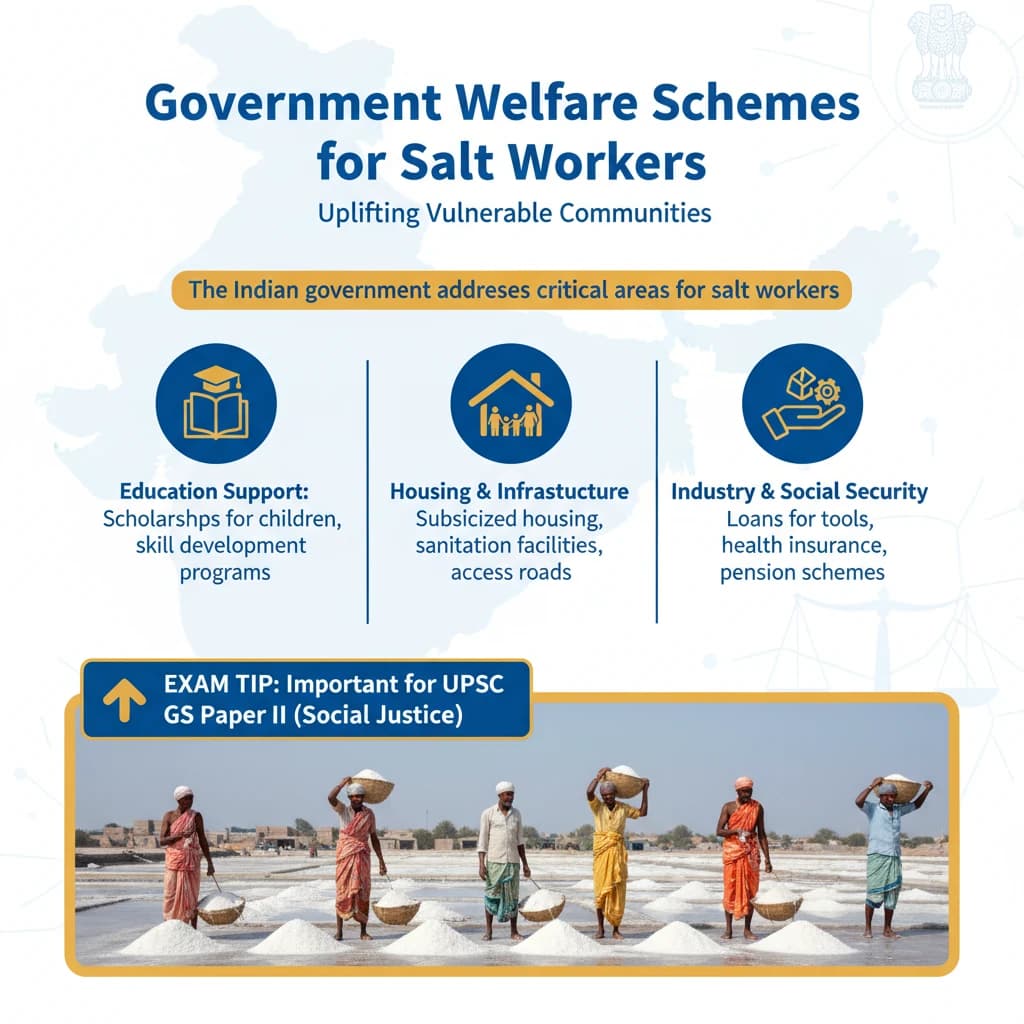
What are Welfare Schemes the Government Initiated for Salt Workers?
Easy⏱️ 6 min read
environment and ecology
📖 Introduction
Government Welfare Schemes for Salt Workers
The Indian government has initiated several welfare schemes specifically designed to uplift and support salt workers, who often belong to vulnerable sections of society. These schemes address critical areas such as education, housing, and overall industry development.
Understanding these targeted welfare programs is important for UPSC GS Paper II, particularly topics related to social justice and vulnerable groups.
Scheme for Grant of Rewards to the Children of Salt Labourers
The Scheme for Grant of Rewards to the Children of Salt Labourers is a crucial initiative aimed at supporting the educational journey of children from salt worker families.
This scheme provides financial rewards to eligible students at various stages of their academic development.
Its primary objective is to foster the educational development and overall upliftment of the next generation, breaking the cycle of poverty.
Nanak Chandor Navas Yojana (NMAY)
The Nanak Chandor Navas Yojana (NMAY) focuses on improving the living conditions of salt workers by addressing their fundamental housing needs.
It specifically provides for the construction of houses for salt workers, ensuring access to safe and dignified shelter.
Beyond housing, NMAY also plays a vital role in promoting the formation and strengthening of cooperative societies within the salt industry.
This cooperative aspect aims to empower workers through collective action, improved bargaining power, and enhanced economic opportunities.
Salt Commissioner’s Organization (SCO)
The Salt Commissioner’s Organization (SCO) serves as a pivotal body responsible for the overall development and regulation of the Indian salt industry.
Its mandate includes comprehensive monitoring of the industry's growth and addressing various sectoral challenges.
Key functions of the SCO involve strategic planning for industry advancement, facilitating technology upgradation to enhance productivity and efficiency, and conducting essential training programs for salt workers.
These activities collectively aim to modernize the industry, improve the skills of its workforce, and ensure sustainable livelihoods.
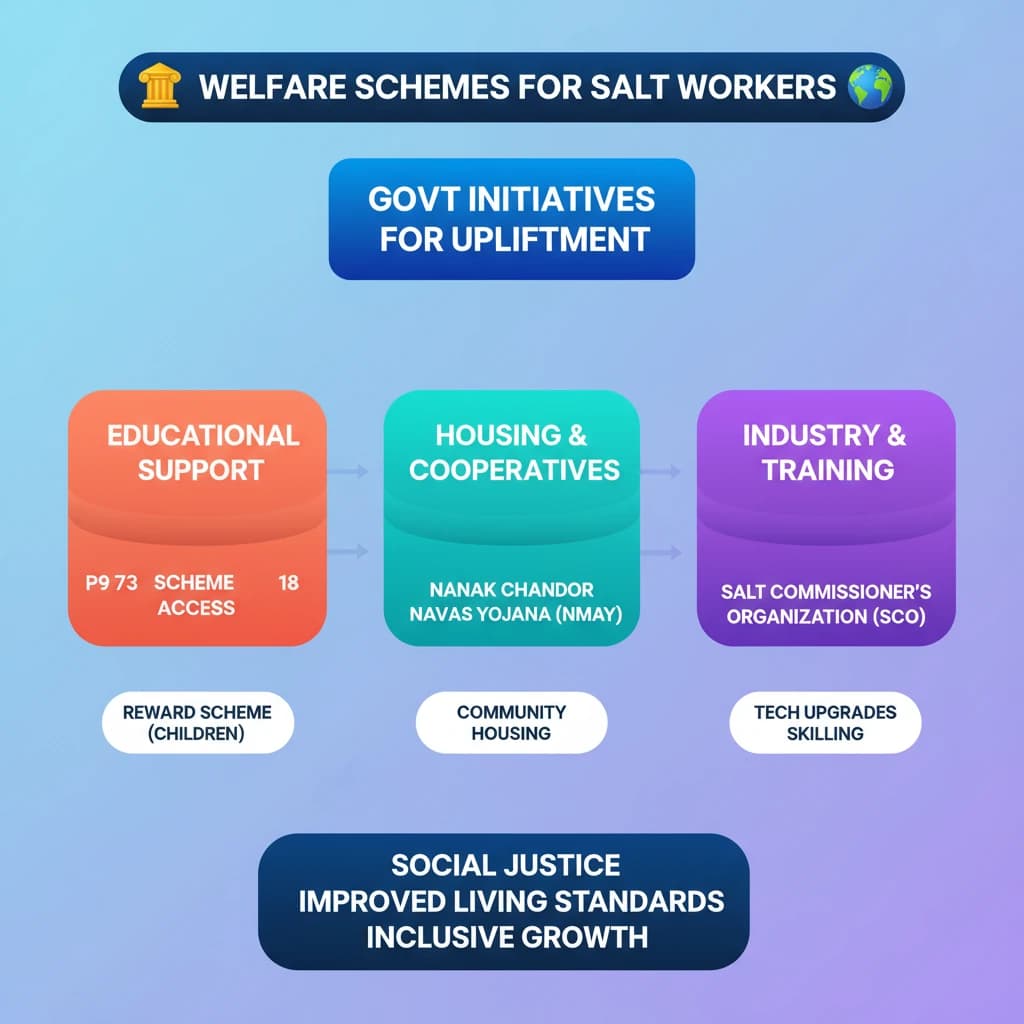
💡 Key Takeaways
- •Government has specific welfare schemes for salt workers focusing on their upliftment.
- •The 'Scheme for Grant of Rewards' supports educational development of children of salt laborers.
- •The 'Nanak Chandor Navas Yojana (NMAY)' provides housing and promotes cooperative societies.
- •The 'Salt Commissioner’s Organization (SCO)' monitors industry development, tech upgradation, and worker training.
- •These schemes are vital for ensuring social justice, improving living standards, and fostering inclusive growth for a vulnerable community.
🧠 Memory Techniques

95% Verified Content
📚 Reference Sources
•Ministry of Commerce & Industry, Department of Salt, Government of India official website
•Reports and publications on labor welfare and social justice in India