Loading page, please wait…
What is Carbon Dioxide Removal (CDR)? - UPSC Environment And Ecology
What is What is Carbon Dioxide Removal (CDR)? in UPSC Environment And Ecology?
What is Carbon Dioxide Removal (CDR)? is a key topic under Environment And Ecology for UPSC Civil Services Examination. Key points include: Carbon Dioxide Removal (CDR) involves removing CO2 from the atmosphere and storing it durably.. CDR methods are categorized as land-based (e.g., afforestation, DACC) or ocean-based (e.g., ocean alkalinity enhancement).. Each method has varying storage timescales, financial costs, and associated trade-offs/risks.. Understanding this topic is essential for both UPSC Prelims and Mains preparation.
Why is What is Carbon Dioxide Removal (CDR)? important for UPSC exam?
What is Carbon Dioxide Removal (CDR)? is a Medium-level topic in UPSC Environment And Ecology. It is tested in both Prelims (factual MCQs) and Mains (analytical answer writing). Previous year UPSC questions have frequently covered aspects of What is Carbon Dioxide Removal (CDR)?, making it essential for comprehensive IAS preparation.
How to prepare What is Carbon Dioxide Removal (CDR)? for UPSC?
To prepare What is Carbon Dioxide Removal (CDR)? for UPSC: (1) Study the comprehensive notes covering all key concepts on Vaidra. (2) Practice previous year questions on this topic. (3) Connect it with current affairs using daily updates. (4) Revise using key takeaways and mind maps available for Environment And Ecology. (5) Write practice answers linking What is Carbon Dioxide Removal (CDR)? to related GS Paper topics.
Key takeaways of What is Carbon Dioxide Removal (CDR)? for UPSC
- Carbon Dioxide Removal (CDR) involves removing CO2 from the atmosphere and storing it durably.
- CDR methods are categorized as land-based (e.g., afforestation, DACC) or ocean-based (e.g., ocean alkalinity enhancement).
- Each method has varying storage timescales, financial costs, and associated trade-offs/risks.
- Land-based methods like afforestation are relatively low-cost but have shorter storage, while DACC is high-cost but offers long-term geological storage.
- Ocean-based methods offer very long storage but come with significant ecological uncertainties.
- CDR is crucial for achieving net-zero emissions and bridging the gap in climate targets, complementing emissions reduction.
- Responsible deployment requires careful consideration of energy, land, water use, and potential environmental impacts.
What is Carbon Dioxide Removal (CDR)?
Medium⏱️ 10 min read
environment and ecology
📖 Introduction
Understanding Carbon Dioxide Removal (CDR)
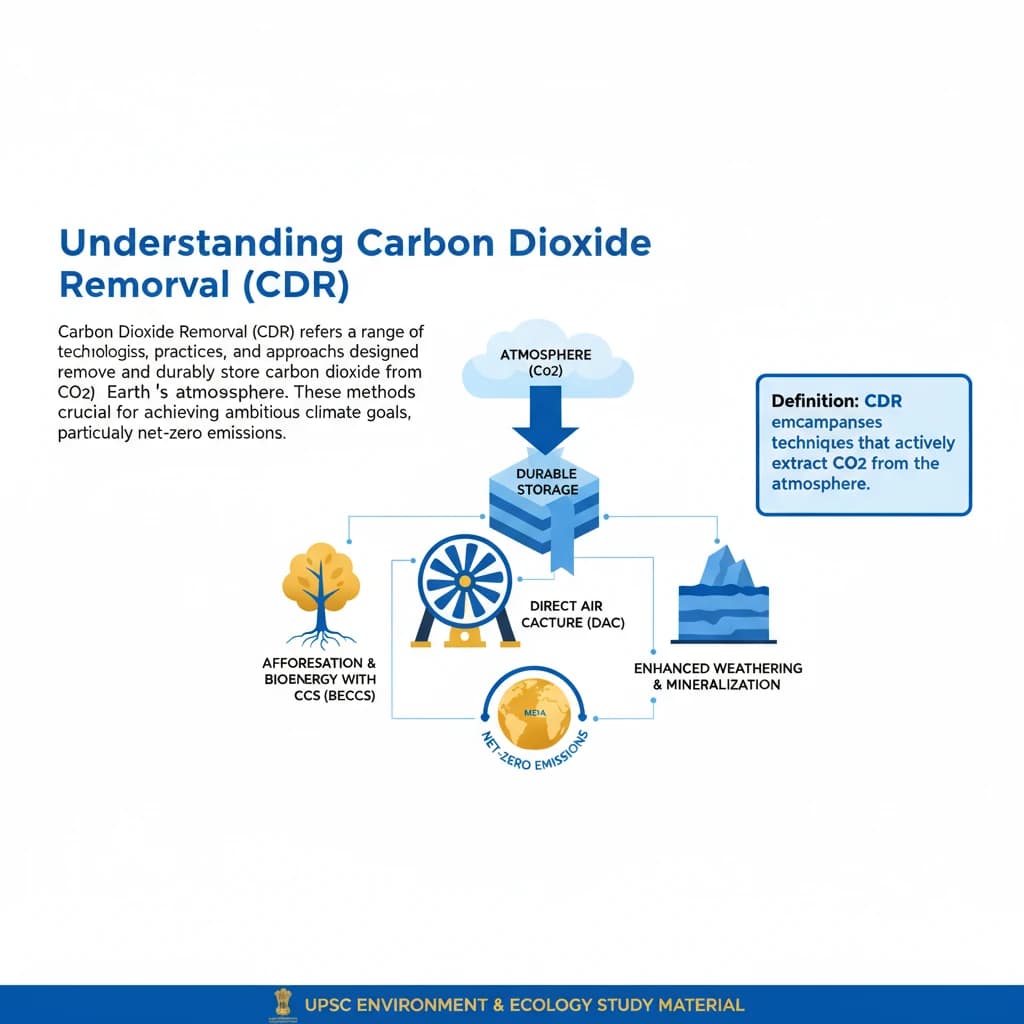
Carbon Dioxide Removal (CDR) refers to a range of technologies, practices, and approaches designed to remove and durably store carbon dioxide (CO2) from the Earth's atmosphere. These methods are crucial for achieving ambitious climate goals, particularly net-zero emissions.
Definition: CDR encompasses techniques that actively extract existing CO2 from the atmosphere and lock it away for extended periods, complementing efforts to reduce new emissions.
Land-Based Carbon Dioxide Removal Methods
Land-based CDR strategies leverage natural processes and engineered solutions on terrestrial ecosystems to capture and store CO2. These methods often involve vegetation, soil, and geological formations.
| Afforestation, Reforestation, and Avoided Deforestation | Agriculture & tree planting; silviculture; timber in construction; bio-based products | Decades to centuries (in vegetation, buildings, soils) | Afforestation/reforestation: ~$50-$100 | Deforestation/reforestation can increase or decrease agricultural yields; large-scale changes can impact water cycles on regional scales; fertilizer use and introduced species can impact biodiversity. |
| Soil Carbon Sequestration | Agricultural practices; pasture management | Decades to centuries (in soils) | Agroforestry and soil carbon sequestration: ~$10-$100 | Potential impacts to agricultural crop yields; competition for biomass could lead to negative impacts from growing energy crops for bioenergy and food. |
| Biochar | Cropping and forestry residues; industrial organic waste; purpose-grown biomass crops | Decades to centuries (in soils and sediments) | ~$10-$45 | Could lead to growing competition for land and food; increased eutrophication; increased acidification. |
| Bioenergy with Carbon Capture and Storage (BECCS) | Purpose-grown biomass crops with industrial carbon capture | 100+ years (in geological formations) | ~$50-$500 | High energy requirement; potential for increased water use and energy use; SACC processes require energy generation. |
| Direct Air Carbon Capture (DACC) | Industrial capture plants | 100+ years (in geological formations) | ~$100-$500 | Some products are used for food production, so could compete with food production; could lead to growing competition for land and food; increased eutrophication; increased acidification. |
| Enhanced Rock Weathering | Agricultural land application of silicate rock | Decades to centuries (weathered rock, sediments) | ~$50-$200 | Potential for increased GHG emissions from mining, transport, and deployment. |
| Wetland and Waterbed Revegetation | Rewetting; revegetation of coastal and freshwater wetlands | Decades to centuries (in soils, sediments) | Not enough data | Potential for significant CH4 release; waste nutrients are likely to release carbon back to the atmosphere. |
Key Point: Land-based methods vary widely in cost, storage duration, and associated environmental trade-offs. Careful planning is essential to maximize benefits and mitigate risks.
Ocean-Based Carbon Dioxide Removal Methods
Ocean-based CDR approaches utilize the vast capacity of marine environments to absorb and store CO2. These methods often involve altering ocean chemistry or enhancing biological processes.
| Blue Carbon Management | Rewetting; coastal revegetation (mangroves, salt marshes, seagrass) | Decades to centuries (in sediments, dedicated) | Not enough data | Potential for significant CH4 release; waste nutrients are likely to release carbon back to the atmosphere. |
| Ocean Alkalinity Enhancement | Adding alkaline materials such as carbonate or silicate rock to the ocean | 10,000+ years (in ocean, sediments) | $40-$500 | Potential for increased GHG emissions from mining, transport, and deployment; may negatively impact marine ecosystems and alter the albedo. |
| Iron Fertilisation | Ocean fertilization; nitrogen and phosphorus fertilization; enhanced upwelling | Centuries to millennia (in ocean, sediments) | $50-$500 | Ocean acidification and eutrophication; altered supply of ocean macronutrients; potential impacts on marine food webs and biodiversity. |
Key Point: Ocean-based CDR methods offer potentially longer storage timescales but carry significant uncertainties regarding ecological impacts and operational feasibility.
UPSC Insight: Understanding the diverse methods, their pros and cons, and their scalability is critical for questions on climate change mitigation strategies in GS-III Environment. Be prepared to discuss both technological and nature-based solutions.
💡 Key Takeaways
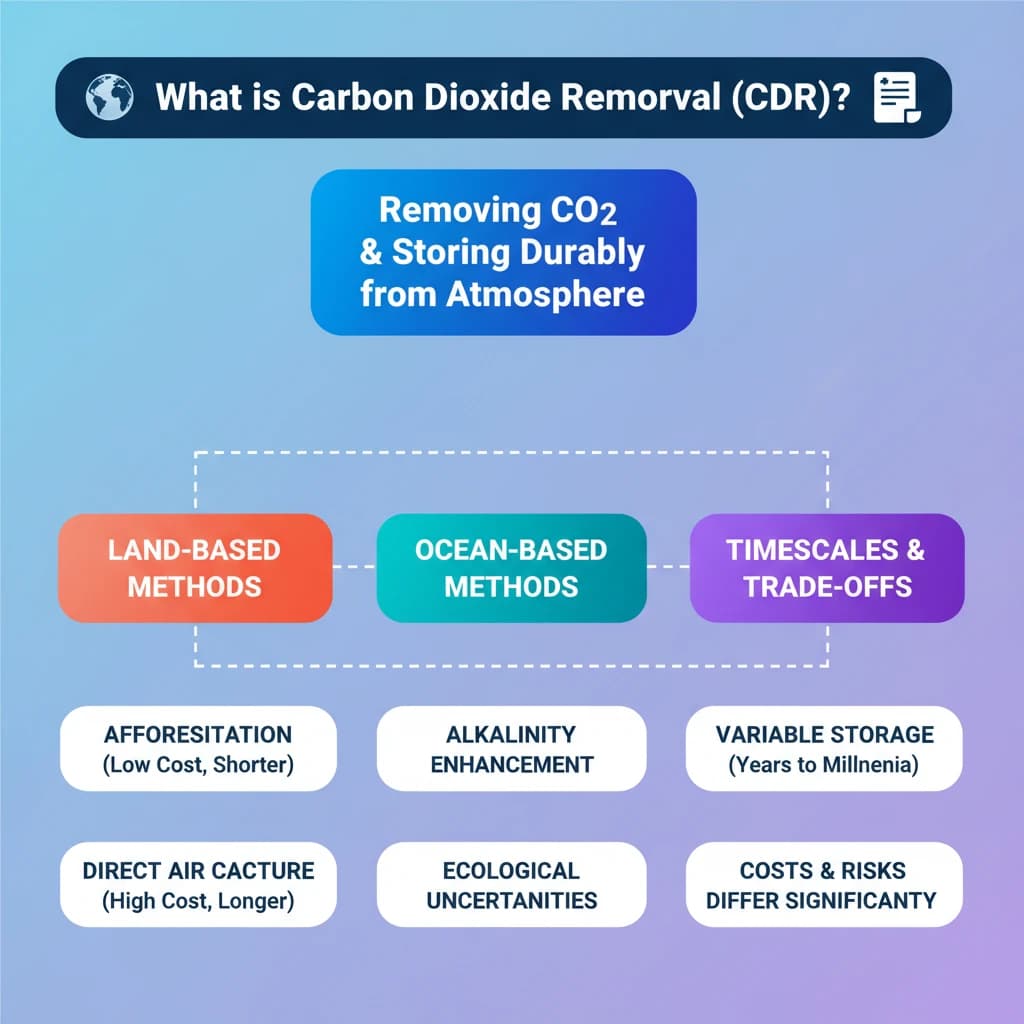
- •Carbon Dioxide Removal (CDR) involves removing CO2 from the atmosphere and storing it durably.
- •CDR methods are categorized as land-based (e.g., afforestation, DACC) or ocean-based (e.g., ocean alkalinity enhancement).
- •Each method has varying storage timescales, financial costs, and associated trade-offs/risks.
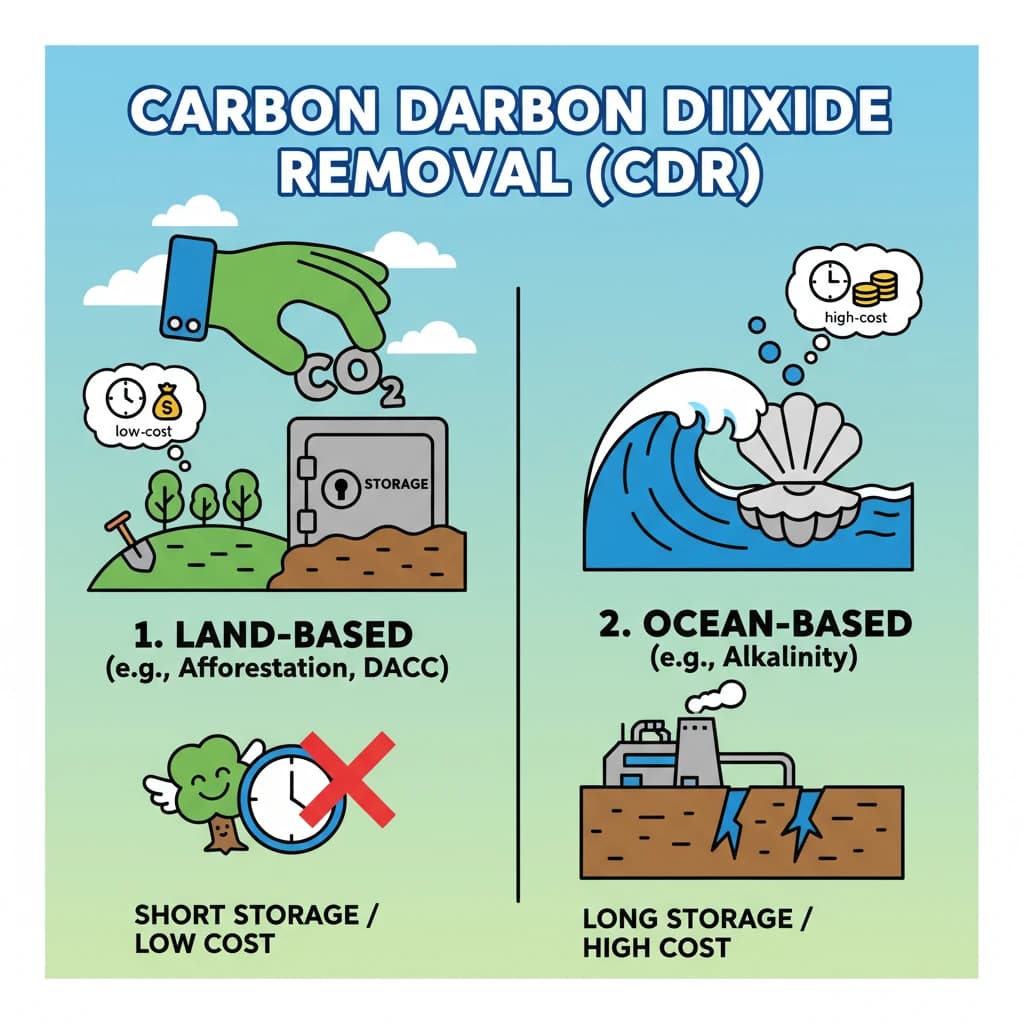
- •Land-based methods like afforestation are relatively low-cost but have shorter storage, while DACC is high-cost but offers long-term geological storage.
- •Ocean-based methods offer very long storage but come with significant ecological uncertainties.
- •CDR is crucial for achieving net-zero emissions and bridging the gap in climate targets, complementing emissions reduction.
- •Responsible deployment requires careful consideration of energy, land, water use, and potential environmental impacts.
🧠 Memory Techniques
95% Verified Content
📚 Reference Sources
•Intergovernmental Panel on Climate Change (IPCC) Reports (general knowledge)
•Various academic and policy reports on climate change mitigation and CDR technologies