Loading page, please wait…
What is Ground Level Ozone Pollution? - UPSC Environment And Ecology
What is What is Ground Level Ozone Pollution? in UPSC Environment And Ecology?
What is Ground Level Ozone Pollution? is a key topic under Environment And Ecology for UPSC Civil Services Examination. Key points include: Ground-level ozone (O3) is a harmful secondary air pollutant, distinct from stratospheric ozone.. It forms from chemical reactions between Nitrogen Oxides (NOx) and Volatile Organic Compounds (VOCs) in the presence of sunlight.. Major sources of NOx and VOCs include vehicles, power plants, industries, and solvents.. Understanding this topic is essential for both UPSC Prelims and Mains preparation.
Why is What is Ground Level Ozone Pollution? important for UPSC exam?
What is Ground Level Ozone Pollution? is a Medium-level topic in UPSC Environment And Ecology. It is tested in both Prelims (factual MCQs) and Mains (analytical answer writing). Previous year UPSC questions have frequently covered aspects of What is Ground Level Ozone Pollution?, making it essential for comprehensive IAS preparation.
How to prepare What is Ground Level Ozone Pollution? for UPSC?
To prepare What is Ground Level Ozone Pollution? for UPSC: (1) Study the comprehensive notes covering all key concepts on Vaidra. (2) Practice previous year questions on this topic. (3) Connect it with current affairs using daily updates. (4) Revise using key takeaways and mind maps available for Environment And Ecology. (5) Write practice answers linking What is Ground Level Ozone Pollution? to related GS Paper topics.
Key takeaways of What is Ground Level Ozone Pollution? for UPSC
- Ground-level ozone (O3) is a harmful secondary air pollutant, distinct from stratospheric ozone.
- It forms from chemical reactions between Nitrogen Oxides (NOx) and Volatile Organic Compounds (VOCs) in the presence of sunlight.
- Major sources of NOx and VOCs include vehicles, power plants, industries, and solvents.
- CPCB sets NAAQS for ozone (100 µg/m³ for 8-hour, 180 µg/m³ for 1-hour average) and monitors it under NAMP.
- Ground-level ozone poses significant risks to human health (respiratory issues) and the environment (crop damage, ecosystem disruption).
What is Ground Level Ozone Pollution?
Medium⏱️ 7 min read
environment and ecology
📖 Introduction
What is Ground Level Ozone (O3) Pollution?
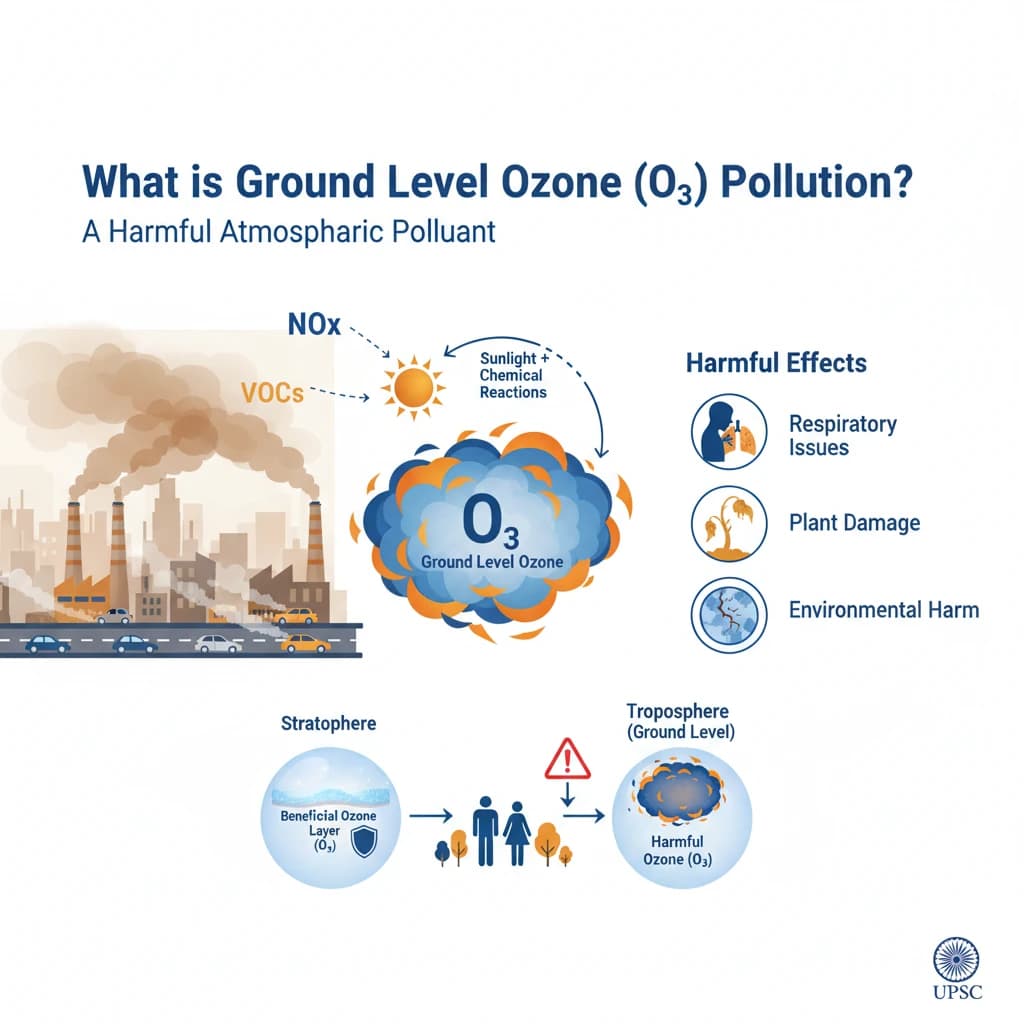
Ground-level ozone (O3) pollution refers to the excess presence of ozone at the Earth’s surface. It is a harmful atmospheric pollutant that forms through complex chemical reactions.
Unlike the beneficial ozone layer in the stratosphere, which shields life from harmful ultraviolet radiation, ground-level ozone poses significant health risks and environmental damage.
Key Distinction: Stratospheric ozone is protective; Ground-level ozone is a pollutant.
Formation of Ground Level Ozone
Ground-level ozone is classified as a secondary pollutant. This means it is not directly emitted into the atmosphere from a source. Instead, it forms through chemical reactions involving other precursor pollutants.
Primary Precursors:
- Nitrogen Oxides (NOx): Emitted primarily by vehicles, power plants, and various industrial processes.
- Volatile Organic Compounds (VOCs): Released from sources such as vehicles, petrol pumps, industrial solvents, and waste burning.
These chemical reactions that form ozone occur specifically in the presence of sunlight. Consequently, ozone formation is significantly more pronounced during sunny days and warmer seasons.
Regulation and Monitoring in India
In India, the Central Pollution Control Board (CPCB) is responsible for setting and enforcing environmental standards. It has established National Ambient Air Quality Standards (NAAQS) for ozone.
NAAQS for Ozone:
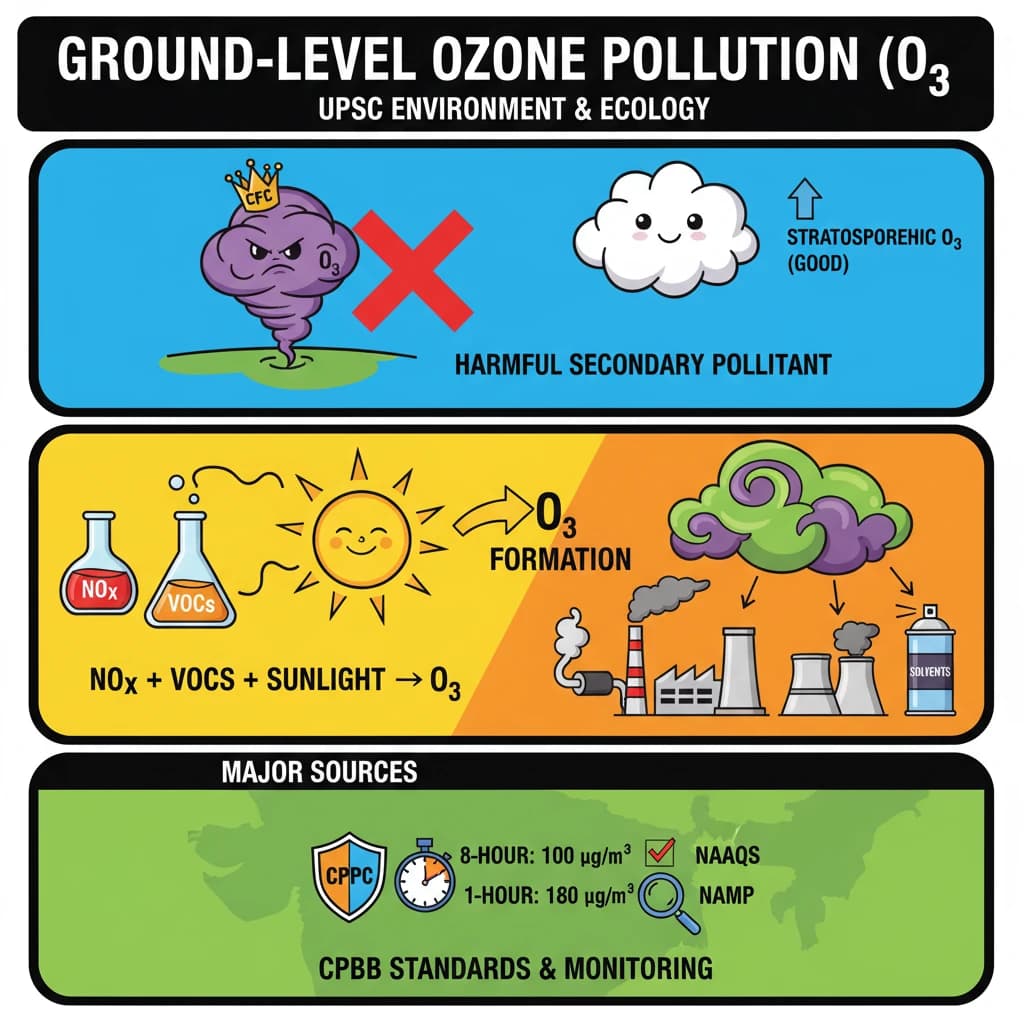
- 8-hour average limit: 100 µg/m³
- 1-hour average limit: 180 µg/m³
Monitoring of ground-level ozone is conducted under the National Air Quality Monitoring Programme (NAMP). This program is managed by the CPCB in collaboration with various State Pollution Control Boards (SPCBs) and the National Environmental Engineering Research Institute (NEERI).
UPSC Insight: Understanding the difference between stratospheric and ground-level ozone is crucial. Also, remember the key precursors (NOx, VOCs) and the role of sunlight in its formation. The regulatory bodies and standards (CPCB, NAAQS, NAMP) are important for GS-III.
💡 Key Takeaways
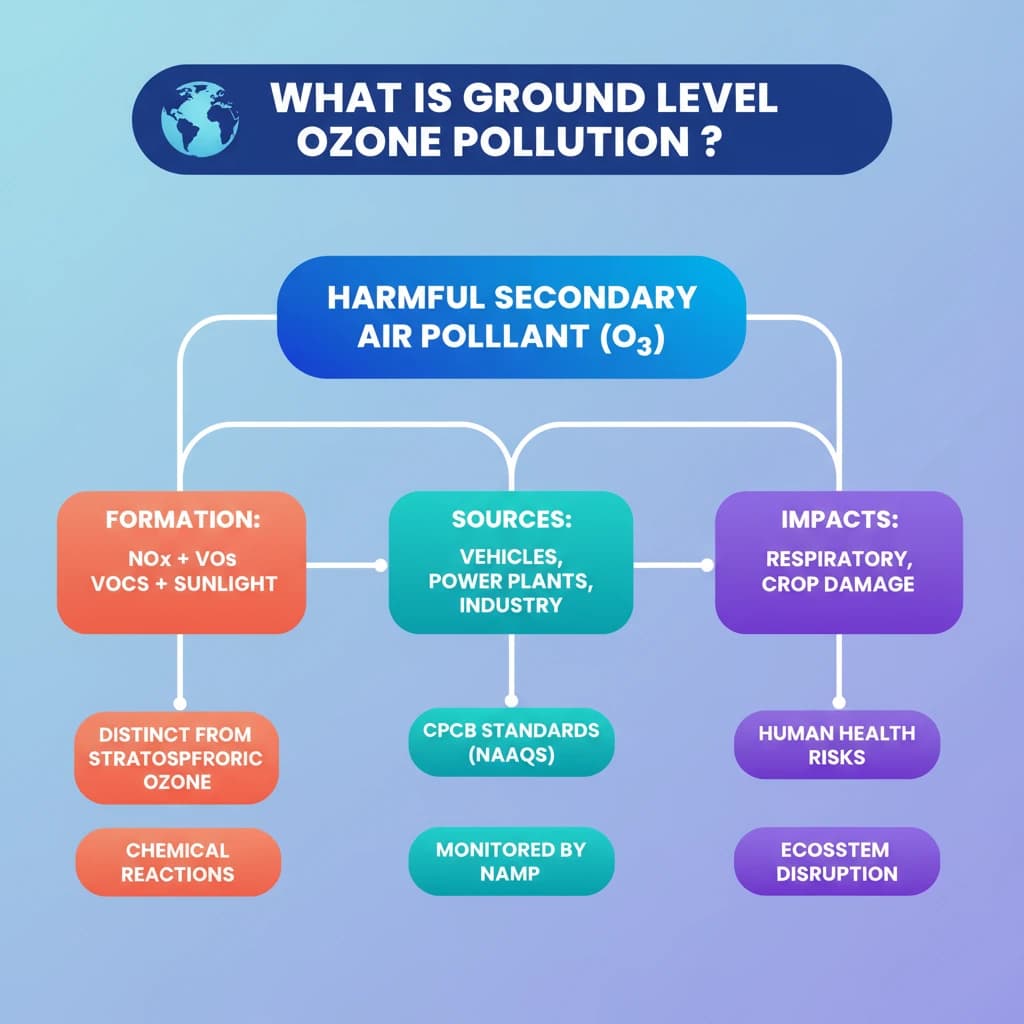
- •Ground-level ozone (O3) is a harmful secondary air pollutant, distinct from stratospheric ozone.
- •It forms from chemical reactions between Nitrogen Oxides (NOx) and Volatile Organic Compounds (VOCs) in the presence of sunlight.
- •Major sources of NOx and VOCs include vehicles, power plants, industries, and solvents.
- •CPCB sets NAAQS for ozone (100 µg/m³ for 8-hour, 180 µg/m³ for 1-hour average) and monitors it under NAMP.
- •Ground-level ozone poses significant risks to human health (respiratory issues) and the environment (crop damage, ecosystem disruption).
🧠 Memory Techniques
98% Verified Content
📚 Reference Sources
•Central Pollution Control Board (CPCB) official website (for NAAQS details, inferred general knowledge)
•Environmental Protection Agency (EPA) resources (for general ozone chemistry, inferred general knowledge)