Loading page, please wait…
What is Nitrogen Pollution? - UPSC Environment And Ecology
What is What is Nitrogen Pollution? in UPSC Environment And Ecology?
What is Nitrogen Pollution? is a key topic under Environment And Ecology for UPSC Civil Services Examination. Key points include: Nitrogen is essential for life but its reactive forms, when in excess, cause significant pollution.. The Haber-Bosch process enabled synthetic fertilizers, boosting food but also reactive nitrogen flows.. Nitrogen pollution manifests as air pollution (NOx, NH₃), greenhouse gas (N₂O), and water pollution (nitrates).. Understanding this topic is essential for both UPSC Prelims and Mains preparation.
Why is What is Nitrogen Pollution? important for UPSC exam?
What is Nitrogen Pollution? is a Medium-level topic in UPSC Environment And Ecology. It is tested in both Prelims (factual MCQs) and Mains (analytical answer writing). Previous year UPSC questions have frequently covered aspects of What is Nitrogen Pollution?, making it essential for comprehensive IAS preparation.
How to prepare What is Nitrogen Pollution? for UPSC?
To prepare What is Nitrogen Pollution? for UPSC: (1) Study the comprehensive notes covering all key concepts on Vaidra. (2) Practice previous year questions on this topic. (3) Connect it with current affairs using daily updates. (4) Revise using key takeaways and mind maps available for Environment And Ecology. (5) Write practice answers linking What is Nitrogen Pollution? to related GS Paper topics.
Key takeaways of What is Nitrogen Pollution? for UPSC
- Nitrogen is essential for life but its reactive forms, when in excess, cause significant pollution.
- The Haber-Bosch process enabled synthetic fertilizers, boosting food but also reactive nitrogen flows.
- Nitrogen pollution manifests as air pollution (NOx, NH₃), greenhouse gas (N₂O), and water pollution (nitrates).
- Nitrous oxide (N₂O) is a powerful GHG (300x CO₂) and the largest human threat to the ozone layer.
- Effects include global warming, ozone depletion, biodiversity loss (dead zones, acidic soils), and severe air quality degradation (smog, particulates).
What is Nitrogen Pollution?
Medium⏱️ 8 min read
environment and ecology
📖 Introduction
The Essential Role of Nitrogen
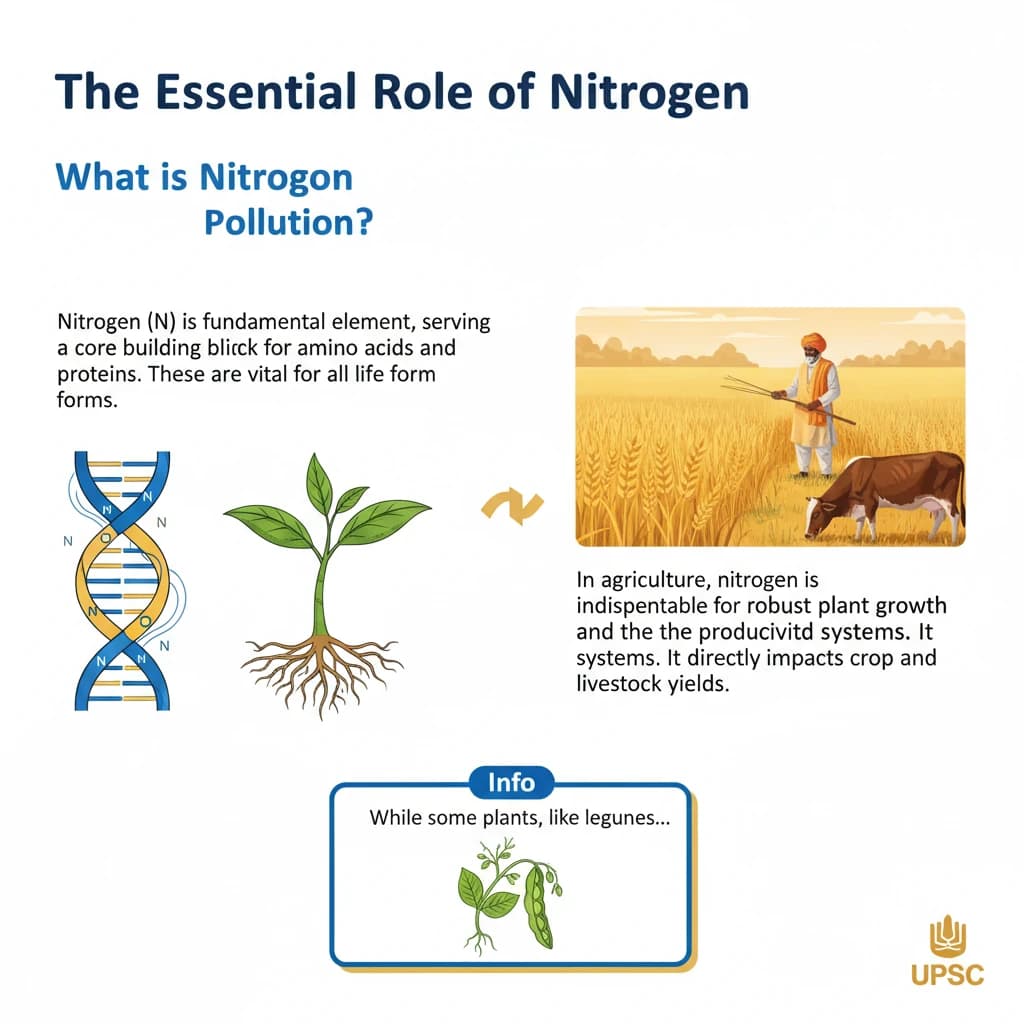
Nitrogen (N) is a fundamental element, serving as a core building block for amino acids and proteins. These are vital for all life forms.
In agriculture, nitrogen is indispensable for robust plant growth and the productivity of agrifood systems. It directly impacts crop and livestock yields.
While some plants, like legumes, can fix atmospheric nitrogen, most depend heavily on soil nitrogen for their nutritional needs.
The Haber-Bosch Process and Reactive Nitrogen
The development of the Haber-Bosch process revolutionized agriculture. This industrial method converts inert atmospheric nitrogen (N₂) into highly reactive nitrogen compounds, primarily ammonium (NH₃).
This process enabled the widespread production of synthetic fertilizers, which significantly boosted global crop production and food security.
The conversion of inert nitrogen into reactive forms is crucial for plant uptake but also a primary driver of nitrogen pollution.
Understanding Nitrogen Pollution
Nitrogen pollution refers to the excessive accumulation of nitrogen compounds in the environment. These compounds primarily include nitrogen oxides (NOx) and nitrates (NO₃⁻).
Such excessive presence disrupts natural biogeochemical cycles and leads to widespread environmental degradation.
The loss of reactive nitrogen to the environment has detrimental effects on air quality, water quality, human health, and biodiversity across both terrestrial and aquatic ecosystems.
Forms of Environmental Nitrogen Loss
Nitrogen pollution manifests in various forms, impacting different environmental compartments:
- Air Pollution: Emissions of ammonia (NH₃) from agriculture and nitrogen oxides (NOx) from combustion sources contribute significantly to air quality degradation.
- Greenhouse Gas Emissions: Nitrous oxide (N₂O) is a potent greenhouse gas (GHG), playing a substantial role in accelerating climate change.
- Water Pollution: The leaching of nitrates (NO₃⁻) into water bodies causes eutrophication and acidification, severely harming aquatic ecosystems and diminishing water quality.
Escalating Concerns: The Scale of Nitrogen Pollution
Over the past 150 years, human activities have dramatically increased the flow of reactive nitrogen into the environment, estimated to have risen tenfold.
Annually, approximately 200 million tonnes of reactive nitrogen are lost, with about 80% of this contaminating soil, rivers, lakes, and the atmosphere.
UPSC often asks about the scale and human impact on biogeochemical cycles. Remember the tenfold increase and 200 million tonnes annual loss as key figures.
Multi-faceted Environmental Impacts
Global Warming and Ozone Layer Depletion
Nitrous oxide (N₂O) is a particularly potent greenhouse gas, approximately 300 times more powerful than both methane and carbon dioxide in its warming potential.
Furthermore, N₂O represents the largest human-made threat to the Earth's protective ozone layer, contributing to its depletion.
Impact on Biodiversity
Excessive use of synthetic fertilizers can degrade soils by making them acidic. This harms soil health, reduces microbial activity, and diminishes agricultural productivity.
In aquatic environments, nitrogen pollution leads to the formation of dead zones in oceans and fuels the proliferation of toxic algal blooms, severely impacting marine ecosystems and biodiversity.
Air Quality Degradation
Emissions of nitrogen oxides (NOx) from sources like coal plants, factories, and vehicle exhausts are primary precursors to smog and the formation of harmful ground-level ozone.
Additionally, agricultural ammonia and vehicle exhaust emissions contribute to the creation of fine particulates, which exacerbate respiratory diseases and other health issues in humans.
💡 Key Takeaways
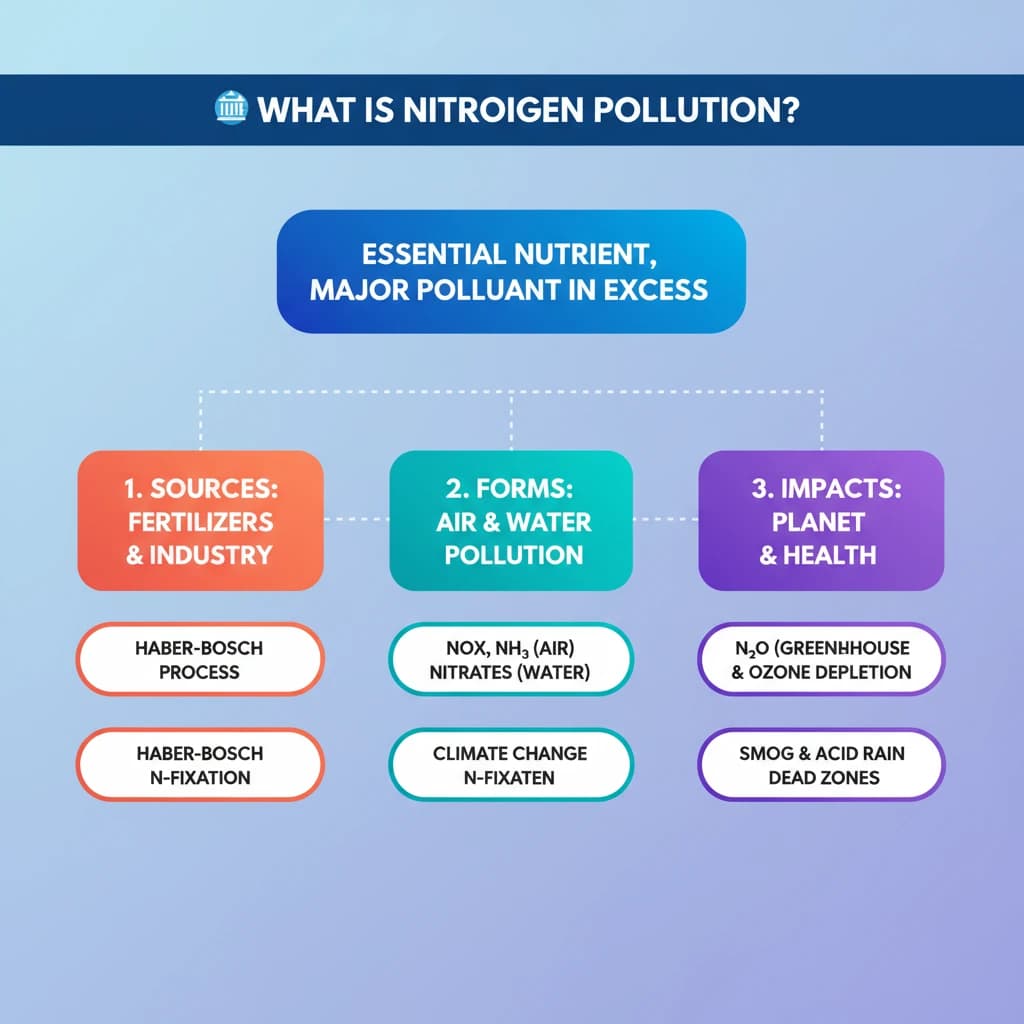
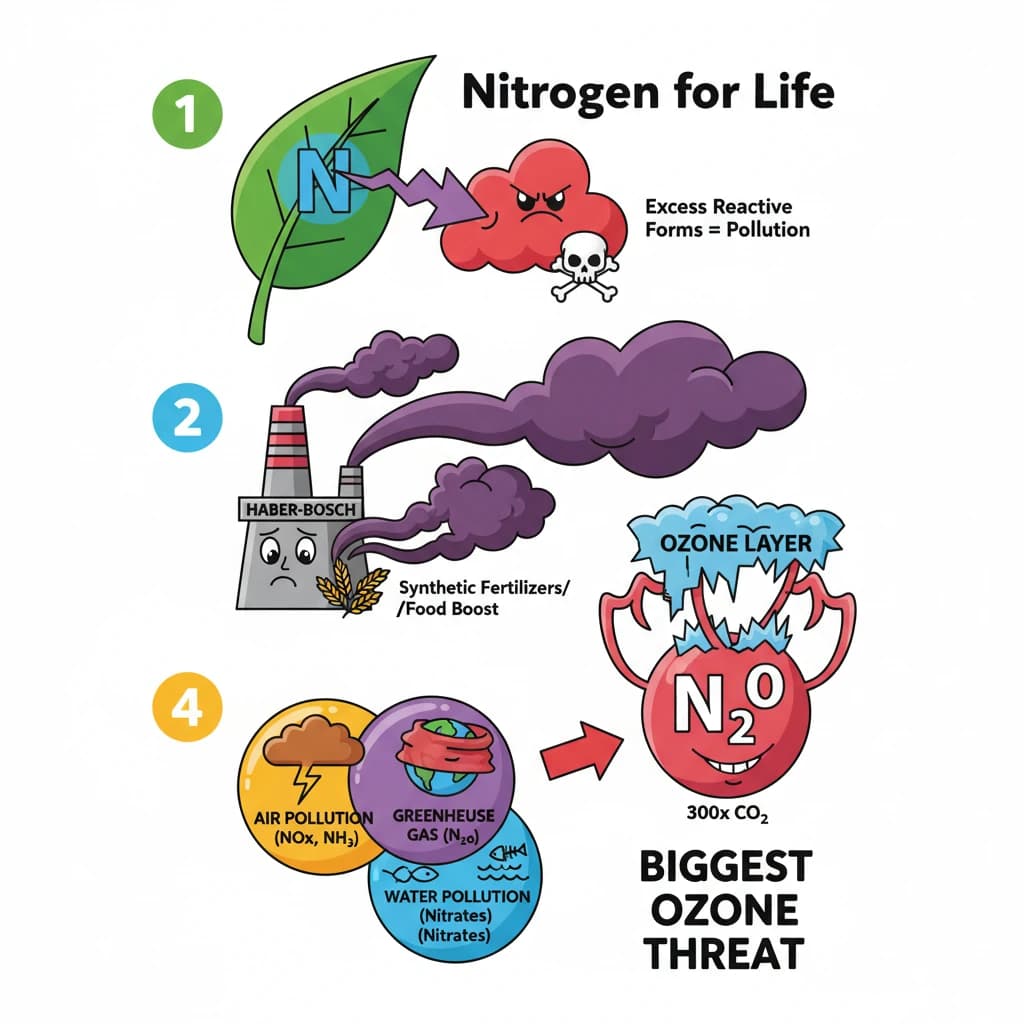
- •Nitrogen is essential for life but its reactive forms, when in excess, cause significant pollution.
- •The Haber-Bosch process enabled synthetic fertilizers, boosting food but also reactive nitrogen flows.
- •Nitrogen pollution manifests as air pollution (NOx, NH₃), greenhouse gas (N₂O), and water pollution (nitrates).
- •Nitrous oxide (N₂O) is a powerful GHG (300x CO₂) and the largest human threat to the ozone layer.
- •Effects include global warming, ozone depletion, biodiversity loss (dead zones, acidic soils), and severe air quality degradation (smog, particulates).
🧠 Memory Techniques
95% Verified Content
📚 Reference Sources
•General environmental science textbooks and reports on nitrogen cycle and pollution.