Loading page, please wait…
What is Ocean Acidification? - UPSC Environment And Ecology
What is What is Ocean Acidification? in UPSC Environment And Ecology?
What is Ocean Acidification? is a key topic under Environment And Ecology for UPSC Civil Services Examination. Key points include: Ocean Acidification is the decrease in ocean pH due to excess atmospheric CO2 absorption.. CO2 reacts with seawater to form carbonic acid, releasing hydrogen ions and lowering pH.. This process reduces carbonate ions, essential for calcifying marine organisms like corals and shellfish.. Understanding this topic is essential for both UPSC Prelims and Mains preparation.
Why is What is Ocean Acidification? important for UPSC exam?
What is Ocean Acidification? is a Medium-level topic in UPSC Environment And Ecology. It is tested in both Prelims (factual MCQs) and Mains (analytical answer writing). Previous year UPSC questions have frequently covered aspects of What is Ocean Acidification?, making it essential for comprehensive IAS preparation.
How to prepare What is Ocean Acidification? for UPSC?
To prepare What is Ocean Acidification? for UPSC: (1) Study the comprehensive notes covering all key concepts on Vaidra. (2) Practice previous year questions on this topic. (3) Connect it with current affairs using daily updates. (4) Revise using key takeaways and mind maps available for Environment And Ecology. (5) Write practice answers linking What is Ocean Acidification? to related GS Paper topics.
Key takeaways of What is Ocean Acidification? for UPSC
- Ocean Acidification is the decrease in ocean pH due to excess atmospheric CO2 absorption.
- CO2 reacts with seawater to form carbonic acid, releasing hydrogen ions and lowering pH.
- This process reduces carbonate ions, essential for calcifying marine organisms like corals and shellfish.
- Impacts include weaker shells, reduced growth, and threats to marine food webs and biodiversity.
- Driven by anthropogenic CO2 emissions, it poses a significant threat to marine ecosystems, food security, and coastal economies.
- It is a critical aspect of climate change, demanding urgent global action to reduce emissions.
What is Ocean Acidification?
Medium⏱️ 10 min read
environment and ecology
📖 Introduction
Understanding Ocean Acidification
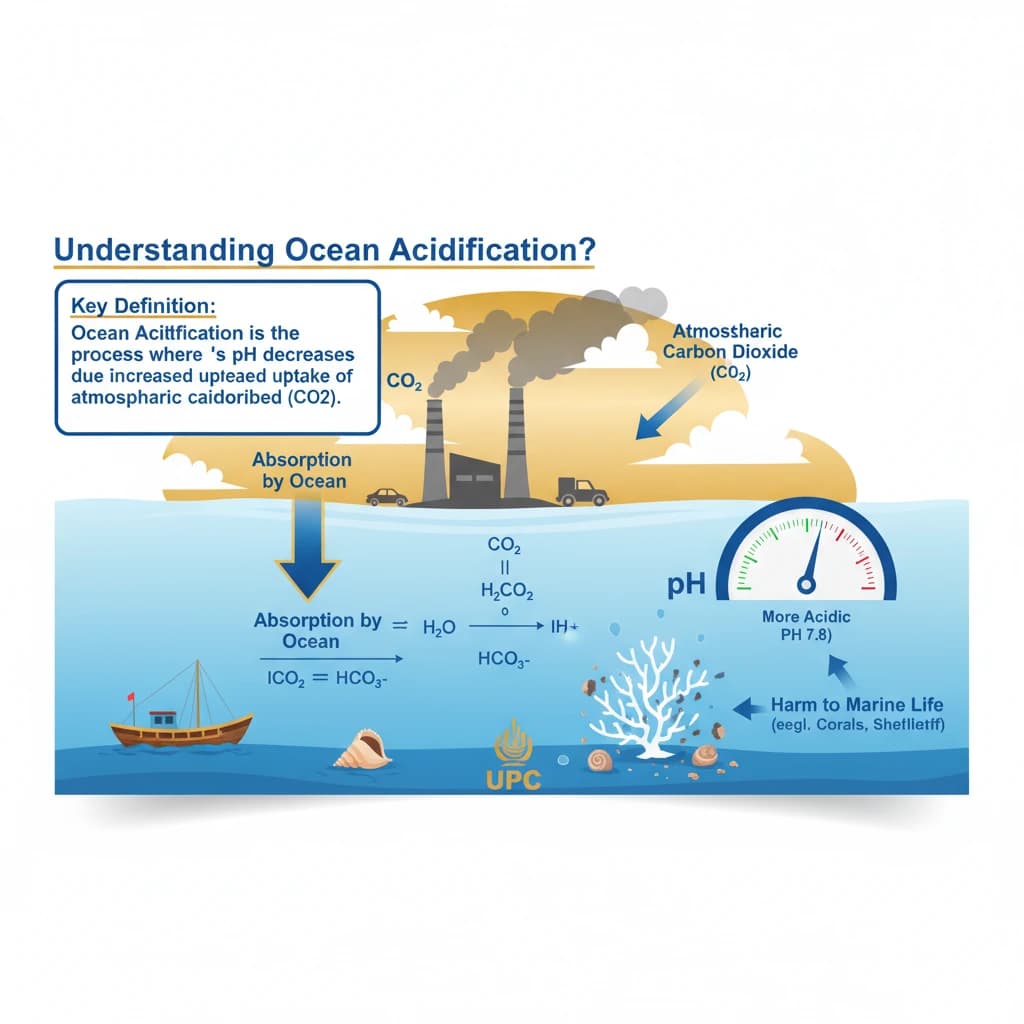
Ocean acidification refers to the ongoing decrease in the pH levels of the Earth's oceans. This critical environmental issue is primarily driven by the absorption of excess atmospheric carbon dioxide (CO2) from human activities.
Key Definition: Ocean Acidification is the process where the ocean's pH decreases due to increased uptake of atmospheric CO2, leading to a more acidic environment.
The Chemical Process
As CO2 levels in the atmosphere rise, a significant portion of this gas dissolves into seawater. When carbon dioxide dissolves in water, it reacts to form carbonic acid (H2CO3).
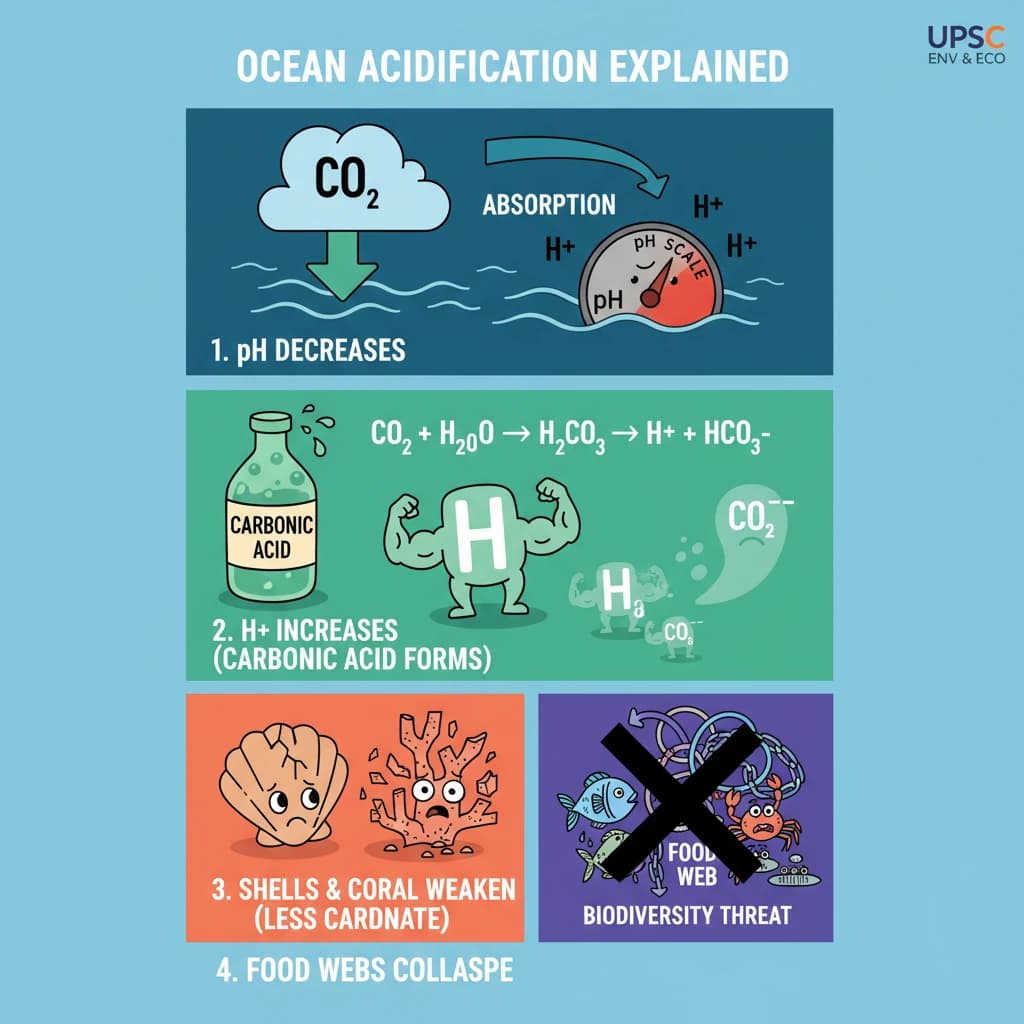
This formation of carbonic acid then dissociates, releasing hydrogen ions (H+) into the water. An increase in hydrogen ions directly leads to a decrease in the water's pH level, making the ocean more acidic.
Chemical Reaction: CO2 (atmospheric) + H2O (seawater) ⇌ H2CO3 (carbonic acid) ⇌ H+ (hydrogen ion) + HCO3- (bicarbonate ion)
Impact on Marine Ecosystems
The rising CO2 emissions are pushing ocean pH beyond sustainable levels. This change significantly impacts marine organisms, especially those that build shells or skeletons from calcium carbonate.
Organisms like corals, mollusks, and plankton struggle to form and maintain their structures in more acidic waters. This can lead to weaker shells, reduced growth rates, and increased mortality.
UPSC often asks about the impacts of environmental phenomena. For Ocean Acidification, focus on its effects on calcifying organisms and the broader marine food web.
Ecological Tipping Points
Crossing ecological tipping points due to ocean acidification threatens irreversible ecosystem damage. Such damage can have profound impacts on marine biodiversity and the billions of people who rely on ocean resources.
While some environmental boundaries, like the ozone layer, show signs of recovery, urgent action is required to address ocean acidification and prevent further degradation of marine environments.
Causes and Drivers
The primary driver of ocean acidification is the anthropogenic release of carbon dioxide. Industrial activities, burning of fossil fuels, and deforestation contribute vast amounts of CO2 to the atmosphere.
The ocean, acting as a crucial carbon sink, absorbs approximately 25-30% of the atmospheric CO2. While this mitigates climate change, it comes at the cost of altering ocean chemistry.
💡 Key Takeaways
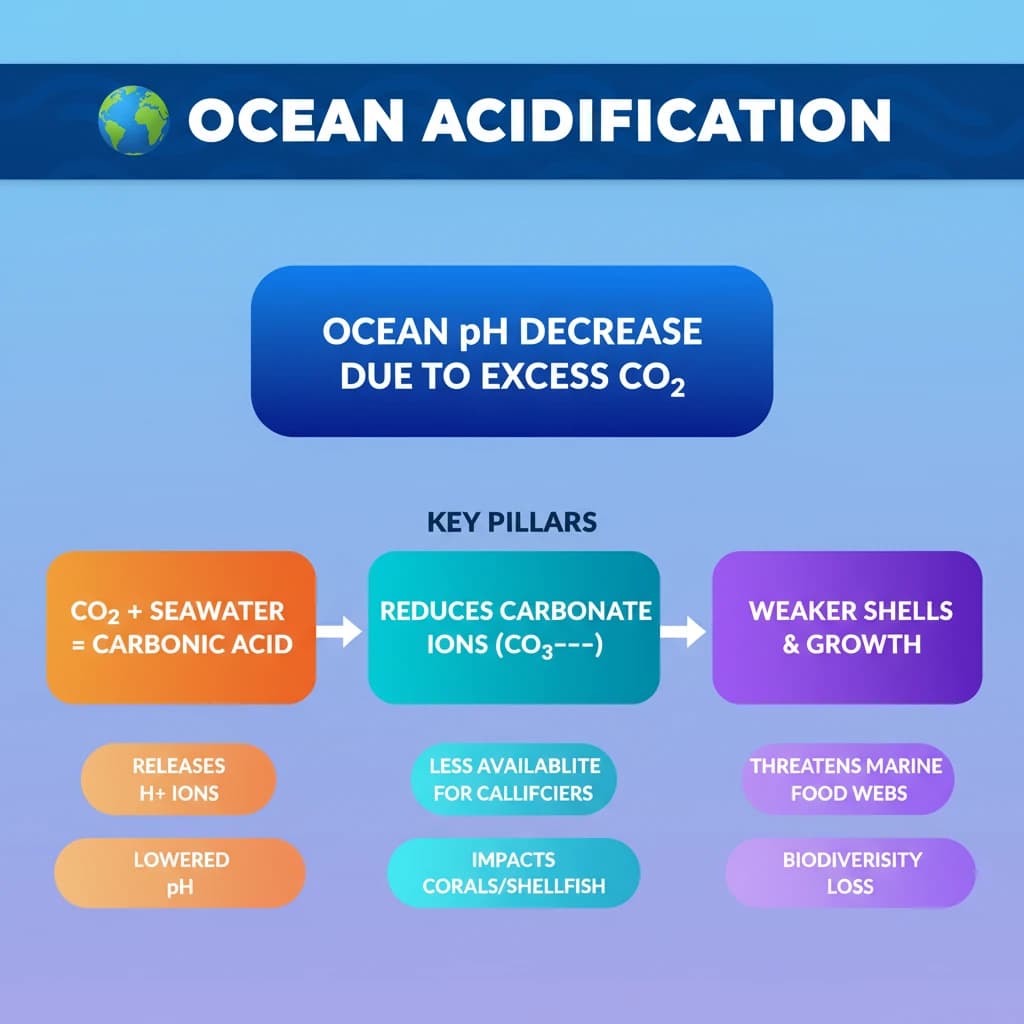
- •Ocean Acidification is the decrease in ocean pH due to excess atmospheric CO2 absorption.
- •CO2 reacts with seawater to form carbonic acid, releasing hydrogen ions and lowering pH.
- •This process reduces carbonate ions, essential for calcifying marine organisms like corals and shellfish.
- •Impacts include weaker shells, reduced growth, and threats to marine food webs and biodiversity.
- •Driven by anthropogenic CO2 emissions, it poses a significant threat to marine ecosystems, food security, and coastal economies.
- •It is a critical aspect of climate change, demanding urgent global action to reduce emissions.
🧠 Memory Techniques
98% Verified Content
📚 Reference Sources
•National Oceanic and Atmospheric Administration (NOAA) Ocean Acidification Program
•United Nations Environment Programme (UNEP) reports on Marine and Coastal Ecosystems
•Scientific literature from journals like Nature, Science, and Marine Pollution Bulletin
•The Ocean Foundation publications on ocean acidification