Loading page, please wait…
What is Rat-hole Mining? - UPSC Environment And Ecology
What is What is Rat-hole Mining? in UPSC Environment And Ecology?
What is Rat-hole Mining? is a key topic under Environment And Ecology for UPSC Civil Services Examination. Key points include: Rat-hole mining is a primitive, hazardous, and illegal coal extraction method.. It involves digging small, confined tunnels, often by children.. Prevalent in northeastern India, especially Meghalaya and Assam.. Understanding this topic is essential for both UPSC Prelims and Mains preparation.
Why is What is Rat-hole Mining? important for UPSC exam?
What is Rat-hole Mining? is a Medium-level topic in UPSC Environment And Ecology. It is tested in both Prelims (factual MCQs) and Mains (analytical answer writing). Previous year UPSC questions have frequently covered aspects of What is Rat-hole Mining?, making it essential for comprehensive IAS preparation.
How to prepare What is Rat-hole Mining? for UPSC?
To prepare What is Rat-hole Mining? for UPSC: (1) Study the comprehensive notes covering all key concepts on Vaidra. (2) Practice previous year questions on this topic. (3) Connect it with current affairs using daily updates. (4) Revise using key takeaways and mind maps available for Environment And Ecology. (5) Write practice answers linking What is Rat-hole Mining? to related GS Paper topics.
Key takeaways of What is Rat-hole Mining? for UPSC
- Rat-hole mining is a primitive, hazardous, and illegal coal extraction method.
- It involves digging small, confined tunnels, often by children.
- Prevalent in northeastern India, especially Meghalaya and Assam.
- Driven by poverty, lack of clear land ownership, and persistent coal demand.
- Causes severe environmental damage (acid mine drainage, deforestation) and human rights abuses.
- Banned by the National Green Tribunal (NGT) in 2014, but continues clandestinely.
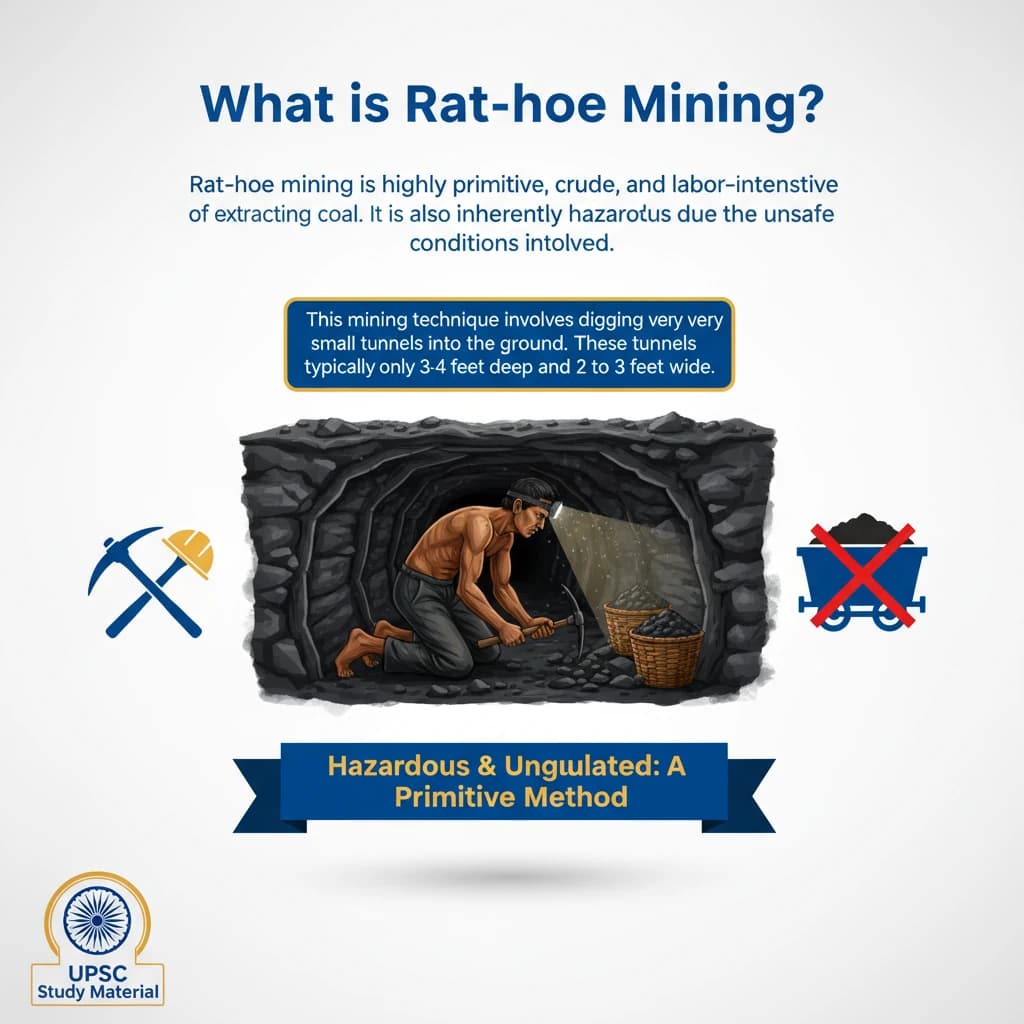
What is Rat-hole Mining?
Medium⏱️ 7 min read
environment and ecology
📖 Introduction
What is Rat-hole Mining?
Rat-hole mining is a highly primitive, crude, and labor-intensive method of extracting coal. It is also inherently hazardous due to the unsafe conditions involved.
This mining technique involves digging very small tunnels into the ground. These tunnels are typically only 3-4 feet deep and 2 to 3 feet wide, making them extremely confined spaces.
Workers, often including children, must enter these narrow shafts to manually extract coal. This practice is predominantly found in northeastern India, particularly in states like Meghalaya and Assam.
Methods of Extraction
Two primary methods are employed in rat-hole mining, each adapted to the local geological conditions.
- Side-Cutting Procedure: This method involves digging narrow tunnels directly into hill slopes. It is used to access thin coal seams, which are typically less than 2 meters in height, characteristic of the region's hilly terrain.
- Box-Cutting: In this procedure, miners first create a rectangular opening on the surface. Following this, a vertical pit is dug downwards. From the bottom of this pit, horizontal tunnels, resembling actual rat holes, are then excavated to extract coal.
Reasons for Rat-Hole Mining
Several socio-economic factors contribute to the persistence of this dangerous mining practice.
Poverty: A significant driver is the profound poverty faced by local tribal communities. With limited alternative livelihood options, rat-hole mining becomes a desperate means of survival.
The immediate financial gain from selling the extracted coal, despite the severe risks, provides a crucial income for those struggling economically.
Lack of Ownership Issues: Ambiguities surrounding land titles and a general absence of proper regulation create a fertile ground for illegal mining. These operations exploit gaps in governance, allowing them to persist without proper accountability or oversight.
Coal Demand: The continuous and robust demand for coal, both through legal and illegal channels, sustains the practice. A network of middlemen and illegal traders further perpetuates this cycle by creating a ready market for unlawfully mined coal.
UPSC Insight: Understanding the socio-economic drivers behind illegal activities like rat-hole mining is crucial for Mains answers, particularly in GS-I (Society) and GS-III (Economy/Environment). Focus on the interplay of poverty, governance, and demand.
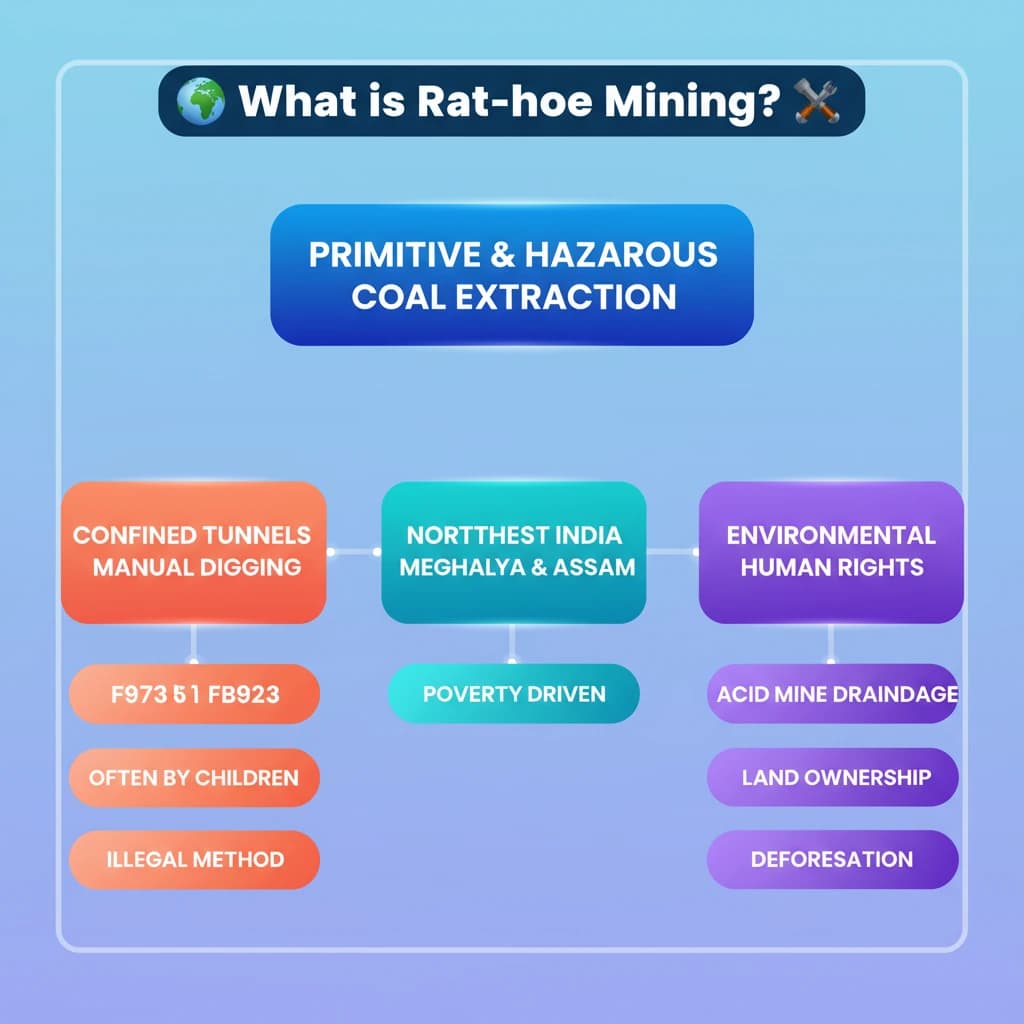
💡 Key Takeaways
- •Rat-hole mining is a primitive, hazardous, and illegal coal extraction method.
- •It involves digging small, confined tunnels, often by children.
- •Prevalent in northeastern India, especially Meghalaya and Assam.
- •Driven by poverty, lack of clear land ownership, and persistent coal demand.
- •Causes severe environmental damage (acid mine drainage, deforestation) and human rights abuses.
- •Banned by the National Green Tribunal (NGT) in 2014, but continues clandestinely.
🧠 Memory Techniques
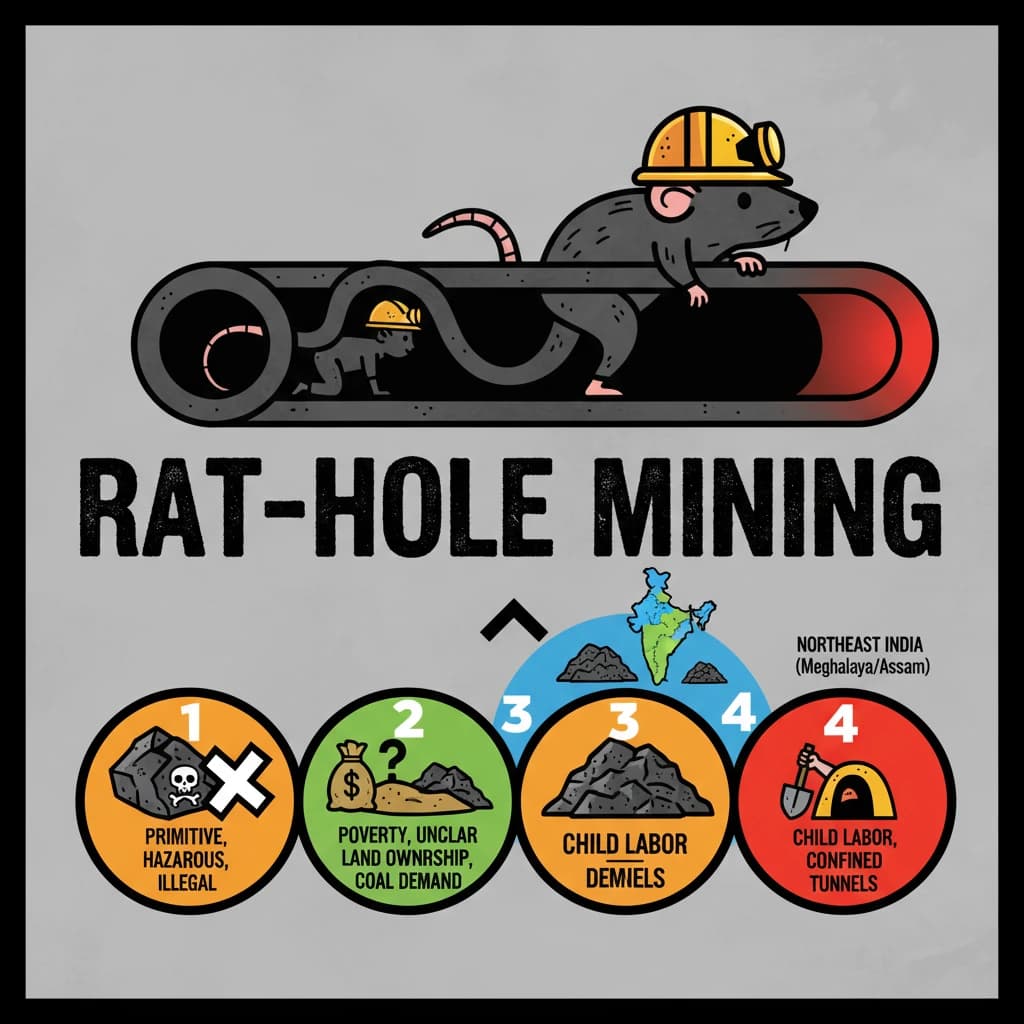
95% Verified Content
📚 Reference Sources
•Reports by National Green Tribunal (NGT) on mining bans
•News articles and investigative reports on rat-hole mining incidents in Meghalaya and Assam
•Government reports on illegal mining and environmental impact assessments