Loading page, please wait…
What is Sundarbans? - UPSC Environment And Ecology
What is What is Sundarbans? in UPSC Environment And Ecology?
What is Sundarbans? is a key topic under Environment And Ecology for UPSC Civil Services Examination. Key points include: Sundarbans is the world's largest mangrove forest, located on the Ganges-Brahmaputra-Meghna delta.. It is a specialized ecosystem between land and sea, found in tropical and subtropical regions.. Mangroves provide crucial ecosystem services, including coastal protection against cyclones and erosion.. Understanding this topic is essential for both UPSC Prelims and Mains preparation.
Why is What is Sundarbans? important for UPSC exam?
What is Sundarbans? is a Medium-level topic in UPSC Environment And Ecology. It is tested in both Prelims (factual MCQs) and Mains (analytical answer writing). Previous year UPSC questions have frequently covered aspects of What is Sundarbans?, making it essential for comprehensive IAS preparation.
How to prepare What is Sundarbans? for UPSC?
To prepare What is Sundarbans? for UPSC: (1) Study the comprehensive notes covering all key concepts on Vaidra. (2) Practice previous year questions on this topic. (3) Connect it with current affairs using daily updates. (4) Revise using key takeaways and mind maps available for Environment And Ecology. (5) Write practice answers linking What is Sundarbans? to related GS Paper topics.
Key takeaways of What is Sundarbans? for UPSC
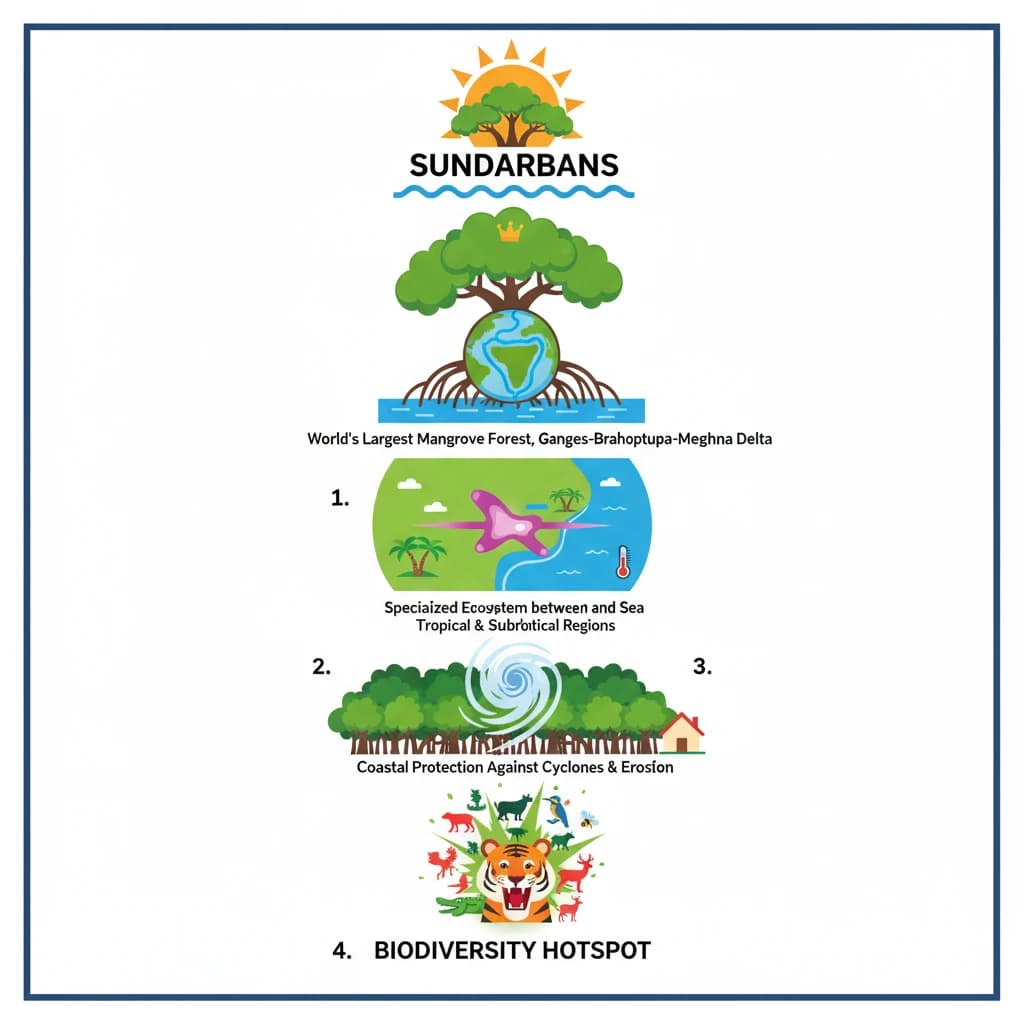
- Sundarbans is the world's largest mangrove forest, located on the Ganges-Brahmaputra-Meghna delta.
- It is a specialized ecosystem between land and sea, found in tropical and subtropical regions.
- Mangroves provide crucial ecosystem services, including coastal protection against cyclones and erosion.
- It is a global biodiversity hotspot, home to the Royal Bengal Tiger and numerous other species.
- The Sundarbans is a UNESCO World Heritage Site and a Ramsar Site, facing severe threats from climate change and human activities.
- Its conservation is vital for both ecological balance and the livelihoods of local communities.
What is Sundarbans?
Medium⏱️ 8 min read
environment and ecology
📖 Introduction
Introduction to the Sundarbans
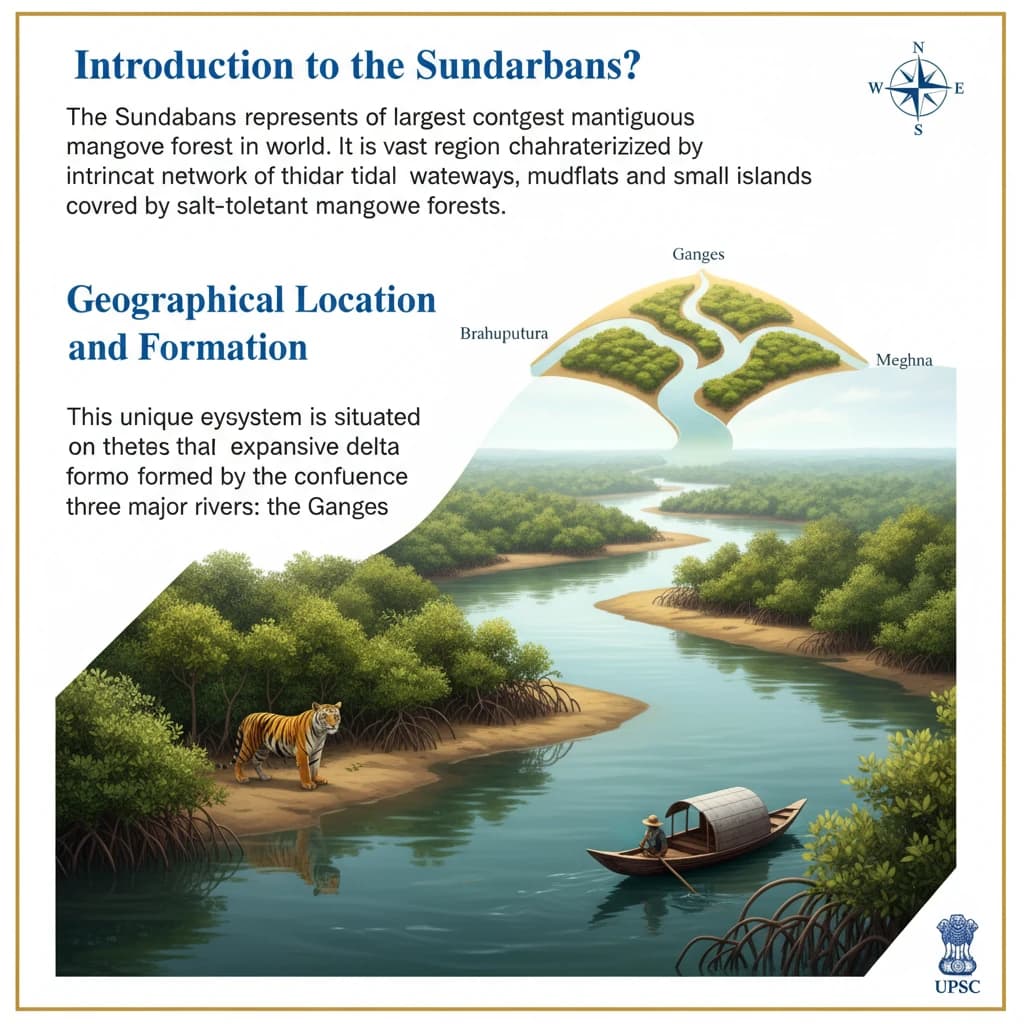
The Sundarbans represents the largest contiguous mangrove forest in the world. It is a vast region characterized by an intricate network of tidal waterways, mudflats, and small islands covered by salt-tolerant mangrove forests.
Geographical Location and Formation
This unique ecosystem is situated on the expansive delta formed by the confluence of three major rivers: the Ganges, Brahmaputra, and Meghna.
Its geographical spread lies across the Bay of Bengal, shared between India (West Bengal) and Bangladesh.
Location: Delta of Ganges, Brahmaputra, and Meghna rivers.
Region: Bay of Bengal, spanning India and Bangladesh.
The Mangrove Ecosystem
The Sundarbans is globally renowned for hosting the largest mangrove forests, which are crucial for ecological balance and biodiversity.
A mangrove ecosystem is a highly specialized type of environment that thrives in specific conditions.
Definition: It exists as an interface, or transitional zone, precisely between the land and the sea.
These ecosystems are predominantly found in particular climatic zones, adapting to unique environmental stressors.
Climatic Zones: Primarily located in tropical and subtropical regions worldwide.
Understanding the unique geographical setting and the specialized nature of mangrove ecosystems is vital for questions on coastal ecology and biodiversity in UPSC Prelims (GS Paper I) and Mains (GS Paper III).
💡 Key Takeaways
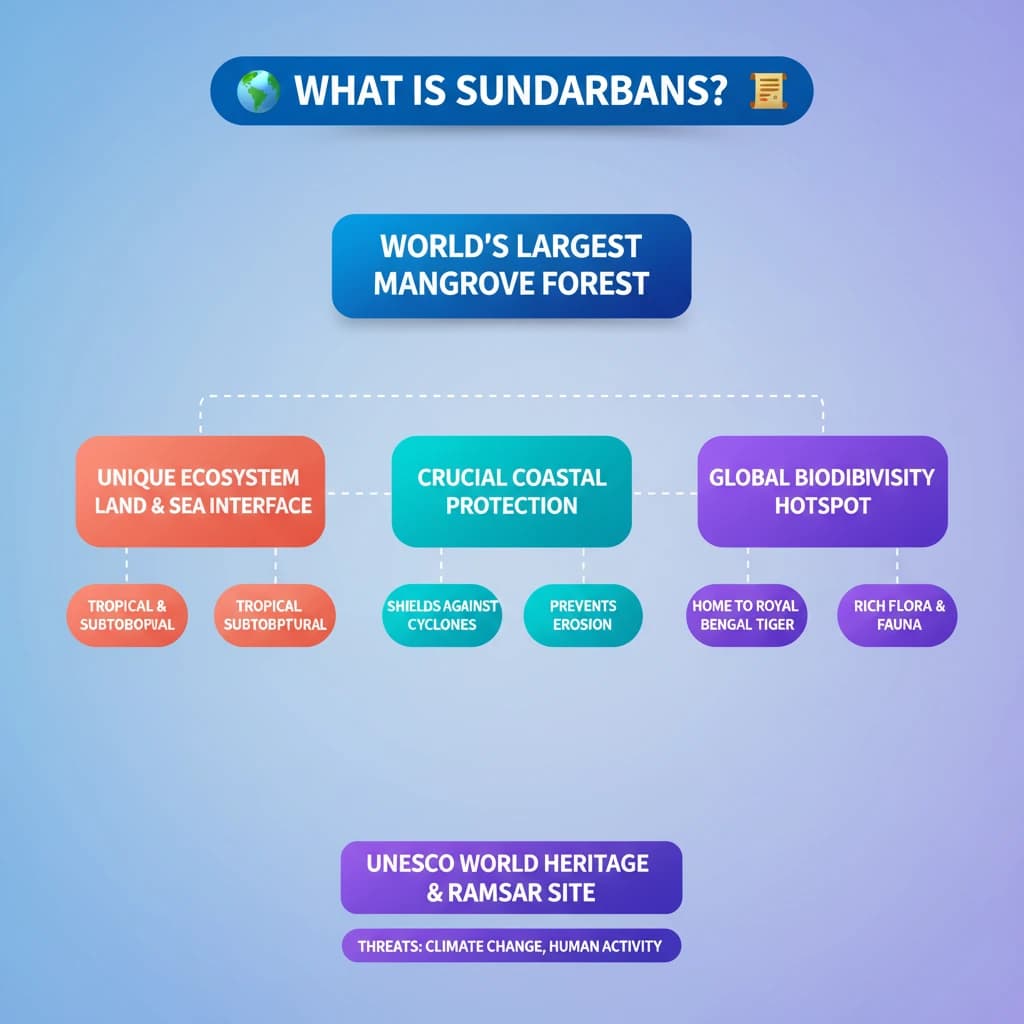
- •Sundarbans is the world's largest mangrove forest, located on the Ganges-Brahmaputra-Meghna delta.
- •It is a specialized ecosystem between land and sea, found in tropical and subtropical regions.
- •Mangroves provide crucial ecosystem services, including coastal protection against cyclones and erosion.
- •It is a global biodiversity hotspot, home to the Royal Bengal Tiger and numerous other species.
- •The Sundarbans is a UNESCO World Heritage Site and a Ramsar Site, facing severe threats from climate change and human activities.
- •Its conservation is vital for both ecological balance and the livelihoods of local communities.
🧠 Memory Techniques
95% Verified Content
📚 Reference Sources
•UNESCO World Heritage Centre official website
•Ramsar Convention on Wetlands official website
•WWF India publications on Sundarbans
•National Geographic articles on mangrove ecosystems