Loading page, please wait…
What is the Island Coastal Regulation Zone (ICRZ)? - UPSC Environment And Ecology
What is What is the Island Coastal Regulation Zone (ICRZ)? in UPSC Environment And Ecology?
What is the Island Coastal Regulation Zone (ICRZ)? is a key topic under Environment And Ecology for UPSC Civil Services Examination. Key points include: ICRZ regulates activities within 500m of HTL and 100m of tidal water bodies in Andaman & Nicobar and Lakshadweep.. It evolved from the earlier Island Protection Zone (IPZ) under the Environment Protection Act, 1986.. HTL is the highest spring tide line, LTL is the lowest spring tide line.. Understanding this topic is essential for both UPSC Prelims and Mains preparation.
Why is What is the Island Coastal Regulation Zone (ICRZ)? important for UPSC exam?
What is the Island Coastal Regulation Zone (ICRZ)? is a Medium-level topic in UPSC Environment And Ecology. It is tested in both Prelims (factual MCQs) and Mains (analytical answer writing). Previous year UPSC questions have frequently covered aspects of What is the Island Coastal Regulation Zone (ICRZ)?, making it essential for comprehensive IAS preparation.
How to prepare What is the Island Coastal Regulation Zone (ICRZ)? for UPSC?
To prepare What is the Island Coastal Regulation Zone (ICRZ)? for UPSC: (1) Study the comprehensive notes covering all key concepts on Vaidra. (2) Practice previous year questions on this topic. (3) Connect it with current affairs using daily updates. (4) Revise using key takeaways and mind maps available for Environment And Ecology. (5) Write practice answers linking What is the Island Coastal Regulation Zone (ICRZ)? to related GS Paper topics.
Key takeaways of What is the Island Coastal Regulation Zone (ICRZ)? for UPSC
- ICRZ regulates activities within 500m of HTL and 100m of tidal water bodies in Andaman & Nicobar and Lakshadweep.
- It evolved from the earlier Island Protection Zone (IPZ) under the Environment Protection Act, 1986.
- HTL is the highest spring tide line, LTL is the lowest spring tide line.
- ICRZ is divided into four categories, with ICRZ-I (IA and IB) detailing ecologically sensitive and intertidal zones.
- Strict restrictions apply to industries; specific essential activities are permitted in non-sensitive ICRZ-IB areas.
- Crucial for biodiversity, climate resilience, and sustainable development of island ecosystems.
What is the Island Coastal Regulation Zone (ICRZ)?
Medium⏱️ 7 min read
environment and ecology
📖 Introduction
Introduction to Island Coastal Regulation Zone (ICRZ)
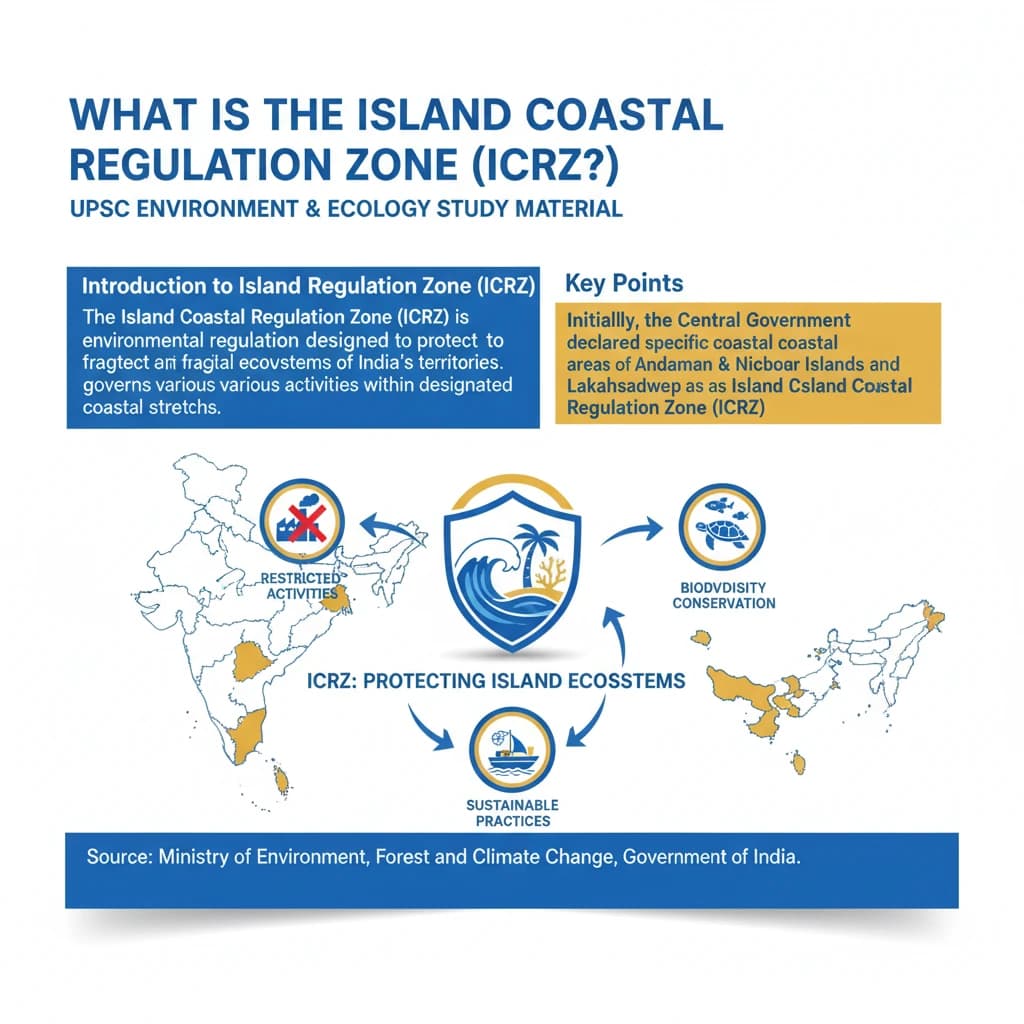
The Island Coastal Regulation Zone (ICRZ) is a critical environmental regulation designed to protect the fragile coastal ecosystems of India's island territories. It governs various activities within designated coastal stretches.
Initially, the Central Government declared specific coastal areas of the Andaman & Nicobar Islands and Lakshadweep as Island Protection Zone (IPZ) under the Environment Protection Act, 1986.
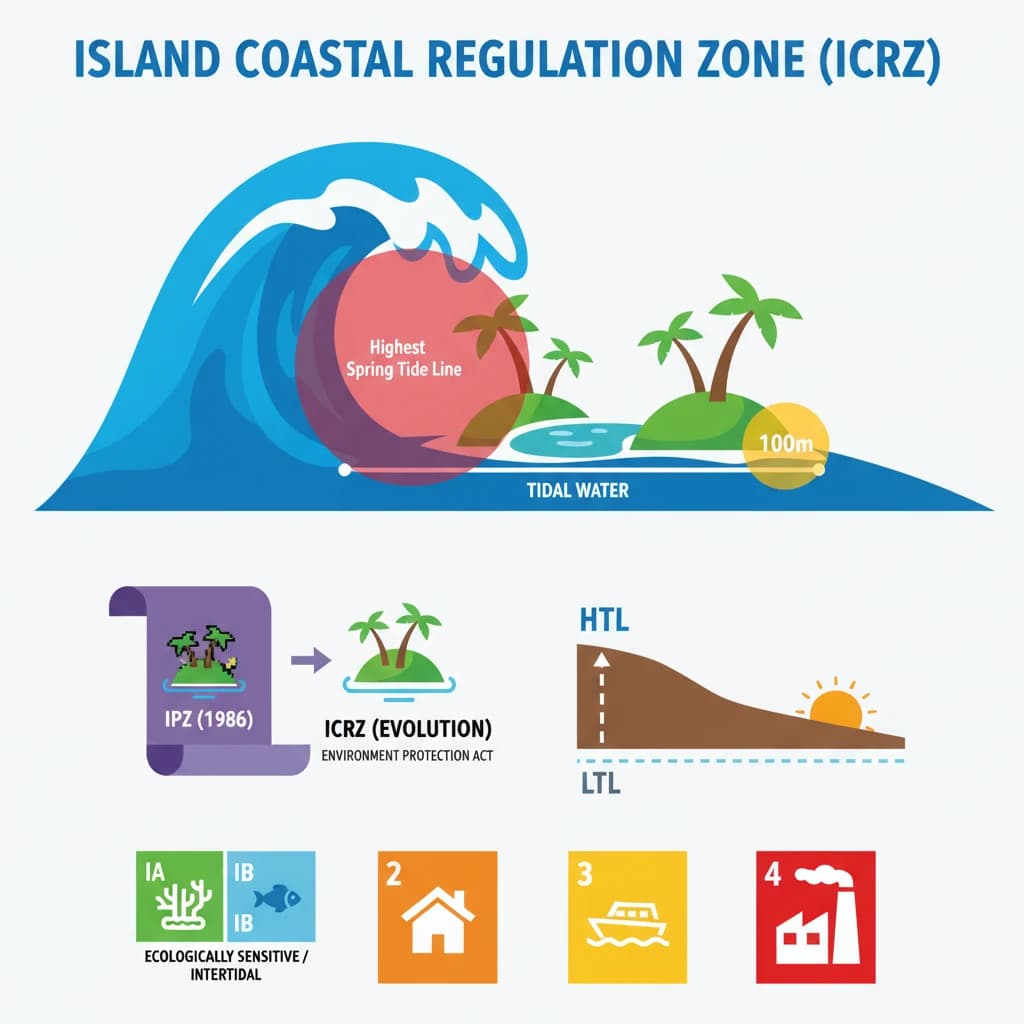
The ICRZ was established to regulate activities within 500 meters of the High Tide Line (HTL) and 100 meters along the banks of creeks, estuaries, backwaters, and rivers subject to tidal fluctuations.
Evolution from IPZ to ICRZ, 2011
Due to various representations from stakeholders, the Ministry of Environment, Forest and Climate Change (MoEF&CC) undertook a revision of the earlier IPZ Notification, 2011.
This revision led to the establishment of the comprehensive Island Coastal Regulation Zone (ICRZ), 2011, which superseded the previous IPZ regulations.
Defining High Tide Line (HTL) and Low Tide Line (LTL)
The High Tide Line (HTL) is defined as the line on the land up to which the highest water line reaches during the spring tide.
Conversely, the Low Tide Line (LTL) refers to the line on the land up to which the lowest water line reaches during the spring tide.
Categorization and Restrictions within ICRZ
The ICRZ is divided into four categories, and the notification imposes strict restrictions on setting up and expanding industries or processing plants within these zones.
The source material specifically details ICRZ-I, which encompasses both ecologically sensitive areas and the intertidal zone. Other categories (ICRZ-II, ICRZ-III, ICRZ-IV) exist within the broader framework but are not detailed in this summary.
- ICRZ-I: Ecologically Sensitive Areas and Areas between LTL and HTL
- ICRZ-IA: Ecologically Sensitive and Important Areas
This sub-category covers crucial natural habitats and heritage sites, where activities are highly restricted to preserve biodiversity and ecological balance.
These include: national parks/marine parks, sanctuaries, reserve forests, wild habitats, mangroves, corals/coral reefs, areas close to breeding and spawning grounds of fish, areas of outstanding natural beauty, historical and heritage areas, areas rich in genetic biodiversity, and areas likely to be inundated due to sea-level rise from global warming, along with any other areas declared by authorities.
- ICRZ-IB: Intertidal Zones
These are the areas located specifically between the Low Tide Line (LTL) and the High Tide Line (HTL).
In non-ecologically sensitive intertidal zones (between LTL and HTL), the following activities are permitted:
- Exploration and extraction of natural gas.
- Construction of basic amenities for traditional inhabitants living within the biosphere reserves.
- Salt harvesting by solar evaporation of seawater.
- Establishment of desalination plants.
- Storage of non-hazardous cargo, such as edible oil and fertilizers, within notified ports.
- ICRZ-IA: Ecologically Sensitive and Important Areas
💡 Key Takeaways
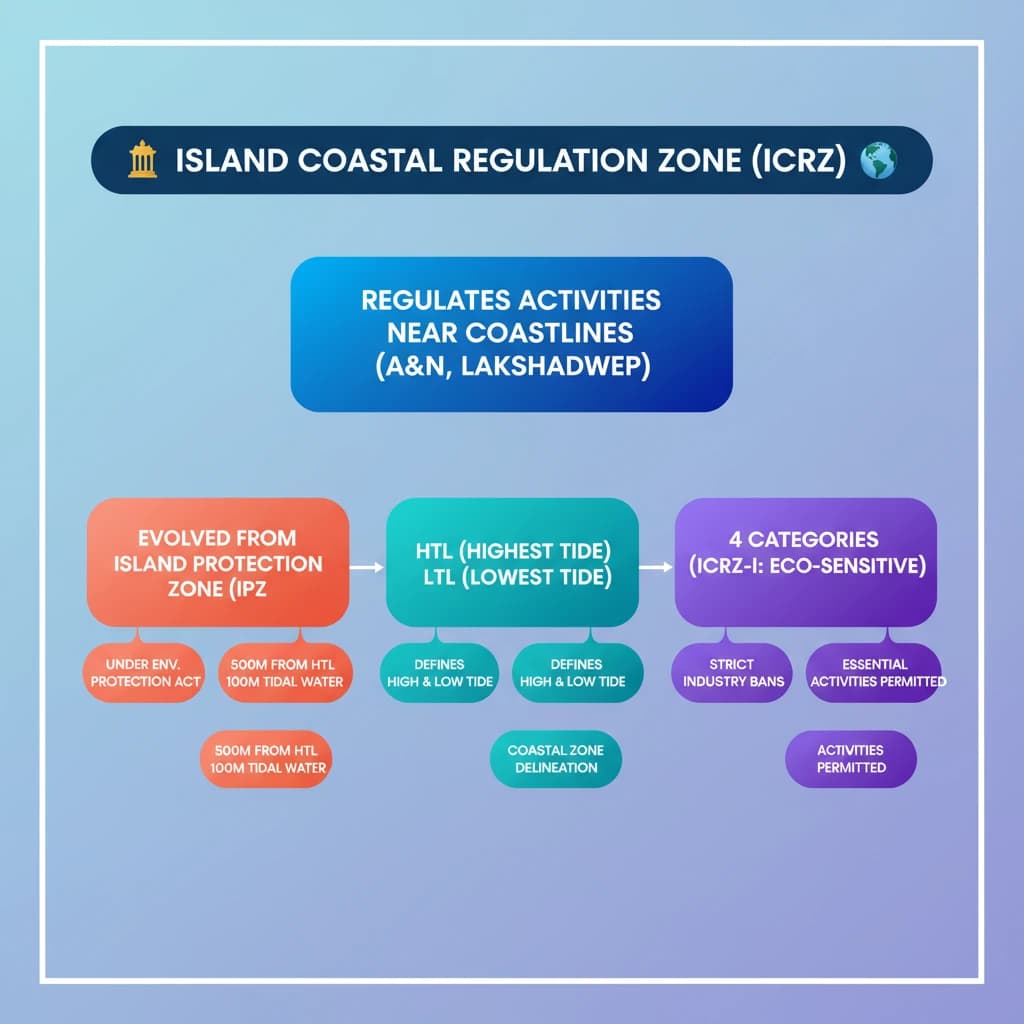
- •ICRZ regulates activities within 500m of HTL and 100m of tidal water bodies in Andaman & Nicobar and Lakshadweep.
- •It evolved from the earlier Island Protection Zone (IPZ) under the Environment Protection Act, 1986.
- •HTL is the highest spring tide line, LTL is the lowest spring tide line.
- •ICRZ is divided into four categories, with ICRZ-I (IA and IB) detailing ecologically sensitive and intertidal zones.
- •Strict restrictions apply to industries; specific essential activities are permitted in non-sensitive ICRZ-IB areas.
- •Crucial for biodiversity, climate resilience, and sustainable development of island ecosystems.
🧠 Memory Techniques
95% Verified Content
📚 Reference Sources
•Environment Protection Act, 1986
•Ministry of Environment, Forest and Climate Change (MoEF&CC) notifications on Coastal Regulation Zones