Loading page, please wait…
What is the Significance of Salt Pans? - UPSC Environment And Ecology
What is What is the Significance of Salt Pans? in UPSC Environment And Ecology?
What is the Significance of Salt Pans? is a key topic under Environment And Ecology for UPSC Civil Services Examination. Key points include: Salt pans are vital ecological barriers, mitigating coastal flooding.. They provide significant employment, especially in rural and coastal areas.. Salt from pans is a crucial raw material for chemical, agricultural, and water treatment industries.. Understanding this topic is essential for both UPSC Prelims and Mains preparation.
Why is What is the Significance of Salt Pans? important for UPSC exam?
What is the Significance of Salt Pans? is a Easy-level topic in UPSC Environment And Ecology. It is tested in both Prelims (factual MCQs) and Mains (analytical answer writing). Previous year UPSC questions have frequently covered aspects of What is the Significance of Salt Pans?, making it essential for comprehensive IAS preparation.
How to prepare What is the Significance of Salt Pans? for UPSC?
To prepare What is the Significance of Salt Pans? for UPSC: (1) Study the comprehensive notes covering all key concepts on Vaidra. (2) Practice previous year questions on this topic. (3) Connect it with current affairs using daily updates. (4) Revise using key takeaways and mind maps available for Environment And Ecology. (5) Write practice answers linking What is the Significance of Salt Pans? to related GS Paper topics.
Key takeaways of What is the Significance of Salt Pans? for UPSC
- Salt pans are vital ecological barriers, mitigating coastal flooding.
- They provide significant employment, especially in rural and coastal areas.
- Salt from pans is a crucial raw material for chemical, agricultural, and water treatment industries.
- Some salt pans are emerging tourist attractions, boosting local economies through ecotourism.
- Historically, salt production played a key role in India's economy and freedom struggle (Dandi March).
What is the Significance of Salt Pans?
Easy⏱️ 6 min read
environment and ecology
📖 Introduction
Introduction to Salt Pans
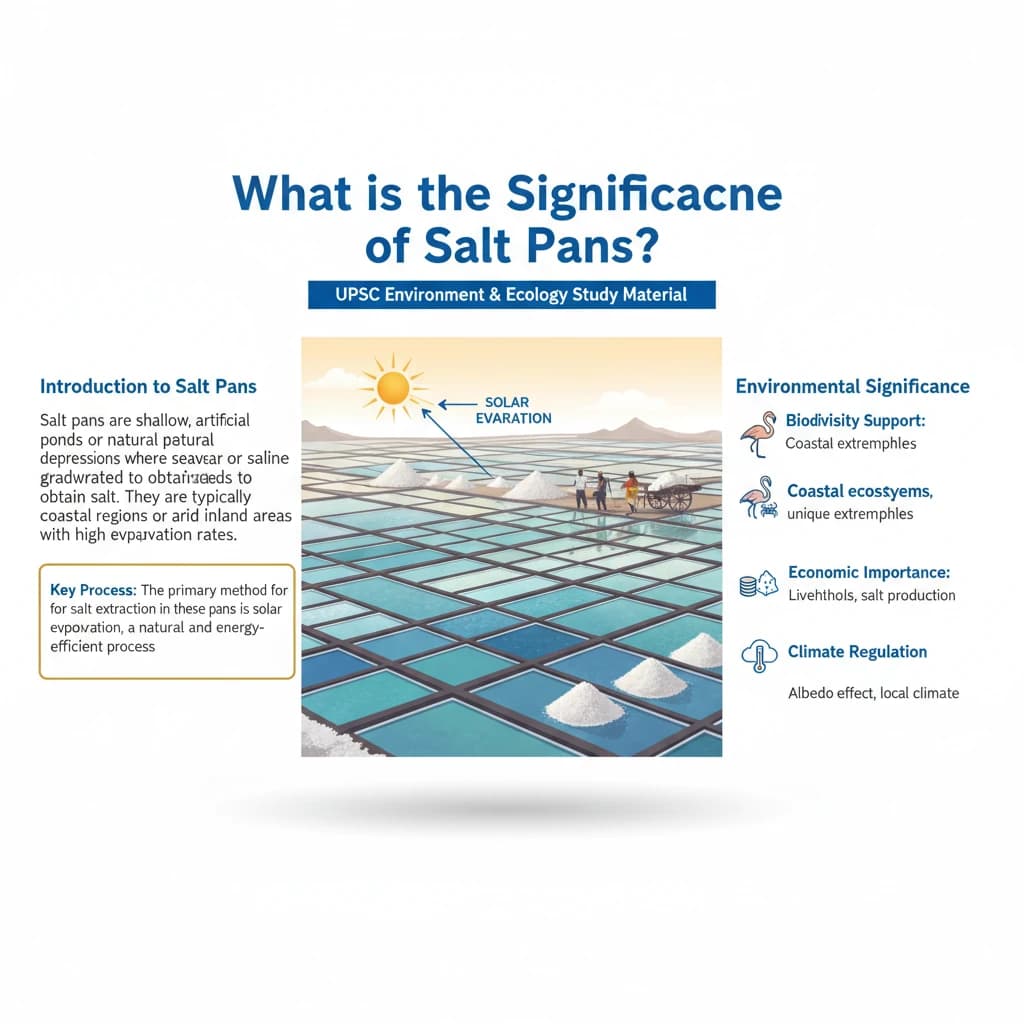
Salt pans are shallow, artificial ponds or natural depressions where seawater or saline groundwater is evaporated to obtain salt. They are typically found in coastal regions or arid inland areas with high evaporation rates.
Key Process: The primary method for salt extraction in these pans is solar evaporation, a natural and energy-efficient process.
Environmental Significance
Salt pans play a crucial role in maintaining coastal ecological balance. They are often found alongside mangroves and other coastal ecosystems.
Ecological Barrier: Alongside coastal mangroves, salt pans form a vital ecological barrier. This natural infrastructure helps in mitigating the risks associated with coastal flooding and erosion.
They act as buffer zones, absorbing excess water during high tides and storm surges, thereby protecting inland areas from inundation.
Economic Significance
Salt pans are significant contributors to local and regional economies, particularly in rural and coastal communities. They provide substantial employment opportunities.
A large number of workers are employed in various activities related to salt production. This includes harvesting, processing, and transporting the salt to markets and industries.
UPSC Relevance: The economic aspect highlights issues like rural employment, livelihood generation, and the informal sector, which are important for GS Paper 3 (Economy) and GS Paper 1 (Society).
Significance as Raw Material
The salt produced in salt pans is a fundamental raw material for a diverse range of industries. Its applications extend far beyond culinary use.
- Chemical Production: It is essential for the manufacture of critical chemicals like chlorine, caustic soda, and soda ash.
- Agriculture: Salt is used in agriculture, primarily as an ingredient in animal feed, providing essential minerals for livestock.
- Water Treatment: It plays a role in various water treatment processes, including water softening and desalination.
Tourism Attraction
Beyond their industrial and ecological roles, some salt pans have evolved into popular tourist destinations. Their unique landscapes and ecosystems attract visitors.
These sites contribute to the local economy through ecotourism and cultural tourism, offering unique experiences such as birdwatching, photography, and observing traditional salt-making practices.
Example: The Rann of Kutch in Gujarat, famous for its vast salt flats, is a prime example of a salt pan region that has become a major tourist attraction, especially during the Rann Utsav.
💡 Key Takeaways
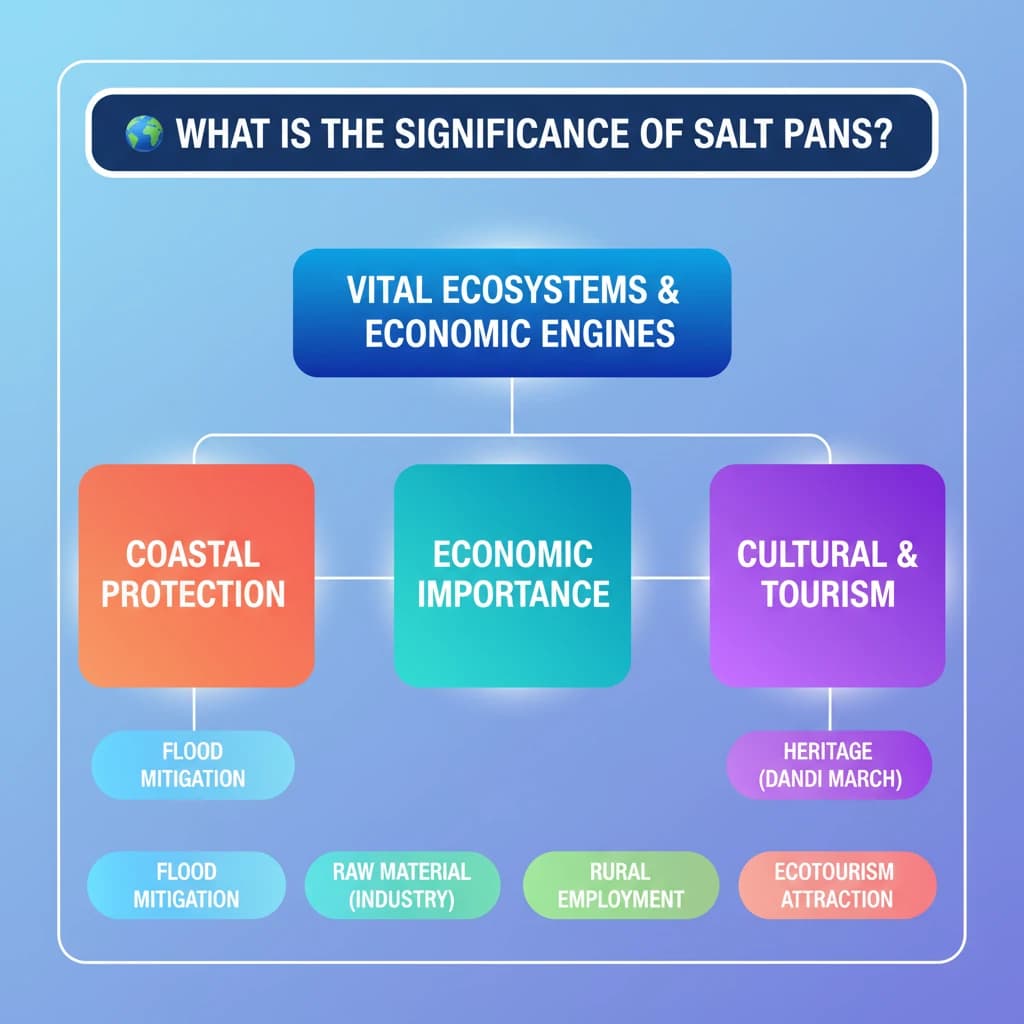
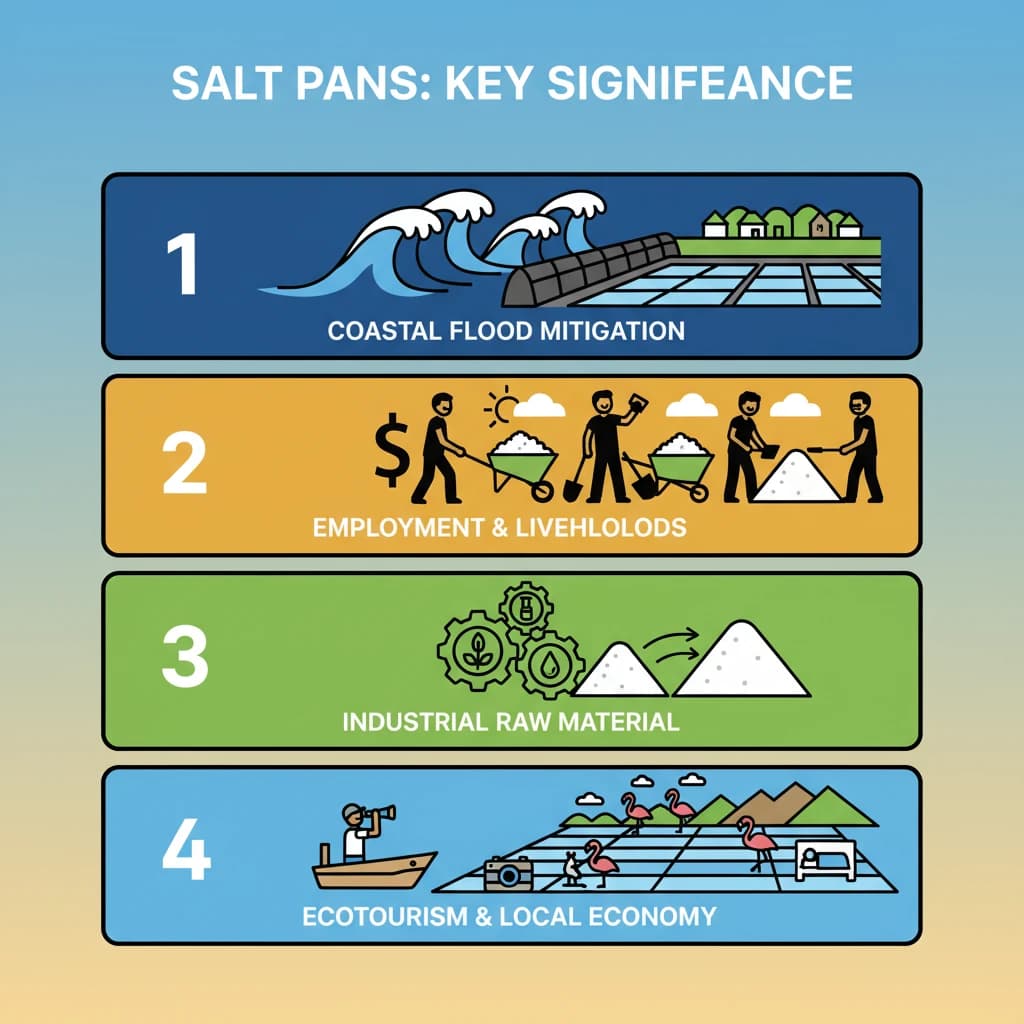
- •Salt pans are vital ecological barriers, mitigating coastal flooding.
- •They provide significant employment, especially in rural and coastal areas.
- •Salt from pans is a crucial raw material for chemical, agricultural, and water treatment industries.
- •Some salt pans are emerging tourist attractions, boosting local economies through ecotourism.
- •Historically, salt production played a key role in India's economy and freedom struggle (Dandi March).
🧠 Memory Techniques
95% Verified Content
📚 Reference Sources
•NCERT Geography Textbooks (Class 11, 12)
•Ministry of Commerce and Industry, Department of Industrial Policy & Promotion (DIPP) - Salt Section reports
•Ramsar Convention on Wetlands official site (for Sambhar Lake)
•Various environmental and economic reports on coastal ecosystems