Loading page, please wait…
Economic Significance of Deccan Volcanism - UPSC Geography
What is Economic Significance of Deccan Volcanism in UPSC Geography?
Economic Significance of Deccan Volcanism is a key topic under Geography for UPSC Civil Services Examination. Key points include: Deccan Volcanism primarily formed Basaltic rocks, leading to the Deccan Traps.. The region is rich in mineral resources like Iron ore (Karnataka) and Bauxite (Eastern Ghats).. Weathering of Basalt forms fertile Black soil, ideal for cotton and tobacco cultivation.. Understanding this topic is essential for both UPSC Prelims and Mains preparation.
Why is Economic Significance of Deccan Volcanism important for UPSC exam?
Economic Significance of Deccan Volcanism is a Medium-level topic in UPSC Geography. It is tested in both Prelims (factual MCQs) and Mains (analytical answer writing). Previous year UPSC questions have frequently covered aspects of Economic Significance of Deccan Volcanism, making it essential for comprehensive IAS preparation.
How to prepare Economic Significance of Deccan Volcanism for UPSC?
To prepare Economic Significance of Deccan Volcanism for UPSC: (1) Study the comprehensive notes covering all key concepts on Vaidra. (2) Practice previous year questions on this topic. (3) Connect it with current affairs using daily updates. (4) Revise using key takeaways and mind maps available for Geography. (5) Write practice answers linking Economic Significance of Deccan Volcanism to related GS Paper topics.
Key takeaways of Economic Significance of Deccan Volcanism for UPSC
- Deccan Volcanism primarily formed Basaltic rocks, leading to the Deccan Traps.
- The region is rich in mineral resources like Iron ore (Karnataka) and Bauxite (Eastern Ghats).
- Weathering of Basalt forms fertile Black soil, ideal for cotton and tobacco cultivation.
- Black soil is rich in iron, magnesium, calcium, and potassium, known for high moisture retention.
- The geological legacy profoundly impacts India's agricultural and industrial economy.
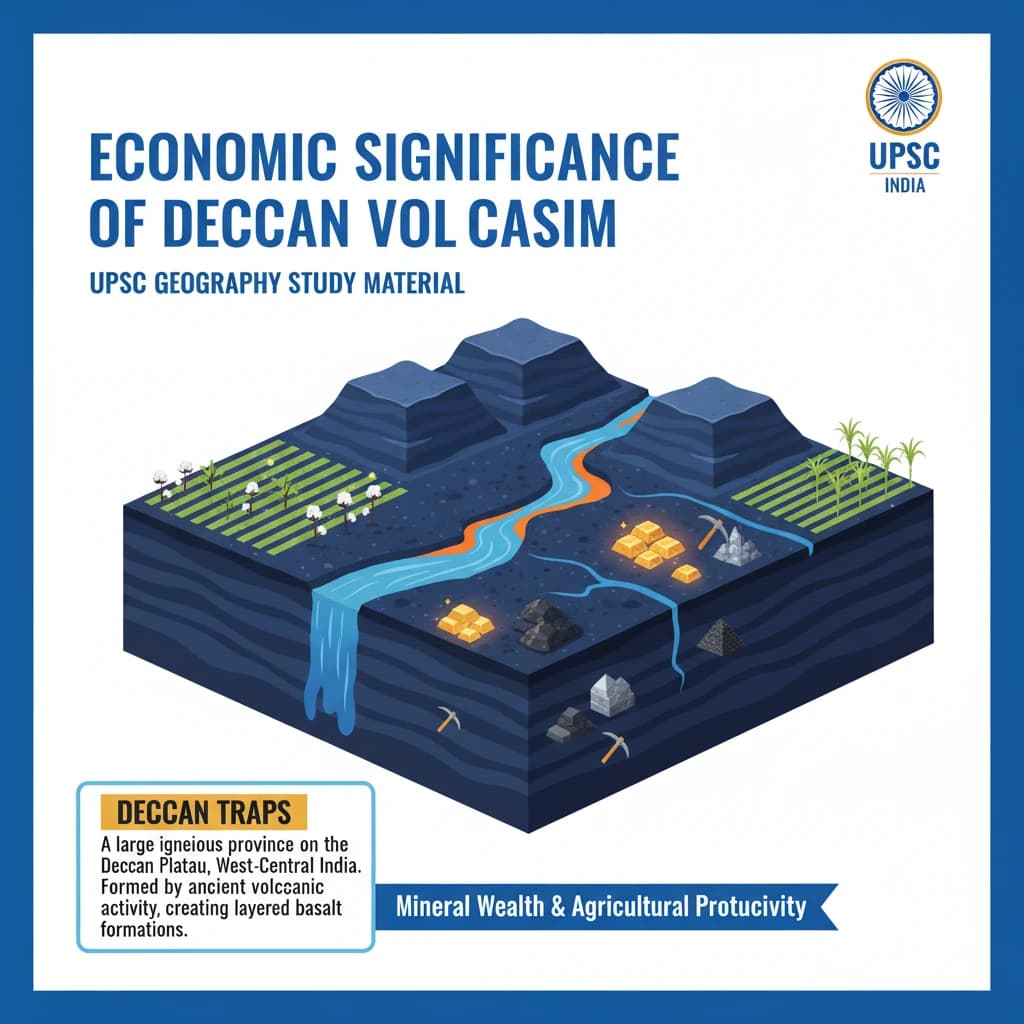
Economic Significance of Deccan Volcanism
Medium⏱️ 7 min read
geography
📖 Introduction
Introduction to Deccan Volcanism's Economic Impact
The Deccan Volcanism, primarily forming the Deccan Traps, has profoundly shaped the economic landscape of peninsular India. Its geological characteristics contribute significantly to both mineral wealth and agricultural productivity.
The Deccan Traps are a large igneous province located on the Deccan Plateau of west-central India. They are one of the largest volcanic features on Earth.
Major Rock Formations
The predominant rock type found in the Deccan Traps is Basalt. This igneous rock is crucial to the region's unique geological and soil characteristics.
Beyond the volcanic regions, other significant rock types like granite and gneiss are common in southern India, particularly in states such as Karnataka and Tamil Nadu.
- Basalt: Dominant in Deccan Traps, formed from rapidly cooling lava.
- Granite & Gneiss: Prevalent in southern India, especially Karnataka and Tamil Nadu, representing older crystalline rocks.
Rich Mineral Resources
The geological formations resulting from Deccan Volcanism and associated processes have led to significant mineral deposits. These are vital for India's industrial sector.
Iron ore is found in abundance, particularly in the state of Karnataka, making it a key contributor to the national steel industry.
Furthermore, significant deposits of bauxite, the primary ore for aluminum, are located in the Eastern Ghats region.
- Iron Ore: Abundant in Karnataka.
- Bauxite: Found in the Eastern Ghats.
Agricultural Significance: Black Soil
One of the most significant economic contributions of Deccan Volcanism is the formation of Black soil, also known as Regur soil. This soil type is highly fertile and supports specific cash crops.
The presence of Black soil makes the region ideal for cultivating crops such as cotton and tobacco, which are economically important.
Black soil is renowned for its high moisture retention capacity, making it suitable for rain-fed agriculture, especially for crops like cotton.
Formation and Composition of Black Soil
Black soil originates from the weathering of volcanic rocks, primarily basalt. This process releases a rich array of minerals into the soil.
The soil is particularly rich in essential minerals like iron, magnesium, calcium, and potassium, which contribute to its fertility and dark color.
Key minerals in Black soil: Iron, Magnesium, Calcium, Potassium. These elements are crucial for plant growth and agricultural productivity.
Understanding the link between Deccan Volcanism, Basalt, and Black soil formation is crucial for questions on Indian physical geography and agriculture in UPSC Prelims and Mains (GS Paper I).
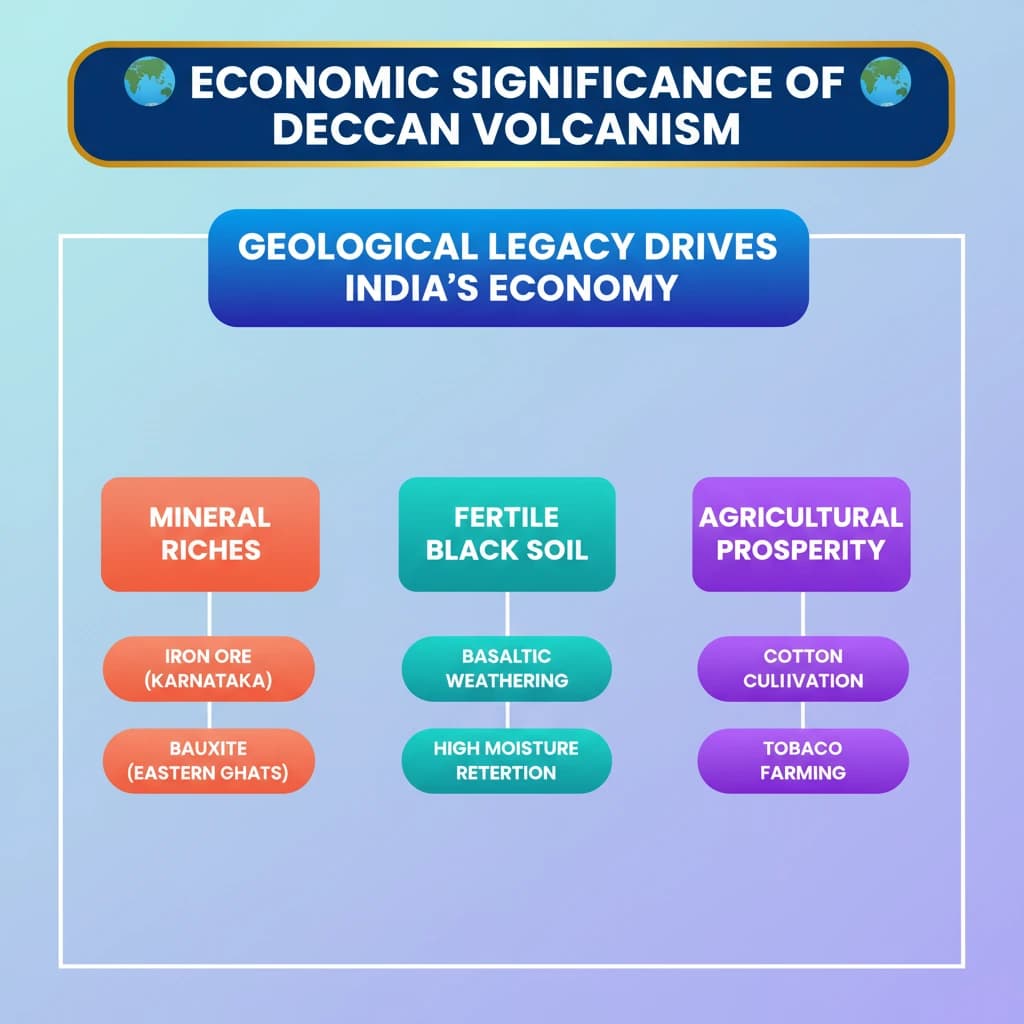
💡 Key Takeaways
- •Deccan Volcanism primarily formed Basaltic rocks, leading to the Deccan Traps.
- •The region is rich in mineral resources like Iron ore (Karnataka) and Bauxite (Eastern Ghats).
- •Weathering of Basalt forms fertile Black soil, ideal for cotton and tobacco cultivation.
- •Black soil is rich in iron, magnesium, calcium, and potassium, known for high moisture retention.
- •The geological legacy profoundly impacts India's agricultural and industrial economy.
🧠 Memory Techniques
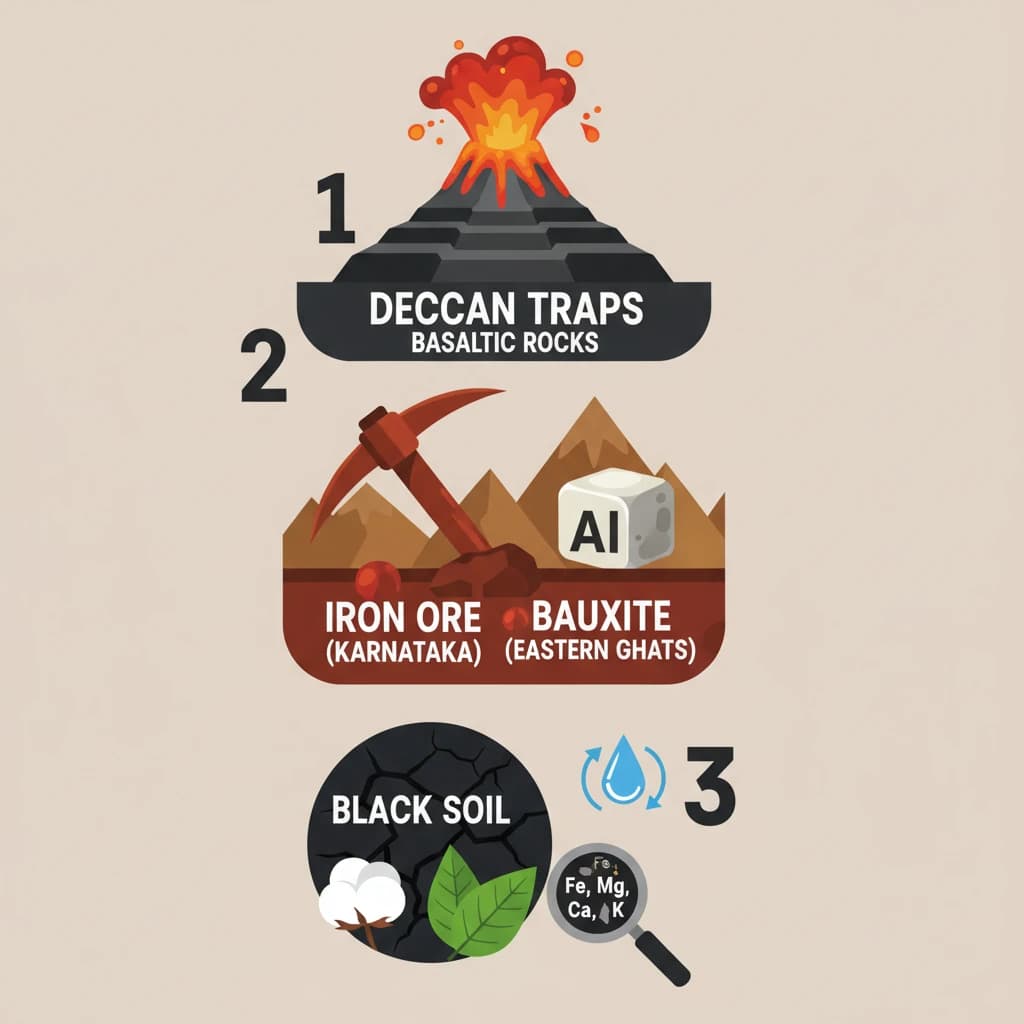
98% Verified Content
📚 Reference Sources
•NCERT Geography Textbooks (Class XI, 'Fundamentals of Physical Geography' & 'India: Physical Environment')
•Geological Survey of India (GSI) Publications
•Indian Council of Agricultural Research (ICAR) data on soils