Loading page, please wait…
Hydrothermal Vents in Indian Ocean - UPSC Geography
What is Hydrothermal Vents in Indian Ocean in UPSC Geography?
Hydrothermal Vents in Indian Ocean is a key topic under Geography for UPSC Civil Services Examination. Key points include: Hydrothermal vents are underwater hot springs near tectonic plates, expelling superheated, mineral-rich water.. They form when cold seawater percolates, heats up by magma, and re-emerges under high pressure (no boiling).. First discovered in 1977 near the Galapagos Islands, revolutionizing deep-sea biology.. Understanding this topic is essential for both UPSC Prelims and Mains preparation.
Why is Hydrothermal Vents in Indian Ocean important for UPSC exam?
Hydrothermal Vents in Indian Ocean is a Medium-level topic in UPSC Geography. It is tested in both Prelims (factual MCQs) and Mains (analytical answer writing). Previous year UPSC questions have frequently covered aspects of Hydrothermal Vents in Indian Ocean, making it essential for comprehensive IAS preparation.
How to prepare Hydrothermal Vents in Indian Ocean for UPSC?
To prepare Hydrothermal Vents in Indian Ocean for UPSC: (1) Study the comprehensive notes covering all key concepts on Vaidra. (2) Practice previous year questions on this topic. (3) Connect it with current affairs using daily updates. (4) Revise using key takeaways and mind maps available for Geography. (5) Write practice answers linking Hydrothermal Vents in Indian Ocean to related GS Paper topics.
Key takeaways of Hydrothermal Vents in Indian Ocean for UPSC
- Hydrothermal vents are underwater hot springs near tectonic plates, expelling superheated, mineral-rich water.
- They form when cold seawater percolates, heats up by magma, and re-emerges under high pressure (no boiling).
- First discovered in 1977 near the Galapagos Islands, revolutionizing deep-sea biology.
- India's Deep Ocean Mission recently imaged an active vent at 4,500m in the Indian Ocean, enhancing mineral exploration and Samudraayan.
- Vents host unique chemosynthetic ecosystems and are significant sources of polymetallic sulfide deposits.
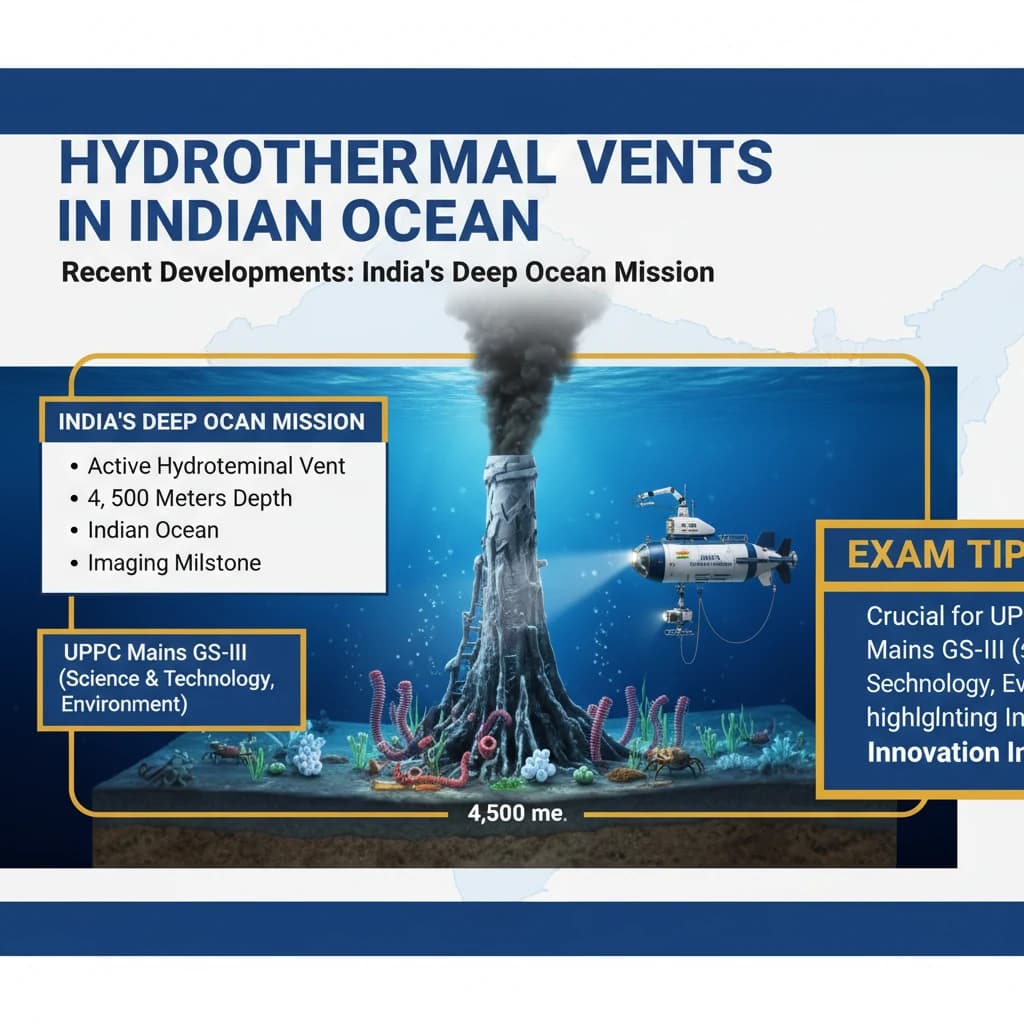
Hydrothermal Vents in Indian Ocean
Medium⏱️ 8 min read
geography
📖 Introduction
Recent Developments: India's Deep Ocean Mission
India has recently achieved a significant milestone through its Deep Ocean Mission. This involves imaging an active hydrothermal vent located at an impressive depth of 4,500 meters beneath the surface of the Indian Ocean.
This development is crucial for UPSC Mains GS-III (Science & Technology, Environment), highlighting India's growing capabilities in deep-sea exploration and its strategic implications.
This breakthrough is set to significantly enhance India’s efforts in mineral exploration and advanced deep-sea research. It holds substantial potential for the ongoing Samudraayan mission and future oceanic exploration initiatives.
Understanding Hydrothermal Vents
Hydrothermal vents are unique geological features found on the ocean floor. They are essentially underwater hot springs that expel superheated water and minerals.
These vents are typically located in areas of intense geological activity, primarily near tectonic plate boundaries. They represent a direct link between the Earth's interior and the ocean.
Definition of Hydrothermal Vents
Definition: Hydrothermal vents are fissures in the Earth's surface, typically found near tectonic plates, from which geothermally heated water and dissolved minerals emerge into the ocean.
Discovery of Hydrothermal Vents
The existence of hydrothermal vents was first scientifically confirmed in 1977. This landmark discovery occurred near the Galapagos Islands, off the coast of Ecuador.
Formation Process of Hydrothermal Vents
The formation of hydrothermal vents begins with seawater percolation. Cold ocean water seeps down through cracks and fissures in the oceanic crust.
These fissures typically form in regions where tectonic plates are either spreading apart (spreading ridges) or moving towards one another (subduction zones).
As the cold seabed water, which is approximately 2°C, descends, it comes into direct contact with extremely hot magma beneath the Earth's crust. This interaction causes the water to heat up dramatically, reaching temperatures as high as 370°C.
Despite reaching temperatures over 700°F (370°C), the water expelled from hydrothermal vents does not boil. This is due to the immense high pressure exerted by the vast amount of water at such extreme depths.
The superheated, mineral-rich seawater then reemerges from the ocean floor. This expulsion of hot fluids forms the distinctive structures known as hydrothermal vents.
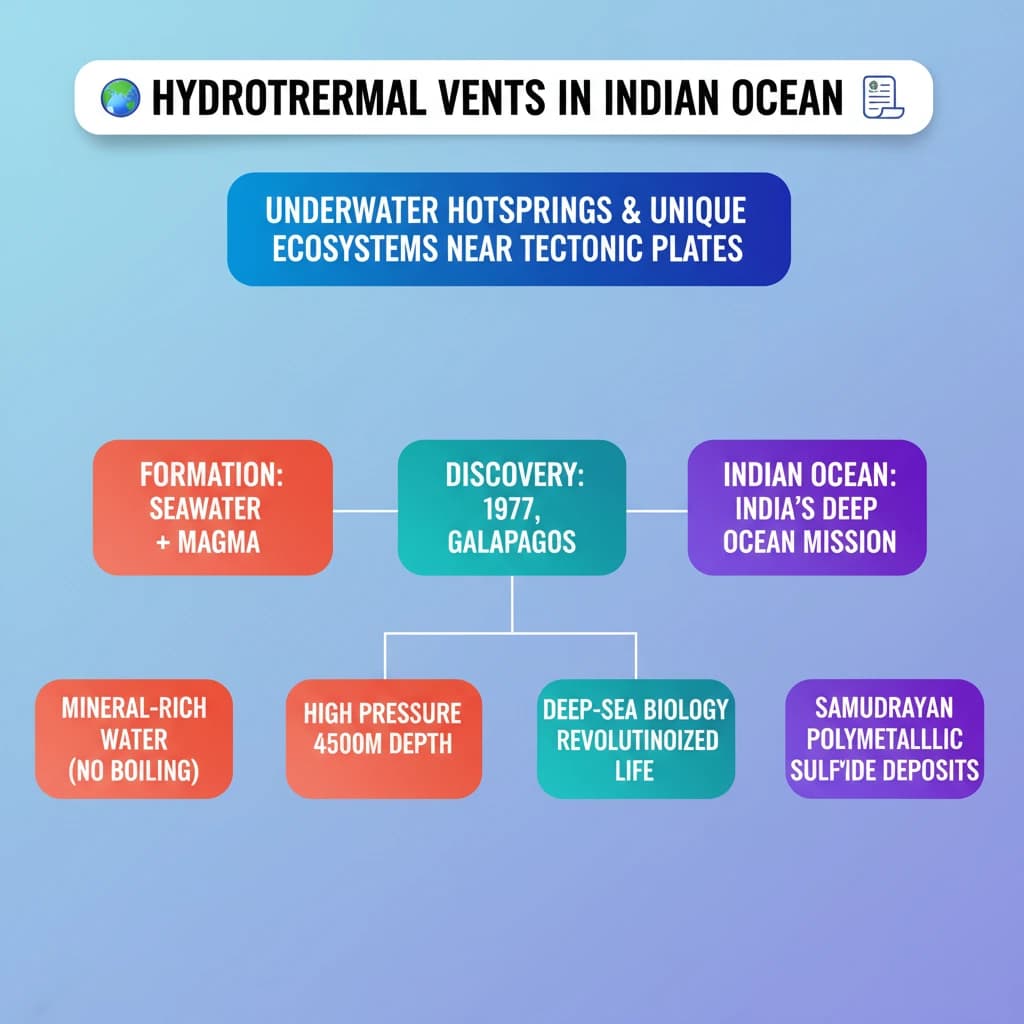
💡 Key Takeaways
- •Hydrothermal vents are underwater hot springs near tectonic plates, expelling superheated, mineral-rich water.
- •They form when cold seawater percolates, heats up by magma, and re-emerges under high pressure (no boiling).
- •First discovered in 1977 near the Galapagos Islands, revolutionizing deep-sea biology.
- •India's Deep Ocean Mission recently imaged an active vent at 4,500m in the Indian Ocean, enhancing mineral exploration and Samudraayan.
- •Vents host unique chemosynthetic ecosystems and are significant sources of polymetallic sulfide deposits.
🧠 Memory Techniques
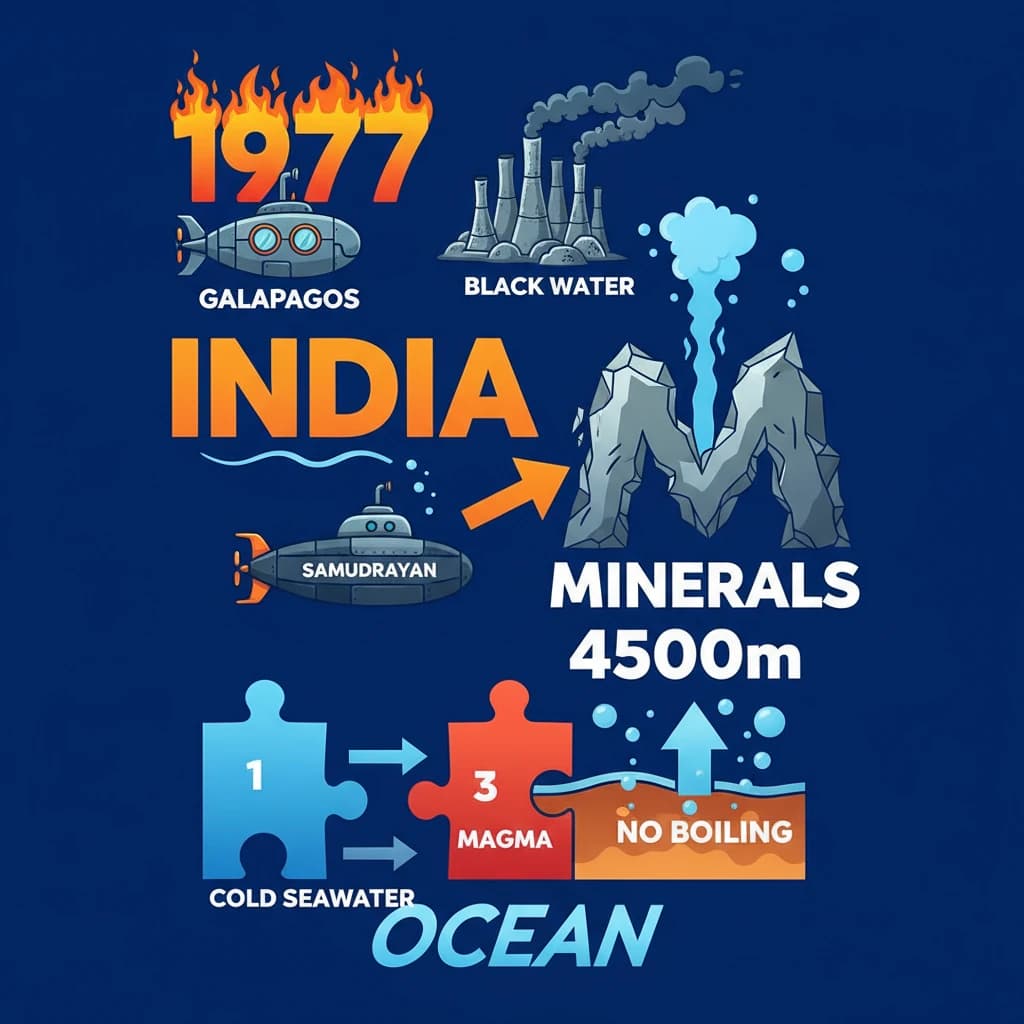
98% Verified Content
📚 Reference Sources
•National Oceanic and Atmospheric Administration (NOAA) - Ocean Explorer
•Woods Hole Oceanographic Institution (WHOI) - Deep Sea Vents
•Geological Survey of India (GSI) - Deep Ocean Mission related reports