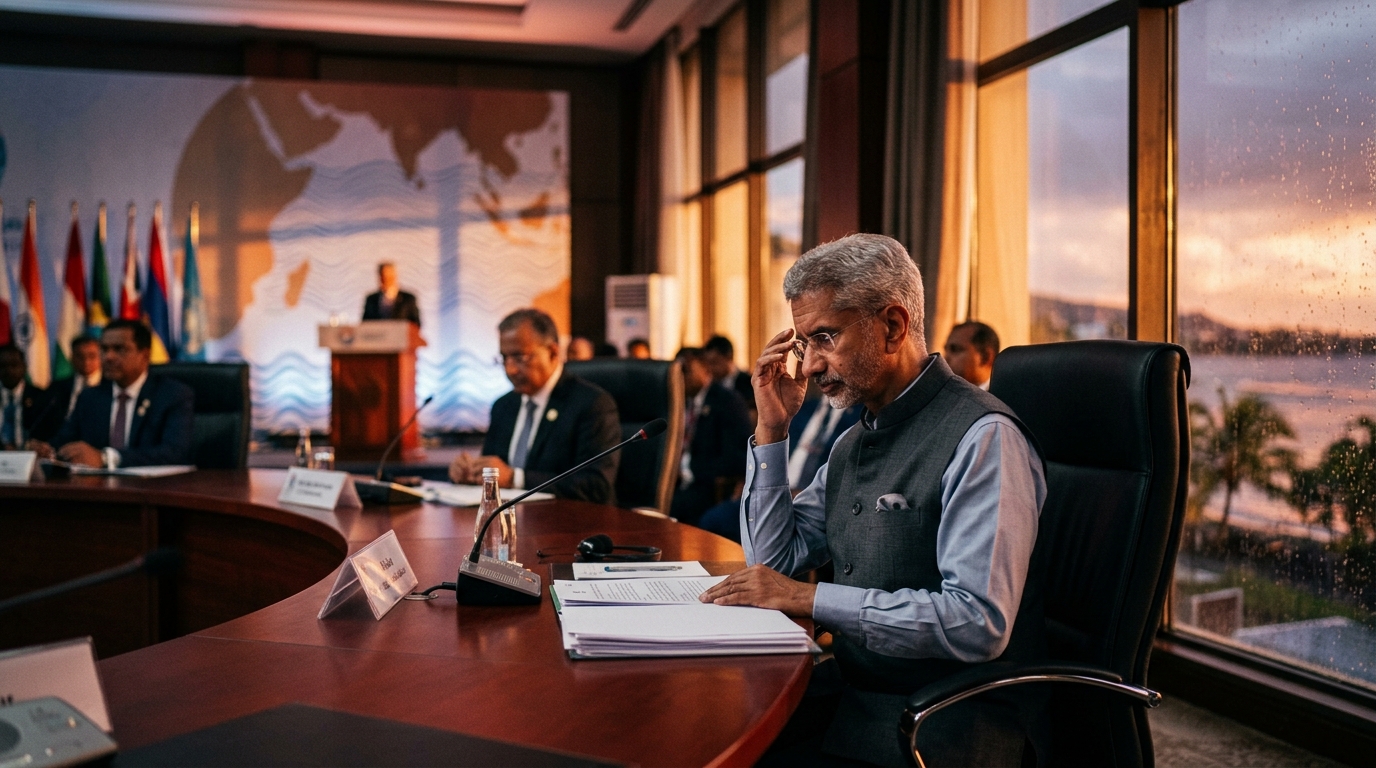
<p><strong>External Affairs Minister <span class="key-term" data-definition="S. Jaishankar — India's External Affairs Minister, responsible for foreign policy and diplomatic engagements (GS2: Polity)">S. Jaishankar</span></strong> used the inauguration of the <span class="key-term" data-definition="Indian Ocean Conference — A biennial diplomatic gathering of Indian Ocean littoral states to discuss regional security, trade, and maritime cooperation (GS2: Polity)">Indian Ocean Conference</span> in Port Louis to voice India's firm opposition to the targeting of civilians and infrastructure, as well as the <span class="key-term" data-definition="navigation disruption — Interruption of commercial shipping lanes, impacting trade and energy supplies (GS3: Economy)">navigation disruption</span> caused by the ongoing <span class="key-term" data-definition="West Asia war — The ongoing armed conflict in the Middle East affecting regional stability and maritime routes (GS1: History; GS2: Polity)">West Asia war</span>. The statement came amid heightened diplomatic activity and travel cancellations linked to the conflict.</p>
<h3>Key Developments</h3>
<ul>
<li>Jaishankar inaugurated the 9th <span class="key-term" data-definition="Indian Ocean Conference — A biennial diplomatic gathering of Indian Ocean littoral states to discuss regional security, trade, and maritime cooperation (GS2: Polity)">Indian Ocean Conference</span> on <strong>April 11, 2026</strong> in Mauritius.</li>
<li>He condemned the <span class="key-term" data-definition="targeting of civilians and infrastructure — Deliberate attacks on non‑combatants and critical assets, violating international humanitarian law (GS2: Polity)">targeting of civilians and infrastructure</span> in the <span class="key-term" data-definition="West Asia war — The ongoing armed conflict in the Middle East affecting regional stability and maritime routes (GS1: History; GS2: Polity)">West Asia war</span>.</li>
<li>Delegates from several Gulf nations, including <span class="key-term" data-definition="Gulf countries — Nations bordering the Persian Gulf, including Saudi Arabia and the United Arab Emirates, significant for India's energy security and trade (GS3: Economy)">Saudi Arabia</span> and the United Arab Emirates, attended the conference.</li>
<li>Numerous participants cancelled their travel due to security concerns; the <strong>Maldives</strong> sent no delegation because diplomatic ties with Mauritius remain suspended over the <span class="key-term" data-definition="Chagos Islands dispute — A territorial disagreement between India, Mauritius, and the Maldives over sovereignty of the Chagos archipelago, affecting diplomatic ties (GS2: Polity)">Chagos Islands</span> dispute.</li>
<li>Jaishankar concluded his Mauritius visit on <strong>April 10, 2026</strong> and departed for the United Arab Emirates the same night.</li>
</ul>
<h3>Important Facts</h3>
<ul>
<li>India’s stance aligns with its long‑standing policy of upholding international humanitarian law.</li>
<li>The conference, originally intended to boost maritime cooperation, was overshadowed by the conflict and diplomatic tensions.</li>
<li>Travel disruptions affected not only participants but also regional trade routes, underscoring the strategic importance of the Indian Ocean.</li>
<li>The suspension of diplomatic ties between Mauritius and the Maldives reflects how territorial disputes (e.g., over the <span class="key-term" data-definition="Chagos Islands dispute — A territorial disagreement between India, Mauritius, and the Maldives over sovereignty of the Chagos archipelago, affecting diplomatic ties (GS2: Polity)">Chagos Islands</span>) can spill over into multilateral forums.</li>
</ul>
<h3>UPSC Relevance</h3>
<p>Understanding India's diplomatic response to the <span class="key-term" data-definition="West Asia war — The ongoing armed conflict in the Middle East affecting regional stability and maritime routes (GS1: History; GS2: Polity)">West Asia war</span> is crucial for GS2 (International Relations) and GS3 (Maritime Economy). The <span class="key-term" data-definition="Indian Ocean Conference — A biennial diplomatic gathering of Indian Ocean littoral states to discuss regional security, trade, and maritime cooperation (GS2: Polity)">Indian Ocean Conference</span> illustrates India's role in regional security architecture, while the <span class="key-term" data-definition="Chagos Islands dispute — A territorial disagreement between India, Mauritius, and the Maldives over sovereignty of the Chagos archipelago, affecting diplomatic ties (GS2: Polity)">Chagos Islands</span> issue highlights the interplay of territorial sovereignty and diplomatic relations.</p>
<h3>Way Forward</h3>
<ul>
<li>India is likely to continue advocating for the protection of civilians and the free flow of maritime traffic in international forums.</li>
<li>Strengthening cooperation among Indian Ocean littoral states can mitigate the impact of external conflicts on regional trade.</li>
<li>Diplomatic engagement to resolve the <span class="key-term" data-definition="Chagos Islands dispute — A territorial disagreement between India, Mauritius, and the Maldives over sovereignty of the Chagos archipelago, affecting diplomatic ties (GS2: Polity)">Chagos Islands</span> dispute may restore full participation of all island nations in future conferences.</li>
<li>Monitoring the security situation in the <span class="key-term" data-definition="West Asia war — The ongoing armed conflict in the Middle East affecting regional stability and maritime routes (GS1: History; GS2: Polity)">West Asia region</span> will be essential for safeguarding India’s maritime interests.</li>
</ul>