Loading page, please wait…
Keeping the Boulders - UPSC Geography
What is Keeping the Boulders in UPSC Geography?
Keeping the Boulders is a key topic under Geography for UPSC Civil Services Examination. Key points include: Boulders at the base of hills provide crucial 'toe support'.. Toe support is essential for maintaining overall slope stability.. Removing these boulders destabilizes the slope by eliminating natural resistance.. Understanding this topic is essential for both UPSC Prelims and Mains preparation.
Why is Keeping the Boulders important for UPSC exam?
Keeping the Boulders is a Medium-level topic in UPSC Geography. It is tested in both Prelims (factual MCQs) and Mains (analytical answer writing). Previous year UPSC questions have frequently covered aspects of Keeping the Boulders, making it essential for comprehensive IAS preparation.
How to prepare Keeping the Boulders for UPSC?
To prepare Keeping the Boulders for UPSC: (1) Study the comprehensive notes covering all key concepts on Vaidra. (2) Practice previous year questions on this topic. (3) Connect it with current affairs using daily updates. (4) Revise using key takeaways and mind maps available for Geography. (5) Write practice answers linking Keeping the Boulders to related GS Paper topics.
Key takeaways of Keeping the Boulders for UPSC
- Boulders at the base of hills provide crucial 'toe support'.
- Toe support is essential for maintaining overall slope stability.
- Removing these boulders destabilizes the slope by eliminating natural resistance.
- Such removal significantly increases the risk and possibility of landslides.
- Preserving natural toe support is a fundamental principle of landslide prevention and disaster management.
Keeping the Boulders
Medium⏱️ 7 min read
geography
📖 Introduction
Understanding Landslides and Slope Stability
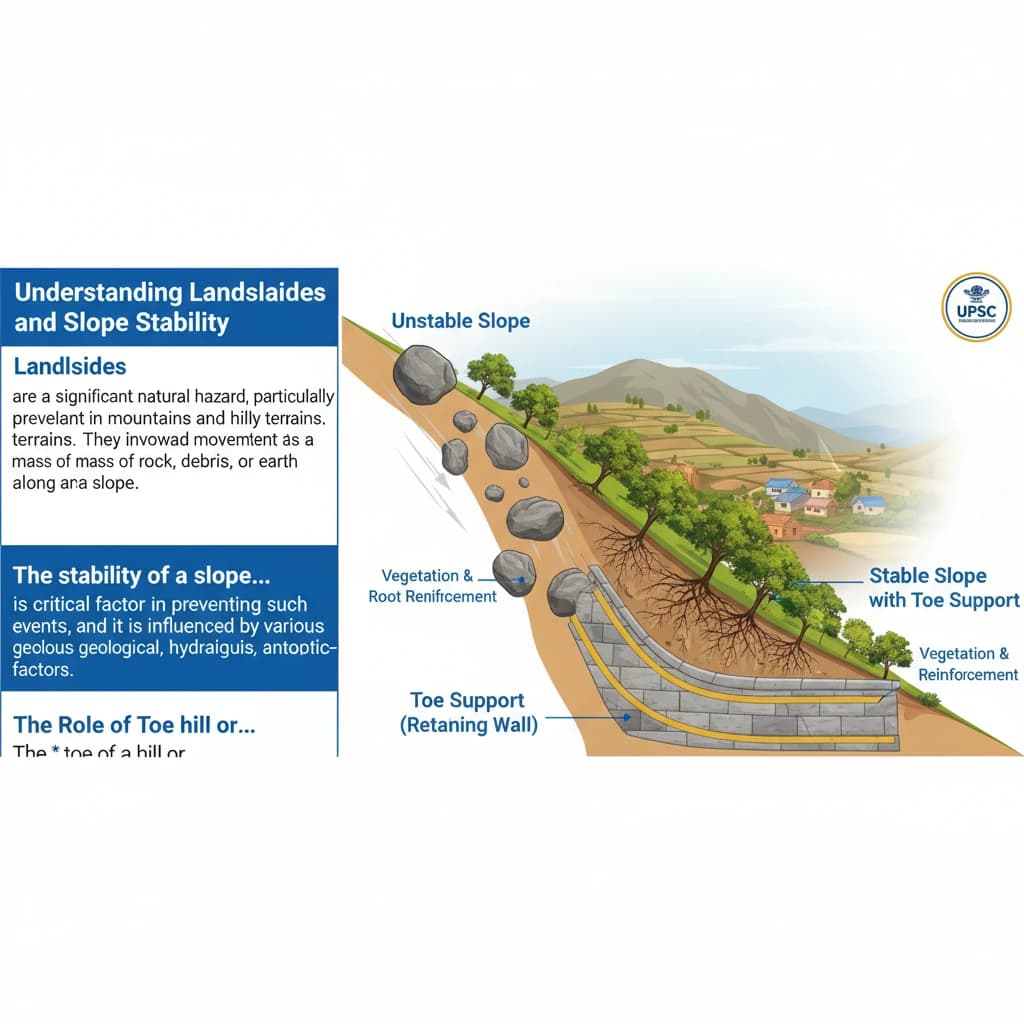
Landslides are a significant natural hazard, particularly prevalent in mountainous and hilly terrains. They involve the downward movement of a mass of rock, debris, or earth along a slope.
The stability of a slope is a critical factor in preventing such events, and it is influenced by various geological, hydrological, and anthropogenic factors.
The Role of Toe Support
The toe of a hill refers to the lowest part or the base of a slope. This section is fundamental in maintaining the overall stability of the entire slope above it.
Toe support is defined as the resistance offered by the material at the base of a slope against the downward or outward movement of the overlying slope material. It acts as a natural buttress.
This support counteracts the gravitational forces that constantly pull the slope material downwards, ensuring the structural integrity of the hillside.
Why Boulders are Essential for Slope Stability
In many regions susceptible to landslides, large stones and boulders naturally accumulate at the base of hills. These natural formations are not merely loose debris; they serve a vital geological function.
These boulders act as a natural barrier, providing crucial toe support. They prevent the outward bulging, spreading, or sliding of the overlying soil and rock mass, thereby significantly contributing to slope stability.
Consequences of Removing Toe Support
The deliberate or accidental removal of these natural fortifications, such as stones and boulders from the bottom of a hill, directly compromises its inherent toe support.
This action reduces the critical resistance at the base of the slope, making the entire hillside inherently unstable. Consequently, it drastically increases the possibility of landslides.
Key Principle: It is imperative to avoid removing natural toe support (e.g., large boulders, consolidated earth) from the base of landslide-prone slopes, as this action fundamentally destabilizes the slope and significantly escalates landslide risk.
UPSC Insight: This concept is crucial for understanding Disaster Management (GS-III), Physical Geography (GS-I), and Environmental Impact Assessment (GS-III). It highlights how seemingly minor human interventions can have profound environmental and disaster-related consequences.
💡 Key Takeaways
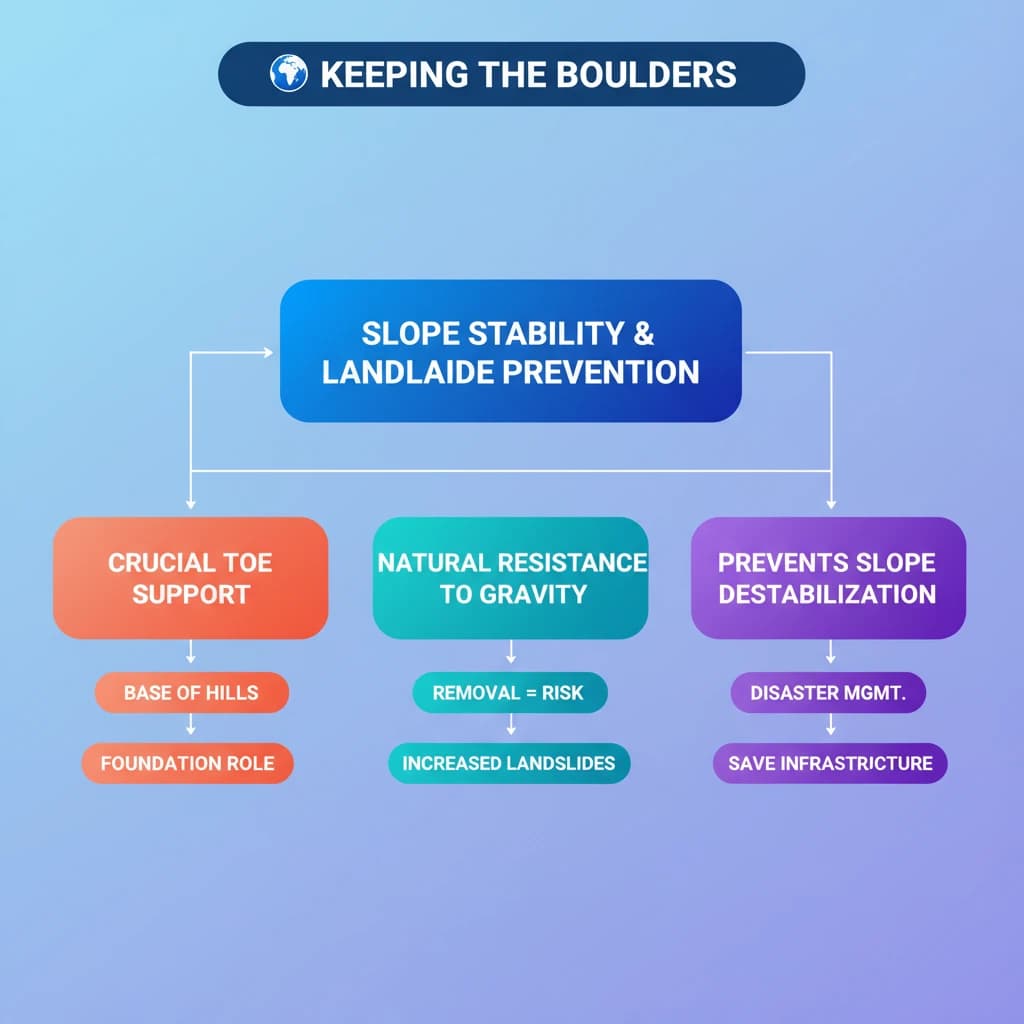
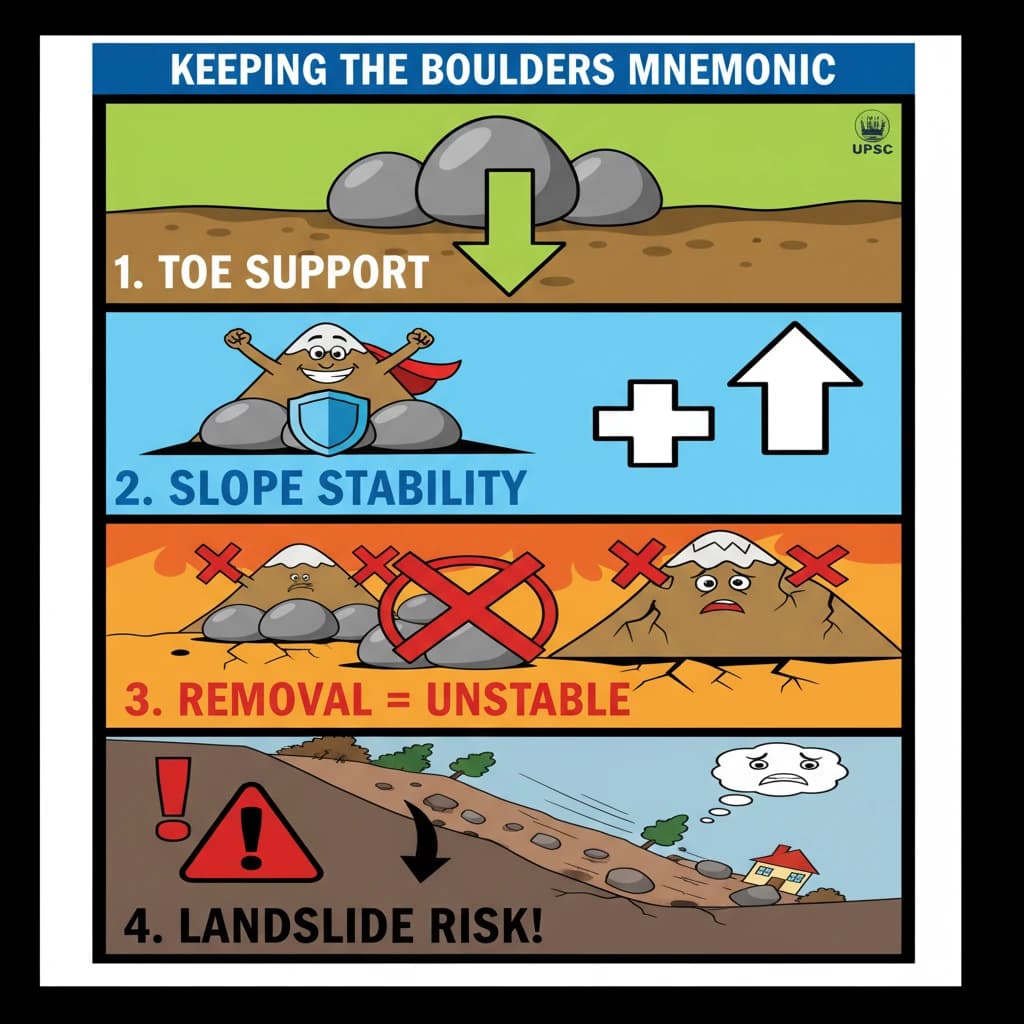
- •Boulders at the base of hills provide crucial 'toe support'.
- •Toe support is essential for maintaining overall slope stability.
- •Removing these boulders destabilizes the slope by eliminating natural resistance.
- •Such removal significantly increases the risk and possibility of landslides.
- •Preserving natural toe support is a fundamental principle of landslide prevention and disaster management.
🧠 Memory Techniques
98% Verified Content
📚 Reference Sources
•National Disaster Management Authority (NDMA) guidelines on Landslide Management
•Basic principles of Geotechnical Engineering and Soil Mechanics