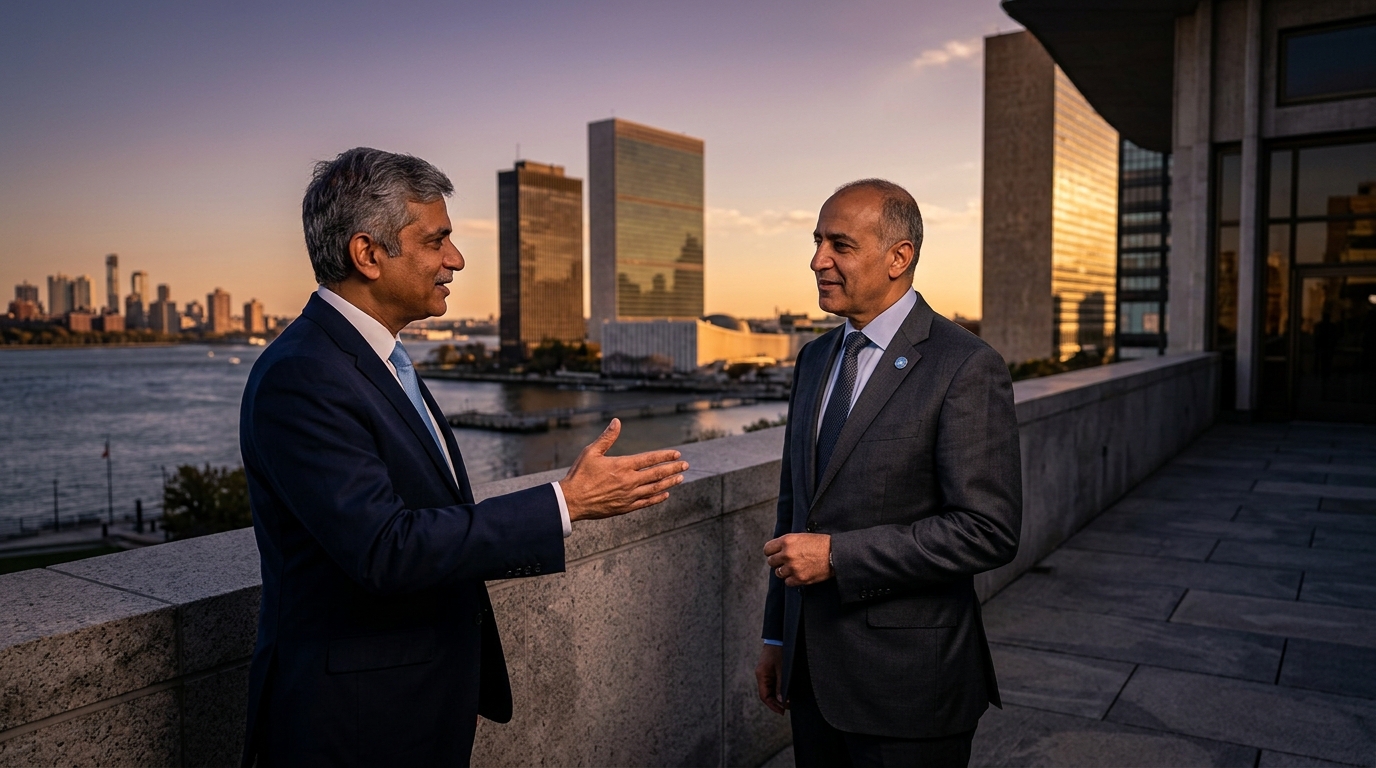
<p>Senior officials from India and the United Nations convened in New York to discuss the future of <span class="key-term" data-definition="United Nations peacekeeping – deployment of UN troops and civilian staff to conflict zones to maintain peace and security; a key instrument of multilateral diplomacy (GS2: International Relations)">peacekeeping</span> operations. The meeting, held on <strong>21 April 2026</strong>, underscores India’s growing role in global security architecture and the importance of bilateral coordination with the UN.</p>
<h3>Key Developments</h3>
<ul>
<li><strong>Participants:</strong> <span class="key-term" data-definition="Sibi George – Secretary (West) in the Ministry of External Affairs, responsible for overseeing India’s diplomatic engagements with the Western world (GS2: Polity)">Sibi George</span> represented the <span class="key-term" data-definition="Permanent Mission of India to the United Nations – India's diplomatic delegation in New York, tasked with advancing India’s interests at the UN (GS2: Polity)">Permanent Mission of India to the United Nations</span>. He met <span class="key-term" data-definition="Khaled Khiari – Assistant Secretary‑General for West Asia, Asia and the Pacific, a senior UN official overseeing political and peacebuilding affairs in the region (GS2: International Relations)">Khaled Khiari</span>, who heads the <span class="key-term" data-definition="Department of Political and Peacebuilding Affairs – UN body that coordinates political missions, peacebuilding and conflict prevention (GS2: International Relations)">Department of Political and Peacebuilding Affairs</span> and the <span class="key-term" data-definition="Department of Peace Operations – UN division that plans, manages and supports peacekeeping missions worldwide (GS2: International Relations)">Department of Peace Operations</span>.</li>
<li><strong>Agenda:</strong> Review of ongoing UN peacekeeping missions, assessment of India’s contributions, and discussion on enhancing cooperation in the West Asia, Asia and Pacific regions.</li>
<li><strong>Outcome:</strong> Both sides expressed commitment to deepen collaboration, with India seeking greater involvement in decision‑making forums and the UN emphasizing the need for timely troop contributions.</li>
</ul>
<h3>Important Facts</h3>
<p>India is currently the second‑largest troop‑contributing country to UN peacekeeping, with over <strong>8,000 personnel</strong> deployed across various missions. The meeting highlighted the strategic importance of the <span class="key-term" data-definition="Ministry of External Affairs (MEA) – India's foreign ministry responsible for diplomatic relations, international negotiations and policy formulation (GS2: Polity)">MEA</span> in shaping India’s multilateral engagements. It also noted that the UN’s peacekeeping budget for 2026‑2027 is projected at <strong>US$10.5 billion</strong>, underscoring the financial dimension of sustained contributions.</p>
<h3>UPSC Relevance</h3>
<p>Understanding the dynamics of <span class="key-term" data-definition="United Nations peacekeeping – a tool of collective security that reflects the principles of the UN Charter; relevant for GS2 and GS3 questions on international security and defence spending)">peacekeeping</span> is essential for GS2 (International Relations) and GS3 (Defence) papers. The role of the <span class="key-term" data-definition="Permanent Mission of India to the United Nations – a key diplomatic institution that interfaces with UN bodies, useful for questions on India’s foreign policy apparatus (GS2: Polity)">Permanent Mission</span> and the <span class="key-term" data-definition="Ministry of External Affairs – the apex body for India’s external relations, often featured in polity and foreign policy topics (GS2: Polity)">MEA</span> illustrates how India projects its strategic interests on global platforms. Moreover, the interaction with senior UN officials like the <span class="key-term" data-definition="Assistant Secretary‑General – a senior UN official who assists the Secretary‑General in managing specific departments; relevant for understanding UN hierarchy (GS2: International Relations)">Assistant Secretary‑General</span> provides insight into the workings of multilateral institutions.</p>
<h3>Way Forward</h3>
<p>Both parties agreed to institutionalise regular dialogues, explore joint training programmes for peacekeepers, and consider India’s proposal for a greater voice in the UN’s peacekeeping decision‑making bodies. For aspirants, tracking subsequent developments—such as any policy revisions in the <span class="key-term" data-definition="UN peacekeeping reforms – ongoing efforts to improve operational efficiency, troop readiness and accountability (GS2: International Relations)">peacekeeping framework</span>—will be crucial for answering current affairs questions in the UPSC exam.</p>