Loading page, please wait…
Key Facts About Ken and Betwa Rivers - UPSC Geography
What is Key Facts About Ken and Betwa Rivers in UPSC Geography?
Key Facts About Ken and Betwa Rivers is a key topic under Geography for UPSC Civil Services Examination. Key points include: Ken River originates in Kaimur hills (Jabalpur, MP), meets Yamuna at Chilla (UP).. Ken is known for the rare Sajhar stone; major tributaries include Bawas, Dewar, Kainth, Bairma, Kopra, Bearma.. Betwa River originates in Vindhya Range (MP), flows through Bundelkhand, meets Yamuna at Hamirpur (UP).. Understanding this topic is essential for both UPSC Prelims and Mains preparation.
Why is Key Facts About Ken and Betwa Rivers important for UPSC exam?
Key Facts About Ken and Betwa Rivers is a Easy-level topic in UPSC Geography. It is tested in both Prelims (factual MCQs) and Mains (analytical answer writing). Previous year UPSC questions have frequently covered aspects of Key Facts About Ken and Betwa Rivers, making it essential for comprehensive IAS preparation.
How to prepare Key Facts About Ken and Betwa Rivers for UPSC?
To prepare Key Facts About Ken and Betwa Rivers for UPSC: (1) Study the comprehensive notes covering all key concepts on Vaidra. (2) Practice previous year questions on this topic. (3) Connect it with current affairs using daily updates. (4) Revise using key takeaways and mind maps available for Geography. (5) Write practice answers linking Key Facts About Ken and Betwa Rivers to related GS Paper topics.
Key takeaways of Key Facts About Ken and Betwa Rivers for UPSC
- Ken River originates in Kaimur hills (Jabalpur, MP), meets Yamuna at Chilla (UP).
- Ken is known for the rare Sajhar stone; major tributaries include Bawas, Dewar, Kainth, Bairma, Kopra, Bearma.
- Betwa River originates in Vindhya Range (MP), flows through Bundelkhand, meets Yamuna at Hamirpur (UP).
- Betwa's ancient name was Vetravati; major tributaries are Newan, Orr, Dhasan.
- Both rivers are vital for the water-stressed Bundelkhand region and are part of the Ken-Betwa Link Project.
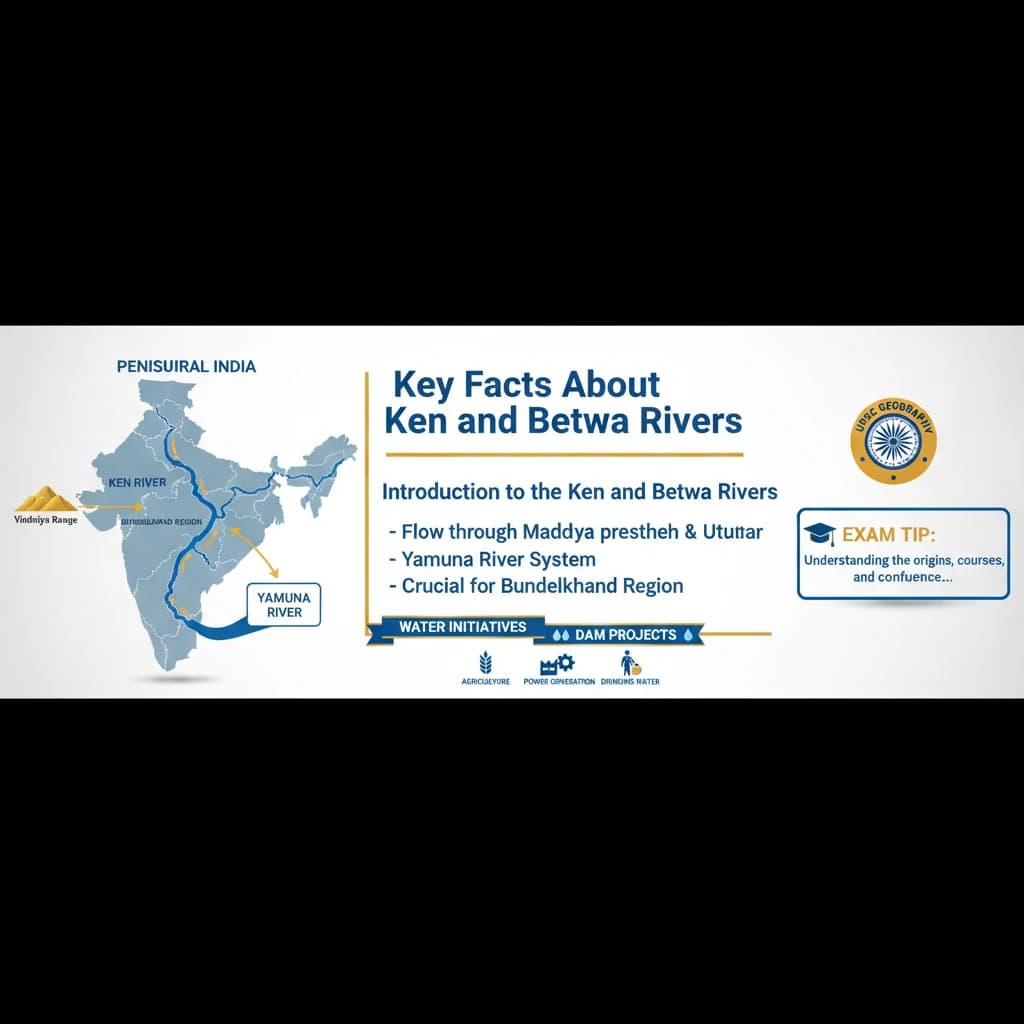
Key Facts About Ken and Betwa Rivers
Easy⏱️ 8 min read
geography
📖 Introduction
Introduction to the Ken and Betwa Rivers
The Ken and Betwa are two significant rivers of the Peninsular India, flowing primarily through Madhya Pradesh and Uttar Pradesh. They are crucial components of the Yamuna river system and hold immense importance for the water-stressed Bundelkhand region.
Understanding the origins, courses, and confluences of these rivers is vital for UPSC Prelims, especially questions related to Indian Geography and River Systems.
The Ken River: Origin and Course
The Ken River originates near Ahirgawan village, situated on the north-west slopes of the Kaimur hills. This source lies within the Jabalpur district of Madhya Pradesh.
Origin Point: Ahirgawan village, Kaimur hills, Jabalpur, Madhya Pradesh.
The river flows generally northward before merging with the mighty Yamuna River. Its confluence point is located at Chilla village, near Fatehpur in Uttar Pradesh.
Confluence: Yamuna River at Chilla village, Fatehpur, Uttar Pradesh.
Unique Features and Tributaries of Ken
The Ken River is particularly renowned for the presence of the rare Sajhar stone. This unique stone is a significant local resource and contributes to the region's geological distinctiveness.
The Sajhar stone is a unique geological feature associated with the Ken River basin.
Several smaller rivers contribute to the flow of the Ken as its major tributaries. These include a network of streams and rivers that join its main course.
- Major Tributaries: Bawas, Dewar, Kainth, Bairma, Kopra, and Bearma.
The Betwa River: Source and Journey
The Betwa River has its origins in the Vindhya Range, a prominent mountain range in central India. Its source is located within the state of Madhya Pradesh.
Origin Point: Vindhya Range, Madhya Pradesh.
After originating, the Betwa flows extensively through the historically and geographically significant Bundelkhand region. This region spans parts of both Madhya Pradesh and Uttar Pradesh.
Similar to the Ken, the Betwa River also eventually meets the Yamuna River. Its confluence occurs at Hamirpur, a town located in Uttar Pradesh.
Confluence: Yamuna River at Hamirpur, Uttar Pradesh.
Betwa's Tributaries and Ancient Name
The Betwa River is fed by several tributaries that contribute to its volume and flow. These rivers are vital for the local hydrology of the regions they traverse.
- Major Tributaries: Newan, Orr, and Dhasan.
Historically, the Betwa River was known by a different name. This ancient appellation provides insight into the river's long-standing presence and cultural significance in the region.
In ancient times, the Betwa River was referred to as Vetravati.
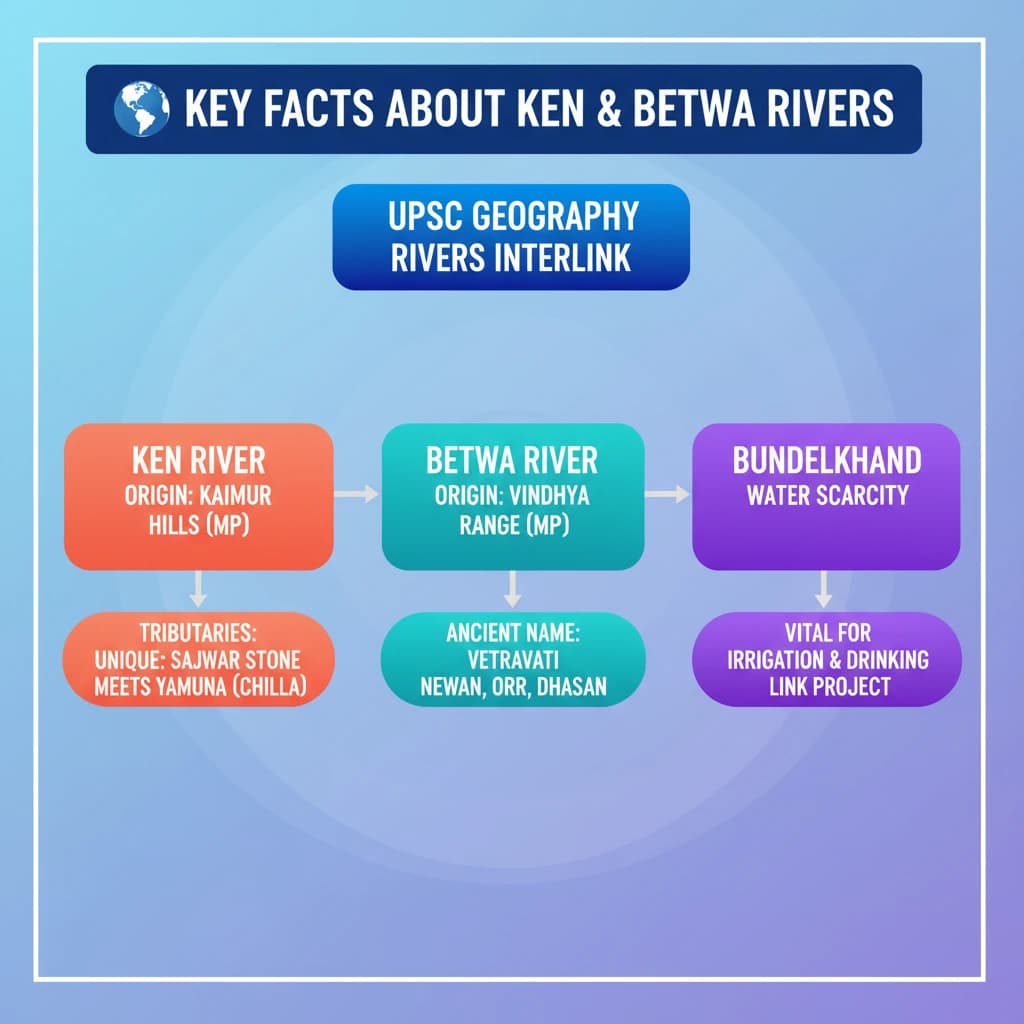
💡 Key Takeaways
- •Ken River originates in Kaimur hills (Jabalpur, MP), meets Yamuna at Chilla (UP).
- •Ken is known for the rare Sajhar stone; major tributaries include Bawas, Dewar, Kainth, Bairma, Kopra, Bearma.
- •Betwa River originates in Vindhya Range (MP), flows through Bundelkhand, meets Yamuna at Hamirpur (UP).
- •Betwa's ancient name was Vetravati; major tributaries are Newan, Orr, Dhasan.
- •Both rivers are vital for the water-stressed Bundelkhand region and are part of the Ken-Betwa Link Project.
🧠 Memory Techniques
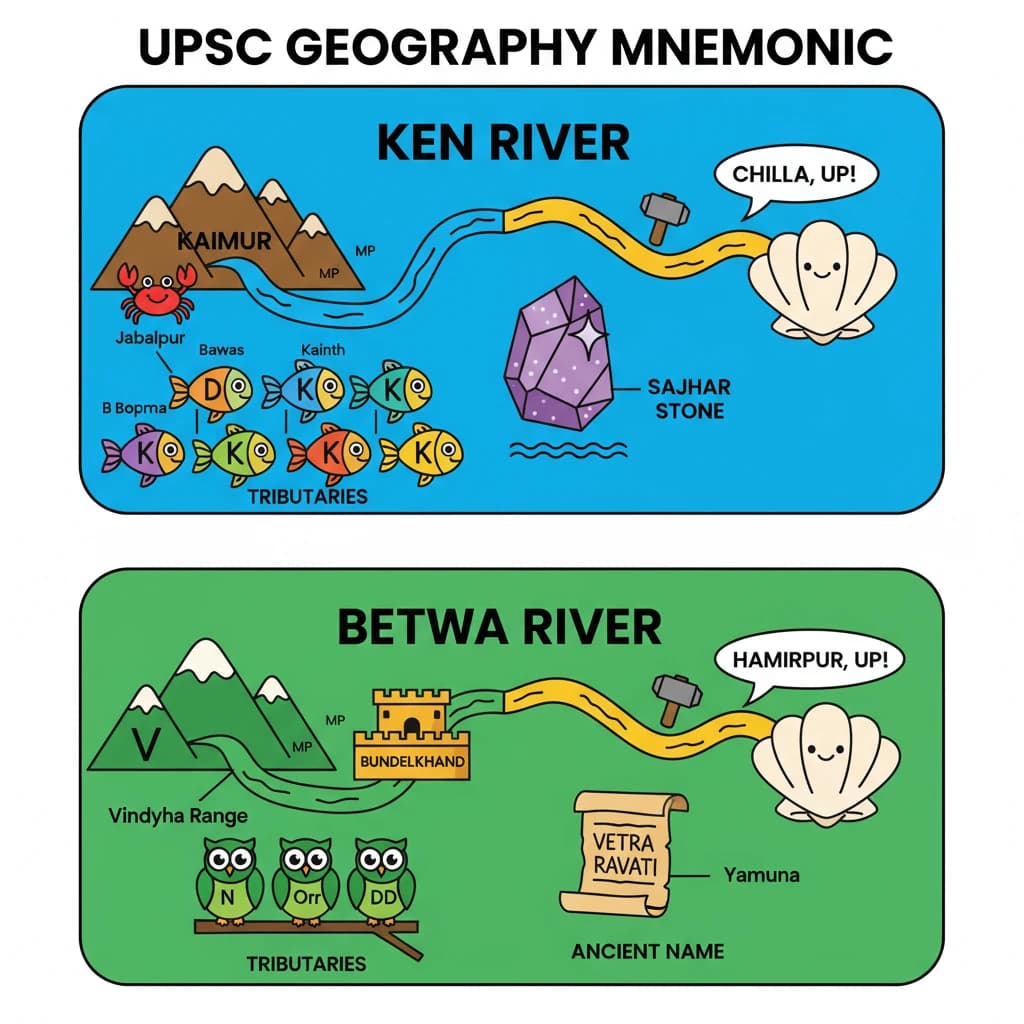
100% Verified Content
📚 Reference Sources
•National Water Development Agency (NWDA) reports on Ken-Betwa Link Project
•NCERT Geography textbooks (Class XI, XII) for river systems in India
•Government of India reports on Bundelkhand development