Loading page, please wait…
Ocean Anoxic Event 1a - UPSC Geography
What is Ocean Anoxic Event 1a in UPSC Geography?
Ocean Anoxic Event 1a is a key topic under Geography for UPSC Civil Services Examination. Key points include: Ocean Anoxic Event 1a (OAE 1a) was a period in the Early Cretaceous marked by widespread oceanic oxygen depletion, driven by massive volcanic CO2 emissions.. OAE 1a led to global warming, ocean acidification, marine extinctions (especially plankton), and the formation of organic-rich black shales.. The Tethys Sea was an ancient ocean whose closure (Late Cretaceous) due to plate tectonics formed the Himalayas and influenced petroleum basins.. Understanding this topic is essential for both UPSC Prelims and Mains preparation.
Why is Ocean Anoxic Event 1a important for UPSC exam?
Ocean Anoxic Event 1a is a Medium-level topic in UPSC Geography. It is tested in both Prelims (factual MCQs) and Mains (analytical answer writing). Previous year UPSC questions have frequently covered aspects of Ocean Anoxic Event 1a, making it essential for comprehensive IAS preparation.
How to prepare Ocean Anoxic Event 1a for UPSC?
To prepare Ocean Anoxic Event 1a for UPSC: (1) Study the comprehensive notes covering all key concepts on Vaidra. (2) Practice previous year questions on this topic. (3) Connect it with current affairs using daily updates. (4) Revise using key takeaways and mind maps available for Geography. (5) Write practice answers linking Ocean Anoxic Event 1a to related GS Paper topics.
Key takeaways of Ocean Anoxic Event 1a for UPSC
- Ocean Anoxic Event 1a (OAE 1a) was a period in the Early Cretaceous marked by widespread oceanic oxygen depletion, driven by massive volcanic CO2 emissions.
- OAE 1a led to global warming, ocean acidification, marine extinctions (especially plankton), and the formation of organic-rich black shales.
- The Tethys Sea was an ancient ocean whose closure (Late Cretaceous) due to plate tectonics formed the Himalayas and influenced petroleum basins.
- The Saraswati River, revered in Vedic texts, originated in the Himalayas and disappeared around 5000 BP due to climatic and tectonic changes.
- Studying OAE 1a provides insights into the severe consequences of high CO2 levels, relevant to modern climate change and ocean health.
Ocean Anoxic Event 1a
Medium⏱️ 7 min read
geography
📖 Introduction
Introduction to Ocean Anoxic Event 1a
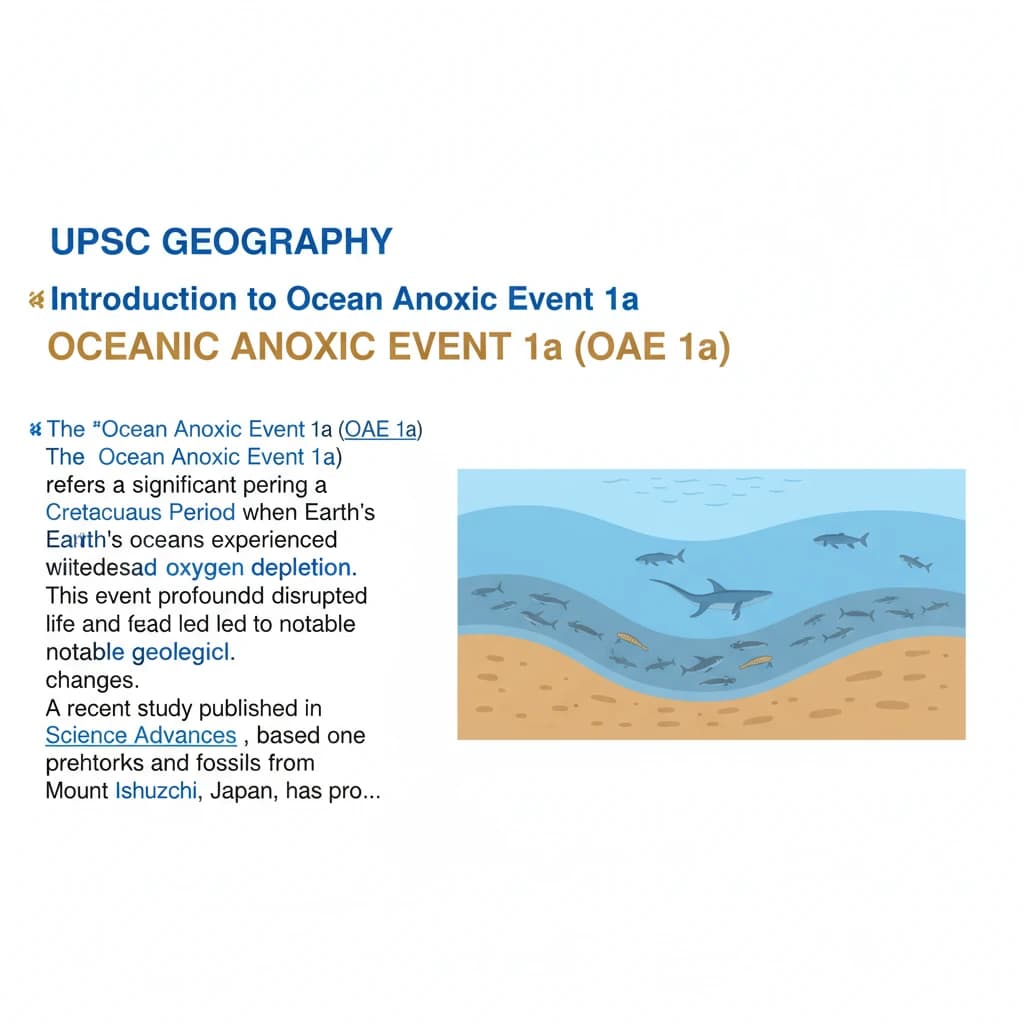
The Ocean Anoxic Event 1a (OAE 1a) refers to a significant period during the Cretaceous Period when Earth's oceans experienced widespread oxygen depletion. This event profoundly disrupted marine life and led to notable geological changes.
A recent study published in Science Advances, based on prehistoric rocks and fossils from Mount Ishizuchi, Japan, has provided new insights into the timing and duration of OAE 1a.
Definition: OAE 1a was a period within the Cretaceous Period (approximately 145 to 66 million years ago) characterized by severe oxygen depletion in global oceans.
Causes of Ocean Anoxic Event 1a
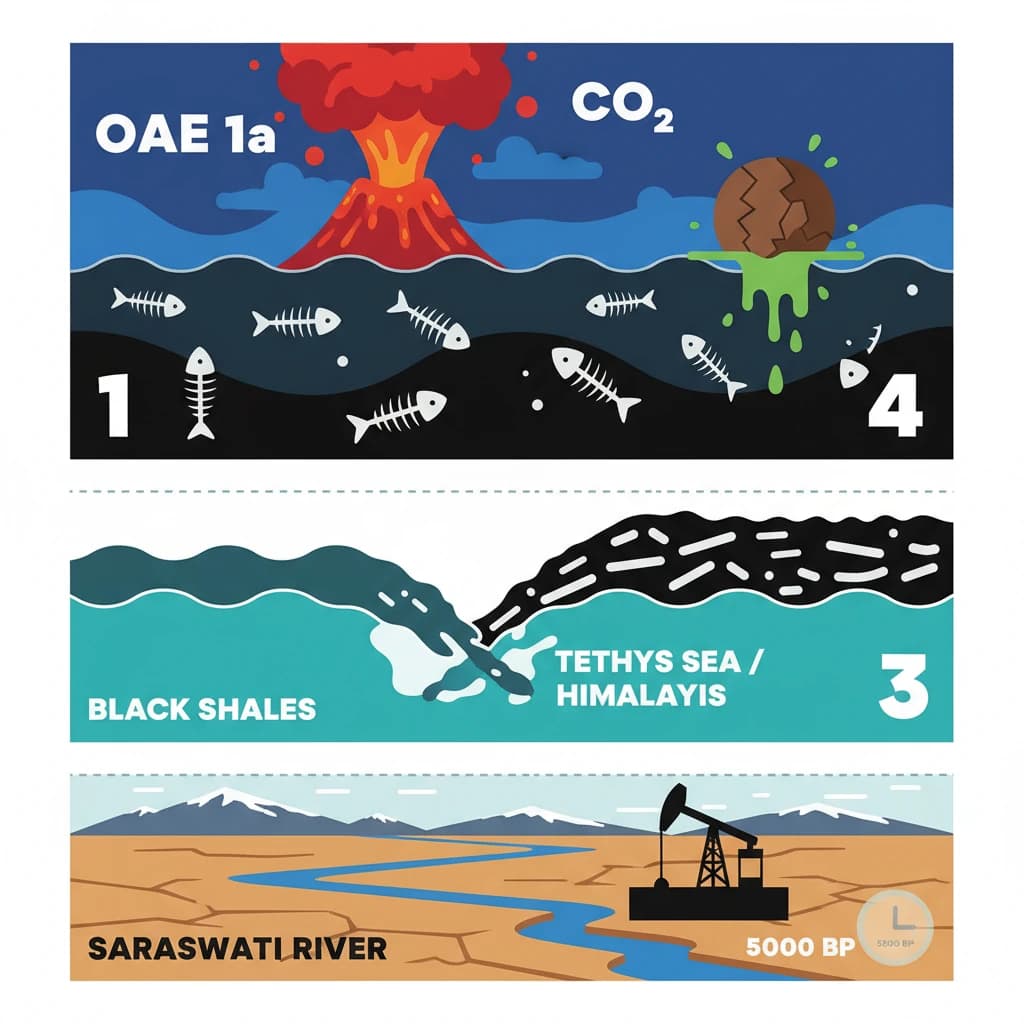
The primary trigger for OAE 1a is believed to be massive volcanic eruptions. These eruptions released substantial amounts of carbon dioxide (CO2) into the atmosphere.
The increased CO2 led to significant global warming. This warming, in turn, reduced the solubility of oxygen in seawater and altered ocean circulation patterns, causing widespread oxygen depletion.
Mechanism: Elevated atmospheric CO2 caused global warming, which decreased oceanic oxygen solubility and disrupted circulation, creating anoxic marine basins.
Impacts of Ocean Anoxic Event 1a
The influx of CO2 into seawater led to the formation of carbonic acid, which increased ocean acidity. This acidity dissolved the shells and skeletons of many marine creatures, especially those made of calcium carbonate.
The severe oxygen depletion had devastating consequences for marine ecosystems, leading to the extinction of many species, particularly various forms of plankton. This event is also associated with the formation of extensive organic carbon-rich layers, known as black shales, preserved in the geological record.
The Tethys Sea: A Precursor Context
The Tethys Sea was an ancient ocean that existed for millions of years, extending across what are now parts of Europe, Asia, Africa, and the Middle East. It served as a vital connection between the Pacific Ocean in the east and the Atlantic Ocean in the west.
By the Late Cretaceous (around 66 million years ago), the Tethys Sea began its gradual closure due to the continuous shifting of tectonic plates.
Remnants: Modern seas such as the Mediterranean Sea, Caspian Sea, and Black Sea are considered remnants of the ancient Tethys Sea.
The closure of the Tethys Sea had profound tectonic significance. It led to the creation of new landmasses and mountain ranges, notably the collision of the Indian subcontinent with the Asian plate, which resulted in the uplift of the Himalayan mountain range and the Tibetan Plateau.
The Tethys Sea was also renowned for its rich diversity of marine life. Fossil evidence indicates it was home to early forms of sharks, ammonites, and marine reptiles like ichthyosaurs and mosasaurs.
UPSC Relevance: Understanding the Tethys Sea's evolution is crucial for comprehending the geological formation of petroleum basins in regions like North Africa and the Middle East, where organic material accumulated and matured into hydrocarbons.
The Saraswati River: An Ancient Indian Enigma
The Saraswati River is a revered river mentioned extensively in ancient Indian texts, primarily the Vedas. It is considered the holiest and mightiest river of the Vedic Period, dating back approximately 8000–5000 years Before Present (BP).
According to ancient descriptions, the Saraswati River originated in the Himalayas. Its course flowed through the regions of Punjab, Haryana, Western Rajasthan, and Gujarat.
It is believed to have joined the Indus River in the west and the Ganges River in the east, eventually draining into the Gulf of Kachchh in the Arabian Sea.
Disappearance: The Saraswati River is believed to have disappeared around 5000 BP, primarily due to a combination of climatic and tectonic changes. It is theorized that the river still flows underground beneath the Thar Desert, maintaining its Himalayan connectivity.
The Saraswati River is frequently mentioned in various ancient Indian literary works, highlighting its cultural and geographical importance.
- Vedas: The Rigveda hails Saraswati as the “Best of Mothers, Rivers, and Goddesses.” The Yajurveda mentions its tributaries.
- Manusmriti: The sacred region between the Saraswati and Drishadvati River (a seasonal river in Haryana) is referred to as Brahmavarta, a divine creation.
- Mahabharata: This epic describes numerous pilgrimages along the river and its disappearance into desert sands at Vinasana, attributed to low water discharge.
- Puranas: The Markandeya Purana narrates the Saraswati rising from the Plaksha tree (Pipal tree), with a sage worshipping its emergence.
💡 Key Takeaways
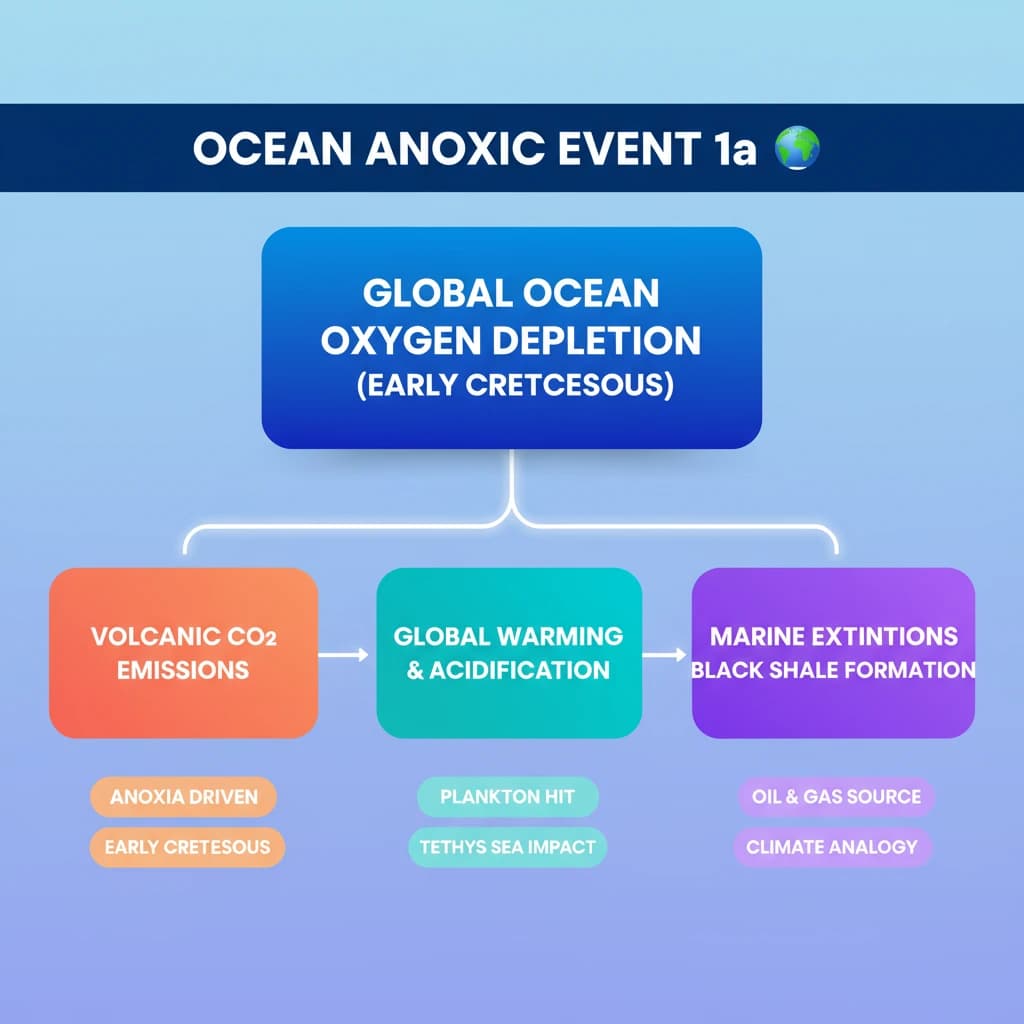
- •Ocean Anoxic Event 1a (OAE 1a) was a period in the Early Cretaceous marked by widespread oceanic oxygen depletion, driven by massive volcanic CO2 emissions.
- •OAE 1a led to global warming, ocean acidification, marine extinctions (especially plankton), and the formation of organic-rich black shales.
- •The Tethys Sea was an ancient ocean whose closure (Late Cretaceous) due to plate tectonics formed the Himalayas and influenced petroleum basins.
- •The Saraswati River, revered in Vedic texts, originated in the Himalayas and disappeared around 5000 BP due to climatic and tectonic changes.
- •Studying OAE 1a provides insights into the severe consequences of high CO2 levels, relevant to modern climate change and ocean health.
🧠 Memory Techniques
95% Verified Content
📚 Reference Sources
•Science Advances (referenced study on OAE 1a)
•General geological and paleoclimate literature on Cretaceous Period and Anoxic Events
•Historical and hydrological studies on the Saraswati River