Loading page, please wait…
United Nations Convention on the Law of the Sea 1982 - UPSC Geography
What is United Nations Convention on the Law of the Sea 1982 in UPSC Geography?
United Nations Convention on the Law of the Sea 1982 is a key topic under Geography for UPSC Civil Services Examination. Key points include: UNCLOS is a comprehensive international treaty governing all aspects of the world's seas and oceans.. It establishes a regulatory framework for maritime zones, navigation rights, and resource management.. India ratified UNCLOS in 1995, adhering to its principles and leveraging its provisions.. Understanding this topic is essential for both UPSC Prelims and Mains preparation.
Why is United Nations Convention on the Law of the Sea 1982 important for UPSC exam?
United Nations Convention on the Law of the Sea 1982 is a Medium-level topic in UPSC Geography. It is tested in both Prelims (factual MCQs) and Mains (analytical answer writing). Previous year UPSC questions have frequently covered aspects of United Nations Convention on the Law of the Sea 1982, making it essential for comprehensive IAS preparation.
How to prepare United Nations Convention on the Law of the Sea 1982 for UPSC?
To prepare United Nations Convention on the Law of the Sea 1982 for UPSC: (1) Study the comprehensive notes covering all key concepts on Vaidra. (2) Practice previous year questions on this topic. (3) Connect it with current affairs using daily updates. (4) Revise using key takeaways and mind maps available for Geography. (5) Write practice answers linking United Nations Convention on the Law of the Sea 1982 to related GS Paper topics.
Key takeaways of United Nations Convention on the Law of the Sea 1982 for UPSC
- UNCLOS is a comprehensive international treaty governing all aspects of the world's seas and oceans.
- It establishes a regulatory framework for maritime zones, navigation rights, and resource management.
- India ratified UNCLOS in 1995, adhering to its principles and leveraging its provisions.
- The 'right of innocent passage' allows foreign non-military ships to transit territorial waters without prejudice to the coastal state's security.
- The US has not ratified UNCLOS, leading to distinct approaches in international maritime affairs.
- UNCLOS is vital for global maritime stability, resource governance, and environmental protection.
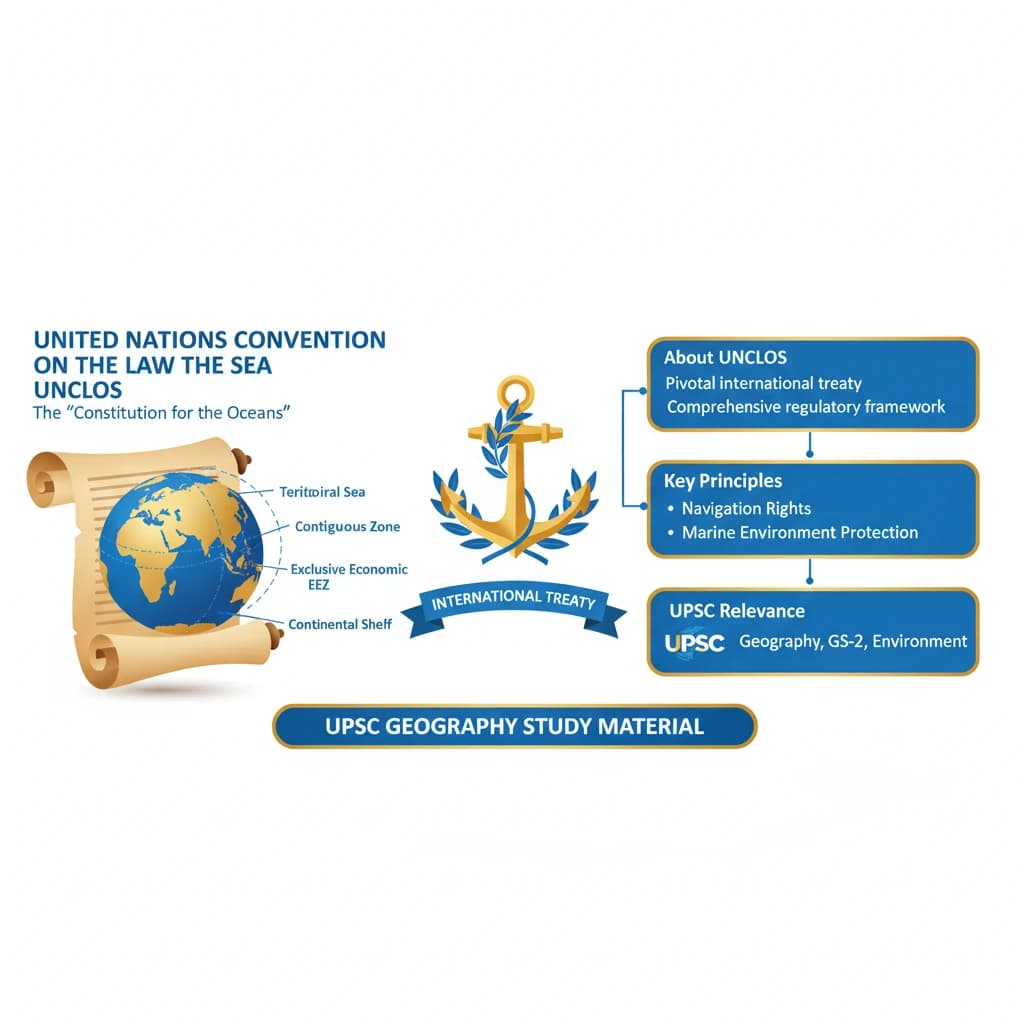
United Nations Convention on the Law of the Sea 1982
Medium⏱️ 7 min read
geography
📖 Introduction
About the United Nations Convention on the Law of the Sea (UNCLOS)
The United Nations Convention on the Law of the Sea (UNCLOS) is a pivotal international treaty. It establishes a comprehensive regulatory framework for all activities related to the world's seas and oceans.
UNCLOS is often referred to as the 'constitution for the oceans' as it defines the rights and responsibilities of nations with respect to their use of the world's oceans, establishing guidelines for businesses, the environment, and the management of marine natural resources.
Ratification and Global Adherence
The Convention was officially opened for signature in December 1982 in Montego Bay, Jamaica. This marked a significant milestone in international maritime law.
As of today, UNCLOS has been ratified by a total of 168 parties. This includes 167 states (comprising 164 United Nations (UN) member states, the UN Observer state Palestine, along with the Cook Islands and Niue) and the European Union.
Additionally, 14 UN member states have signed the convention, indicating their intent to comply, but have not yet completed the ratification process.
India's Stance on UNCLOS
India demonstrated its commitment to international maritime law by ratifying UNCLOS in 1995. This aligns India with the global framework for ocean governance.
It is important to note for UPSC exams that the United States (US), a major maritime power, has notably failed to ratify the convention to date. This often leads to discussions on its implications for international maritime disputes.
Indian Law and Innocent Passage
India's maritime legal framework is enshrined in the India’s Territorial Waters, Continental Shelf, Exclusive Economic Zone and Other Maritime Zones Act, 1976. This act defines various maritime zones and their associated rights.
Under this Indian law, all foreign ships, with the exception of warships (including submarines and other underwater vehicles), are granted the fundamental right of innocent passage through India's territorial waters.
Definition of Innocent Passage: This refers to a passage that is not prejudicial to the peace, good order or security of India. It implies transit that is continuous, expeditious, and does not involve any threat or illegal activity.
💡 Key Takeaways
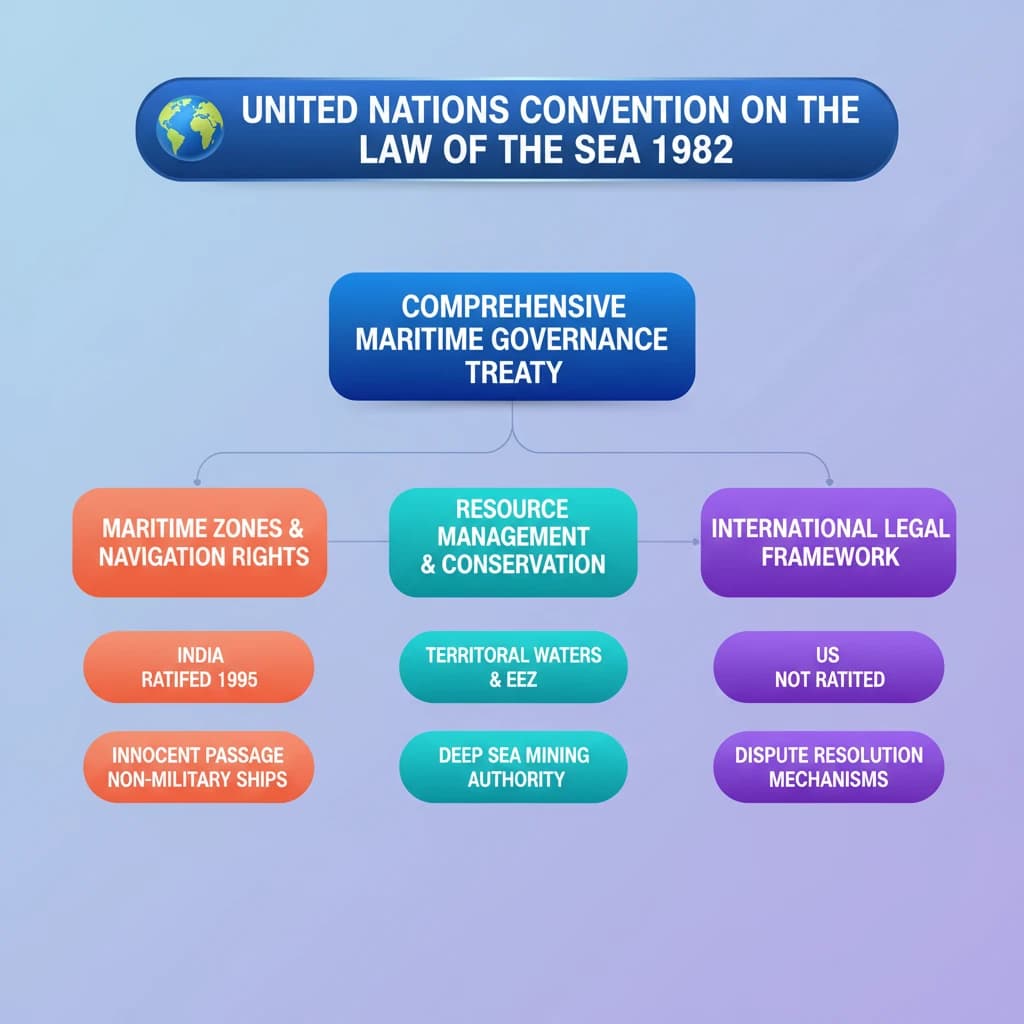
- •UNCLOS is a comprehensive international treaty governing all aspects of the world's seas and oceans.
- •It establishes a regulatory framework for maritime zones, navigation rights, and resource management.
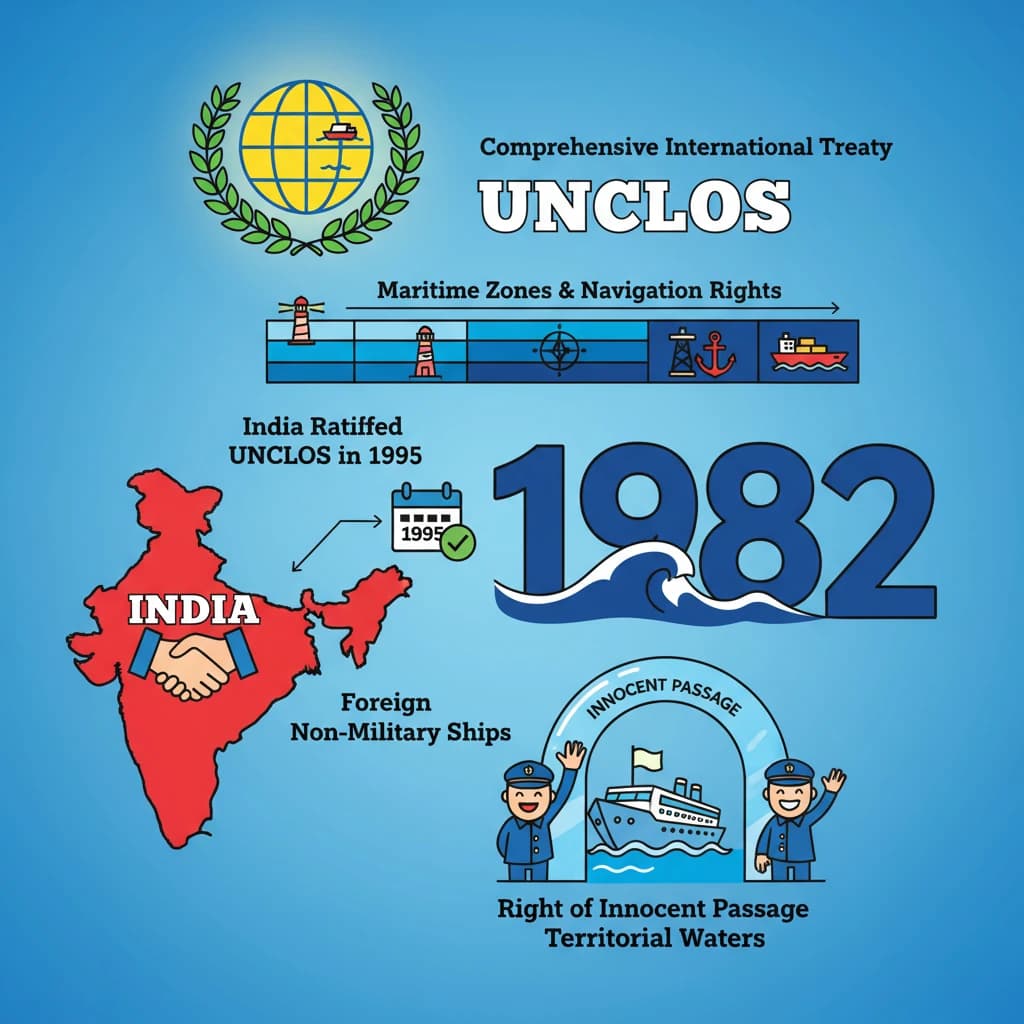
- •India ratified UNCLOS in 1995, adhering to its principles and leveraging its provisions.
- •The 'right of innocent passage' allows foreign non-military ships to transit territorial waters without prejudice to the coastal state's security.
- •The US has not ratified UNCLOS, leading to distinct approaches in international maritime affairs.
- •UNCLOS is vital for global maritime stability, resource governance, and environmental protection.
🧠 Memory Techniques
98% Verified Content
📚 Reference Sources
•United Nations Division for Ocean Affairs and the Law of the Sea (DOALOS) - Official UNCLOS website
•India’s Territorial Waters, Continental Shelf, Exclusive Economic Zone and Other Maritime Zones Act, 1976