Loading page, please wait…
Rani Chennamma: Rebellion Against British & "Naanoo Rani Chennamma" Campaign - UPSC History
What is Rani Chennamma: Rebellion Against British & "Naanoo Rani Chennamma" Campaign in UPSC History?
Rani Chennamma: Rebellion Against British & "Naanoo Rani Chennamma" Campaign is a key topic under History for UPSC Civil Services Examination. Key points include: Rani Chennamma of Kittur led a rebellion against the British East India Company in 1824.. Her resistance was primarily triggered by the British application of the Doctrine of Lapse, refusing to recognize her adopted heir.. She was a formidable leader, skilled in martial arts and guerrilla warfare, and killed a British official during the conflict.. Understanding this topic is essential for both UPSC Prelims and Mains preparation.
Why is Rani Chennamma: Rebellion Against British & "Naanoo Rani Chennamma" Campaign important for UPSC exam?
Rani Chennamma: Rebellion Against British & "Naanoo Rani Chennamma" Campaign is a Medium-level topic in UPSC History. It is tested in both Prelims (factual MCQs) and Mains (analytical answer writing). Previous year UPSC questions have frequently covered aspects of Rani Chennamma: Rebellion Against British & "Naanoo Rani Chennamma" Campaign, making it essential for comprehensive IAS preparation.
How to prepare Rani Chennamma: Rebellion Against British & "Naanoo Rani Chennamma" Campaign for UPSC?
To prepare Rani Chennamma: Rebellion Against British & "Naanoo Rani Chennamma" Campaign for UPSC: (1) Study the comprehensive notes covering all key concepts on Vaidra. (2) Practice previous year questions on this topic. (3) Connect it with current affairs using daily updates. (4) Revise using key takeaways and mind maps available for History. (5) Write practice answers linking Rani Chennamma: Rebellion Against British & "Naanoo Rani Chennamma" Campaign to related GS Paper topics.
Key takeaways of Rani Chennamma: Rebellion Against British & "Naanoo Rani Chennamma" Campaign for UPSC
- Rani Chennamma of Kittur led a rebellion against the British East India Company in 1824.
- Her resistance was primarily triggered by the British application of the Doctrine of Lapse, refusing to recognize her adopted heir.
- She was a formidable leader, skilled in martial arts and guerrilla warfare, and killed a British official during the conflict.
- Despite her bravery, she was eventually captured and imprisoned, but her rebellion inspired many.
- The Doctrine of Lapse, formalized by Lord Dalhousie, was a key British annexation policy used to absorb princely states.
- Rani Chennamma remains a powerful symbol of courage, defiance, and women's empowerment in India.
Rani Chennamma: Rebellion Against British & "Naanoo Rani Chennamma" Campaign
Medium⏱️ 8 min read
history
📖 Introduction
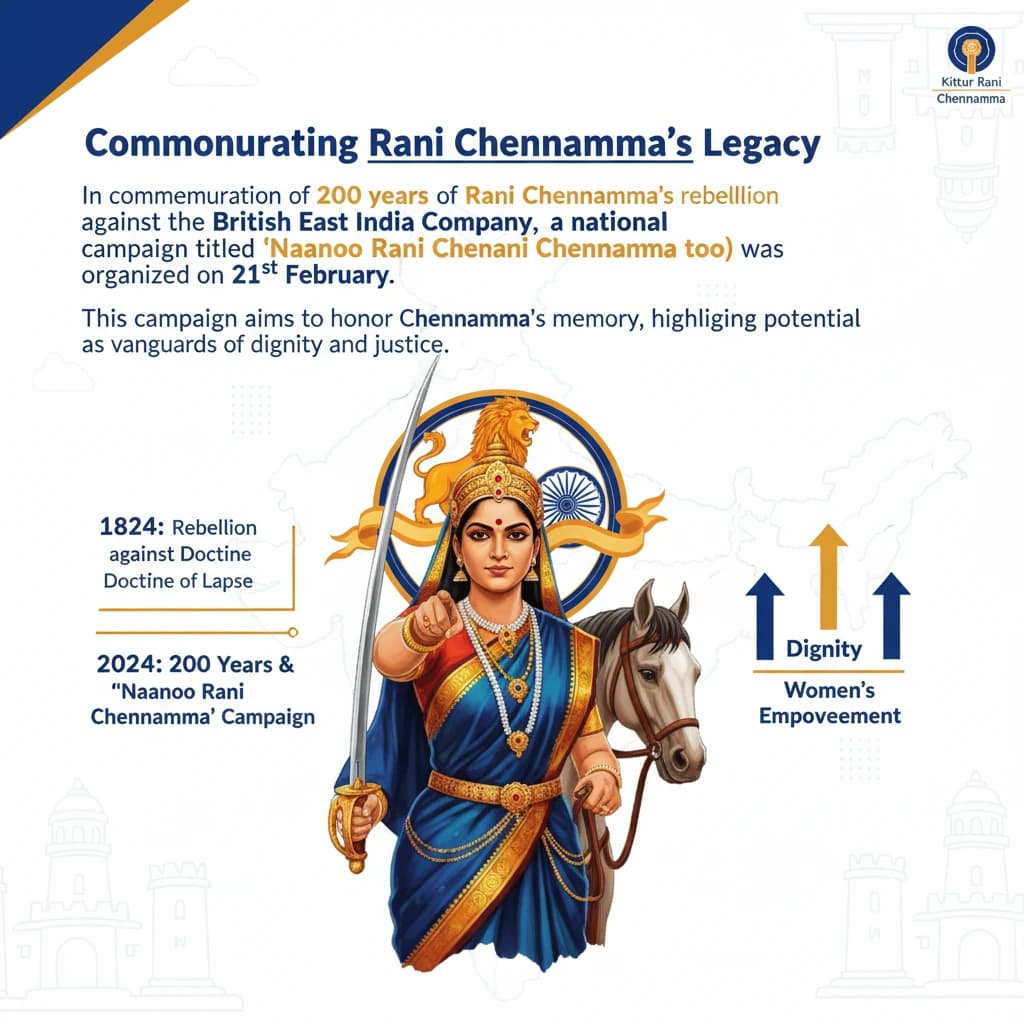
Commemorating Rani Chennamma's Legacy
In commemoration of 200 years of Rani Chennamma's rebellion against the British East India Company, a national campaign titled 'Naanoo Rani Chennamma' (I am Rani Chennamma too) was organized on 21st February.
This campaign aims to honor Chennamma's memory, highlighting women's potential as vanguards of dignity and justice. Her bravery continues to inspire women across the nation.
Her strategic acumen and quick thinking to safeguard her homeland exemplify her commitment and dedication as a leader.
Who was Rani Chennamma?
Rani Chennamma was born on October 23, 1778, in Kagati, a village located in the present-day Belagavi district of Karnataka.
At the age of 15, she married Raja Mallasarja of Kittur, who governed the province until 1816.
Following Raja Mallasarja's death in 1816, his eldest son, Shivalingarudra Sarja, ascended the throne. However, his health began to decline shortly thereafter.
The kingdom of Kittur faced a crisis without a direct heir. Shivalingarudra had no natural successor, and Rani Chennamma had also lost her own son.
Before his demise in 1824, Shivalingarudra adopted a child named Shivalingappa as his successor. This adoption, however, was rejected by the British East India Company.
The British refused to recognize Shivalingappa under the controversial 'Doctrine of Lapse', an annexation policy.
John Thackeray, the British official stationed at Dharwad, subsequently initiated an attack on Kittur in October 1824.
Understanding the Doctrine of Lapse
The Doctrine of Lapse was an annexation policy implemented by Lord Dalhousie, the Governor-General of India from 1848 to 1856.
According to this doctrine, any princely state under the direct or indirect control of the East India Company would be annexed if its ruler died without a natural male heir.
Crucially, the policy stipulated that an adopted son of an Indian ruler could not be recognized as the legitimate heir to the kingdom.
Through the application of this doctrine, Dalhousie annexed several significant states:
- Satara (1848 A.D.)
- Jaitpur and Sambalpur (1849 A.D.)
- Baghat (1850 A.D.)
- Udaipur (1852 A.D.)
- Jhansi (1853 A.D.)
- Nagpur (1854 A.D.)
Rani Chennamma's Battle Against the British
In 1824, a formidable force of 20,000 British soldiers was deployed at the foothills of the Kittur fort, preparing to invade the princely state in Karnataka.
Rani Chennamma, a formidable leader trained in martial arts and military tactics, retaliated fiercely to protect her homeland.
She personally led her army into battle, employing effective guerrilla warfare tactics to surprise the invading British forces.
During the conflict, she famously killed a British official, demonstrating her resolve and bravery.
The intense conflict lasted for several days. However, the British forces ultimately prevailed due to their overwhelming superior firepower.
Legacy of Rani Chennamma: A Symbol of Resistance
Despite her eventual capture and imprisonment in Bailhongal Fort (located in Belagavi, Karnataka), Rani Chennamma's spirit remained unbroken.
Her courageous rebellion served as a profound inspiration for countless others to rise against British rule, solidifying her status as a powerful symbol of courage and defiance.
In 2007, the Indian government issued a postage stamp in her honor, recognizing her significant contribution to India's history.
Numerous Kannada lavanis, or folk songs, continue to be recited, affectionately remembering Rani Chennamma as a protector and guardian of her people.
Lavani is a vibrant and expressive folk art form originating from Maharashtra's cultural heritage, also found in parts of Karnataka. The term "Lavani" derives from the Marathi word "lavanya," meaning beauty.
It combines traditional song and dance, performed to the rhythmic beats of the Dholki, a percussion instrument.
💡 Key Takeaways
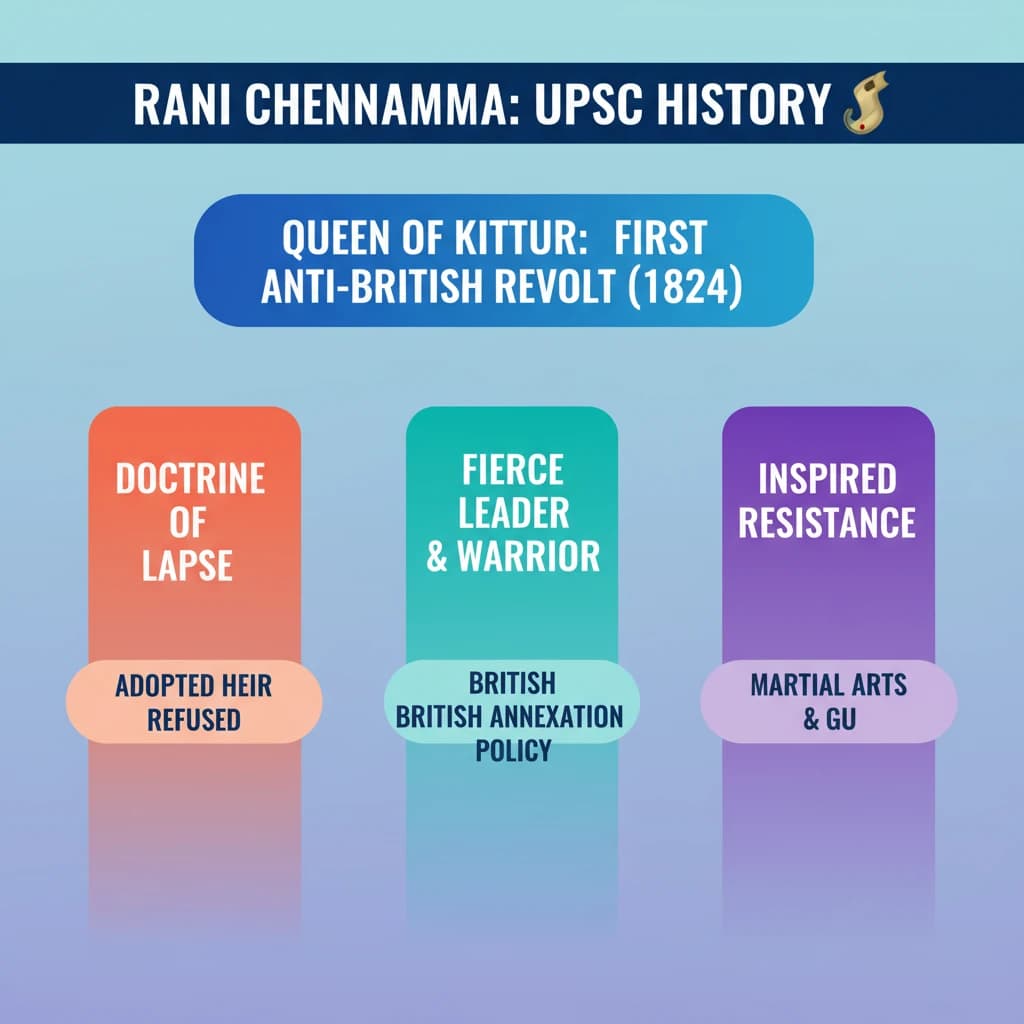
- •Rani Chennamma of Kittur led a rebellion against the British East India Company in 1824.
- •Her resistance was primarily triggered by the British application of the Doctrine of Lapse, refusing to recognize her adopted heir.
- •She was a formidable leader, skilled in martial arts and guerrilla warfare, and killed a British official during the conflict.
- •Despite her bravery, she was eventually captured and imprisoned, but her rebellion inspired many.
- •The Doctrine of Lapse, formalized by Lord Dalhousie, was a key British annexation policy used to absorb princely states.
- •Rani Chennamma remains a powerful symbol of courage, defiance, and women's empowerment in India.
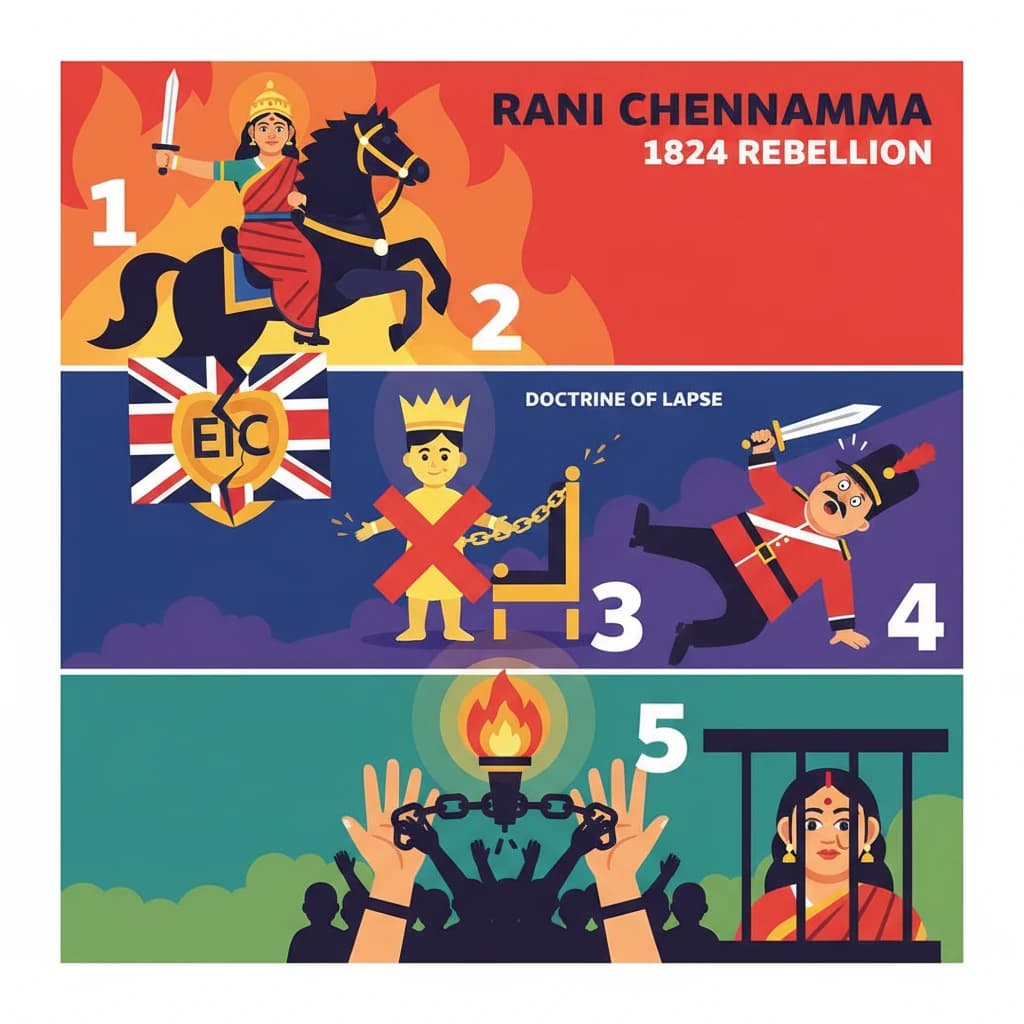
🧠 Memory Techniques
98% Verified Content