Loading page, please wait…
The empire frequently clashed with the Bahmani Sultanate - UPSC History
What is The empire frequently clashed with the Bahmani Sultanate in UPSC History?
The empire frequently clashed with the Bahmani Sultanate is a key topic under History for UPSC Civil Services Examination. Key points include: The Vijayanagara Empire frequently clashed with the Bahmani Sultanate in the Deccan.. These conflicts were primarily territorial, driven by competition for strategic and economic resources.. The Raichur Doab, a fertile land between the Krishna and Tungabhadra rivers, was a key disputed territory.. Understanding this topic is essential for both UPSC Prelims and Mains preparation.
Why is The empire frequently clashed with the Bahmani Sultanate important for UPSC exam?
The empire frequently clashed with the Bahmani Sultanate is a Medium-level topic in UPSC History. It is tested in both Prelims (factual MCQs) and Mains (analytical answer writing). Previous year UPSC questions have frequently covered aspects of The empire frequently clashed with the Bahmani Sultanate, making it essential for comprehensive IAS preparation.
How to prepare The empire frequently clashed with the Bahmani Sultanate for UPSC?
To prepare The empire frequently clashed with the Bahmani Sultanate for UPSC: (1) Study the comprehensive notes covering all key concepts on Vaidra. (2) Practice previous year questions on this topic. (3) Connect it with current affairs using daily updates. (4) Revise using key takeaways and mind maps available for History. (5) Write practice answers linking The empire frequently clashed with the Bahmani Sultanate to related GS Paper topics.
Key takeaways of The empire frequently clashed with the Bahmani Sultanate for UPSC
- The Vijayanagara Empire frequently clashed with the Bahmani Sultanate in the Deccan.
- These conflicts were primarily territorial, driven by competition for strategic and economic resources.
- The Raichur Doab, a fertile land between the Krishna and Tungabhadra rivers, was a key disputed territory.
- The Bahmani Sultanate emerged after the Tughlaq dynasty's control collapsed in the Deccan.
- Religious differences were secondary to geopolitical and economic motives in these rivalries.
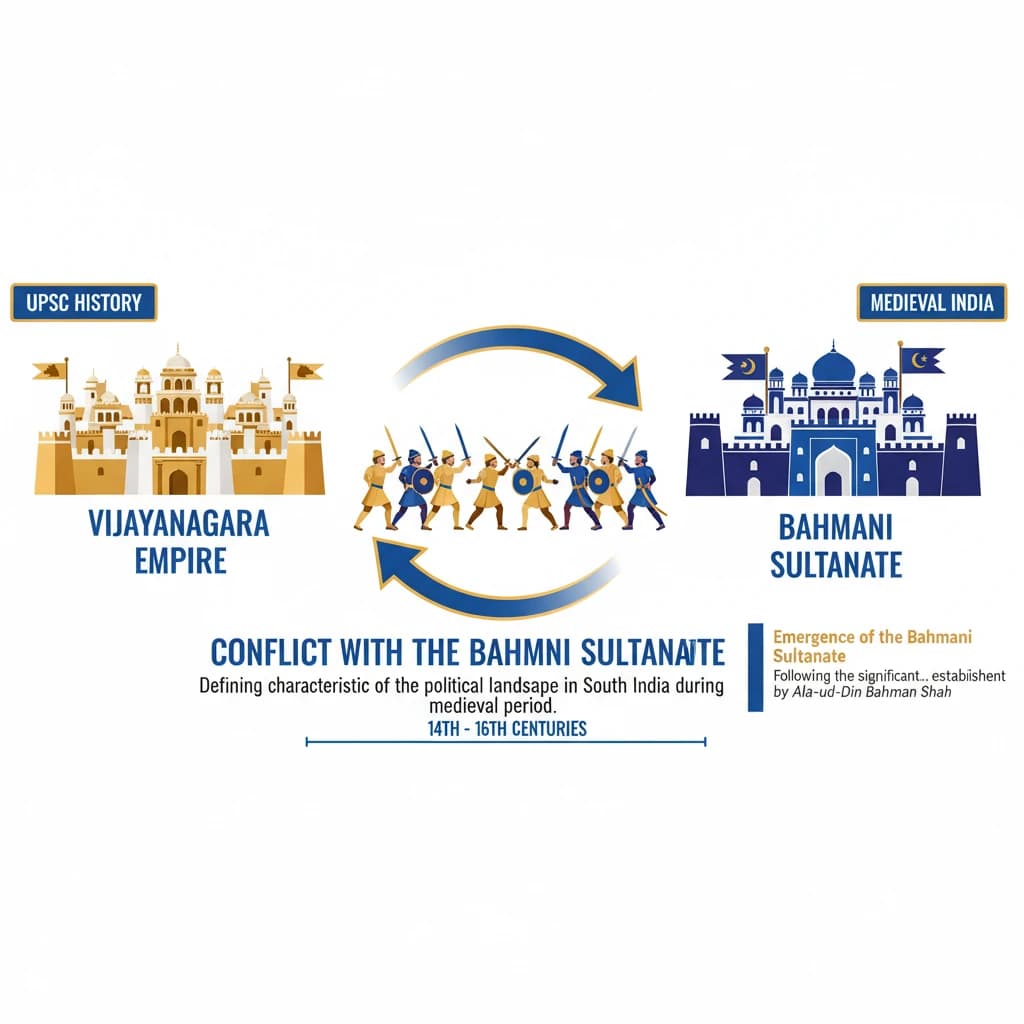
The empire frequently clashed with the Bahmani Sultanate
Medium⏱️ 5 min read
history
📖 Introduction
Conflict with the Bahmani Sultanate
The empire, widely identified as the Vijayanagara Empire, was frequently engaged in intense clashes with the Bahmani Sultanate.
These conflicts were a defining characteristic of the political landscape in South India during the medieval period.
Emergence of the Bahmani Sultanate
The Bahmani Sultanate came into existence following the significant weakening and eventual collapse of the Tughlaq dynasty's authority in the Deccan region.
The Tughlaq dynasty, particularly under rulers like Muhammad bin Tughlaq, had attempted to control the Deccan, but this control proved unsustainable, leading to the rise of powerful independent regional kingdoms.
Nature of the Clashes
The conflicts between the empire and the various Deccan Sultanates, including the Bahmani Sultanate, were predominantly territorial disputes.
These clashes were not primarily driven by purely religious differences, but rather by intense competition for crucial strategic and economic resources.
Key Point: The fundamental motivations behind these conflicts were geopolitical and economic, emphasizing control over land and resources, rather than solely religious ideology.
The Raichur Doab Dispute
A particularly significant and persistent point of contention between the rival powers was the region known as the Raichur Doab.
The Raichur Doab is a highly fertile and strategically vital tract of land located between the Krishna River to the north and the Tungabhadra River to the south.
Control over this rich agricultural and strategically positioned area was a continuous source of rivalry and warfare between the Vijayanagara Empire and the Bahmani Sultanate.
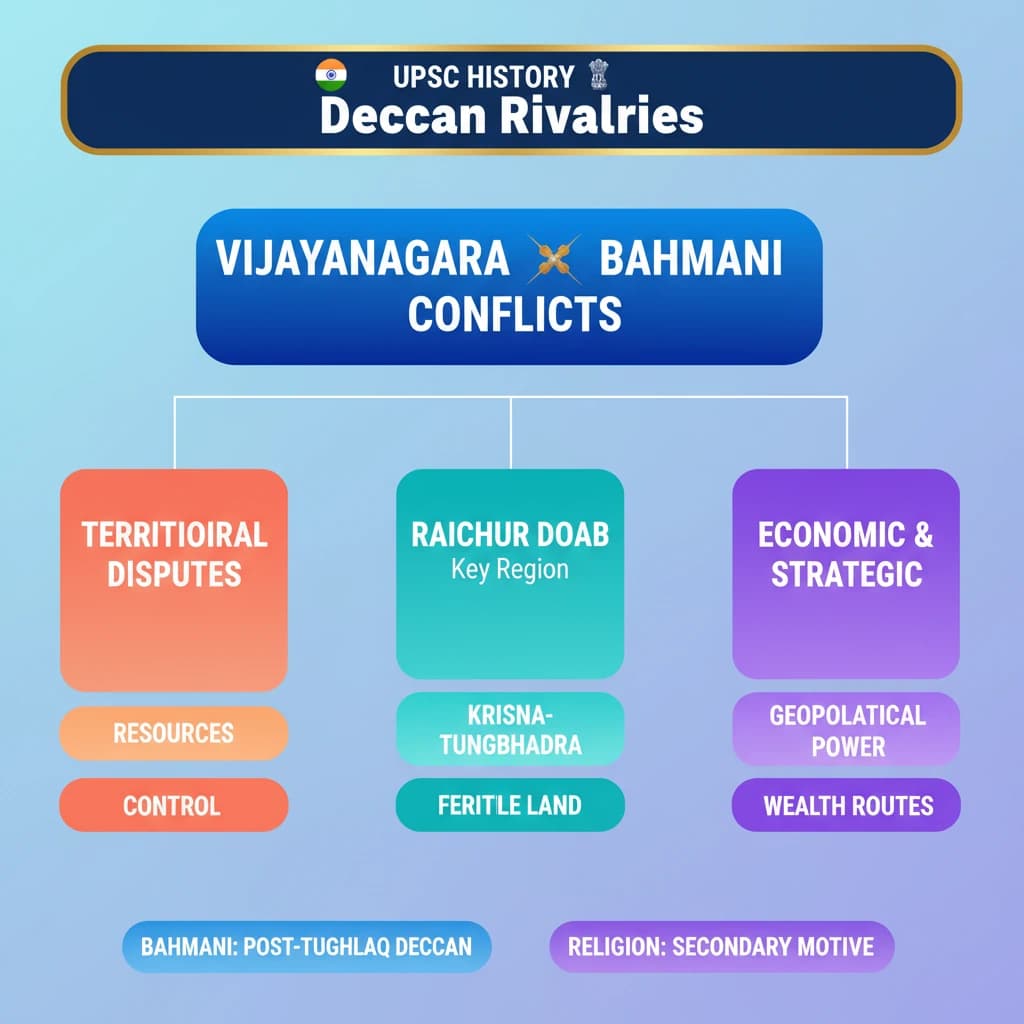
💡 Key Takeaways
- •The Vijayanagara Empire frequently clashed with the Bahmani Sultanate in the Deccan.
- •These conflicts were primarily territorial, driven by competition for strategic and economic resources.
- •The Raichur Doab, a fertile land between the Krishna and Tungabhadra rivers, was a key disputed territory.
- •The Bahmani Sultanate emerged after the Tughlaq dynasty's control collapsed in the Deccan.
- •Religious differences were secondary to geopolitical and economic motives in these rivalries.
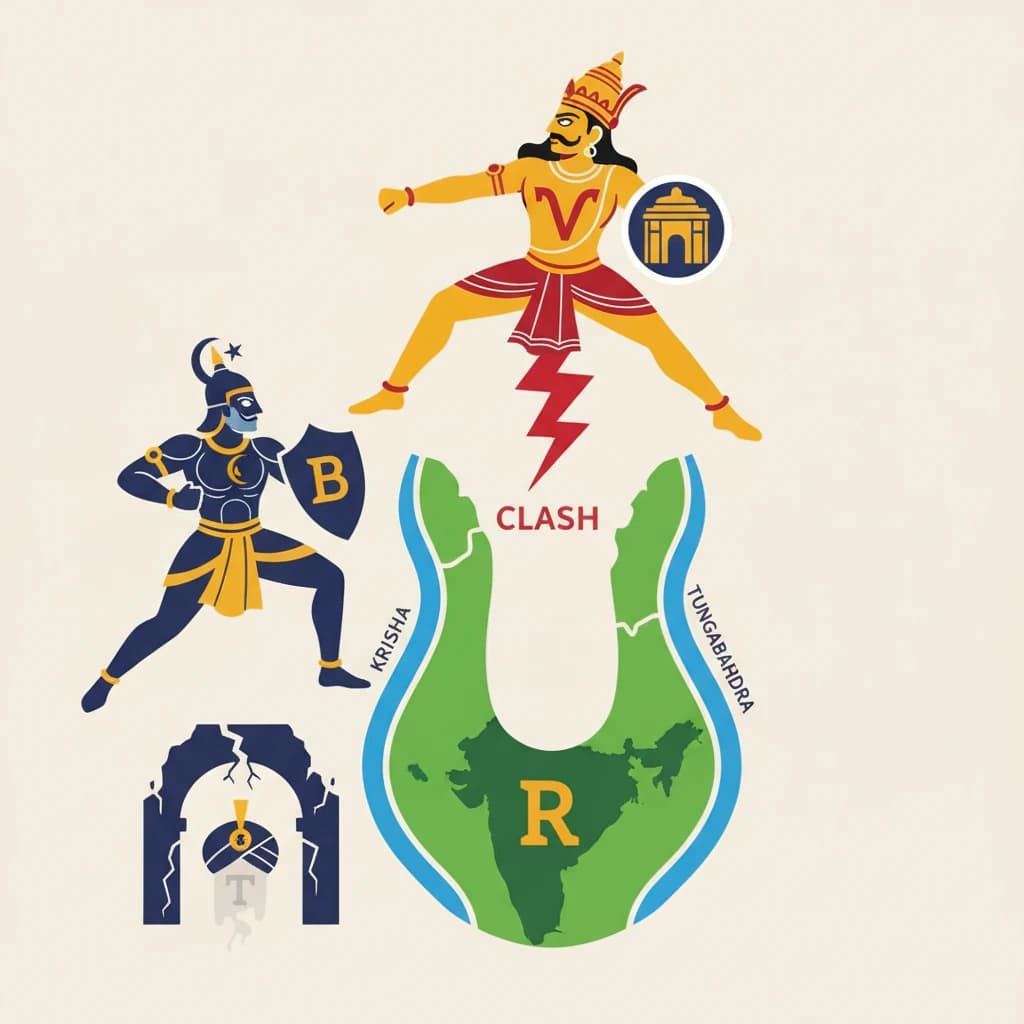
🧠 Memory Techniques
95% Verified Content
📚 Reference Sources
•NCERT Class XI/XII History Textbooks (Old & New Editions)
•A History of South India by K.A. Nilakanta Sastri
•The Cambridge Economic History of India, Vol. 1