Loading page, please wait…
What was the Role of Sardar Patel in Integration of Princely States? - UPSC History
What is What was the Role of Sardar Patel in Integration of Princely States? in UPSC History?
What was the Role of Sardar Patel in Integration of Princely States? is a key topic under History for UPSC Civil Services Examination. Key points include: Sardar Patel was instrumental in integrating over 560 princely states into the Indian Union.. His role began in the Interim Government (Home & States portfolios) and was acknowledged by Nehru as the 'strongest pillar'.. He established the States Department with V.P. Menon to systematically manage the accession process.. Understanding this topic is essential for both UPSC Prelims and Mains preparation.
Why is What was the Role of Sardar Patel in Integration of Princely States? important for UPSC exam?
What was the Role of Sardar Patel in Integration of Princely States? is a Medium-level topic in UPSC History. It is tested in both Prelims (factual MCQs) and Mains (analytical answer writing). Previous year UPSC questions have frequently covered aspects of What was the Role of Sardar Patel in Integration of Princely States?, making it essential for comprehensive IAS preparation.
How to prepare What was the Role of Sardar Patel in Integration of Princely States? for UPSC?
To prepare What was the Role of Sardar Patel in Integration of Princely States? for UPSC: (1) Study the comprehensive notes covering all key concepts on Vaidra. (2) Practice previous year questions on this topic. (3) Connect it with current affairs using daily updates. (4) Revise using key takeaways and mind maps available for History. (5) Write practice answers linking What was the Role of Sardar Patel in Integration of Princely States? to related GS Paper topics.
Key takeaways of What was the Role of Sardar Patel in Integration of Princely States? for UPSC
- Sardar Patel was instrumental in integrating over 560 princely states into the Indian Union.
- His role began in the Interim Government (Home & States portfolios) and was acknowledged by Nehru as the 'strongest pillar'.
- He established the States Department with V.P. Menon to systematically manage the accession process.
- Patel employed a 'Carrot and Stick' approach, balancing diplomacy with firm pressure.
- Key examples of his integration strategy include Junagadh (plebiscite) and Hyderabad ('Police Action').
- His efforts ensured India's territorial integrity and prevented the Balkanization of the newly independent nation.
What was the Role of Sardar Patel in Integration of Princely States?
Medium⏱️ 8 min read
history
📖 Introduction
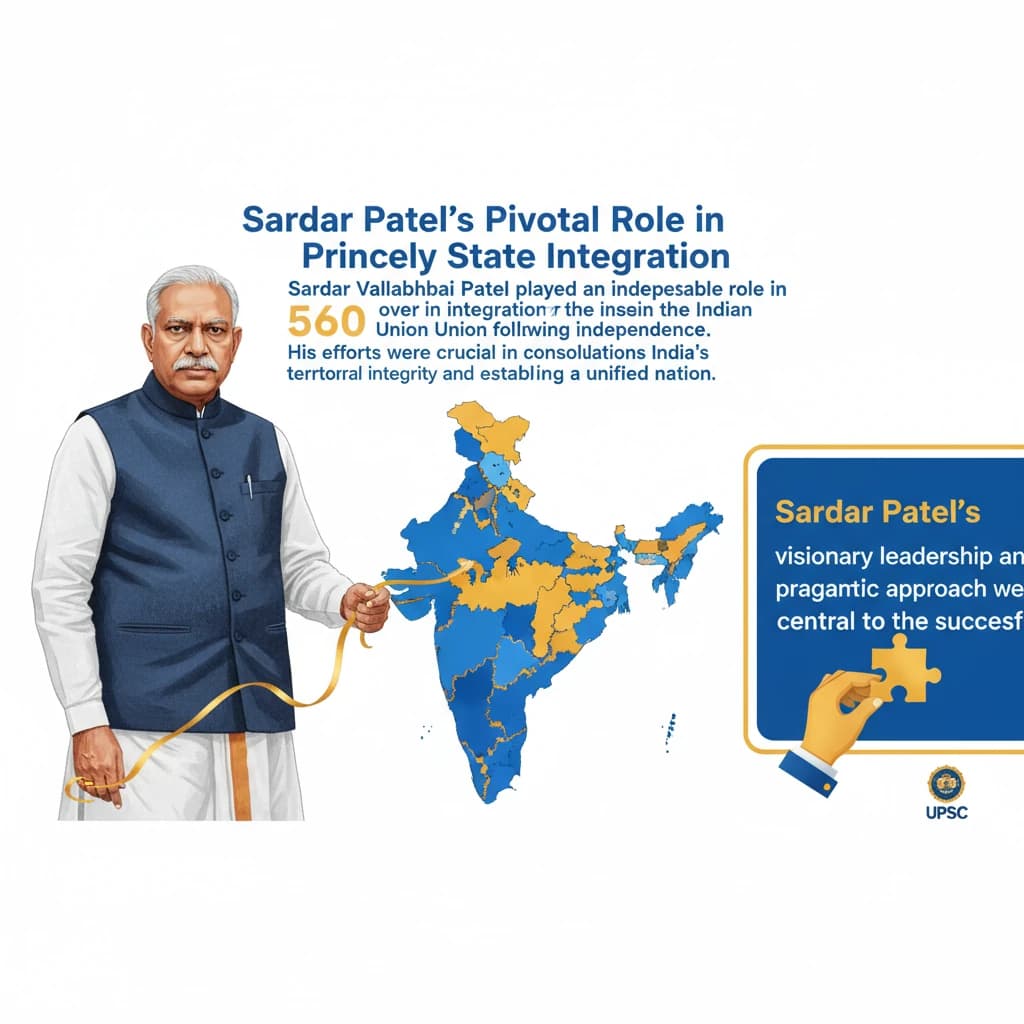
Sardar Patel's Pivotal Role in Princely State Integration
Sardar Vallabhbhai Patel played an indispensable role in the integration of over 560 princely states into the Indian Union following independence.
His efforts were crucial in consolidating India's territorial integrity and establishing a unified nation.
Sardar Patel's visionary leadership and pragmatic approach were central to the successful integration of princely states, ensuring India's unity.
Role in the Interim Government (1946)
On September 2, 1946, Sardar Patel was allocated key portfolios in the Interim Government, even before India gained full independence.
His responsibilities included Home, States, and Information & Broadcasting. This positioning was vital for his future role in state integration.
Nehru's Acknowledgment of Patel's Strength
Just weeks before India gained independence, Jawaharlal Nehru recognized Patel's significant capabilities and indispensable role.
On August 1, 1947, Nehru invited Patel to join his cabinet, famously referring to him as the "strongest pillar of the Cabinet."
Collaboration with Lord Mountbatten
Patel worked closely with the last Viceroy, Lord Mountbatten, to achieve the daunting task of state integration.
Their approach involved a blend of astute diplomacy and strategic pressure to persuade the princes to accede to India.
They effectively warned the Princely States of the inherent perils and unsustainable nature of independent existence in a newly independent India.
Establishment of the States Department (1947)
A critical administrative step was the creation of the States Department on July 5, 1947, specifically for this purpose.
Patel organized this crucial department and appointed V.P. Menon as its secretary, forming a formidable team for the integration process.
The department's primary goal was to secure the accession of states in matters of defence, foreign affairs, and communications.
It also aimed to maintain Standstill Agreements to ensure continuity of common interests and administrative services with the newly formed Indian dominion.
The "Carrot and Stick" Approach
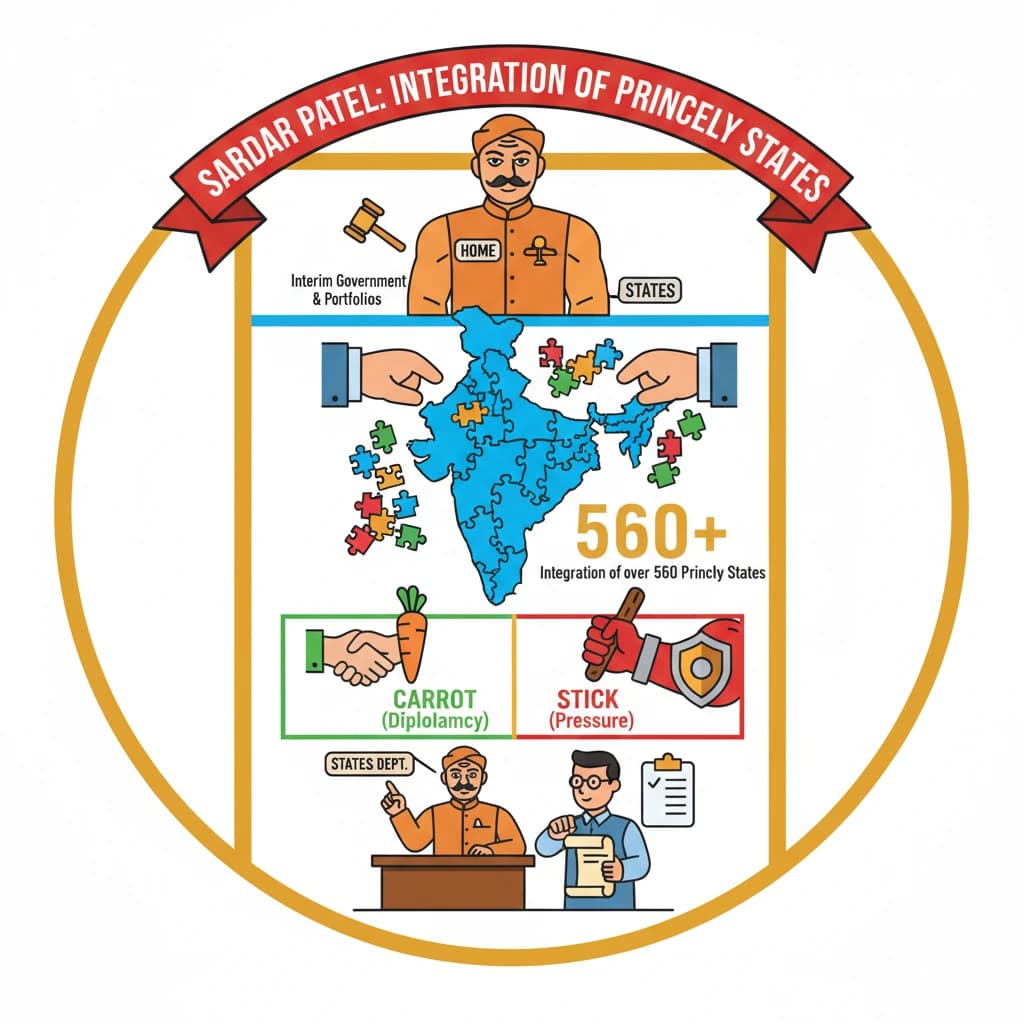
Sardar Patel adopted a balanced strategy, often termed the "Carrot and Stick" approach, in negotiating the accession of states.
This involved a conciliatory and diplomatic stance, offering incentives (the "carrot") while also applying necessary pressure (the "stick") when persuasion failed.
This policy demonstrated Patel's pragmatic statesmanship, balancing reassurance with firmness to achieve the overarching goal of national unity.
Appeal for Friendship and Equality
Patel extended a heartfelt invitation to the princes to join independent India as friends and equals, not as subordinate entities.
He articulated that it was far more beneficial to collaboratively create laws within a unified framework than to establish treaties as separate, smaller entities.
This appeal underscored the vision of a strong, united India where all regions contributed to national progress and shared sovereignty.
"Police Action" in Hyderabad (1948)
The integration of Hyderabad, one of the largest princely states, presented unique and significant challenges, ultimately leading to a decisive intervention.
This operation was referred to as "Police Action" because it was considered an internal matter of India, addressing a grave law and order situation within its borders.
On September 17, 1948, the Nizam of Hyderabad formally surrendered after dismissing his Prime Minister, Mir Laik Ali, and his cabinet, thereby integrating Hyderabad into India.
💡 Key Takeaways
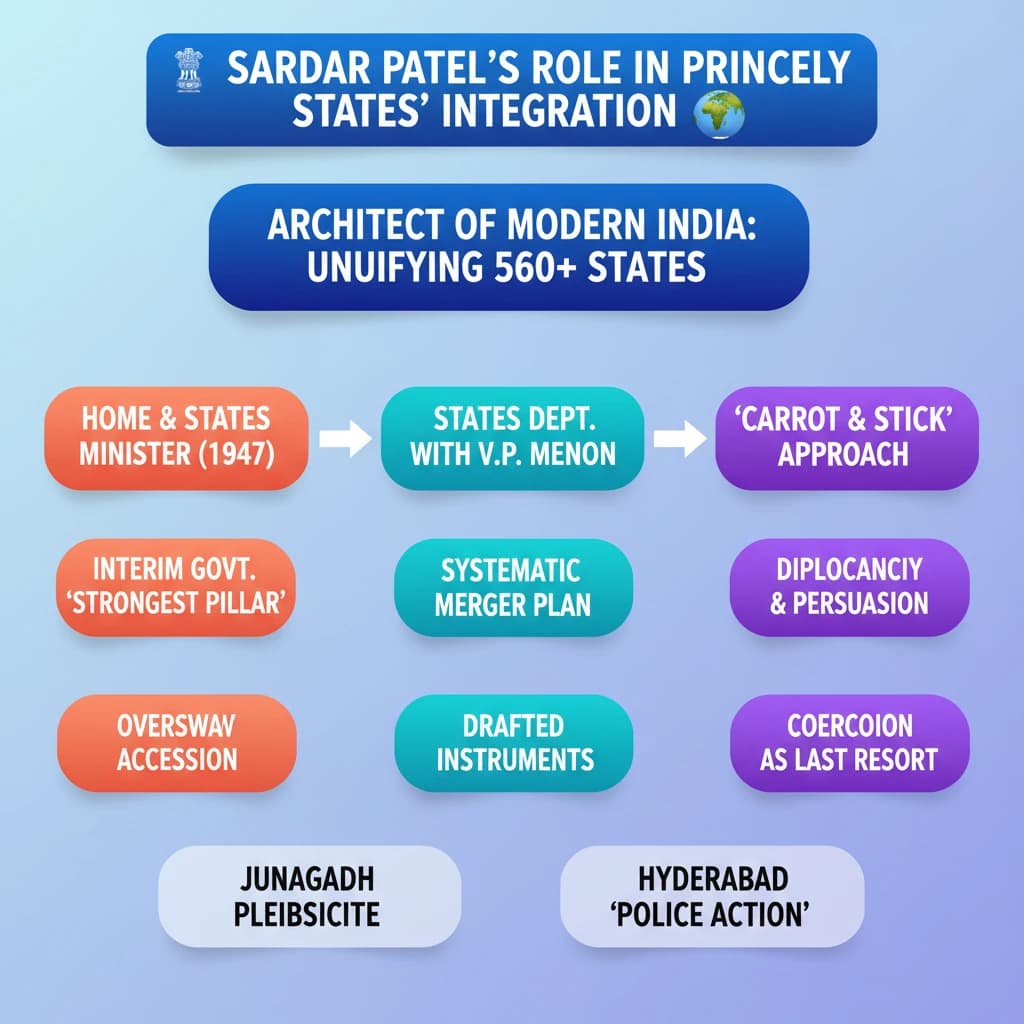
- •Sardar Patel was instrumental in integrating over 560 princely states into the Indian Union.
- •His role began in the Interim Government (Home & States portfolios) and was acknowledged by Nehru as the 'strongest pillar'.
- •He established the States Department with V.P. Menon to systematically manage the accession process.
- •Patel employed a 'Carrot and Stick' approach, balancing diplomacy with firm pressure.
- •Key examples of his integration strategy include Junagadh (plebiscite) and Hyderabad ('Police Action').
- •His efforts ensured India's territorial integrity and prevented the Balkanization of the newly independent nation.
🧠 Memory Techniques
95% Verified Content