Loading page, please wait…
19th NAM Summit and India-Uganda Relations - UPSC International Relations
What is 19th NAM Summit and India-Uganda Relations in UPSC International Relations?
19th NAM Summit and India-Uganda Relations is a key topic under International Relations for UPSC Civil Services Examination. Key points include: The 19th NAM Summit in Kampala, Uganda, saw President Museveni regret Idi Amin's expulsion of Indians.. The summit adopted the Kampala Declaration, condemning Israeli aggression and calling for Gaza aid.. India's EAM advocated for a sustainable solution and humanitarian relief in Gaza.. Understanding this topic is essential for both UPSC Prelims and Mains preparation.
Why is 19th NAM Summit and India-Uganda Relations important for UPSC exam?
19th NAM Summit and India-Uganda Relations is a Medium-level topic in UPSC International Relations. It is tested in both Prelims (factual MCQs) and Mains (analytical answer writing). Previous year UPSC questions have frequently covered aspects of 19th NAM Summit and India-Uganda Relations, making it essential for comprehensive IAS preparation.
How to prepare 19th NAM Summit and India-Uganda Relations for UPSC?
To prepare 19th NAM Summit and India-Uganda Relations for UPSC: (1) Study the comprehensive notes covering all key concepts on Vaidra. (2) Practice previous year questions on this topic. (3) Connect it with current affairs using daily updates. (4) Revise using key takeaways and mind maps available for International Relations. (5) Write practice answers linking 19th NAM Summit and India-Uganda Relations to related GS Paper topics.
Key takeaways of 19th NAM Summit and India-Uganda Relations for UPSC
- The 19th NAM Summit in Kampala, Uganda, saw President Museveni regret Idi Amin's expulsion of Indians.
- The summit adopted the Kampala Declaration, condemning Israeli aggression and calling for Gaza aid.
- India's EAM advocated for a sustainable solution and humanitarian relief in Gaza.
- NAM was founded in 1961 by leaders like Nehru, Tito, Nasser, Nkrumah, and Sukarno during the Cold War.
- NAM aims for states to remain independent and neutral, without aligning with major power blocs.
- India and Uganda share historical ties, with India's freedom struggle inspiring Uganda's independence.
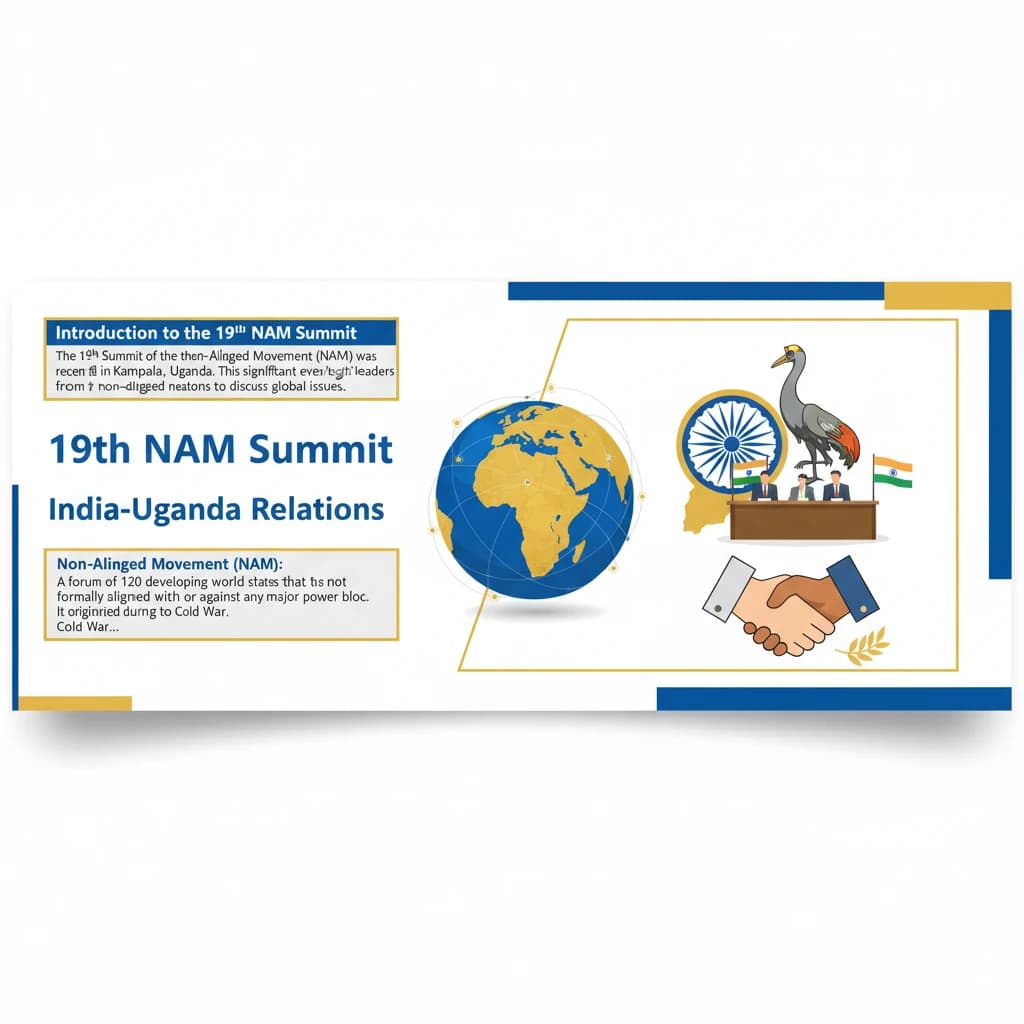
19th NAM Summit and India-Uganda Relations
Medium⏱️ 8 min read
international relations
📖 Introduction
Context of the 19th NAM Summit
The 19th Summit of the Non-Aligned Movement (NAM) was recently held in Kampala, Uganda. This event brought significant attention to India-Uganda relations, particularly a historical incident.
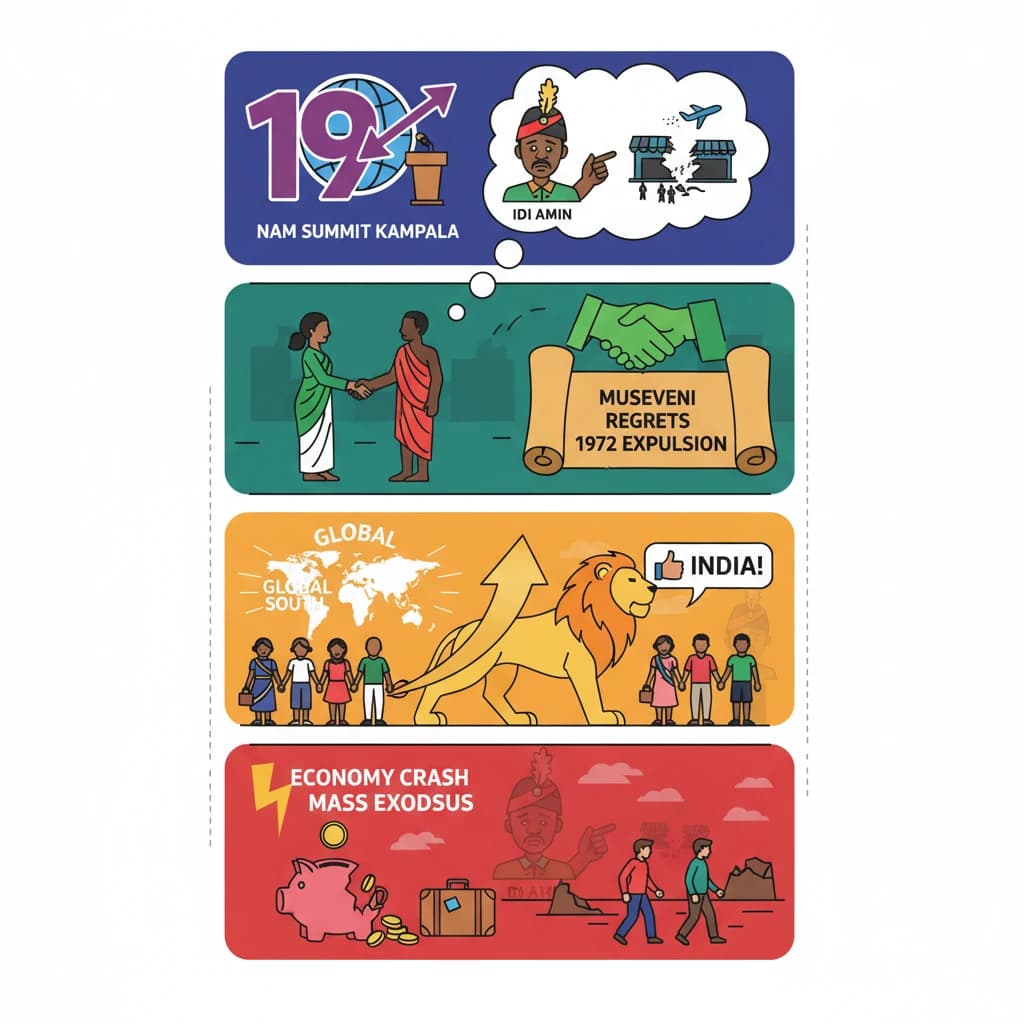
During the summit, Ugandan President Yoweri Museveni expressed regret over the expulsion of Indians by former dictator Idi Amin in the 1970s. He acknowledged the positive contributions of the Indian diaspora in Uganda and commended India's leadership in the Global South.
Idi Amin's Expulsion Order: In August 1972, Idi Amin, then dictator of Uganda, ordered the expulsion of approximately 80,000 Indians and other Asians. This drastic measure had a devastating impact on the Ugandan economy, as these communities were central to the country's commerce and industry.
Key Outcomes of the 19th NAM Summit
The 19th NAM Summit was themed “Deepening Cooperation for Shared Global Affluence”. Uganda assumed the chairmanship of NAM from Azerbaijan, a role it will hold until 2027.
A significant outcome was the adoption of the Kampala Declaration. This declaration strongly condemned Israeli military aggression and called for the immediate implementation of the UN Security Council resolution. The resolution aims to facilitate humanitarian aid into the besieged Gaza Strip.
India's External Affairs Minister (EAM) led the Indian delegation. He advocated for a sustainable solution to the Gaza crisis, emphasizing the urgent need for humanitarian relief. The EAM also urged the international community to prevent the conflict's spread across the wider West Asia region.
The Non-Aligned Movement: Foundation and Principles
The Non-Aligned Movement was formally founded in September 1961 at the First Summit Conference of Belgrade. This followed six years after the preparatory Bandung Conference.
Founding Leaders: NAM was established under the visionary leadership of five key figures:
- Josip Broz Tito of Yugoslavia
- Gamal Abdel Nasser of Egypt
- Jawaharlal Nehru of India
- Kwame Nkrumah of Ghana
- Sukarno of Indonesia
The movement emerged during the intense geopolitical climate of the Cold War. Its primary objective was to create an organization of states that would not formally align with either the United States or the Soviet Union. Instead, these states sought to maintain their independence and neutrality in global affairs.
NAM operates without a permanent secretariat or a formal founding charter, act, or treaty. Its summits are typically held every three years to discuss and coordinate member states' positions on global issues.
Evolution of India-Uganda Relations
India and Uganda share a deep historical relationship spanning over a century. The initial influx of Indians to Uganda began at the start of the 20th century.
India's freedom struggle served as a significant inspiration for early Ugandan activists in their fight against colonization. This shared history culminated in Uganda achieving its independence in 1962.
India officially established its diplomatic presence in Uganda in 1965, solidifying the bilateral ties between the two nations.
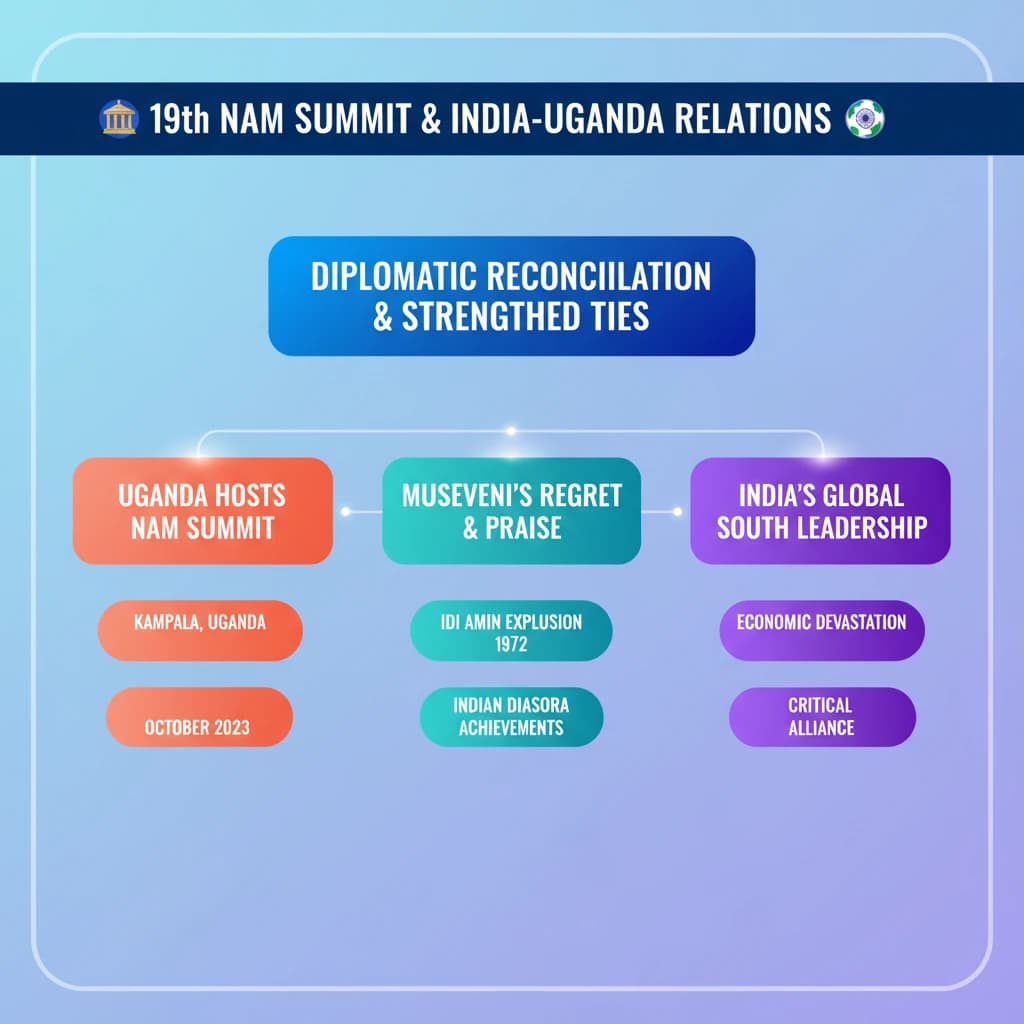
💡 Key Takeaways
- •The 19th NAM Summit in Kampala, Uganda, saw President Museveni regret Idi Amin's expulsion of Indians.
- •The summit adopted the Kampala Declaration, condemning Israeli aggression and calling for Gaza aid.
- •India's EAM advocated for a sustainable solution and humanitarian relief in Gaza.
- •NAM was founded in 1961 by leaders like Nehru, Tito, Nasser, Nkrumah, and Sukarno during the Cold War.
- •NAM aims for states to remain independent and neutral, without aligning with major power blocs.
- •India and Uganda share historical ties, with India's freedom struggle inspiring Uganda's independence.
🧠 Memory Techniques
95% Verified Content
📚 Reference Sources
•General knowledge on Non-Aligned Movement (NAM) and India-Uganda relations