Loading page, please wait…
Brazil Declines Belt and Road Initiative - UPSC International Relations
What is Brazil Declines Belt and Road Initiative in UPSC International Relations?
Brazil Declines Belt and Road Initiative is a key topic under International Relations for UPSC Civil Services Examination. Key points include: Brazil declined China's Belt and Road Initiative (BRI), becoming the second BRICS nation after India to do so.. The decision was made despite strong economic ties between Brazil and China.. BRI is China's strategic initiative to connect Asia, Africa, and Europe via land (Silk Road Economic Belt) and maritime (Maritime Silk Road) networks.. Understanding this topic is essential for both UPSC Prelims and Mains preparation.
Why is Brazil Declines Belt and Road Initiative important for UPSC exam?
Brazil Declines Belt and Road Initiative is a Medium-level topic in UPSC International Relations. It is tested in both Prelims (factual MCQs) and Mains (analytical answer writing). Previous year UPSC questions have frequently covered aspects of Brazil Declines Belt and Road Initiative, making it essential for comprehensive IAS preparation.
How to prepare Brazil Declines Belt and Road Initiative for UPSC?
To prepare Brazil Declines Belt and Road Initiative for UPSC: (1) Study the comprehensive notes covering all key concepts on Vaidra. (2) Practice previous year questions on this topic. (3) Connect it with current affairs using daily updates. (4) Revise using key takeaways and mind maps available for International Relations. (5) Write practice answers linking Brazil Declines Belt and Road Initiative to related GS Paper topics.
Key takeaways of Brazil Declines Belt and Road Initiative for UPSC
- Brazil declined China's Belt and Road Initiative (BRI), becoming the second BRICS nation after India to do so.
- The decision was made despite strong economic ties between Brazil and China.
- BRI is China's strategic initiative to connect Asia, Africa, and Europe via land (Silk Road Economic Belt) and maritime (Maritime Silk Road) networks.
- BRI aims to improve regional integration, increase trade, and stimulate economic growth.
- Brazil's refusal highlights concerns over national sovereignty, potential debt burdens, and strategic autonomy in global partnerships.
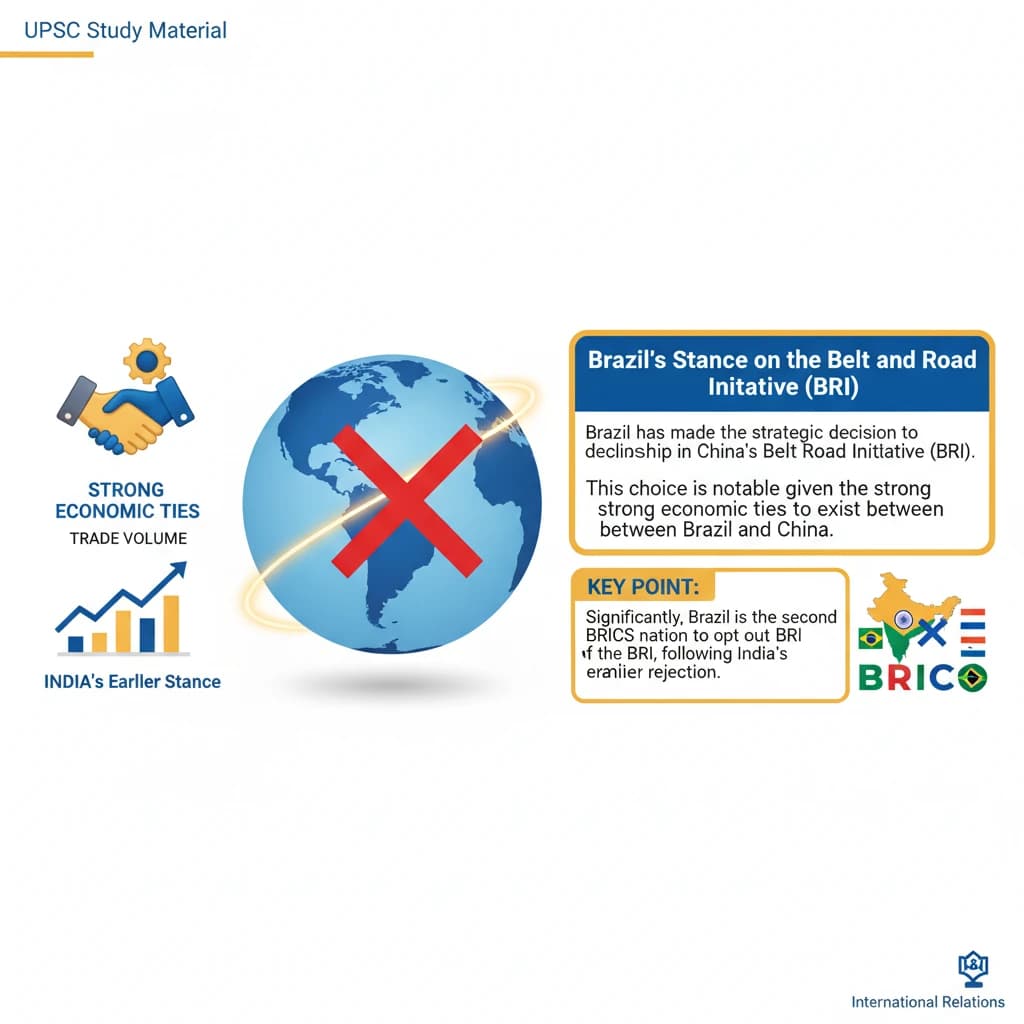
Brazil Declines Belt and Road Initiative
Medium⏱️ 7 min read
international relations
📖 Introduction
Brazil's Stance on the Belt and Road Initiative (BRI)
Brazil has made the strategic decision to decline membership in China's Belt and Road Initiative (BRI).
This choice is notable given the strong economic ties that exist between Brazil and China.
Significantly, Brazil is the second BRICS nation to opt out of the BRI, following India's earlier refusal to join the initiative.
Understanding the Belt and Road Initiative (BRI)
The Belt and Road Initiative (BRI) is a monumental strategic initiative spearheaded by China.
BRI's Core Aim: To establish extensive land and maritime networks connecting Asia with Africa and Europe.
The overarching objectives of the BRI include enhancing regional integration, boosting global trade, and stimulating economic growth across participating countries.
Key Components of the BRI
The BRI is structured around two primary components, each focusing on different modes of connectivity:
- Silk Road Economic Belt: This component concentrates on improving connectivity, infrastructure, and trade links across Eurasia. It primarily utilizes a network of overland transportation routes.
- Maritime Silk Road: This segment is designed to strengthen maritime connections and cooperation. Its routes commence in the South China Sea, extending through Indo-China and Southeast Asia, and then across the Indian Ocean to Africa and Europe.
Major Economic Corridors under BRI
The BRI's development strategy is supported by several critical economic corridors:
- China-Pakistan Economic Corridor (CPEC)
- New Eurasian Land Bridge Economic Corridor
- China-Indochina Peninsula Economic Corridor
- China-Mongolia-Russia Economic Corridor
- China-Central Asia-West Asia Economic Corridor
- China-Myanmar Economic Corridor
UPSC Insight: Understanding why key countries like Brazil and India, despite strong economic relations with China, decline participation in BRI is crucial. This reflects concerns over sovereignty, debt sustainability, and geopolitical implications, which are vital for GS Paper 2 (International Relations).
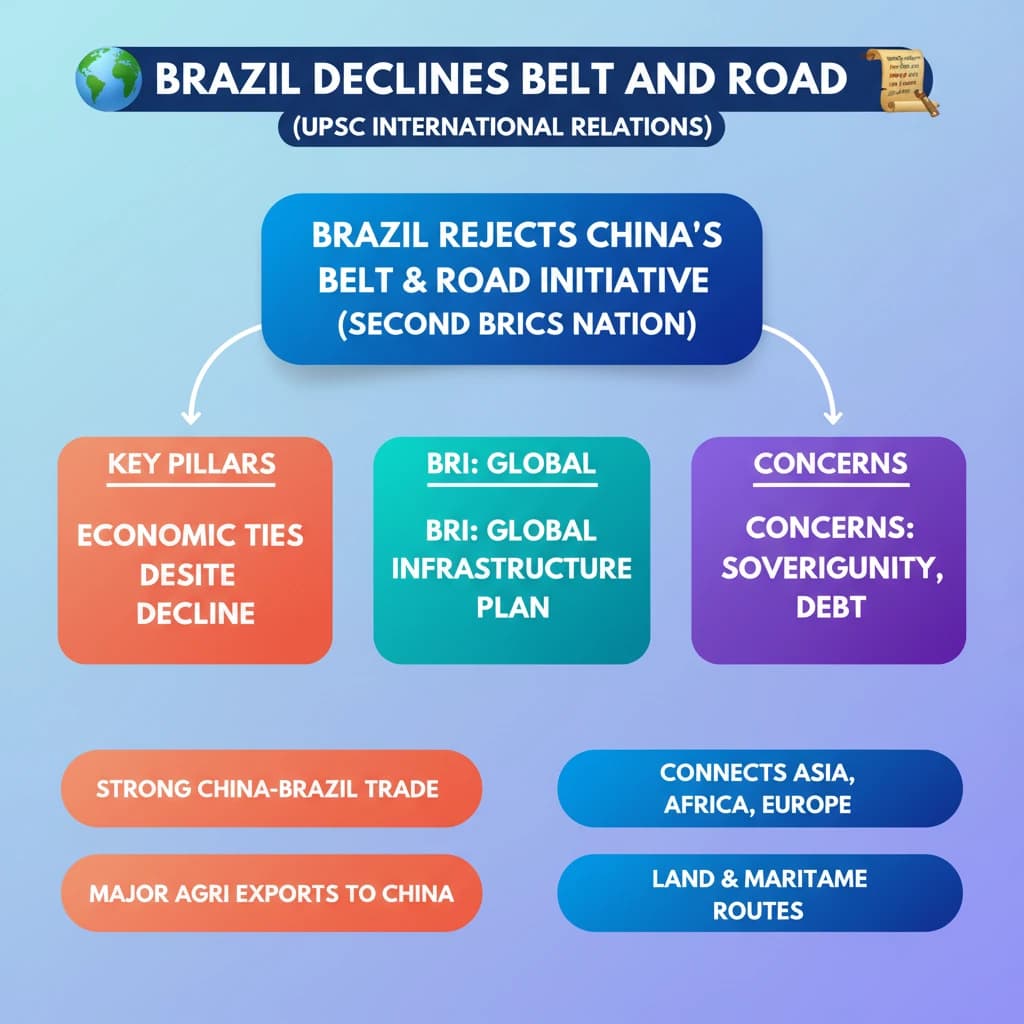
💡 Key Takeaways
- •Brazil declined China's Belt and Road Initiative (BRI), becoming the second BRICS nation after India to do so.
- •The decision was made despite strong economic ties between Brazil and China.
- •BRI is China's strategic initiative to connect Asia, Africa, and Europe via land (Silk Road Economic Belt) and maritime (Maritime Silk Road) networks.
- •BRI aims to improve regional integration, increase trade, and stimulate economic growth.
- •Brazil's refusal highlights concerns over national sovereignty, potential debt burdens, and strategic autonomy in global partnerships.
🧠 Memory Techniques
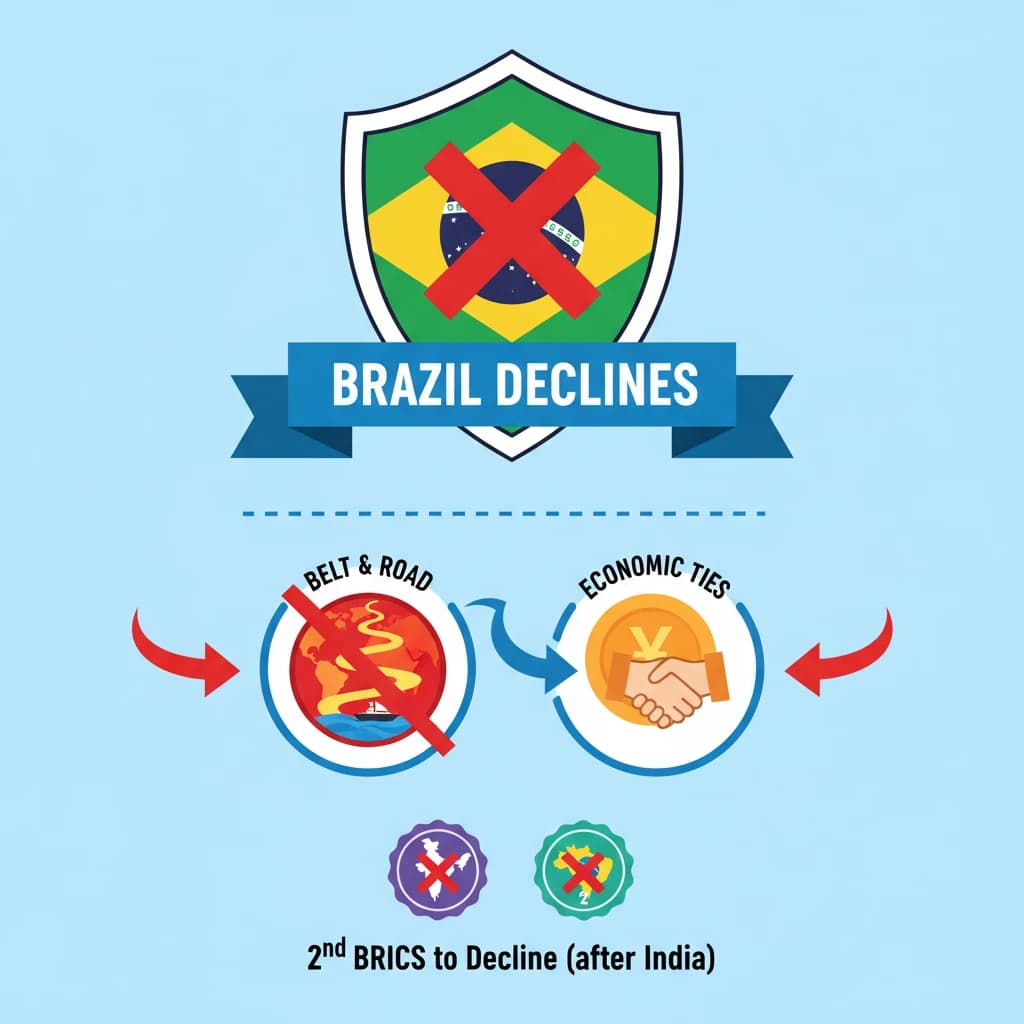
95% Verified Content
📚 Reference Sources
•Official statements and reports from Brazilian government on foreign policy
•Academic analyses and reputable news reports on the Belt and Road Initiative and its global reception
•BRICS summit declarations and related policy documents