Loading page, please wait…
China’s ‘Xiaokang’ Border Defence Villages along the LAC - UPSC International Relations
What is China’s ‘Xiaokang’ Border Defence Villages along the LAC in UPSC International Relations?
China’s ‘Xiaokang’ Border Defence Villages along the LAC is a key topic under International Relations for UPSC Civil Services Examination. Key points include: Xiaokang villages are China's 'well-off' border settlements with dual civilian-military use.. They are strategically built in disputed areas like Arunachal Pradesh (Lohit Valley, Tawang).. India views them as a threat, asserting territorial claims and increasing militarization.. Understanding this topic is essential for both UPSC Prelims and Mains preparation.
Why is China’s ‘Xiaokang’ Border Defence Villages along the LAC important for UPSC exam?
China’s ‘Xiaokang’ Border Defence Villages along the LAC is a Medium-level topic in UPSC International Relations. It is tested in both Prelims (factual MCQs) and Mains (analytical answer writing). Previous year UPSC questions have frequently covered aspects of China’s ‘Xiaokang’ Border Defence Villages along the LAC, making it essential for comprehensive IAS preparation.
How to prepare China’s ‘Xiaokang’ Border Defence Villages along the LAC for UPSC?
To prepare China’s ‘Xiaokang’ Border Defence Villages along the LAC for UPSC: (1) Study the comprehensive notes covering all key concepts on Vaidra. (2) Practice previous year questions on this topic. (3) Connect it with current affairs using daily updates. (4) Revise using key takeaways and mind maps available for International Relations. (5) Write practice answers linking China’s ‘Xiaokang’ Border Defence Villages along the LAC to related GS Paper topics.
Key takeaways of China’s ‘Xiaokang’ Border Defence Villages along the LAC for UPSC
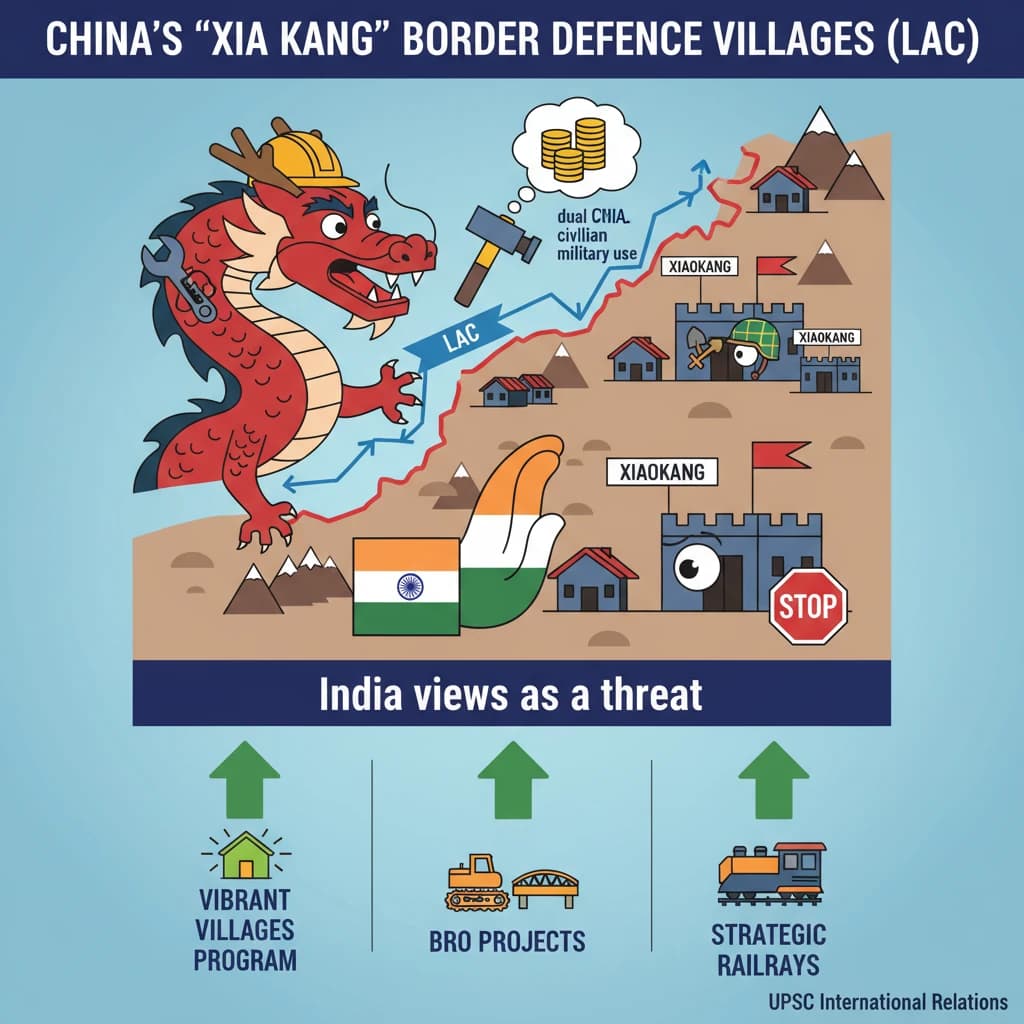
- Xiaokang villages are China's 'well-off' border settlements with dual civilian-military use.
- They are strategically built in disputed areas like Arunachal Pradesh (Lohit Valley, Tawang).
- India views them as a threat, asserting territorial claims and increasing militarization.
- India's response includes the Vibrant Villages Program, BRO projects, and strategic railway lines.
- The issue highlights China's grey-zone tactics and India's intensified border infrastructure development since 2019.
China’s ‘Xiaokang’ Border Defence Villages along the LAC
Medium⏱️ 8 min read
international relations
📖 Introduction
Context and Recent Developments
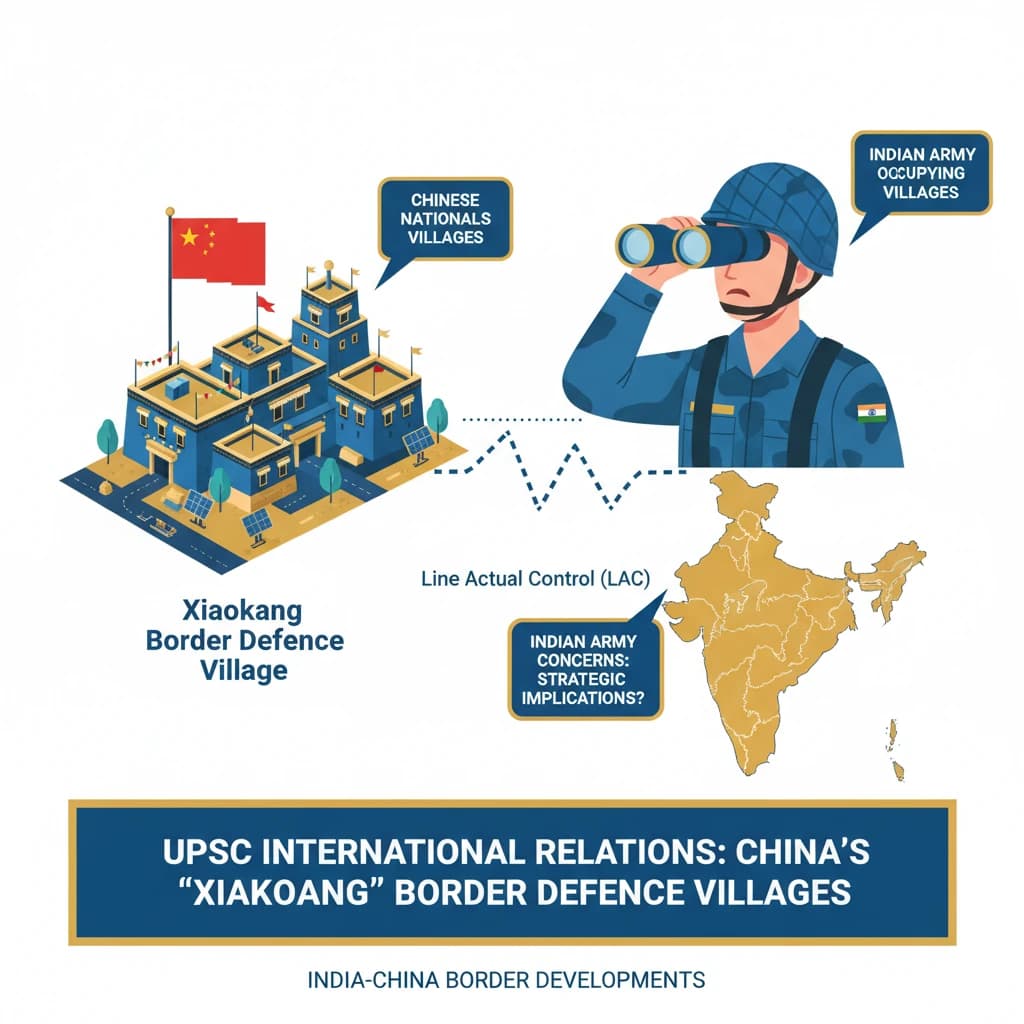
In recent times, Chinese nationals have begun to occupy previously vacant “Xiaokang” border defence villages along the Line of Actual Control (LAC) between India and China. These developments have raised significant concerns for the Indian Army.
The primary worries revolve around the nature of the occupants and the broader strategic implications of these settlements.
Key Event: Chinese nationals occupying Xiaokang villages along the LAC.
Indian Concern: Nature of occupants and strategic implications.
Understanding “Xiaokang” Border Defence Villages
The Xiaokang, or “well-off villages”, are a crucial part of China’s strategic infrastructure development initiative. They are specifically located along its borders, particularly the LAC with India.
These villages are strategically built in regions where territorial claims are contested or where China perceives a need to reinforce its sovereignty.
Notable Occupation Areas: Villages opposite Lohit Valley and the Tawang sector in Arunachal Pradesh.
Dual-Use Infrastructure: A Strategic Design
A defining characteristic of these villages is their dual-use infrastructure. This means they are designed to serve multiple purposes simultaneously.
They function both as civilian settlements and potentially as locations for military presence, allowing for flexible deployment and resource utilization.
Dual-Use: Combines civilian settlement with potential military presence.
Associated Concerns for India
The establishment and occupation of these villages present several significant challenges and concerns for India.
- Territorial Claims: China’s construction of 628 such villages along India’s borders with the Tibet Autonomous Region is seen as a concerted effort to assert and solidify territorial claims along the LAC. This necessitates heightened vigilance from Indian military strategists.
- Military Implications: The inherent dual-use nature of these villages raises serious concerns about increased militarisation along the already tense LAC. This could escalate border tensions.
- Uncertain Intentions: A lack of transparency from China regarding the specific purpose and the scale of the civilian population in these villages creates deep suspicion. This opacity significantly hinders any efforts towards trust-building between the two nations.
UPSC Insight: The Xiaokang villages are a classic example of grey-zone tactics used by states to alter ground realities without direct military confrontation. Understanding their dual-use nature is crucial for analyzing India-China border dynamics.
India’s Counter Initiatives along the LAC
In direct response to China’s infrastructure development, India has significantly intensified its own efforts to enhance border infrastructure since 2019.
- Vibrant Villages Program: This program aims to modernise 663 border villages. Specifically, 17 villages have been selected for development along the China-India border in regions such as Ladakh, Himachal Pradesh, Uttarakhand, Sikkim, and Arunachal Pradesh.
- Border Roads Organization (BRO): The BRO has completed 90 infrastructure projects along the India-China border, with a total value of Rs 2,941 crore. As of September 2023, 36 projects are in Arunachal Pradesh, 26 in Ladakh, and 11 in Jammu and Kashmir.
- Major Highway Projects: The BRO is actively involved in constructing key highways, including the Trans-Arunachal Highway, Frontier Highway, and East-West Industrial Corridor Highway. These projects aim to improve connectivity, especially in eastern Arunachal Pradesh and the Tawang region.
- Border Area Development Programme (BADP): This is a centrally sponsored scheme designed to address the special developmental needs of people living in remote and inaccessible areas near the international border. Funds from BADP can be utilized for projects related to Infrastructure, Livelihood, Education, Health, Agriculture, and allied sectors.
- Railways: Indian Railways is constructing strategic rail lines in the Northeast region. The primary objective is to facilitate the swift mobilisation of the Indian Army, enhancing rapid response capabilities.
💡 Key Takeaways
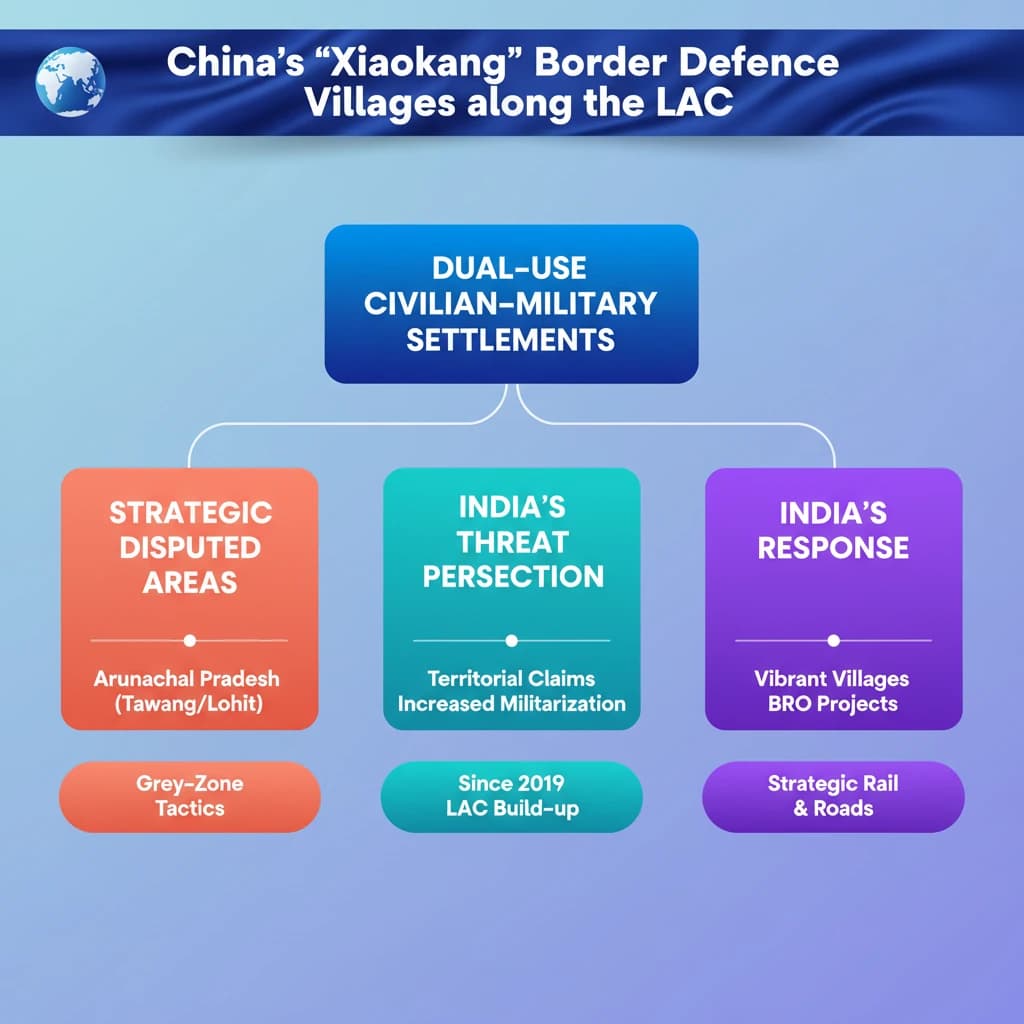
- •Xiaokang villages are China's 'well-off' border settlements with dual civilian-military use.
- •They are strategically built in disputed areas like Arunachal Pradesh (Lohit Valley, Tawang).
- •India views them as a threat, asserting territorial claims and increasing militarization.
- •India's response includes the Vibrant Villages Program, BRO projects, and strategic railway lines.
- •The issue highlights China's grey-zone tactics and India's intensified border infrastructure development since 2019.
🧠 Memory Techniques
95% Verified Content