Loading page, please wait…
Dispute Settlement Body (DSB) - UPSC International Relations
What is Dispute Settlement Body (DSB) in UPSC International Relations?
Dispute Settlement Body (DSB) is a key topic under International Relations for UPSC Civil Services Examination. Key points include: The Dispute Settlement Body (DSB) is the WTO's central authority for resolving trade disputes among member countries.. It comprises all WTO members and makes decisions by 'negative consensus' (decisions adopted unless all members object).. The DSB has sole authority to establish expert panels, accept/reject findings, monitor implementation, and authorize retaliation for non-compliance.. Understanding this topic is essential for both UPSC Prelims and Mains preparation.
Why is Dispute Settlement Body (DSB) important for UPSC exam?
Dispute Settlement Body (DSB) is a Medium-level topic in UPSC International Relations. It is tested in both Prelims (factual MCQs) and Mains (analytical answer writing). Previous year UPSC questions have frequently covered aspects of Dispute Settlement Body (DSB), making it essential for comprehensive IAS preparation.
How to prepare Dispute Settlement Body (DSB) for UPSC?
To prepare Dispute Settlement Body (DSB) for UPSC: (1) Study the comprehensive notes covering all key concepts on Vaidra. (2) Practice previous year questions on this topic. (3) Connect it with current affairs using daily updates. (4) Revise using key takeaways and mind maps available for International Relations. (5) Write practice answers linking Dispute Settlement Body (DSB) to related GS Paper topics.
Key takeaways of Dispute Settlement Body (DSB) for UPSC
- The Dispute Settlement Body (DSB) is the WTO's central authority for resolving trade disputes among member countries.
- It comprises all WTO members and makes decisions by 'negative consensus' (decisions adopted unless all members object).
- The DSB has sole authority to establish expert panels, accept/reject findings, monitor implementation, and authorize retaliation for non-compliance.
- The WTO Appellate Body (WTOAB) reviews panel rulings but is currently non-functional due to the US blocking appointments of new members.
- Over 20 disputes are pending at the Appellate Body, significantly challenging the effectiveness and credibility of the multilateral trading system.
Dispute Settlement Body (DSB)
Medium⏱️ 8 min read
international relations
📖 Introduction
Introduction to the Dispute Settlement Body (DSB)
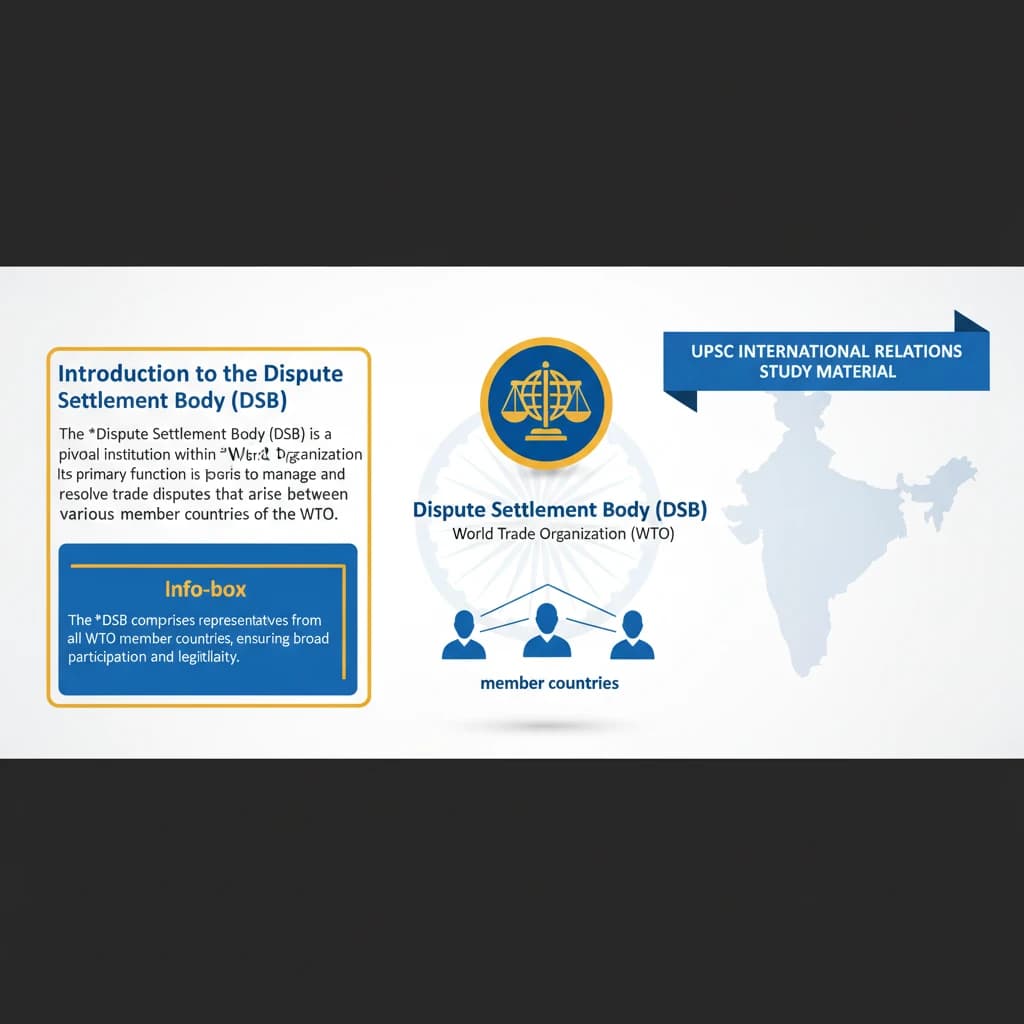
The Dispute Settlement Body (DSB) is a pivotal institution within the World Trade Organization (WTO). Its primary function is to manage and resolve trade disputes that arise between various member countries of the WTO.
The DSB comprises representatives from all WTO member countries, ensuring broad participation and legitimacy in its decision-making processes regarding international trade disagreements.
Decision-Making by Consensus
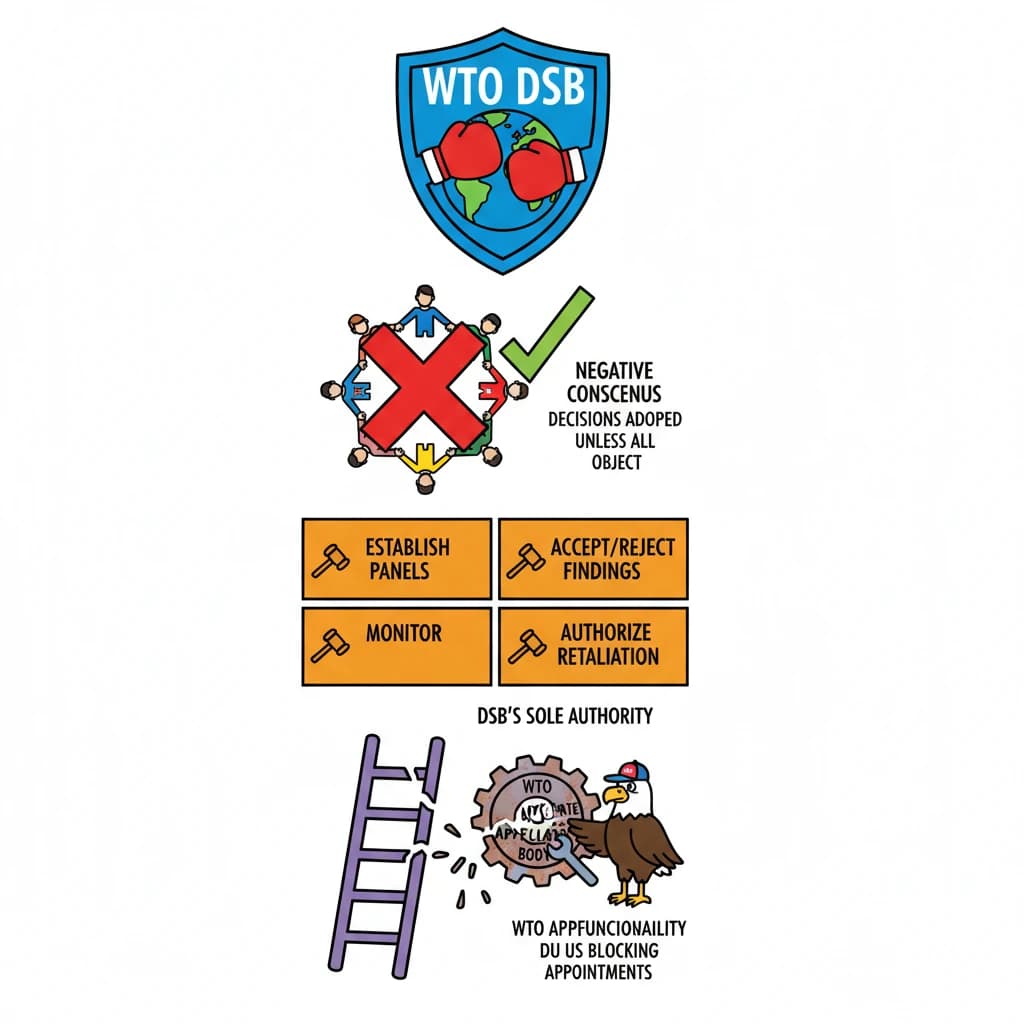
A distinctive feature of the DSB's operation is its decision-making mechanism. All decisions made by the DSB are achieved through consensus. This means that a decision is adopted unless there is an explicit objection from all members present.
The consensus rule implies that a decision is adopted unless *all* members explicitly object, a mechanism often referred to as 'reverse consensus' or 'negative consensus', making it difficult to block rulings.
Powers and Authority of the DSB
The DSB holds exclusive authority over several critical stages of the dispute settlement process. This centralized power ensures consistency and adherence to WTO rules.
- It has the sole authority to establish panels of experts. These panels are tasked with thoroughly examining specific trade disputes brought before the WTO.
- The DSB also possesses the power to either accept or reject the findings presented by these expert panels. This oversight ensures the integrity of the dispute resolution process.
- Furthermore, it can accept or reject the results of an appeal, once a panel's finding has been reviewed by the Appellate Body.
Monitoring and Enforcement
Beyond initial rulings, the DSB plays a crucial role in ensuring compliance with its decisions. It actively monitors how member countries implement the rulings and recommendations issued.
In cases where a country fails to comply with a ruling, the DSB is empowered to authorize retaliation. This can involve allowing the aggrieved country to impose trade sanctions on the non-compliant member, providing a robust mechanism for enforcement.
The Appellate Body and Its Current Crisis
Panel rulings or reports can be challenged at the WTO's Appellate Body (WTOAB). The Appellate Body serves as the highest judicial authority in the WTO's dispute settlement system, reviewing points of law in panel reports.
UPSC Insight: Currently, the WTO Appellate Body is not functioning. This critical situation stems from significant differences among member countries regarding the appointment of new members to this body.
The United States (US) has been consistently blocking the appointment of new members, leading to a shortage of judges required for the Appellate Body to hear new cases. As a result, over 20 disputes are presently pending without resolution at the Appellate Body level.
The paralysis of the Appellate Body represents a major challenge to the rule-based multilateral trading system and is a frequently discussed topic in international relations and global governance.
💡 Key Takeaways
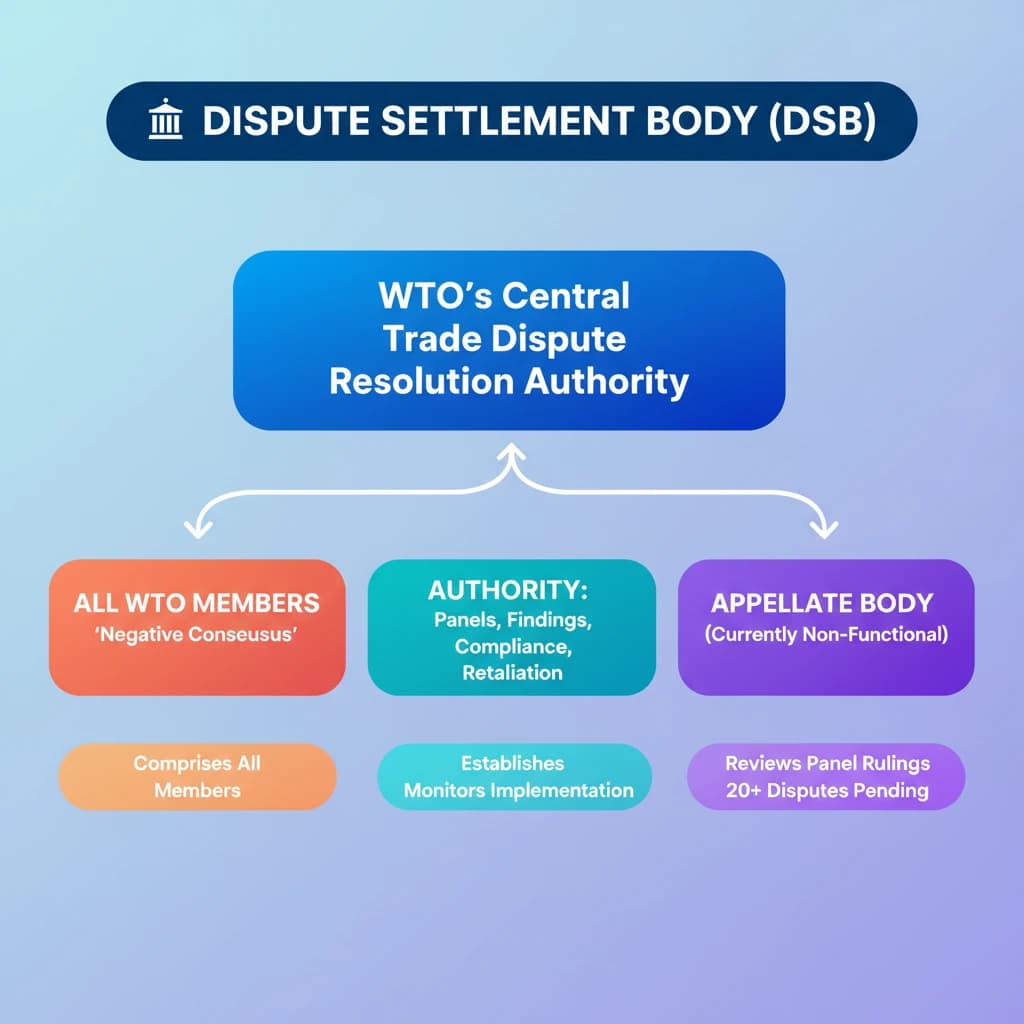
- •The Dispute Settlement Body (DSB) is the WTO's central authority for resolving trade disputes among member countries.
- •It comprises all WTO members and makes decisions by 'negative consensus' (decisions adopted unless all members object).
- •The DSB has sole authority to establish expert panels, accept/reject findings, monitor implementation, and authorize retaliation for non-compliance.
- •The WTO Appellate Body (WTOAB) reviews panel rulings but is currently non-functional due to the US blocking appointments of new members.
- •Over 20 disputes are pending at the Appellate Body, significantly challenging the effectiveness and credibility of the multilateral trading system.
🧠 Memory Techniques
95% Verified Content
📚 Reference Sources
•World Trade Organization (WTO) official website (for general structure and functions and Appellate Body status)