Loading page, please wait…
East Asia Summit - UPSC International Relations
What is East Asia Summit in UPSC International Relations?
East Asia Summit is a key topic under International Relations for UPSC Civil Services Examination. Key points include: EAS is a premier leaders-led forum with 18 members, including 10 ASEAN states and 8 dialogue partners (India, US, China, Russia, Japan, South Korea, Australia, New Zealand).. Economically, EAS members represent 53% of world population and 60% of global GDP; India-ASEAN trade exceeds USD 130 billion.. Strategically, EAS is vital for India's Act East Policy, supporting connectivity projects like the India-Myanmar-Thailand Highway and Kaladan Multi-Modal Transit Transport.. Understanding this topic is essential for both UPSC Prelims and Mains preparation.
Why is East Asia Summit important for UPSC exam?
East Asia Summit is a Medium-level topic in UPSC International Relations. It is tested in both Prelims (factual MCQs) and Mains (analytical answer writing). Previous year UPSC questions have frequently covered aspects of East Asia Summit, making it essential for comprehensive IAS preparation.
How to prepare East Asia Summit for UPSC?
To prepare East Asia Summit for UPSC: (1) Study the comprehensive notes covering all key concepts on Vaidra. (2) Practice previous year questions on this topic. (3) Connect it with current affairs using daily updates. (4) Revise using key takeaways and mind maps available for International Relations. (5) Write practice answers linking East Asia Summit to related GS Paper topics.
Key takeaways of East Asia Summit for UPSC
- EAS is a premier leaders-led forum with 18 members, including 10 ASEAN states and 8 dialogue partners (India, US, China, Russia, Japan, South Korea, Australia, New Zealand).
- Economically, EAS members represent 53% of world population and 60% of global GDP; India-ASEAN trade exceeds USD 130 billion.
- Strategically, EAS is vital for India's Act East Policy, supporting connectivity projects like the India-Myanmar-Thailand Highway and Kaladan Multi-Modal Transit Transport.
- Culturally, India leverages shared Buddhist heritage, with initiatives like Nalanda University restoration strengthening ties with Myanmar, Thailand, and Cambodia.
- EAS facilitates comprehensive dialogue on political, security, and economic issues, upholding ASEAN centrality and contributing to regional stability and prosperity.
East Asia Summit
Medium⏱️ 7 min read
international relations
📖 Introduction
Introduction to the East Asia Summit (EAS)
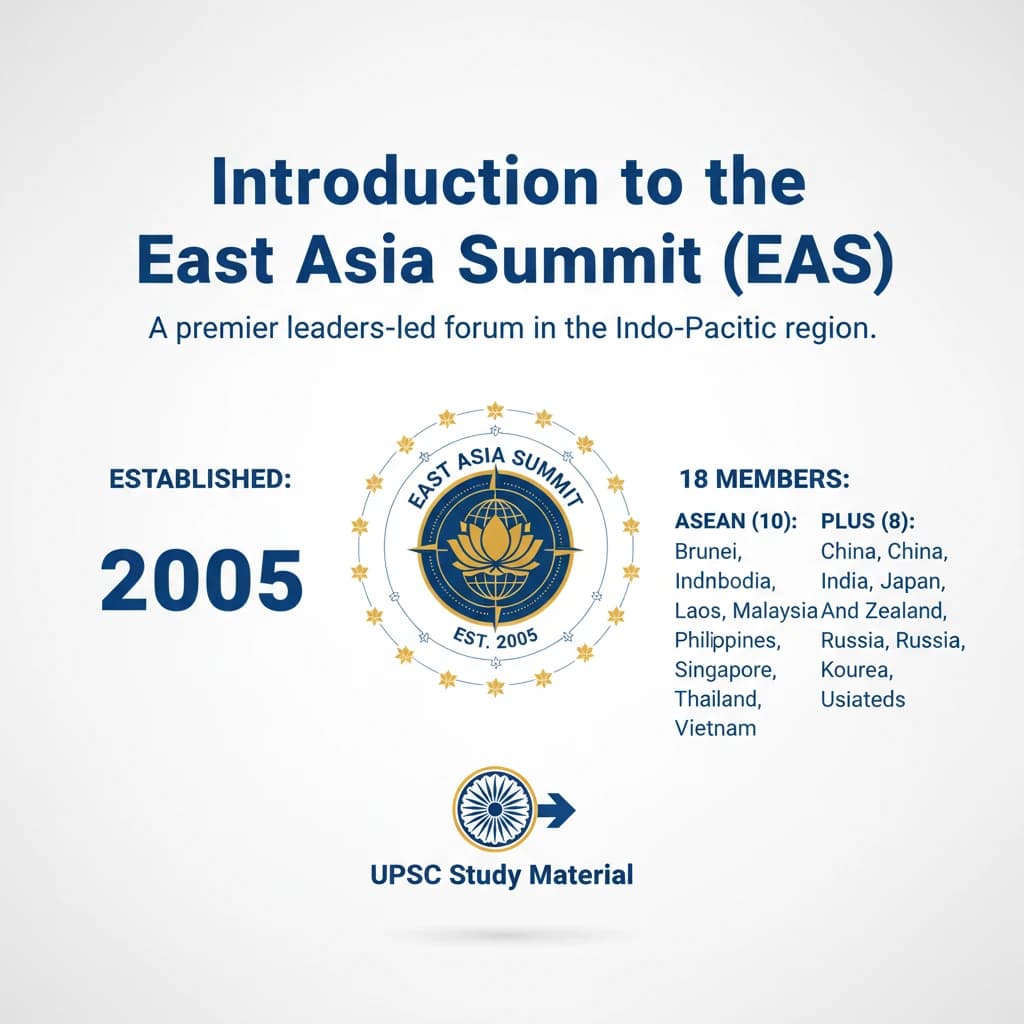
The East Asia Summit (EAS) is a premier leaders-led forum in the Indo-Pacific region. It serves as a platform for strategic dialogue and cooperation on key political, security, and economic challenges.
Established in 2005, the EAS comprises 18 members: the ten ASEAN member states (Brunei Darussalam, Cambodia, Indonesia, Lao PDR, Malaysia, Myanmar, Philippines, Singapore, Thailand, Vietnam) and eight dialogue partners (Australia, China, India, Japan, New Zealand, Republic of Korea, Russia, and the United States).
The EAS plays a crucial role in fostering regional stability and prosperity by addressing issues of common interest and concern.
Economic Importance of EAS
The EAS member countries collectively represent a significant portion of the global economy. Their combined economic power makes the forum vital for international trade and investment.
In 2023, EAS members accounted for approximately 53% of the world's population and contributed roughly 60% of global GDP.
India's economic ties with ASEAN, a core component of EAS, are particularly strong. ASEAN is India's fourth-largest trading partner, highlighting the robust commercial relationship.
India is ASEAN's seventh-largest trading partner. Over the last decade, India-ASEAN trade has more than doubled, reaching over USD 130 billion.
Strategic Importance of EAS
The EAS is strategically vital for India's foreign policy, particularly its Act East Policy. It provides a platform for enhancing connectivity and security in the Southeast Asian region.
Connectivity projects, encompassing both physical infrastructure and digital links, are central to India's engagement. These initiatives aim to boost regional integration and strengthen ties with East Asian nations.
Major initiatives include the India-Myanmar-Thailand Trilateral Highway and the Kaladan Multi-Modal Transit Transport Project. These projects are crucial for improving regional links.
Beyond infrastructure, India also focuses on capacity-building through programs like the Indian Technical and Economic Cooperation (ITEC). This initiative supports countries such as Cambodia, Laos, and Vietnam.
Understanding the strategic projects like Kaladan Multi-Modal Transit Transport is key for questions on India's connectivity initiatives and Act East Policy in GS Paper 2.
Cultural Importance of EAS
Cultural ties form another significant pillar of India's engagement with EAS nations. Buddhism, originating in India, serves as a major cultural and religious bridge connecting many Southeast Asian and East Asian countries.
India actively promotes these shared heritage links. Initiatives like the restoration of Nalanda University and support for the International Buddhist Confederation reinforce these spiritual and cultural bonds.
These efforts enhance India's cultural diplomacy with nations such as Myanmar, Thailand, and Cambodia, showcasing its commitment to promoting Buddhist traditions globally.
💡 Key Takeaways
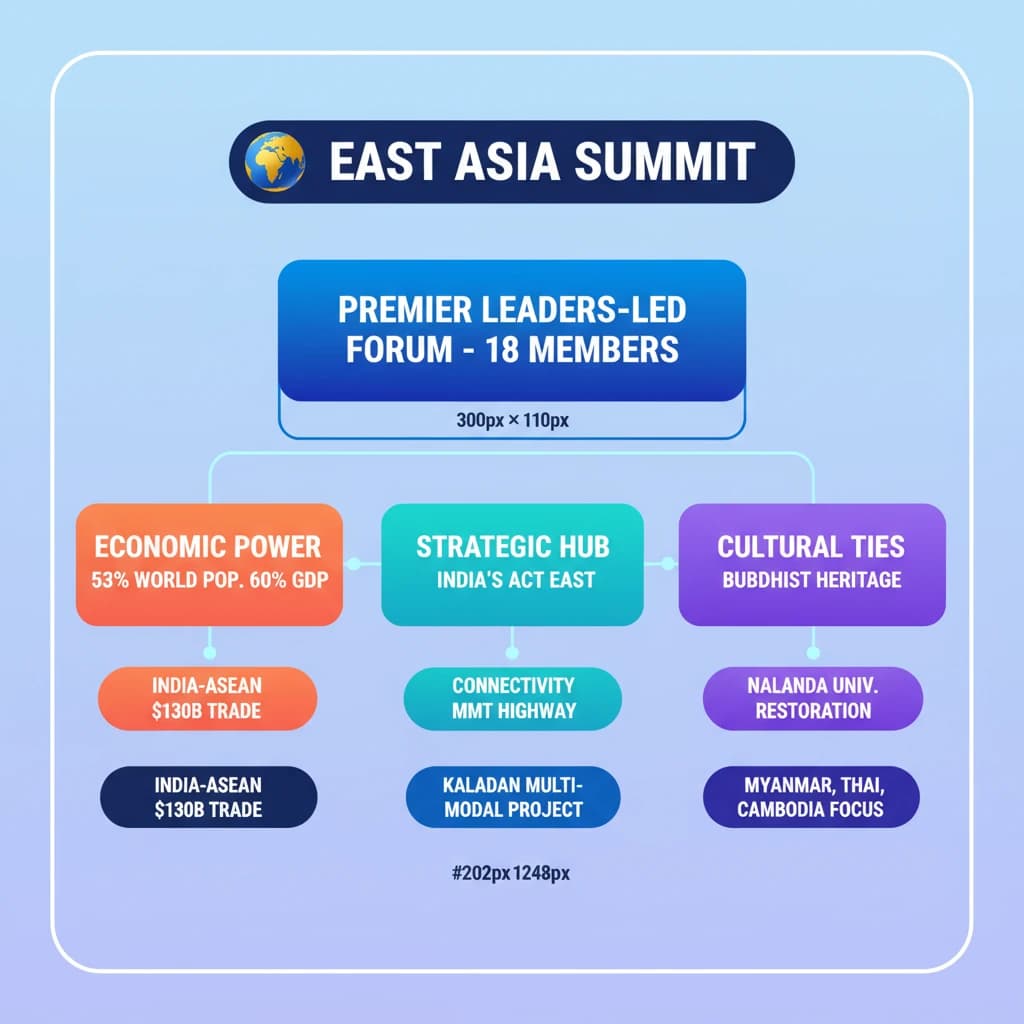
- •EAS is a premier leaders-led forum with 18 members, including 10 ASEAN states and 8 dialogue partners (India, US, China, Russia, Japan, South Korea, Australia, New Zealand).
- •Economically, EAS members represent 53% of world population and 60% of global GDP; India-ASEAN trade exceeds USD 130 billion.
- •Strategically, EAS is vital for India's Act East Policy, supporting connectivity projects like the India-Myanmar-Thailand Highway and Kaladan Multi-Modal Transit Transport.
- •Culturally, India leverages shared Buddhist heritage, with initiatives like Nalanda University restoration strengthening ties with Myanmar, Thailand, and Cambodia.
- •EAS facilitates comprehensive dialogue on political, security, and economic issues, upholding ASEAN centrality and contributing to regional stability and prosperity.
🧠 Memory Techniques
98% Verified Content
📚 Reference Sources
•Official ASEAN and Ministry of External Affairs (India) publications for general EAS context and membership details.