Loading page, please wait…
Gulf Cooperation Council (GCC) - UPSC International Relations
What is Gulf Cooperation Council (GCC) in UPSC International Relations?
Gulf Cooperation Council (GCC) is a key topic under International Relations for UPSC Civil Services Examination. Key points include: The GCC is a 6-nation regional organization (Saudi Arabia, UAE, Oman, Kuwait, Qatar, Bahrain) established in 1981.. Its primary aim is to promote cooperation, integration, and interconnectivity based on regional and cultural proximity.. GCC economies are heavily reliant on oil and natural gas exports, making them crucial for global energy security.. Understanding this topic is essential for both UPSC Prelims and Mains preparation.
Why is Gulf Cooperation Council (GCC) important for UPSC exam?
Gulf Cooperation Council (GCC) is a Medium-level topic in UPSC International Relations. It is tested in both Prelims (factual MCQs) and Mains (analytical answer writing). Previous year UPSC questions have frequently covered aspects of Gulf Cooperation Council (GCC), making it essential for comprehensive IAS preparation.
How to prepare Gulf Cooperation Council (GCC) for UPSC?
To prepare Gulf Cooperation Council (GCC) for UPSC: (1) Study the comprehensive notes covering all key concepts on Vaidra. (2) Practice previous year questions on this topic. (3) Connect it with current affairs using daily updates. (4) Revise using key takeaways and mind maps available for International Relations. (5) Write practice answers linking Gulf Cooperation Council (GCC) to related GS Paper topics.
Key takeaways of Gulf Cooperation Council (GCC) for UPSC
- The GCC is a 6-nation regional organization (Saudi Arabia, UAE, Oman, Kuwait, Qatar, Bahrain) established in 1981.
- Its primary aim is to promote cooperation, integration, and interconnectivity based on regional and cultural proximity.
- GCC economies are heavily reliant on oil and natural gas exports, making them crucial for global energy security.
- The Persian Gulf region, home to GCC, holds the world's largest proven oil and gas reserves.
- The Strait of Hormuz, a narrow chokepoint, is vital for global oil shipping from the Persian Gulf.
- The GCC plays a significant role in regional stability and is a key partner for India's energy and economic interests.
Gulf Cooperation Council (GCC)
Medium⏱️ 7 min read
international relations
📖 Introduction
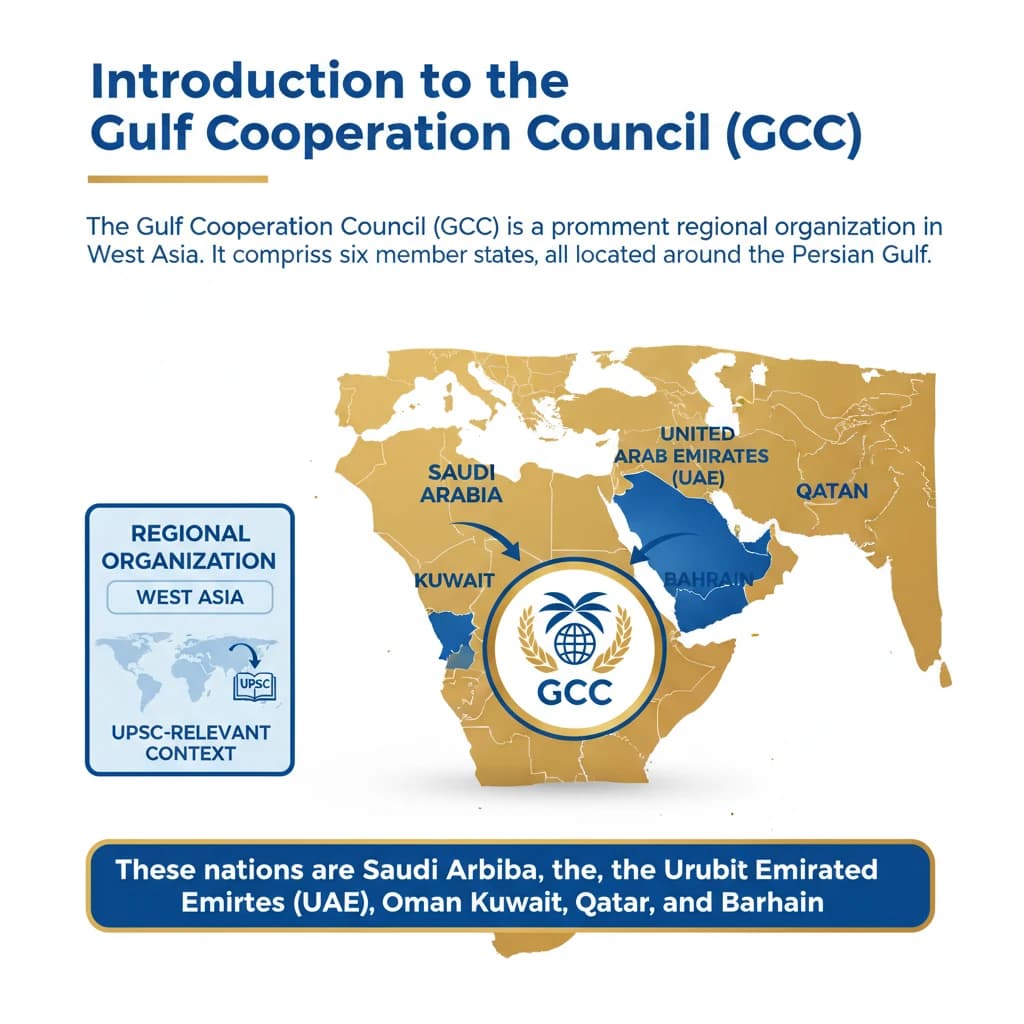
Introduction to the Gulf Cooperation Council (GCC)
The Gulf Cooperation Council (GCC) is a prominent regional organization in West Asia. It comprises six member states, all located around the Persian Gulf.
These nations are Saudi Arabia, the United Arab Emirates (UAE), Oman, Kuwait, Qatar, and Bahrain.
Establishment: The GCC was founded in 1981.
Primary Aim: To foster cooperation, integration, and interconnectivity among its member states. This is based on their shared regional and cultural proximity.
Economic Backbone: Oil and Gas Exports
The GCC countries are significantly reliant on their vast oil resources. These have historically been the primary driver of their economies.
Currently, the main source of revenue for these nations is derived from the export of oil and natural gas.
Economic Reliance: For decades, oil resources have served as the fundamental backbone of the GCC member states' economies.
The Broader Persian Gulf Region
The Persian Gulf region encompasses a wider geographical area than just the GCC. It is shared by eight countries, all of which are members of the United Nations.
These eight nations are Bahrain, Iran, Iraq, Kuwait, Oman, Qatar, Saudi Arabia, and the United Arab Emirates (UAE).
- GCC Members: UAE, Bahrain, Saudi Arabia, Oman, Qatar, Kuwait.
- OPEC Members from Persian Gulf: Iran, Iraq, Kuwait, UAE, and Saudi Arabia are also part of the Organization of the Petroleum Exporting Countries (OPEC).
Strategic Importance of the Persian Gulf
The Persian Gulf is globally recognized as one of the most strategically important regions. Its significance stems from two critical factors.
Global Significance: The Persian Gulf plays a pivotal role in global geopolitics and energy security due to its immense natural resources and critical maritime routes.
Vast Oil and Gas Reserves
The region surrounding the Persian Gulf holds the world's largest proven reserves of both oil and natural gas.
Energy Hub: This makes the Persian Gulf an indispensable source of energy, supplying a significant portion of the world's energy demands.
Critical Shipping Lane and Chokepoint
The Persian Gulf serves as a vital shipping lane for the global export of oil. This waterway facilitates the transportation of energy resources from the region to international markets.
Strait of Hormuz: A particularly crucial segment is the Strait of Hormuz. This narrow waterway, situated between Iran and Oman, acts as a chokepoint through which a substantial volume of the world's oil transits daily.
UPSC Insight: Understanding the strategic importance of the Persian Gulf and the Strait of Hormuz is crucial for topics like International Relations (GS-II), Energy Security (GS-III), and Geopolitics. Questions often relate to global trade routes and resource control.

💡 Key Takeaways
- •The GCC is a 6-nation regional organization (Saudi Arabia, UAE, Oman, Kuwait, Qatar, Bahrain) established in 1981.
- •Its primary aim is to promote cooperation, integration, and interconnectivity based on regional and cultural proximity.
- •GCC economies are heavily reliant on oil and natural gas exports, making them crucial for global energy security.
- •The Persian Gulf region, home to GCC, holds the world's largest proven oil and gas reserves.
- •The Strait of Hormuz, a narrow chokepoint, is vital for global oil shipping from the Persian Gulf.
- •The GCC plays a significant role in regional stability and is a key partner for India's energy and economic interests.
🧠 Memory Techniques
95% Verified Content
📚 Reference Sources
•General knowledge of international relations and geography