Loading page, please wait…
India-Bangladesh Relations Amid Political Turmoil in Bangladesh - UPSC International Relations
What is India-Bangladesh Relations Amid Political Turmoil in Bangladesh in UPSC International Relations?
India-Bangladesh Relations Amid Political Turmoil in Bangladesh is a key topic under International Relations for UPSC Civil Services Examination. Key points include: India-Bangladesh relations are historically rooted in the 1971 Liberation War but have faced periods of strain.. Recent political turmoil in Bangladesh, including Sheikh Hasina's resignation, significantly impacts regional stability.. India's national security is directly linked to Bangladesh's internal political situation.. Understanding this topic is essential for both UPSC Prelims and Mains preparation.
Why is India-Bangladesh Relations Amid Political Turmoil in Bangladesh important for UPSC exam?
India-Bangladesh Relations Amid Political Turmoil in Bangladesh is a Medium-level topic in UPSC International Relations. It is tested in both Prelims (factual MCQs) and Mains (analytical answer writing). Previous year UPSC questions have frequently covered aspects of India-Bangladesh Relations Amid Political Turmoil in Bangladesh, making it essential for comprehensive IAS preparation.
How to prepare India-Bangladesh Relations Amid Political Turmoil in Bangladesh for UPSC?
To prepare India-Bangladesh Relations Amid Political Turmoil in Bangladesh for UPSC: (1) Study the comprehensive notes covering all key concepts on Vaidra. (2) Practice previous year questions on this topic. (3) Connect it with current affairs using daily updates. (4) Revise using key takeaways and mind maps available for International Relations. (5) Write practice answers linking India-Bangladesh Relations Amid Political Turmoil in Bangladesh to related GS Paper topics.
Key takeaways of India-Bangladesh Relations Amid Political Turmoil in Bangladesh for UPSC
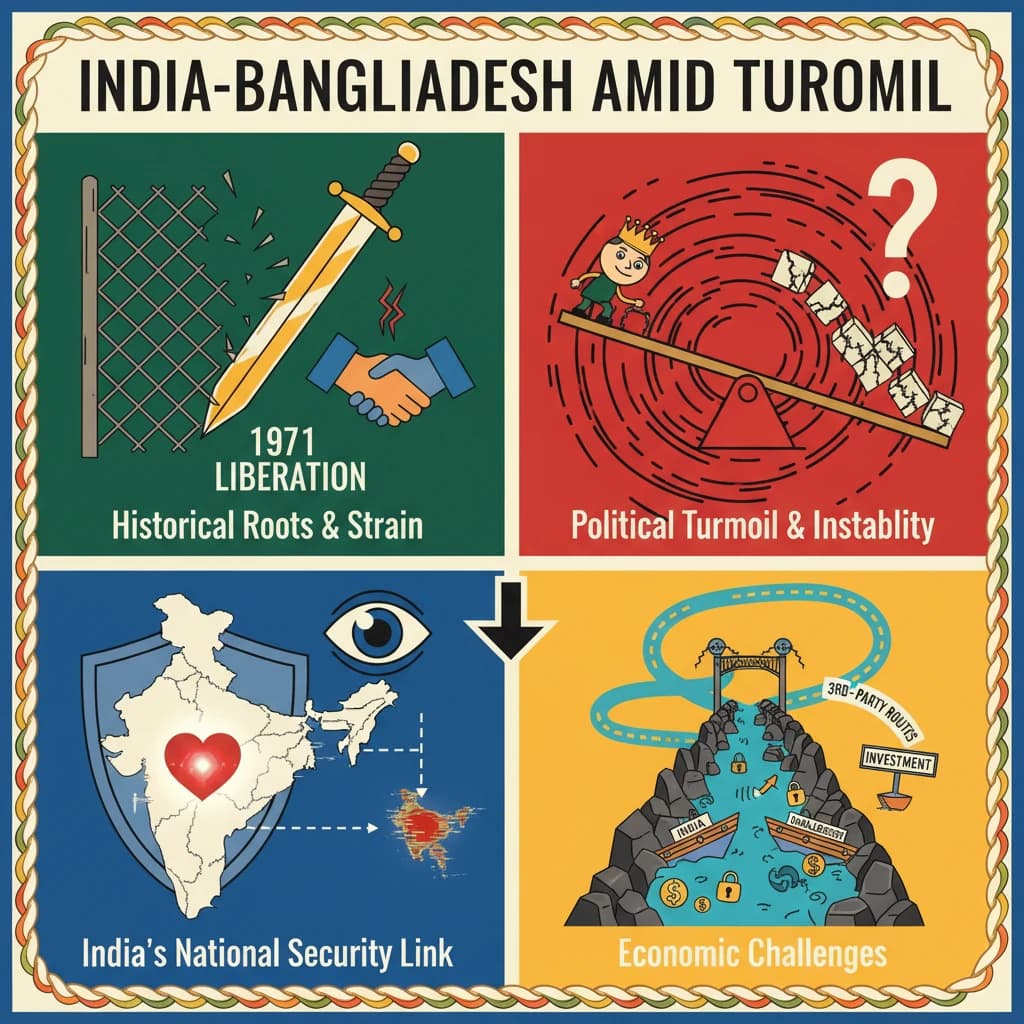
- India-Bangladesh relations are historically rooted in the 1971 Liberation War but have faced periods of strain.
- Recent political turmoil in Bangladesh, including Sheikh Hasina's resignation, significantly impacts regional stability.
- India's national security is directly linked to Bangladesh's internal political situation.
- Economic challenges like limited cross-border investment and reliance on third-party trade routes hinder bilateral growth.
- China's increasing presence in Pakistan and the broader region adds a complex geopolitical dimension to India-Bangladesh ties.
India-Bangladesh Relations Amid Political Turmoil in Bangladesh
Medium⏱️ 7 min read
international relations
📖 Introduction
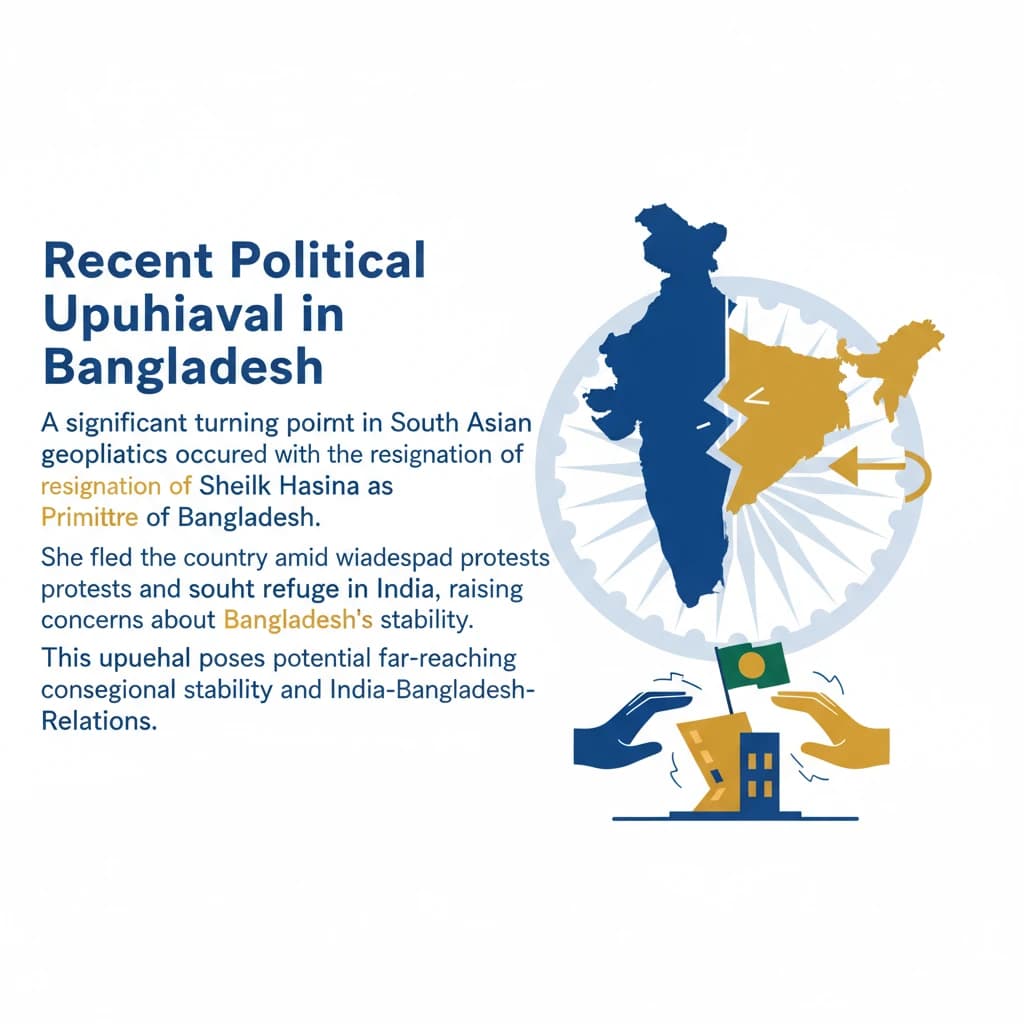
Recent Political Upheaval in Bangladesh
A significant turning point in South Asian geopolitics occurred with the resignation of Sheikh Hasina as Prime Minister of Bangladesh.
She fled the country amid widespread protests and sought refuge in India, raising concerns about Bangladesh's stability.
This upheaval poses potential far-reaching consequences for regional stability and India's national security.
Foundational Ties: The 1971 Liberation War
The bedrock of India's relationship with Bangladesh was established during the 1971 Bangladesh Liberation War.
India provided crucial military and material support, aiding Bangladesh in its struggle for independence from Pakistan.
Challenges and Deterioration Post-1975
Despite the initial strong ties, relations between the two nations soured within a few years after the war.
The rise of military regimes in Bangladesh led to an increase in anti-India sentiment by the mid-1970s.
Key issues that strained relations included boundary disputes, cross-border insurgency, and disagreements over water sharing.
Economic Impediments to Bilateral Growth
One significant challenge is the limited cross-border investment. Political tensions and security concerns actively discourage joint ventures and investments between businesses in both countries.
Limited Cross-border Investment: Political tensions and security concerns hinder joint ventures and investments between businesses in India and Bangladesh.
Both economies also face challenges due to dependence on third-party trade routes. Relying on routes outside the immediate region increases operational costs and reduces overall efficiency.
Third-Party Trade Routes: Reliance on non-regional trade routes escalates costs and diminishes efficiency for both Indian and Bangladeshi economies.
Regional Geopolitical Dynamics
The increasing presence and investment of China in Pakistan significantly impact regional geopolitics.
Projects like the China-Pakistan Economic Corridor (CPEC) raise concerns for India regarding strategic alliances and the regional balance of power.
China's Role in Pakistan: Increased Chinese investment and projects like CPEC in Pakistan are a strategic concern for India, influencing the regional balance of power.
Related Geopolitical Context: India-Pakistan Dynamics
In 2019, following the Pulwama terrorist incident, India revoked Pakistan's Most Favored Nation (MFN) designation.
Concurrently, India imposed a substantial 200% tariff on imports originating from Pakistan.
Pulwama Incident (2019): India removed Pakistan's MFN status and imposed a 200% tariff on Pakistani imports after the Pulwama terrorist attack.
💡 Key Takeaways
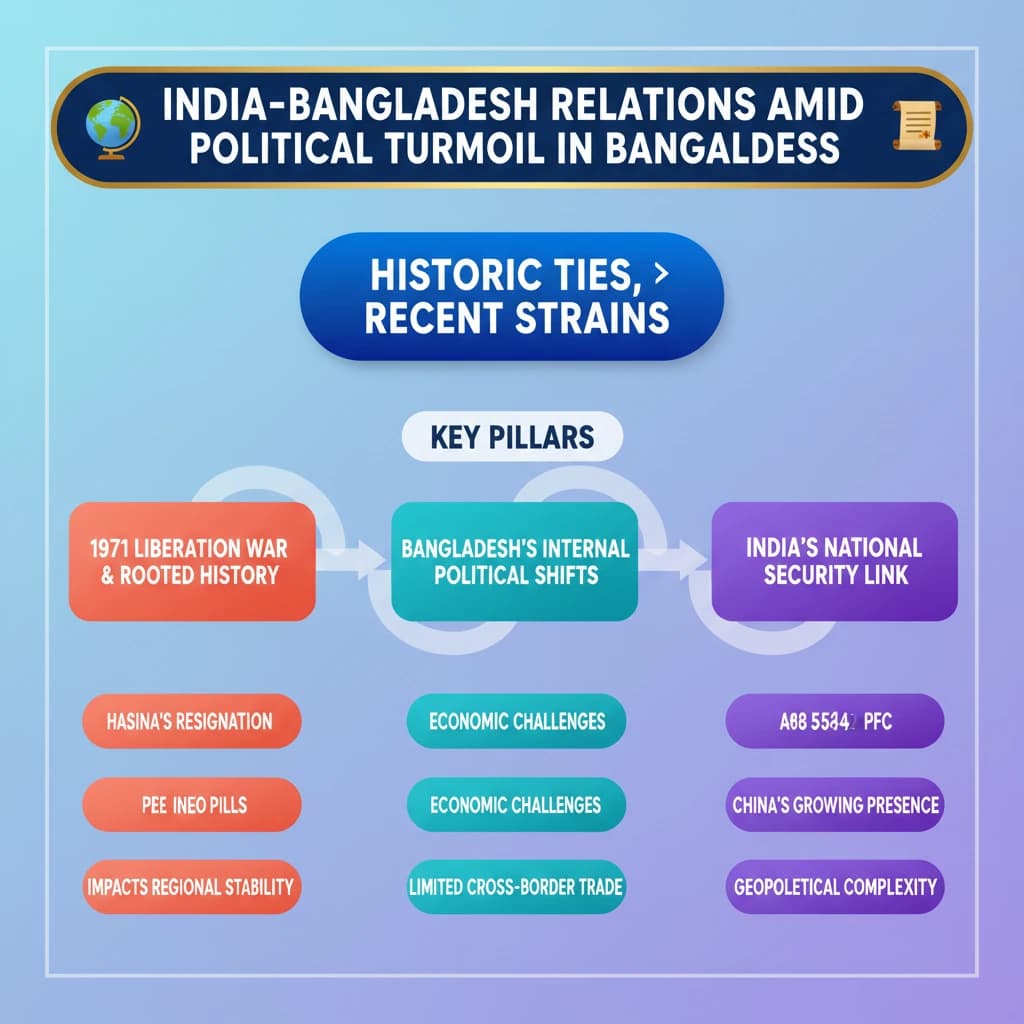
- •India-Bangladesh relations are historically rooted in the 1971 Liberation War but have faced periods of strain.
- •Recent political turmoil in Bangladesh, including Sheikh Hasina's resignation, significantly impacts regional stability.
- •India's national security is directly linked to Bangladesh's internal political situation.
- •Economic challenges like limited cross-border investment and reliance on third-party trade routes hinder bilateral growth.
- •China's increasing presence in Pakistan and the broader region adds a complex geopolitical dimension to India-Bangladesh ties.
🧠 Memory Techniques
95% Verified Content