Loading page, please wait…
India Rejects China’s Claim Over Arunachal Pradesh - UPSC International Relations
What is India Rejects China’s Claim Over Arunachal Pradesh in UPSC International Relations?
India Rejects China’s Claim Over Arunachal Pradesh is a key topic under International Relations for UPSC Civil Services Examination. Key points include: India firmly rejects China's claims over Arunachal Pradesh, asserting its integral status.. China refers to Arunachal Pradesh as 'Zangnan' and claims it as 'South Tibet'.. The India-China border is 3,488 km long, with major disputes in Aksai Chin (western) and Arunachal Pradesh (eastern).. Understanding this topic is essential for both UPSC Prelims and Mains preparation.
Why is India Rejects China’s Claim Over Arunachal Pradesh important for UPSC exam?
India Rejects China’s Claim Over Arunachal Pradesh is a Medium-level topic in UPSC International Relations. It is tested in both Prelims (factual MCQs) and Mains (analytical answer writing). Previous year UPSC questions have frequently covered aspects of India Rejects China’s Claim Over Arunachal Pradesh, making it essential for comprehensive IAS preparation.
How to prepare India Rejects China’s Claim Over Arunachal Pradesh for UPSC?
To prepare India Rejects China’s Claim Over Arunachal Pradesh for UPSC: (1) Study the comprehensive notes covering all key concepts on Vaidra. (2) Practice previous year questions on this topic. (3) Connect it with current affairs using daily updates. (4) Revise using key takeaways and mind maps available for International Relations. (5) Write practice answers linking India Rejects China’s Claim Over Arunachal Pradesh to related GS Paper topics.
Key takeaways of India Rejects China’s Claim Over Arunachal Pradesh for UPSC
- India firmly rejects China's claims over Arunachal Pradesh, asserting its integral status.
- China refers to Arunachal Pradesh as 'Zangnan' and claims it as 'South Tibet'.
- The India-China border is 3,488 km long, with major disputes in Aksai Chin (western) and Arunachal Pradesh (eastern).
- The Line of Actual Control (LAC) emerged post-1962 war, but its alignment remains disputed.
- Lack of clear border demarcation is a core reason for ongoing tensions and incidents.
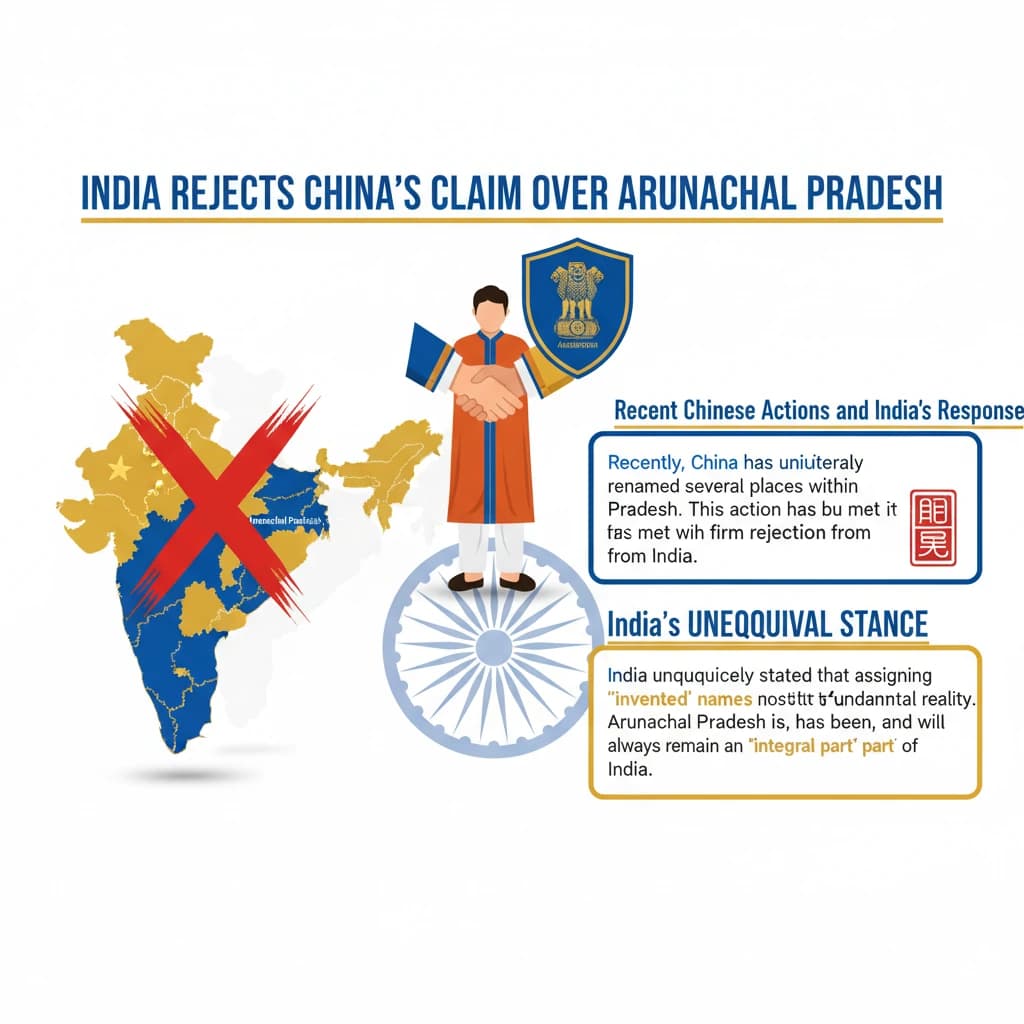
India Rejects China’s Claim Over Arunachal Pradesh
Medium⏱️ 8 min read
international relations
📖 Introduction
Recent Chinese Actions and India's Response
Recently, China has unilaterally renamed several places within Arunachal Pradesh. This action has been met with a firm rejection from India.
India unequivocally stated that assigning "invented" names does not alter the fundamental reality. Arunachal Pradesh is, has been, and will always remain an "integral part of India".
The Chinese Ministry of Civil Affairs released its fourth list of standardised geographical names. These names were for Zangnan, which is China's name for Arunachal Pradesh, a region Beijing claims as part of south Tibet.
Understanding the India-China Border Dispute
The India-China border dispute is a long-standing and complex issue. It involves territorial claims along their shared border, which stretches approximately 3,488 kilometres.
The primary areas of contention are the Aksai Chin region in the western sector and the entire state of Arunachal Pradesh in the eastern sector.
There is no clear demarcation of the border throughout its length. Consequently, there is no mutually agreed Line of Actual Control (LAC) along certain stretches of this boundary.
Key Disputed Regions
- Aksai Chin: This region is administered by China as part of its Xinjiang region. India, however, considers it an integral part of its Union Territory of Ladakh.
- Strategic Significance of Aksai Chin: The area holds immense strategic importance. It is close to the China-Pakistan Economic Corridor (CPEC) and serves as a potential military route for China.
- Arunachal Pradesh: China claims the entire state, referring to it as "South Tibet". India administers this region as a northeastern state and firmly considers it an integral part of its territory.
The Line of Actual Control (LAC)
The concept of the Line of Actual Control (LAC) came into existence following the 1962 Indo-China war. It is a de facto boundary but lacks mutual agreement on its precise alignment in many areas.
Understanding the distinction between the Line of Actual Control (LAC) and an internationally recognised border is crucial for UPSC Mains (GS Paper 2) questions on India-China relations and border management.
Sectors of the India-China Border
The India-China border is broadly divided into three sectors for administrative and strategic purposes:
- Western Sector: This sector primarily encompasses the region of Ladakh.
- Middle Sector: This relatively less disputed sector covers areas like Himachal Pradesh and Uttarakhand.
- Eastern Sector: This sector covers Arunachal Pradesh and parts of Sikkim, with Arunachal Pradesh being the most contentious area.
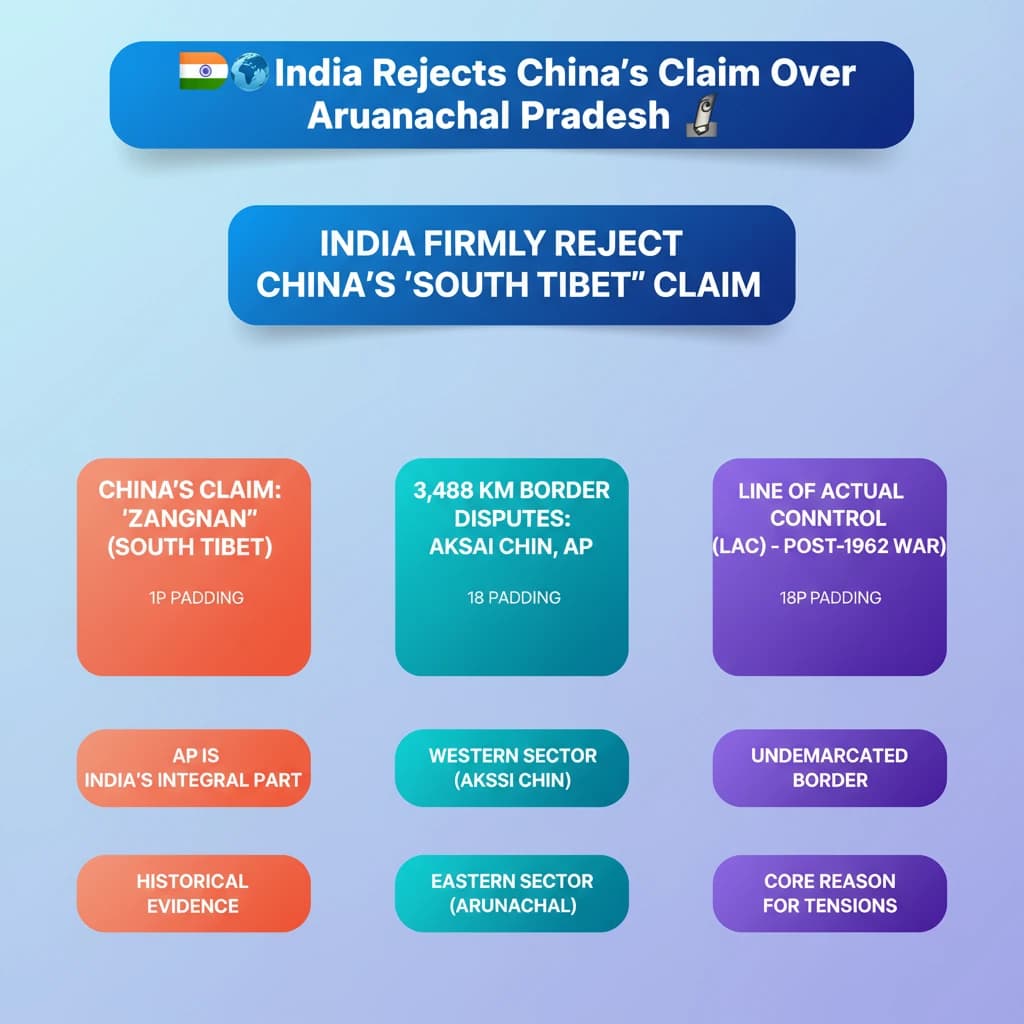
💡 Key Takeaways
- •India firmly rejects China's claims over Arunachal Pradesh, asserting its integral status.
- •China refers to Arunachal Pradesh as 'Zangnan' and claims it as 'South Tibet'.
- •The India-China border is 3,488 km long, with major disputes in Aksai Chin (western) and Arunachal Pradesh (eastern).
- •The Line of Actual Control (LAC) emerged post-1962 war, but its alignment remains disputed.
- •Lack of clear border demarcation is a core reason for ongoing tensions and incidents.
🧠 Memory Techniques
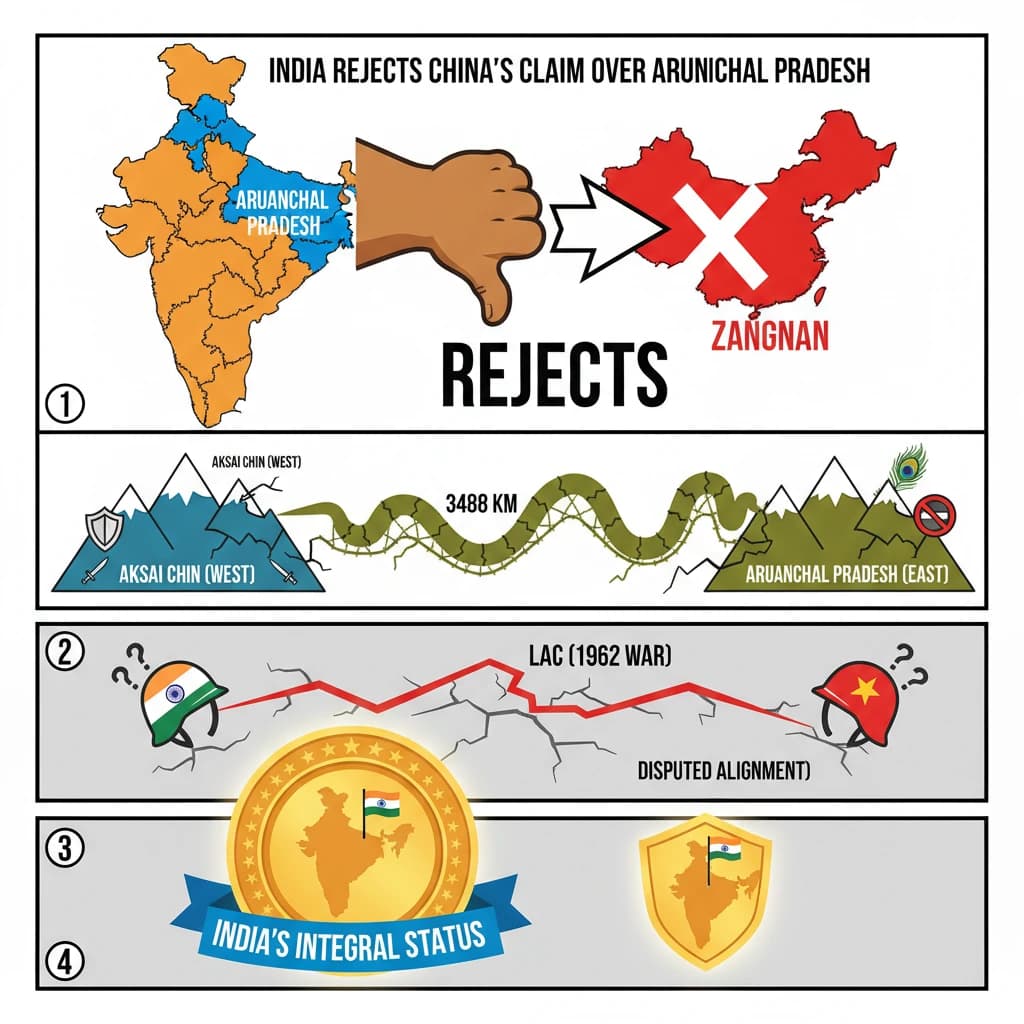
95% Verified Content