Loading page, please wait…
International Criminal Court: Jurisdiction and Working - UPSC International Relations
What is International Criminal Court: Jurisdiction and Working in UPSC International Relations?
International Criminal Court: Jurisdiction and Working is a key topic under International Relations for UPSC Civil Services Examination. Key points include: ICC investigates and tries individuals for genocide, war crimes, crimes against humanity, and crimes of aggression.. Jurisdiction is triggered by State Party nationality/territory, accepted jurisdiction, or UNSC referral.. ICC complements national systems, acting only when states are unwilling/unable to prosecute.. Understanding this topic is essential for both UPSC Prelims and Mains preparation.
Why is International Criminal Court: Jurisdiction and Working important for UPSC exam?
International Criminal Court: Jurisdiction and Working is a Medium-level topic in UPSC International Relations. It is tested in both Prelims (factual MCQs) and Mains (analytical answer writing). Previous year UPSC questions have frequently covered aspects of International Criminal Court: Jurisdiction and Working, making it essential for comprehensive IAS preparation.
How to prepare International Criminal Court: Jurisdiction and Working for UPSC?
To prepare International Criminal Court: Jurisdiction and Working for UPSC: (1) Study the comprehensive notes covering all key concepts on Vaidra. (2) Practice previous year questions on this topic. (3) Connect it with current affairs using daily updates. (4) Revise using key takeaways and mind maps available for International Relations. (5) Write practice answers linking International Criminal Court: Jurisdiction and Working to related GS Paper topics.
Key takeaways of International Criminal Court: Jurisdiction and Working for UPSC
- ICC investigates and tries individuals for genocide, war crimes, crimes against humanity, and crimes of aggression.
- Jurisdiction is triggered by State Party nationality/territory, accepted jurisdiction, or UNSC referral.
- ICC complements national systems, acting only when states are unwilling/unable to prosecute.
- It is not a UN organization but cooperates with the UN.
- Major powers like the US, Russia, China, and Israel do not accept its jurisdiction.
International Criminal Court: Jurisdiction and Working
Medium⏱️ 7 min read
international relations
📖 Introduction
Introduction to ICC Jurisdiction
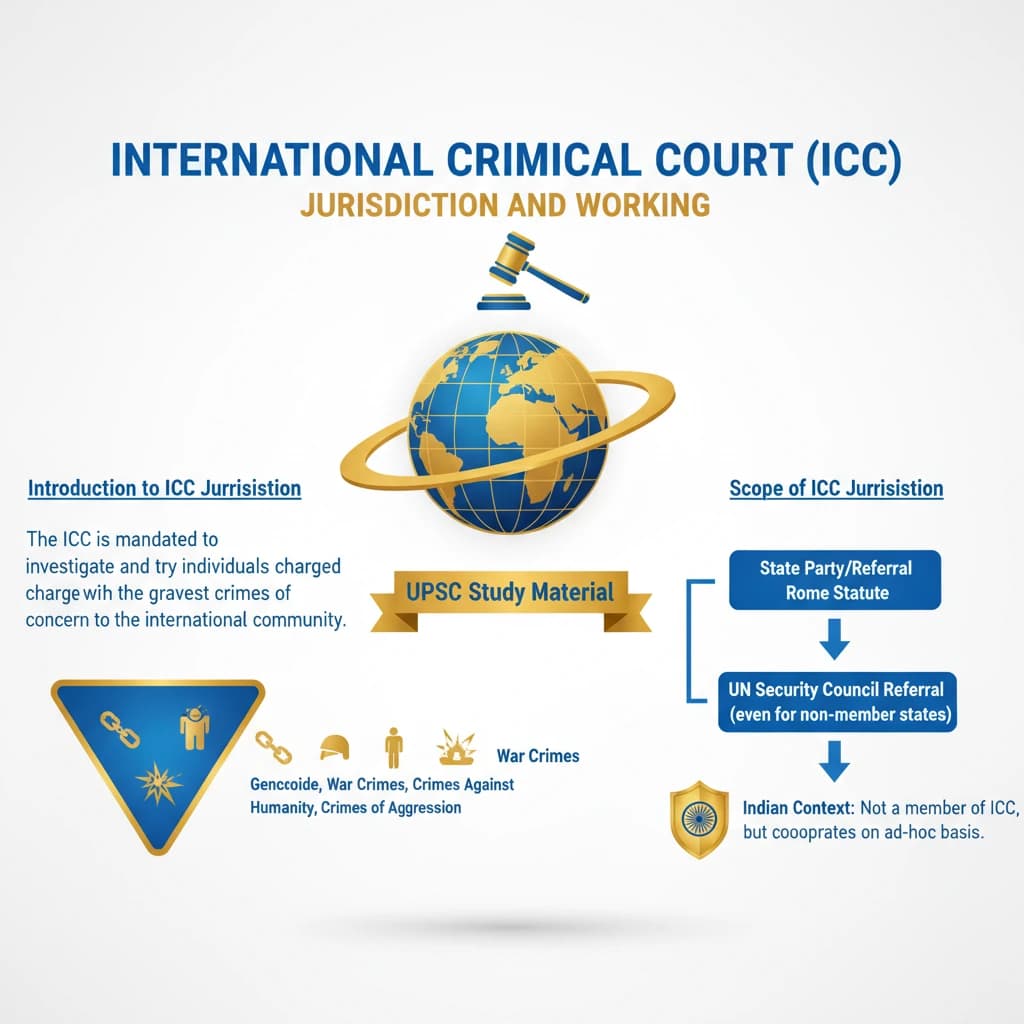
The International Criminal Court (ICC) is mandated to investigate and, where warranted, try individuals charged with the gravest crimes of concern to the international community.
These severe crimes include genocide, war crimes, crimes against humanity, and crimes of aggression.
Scope of ICC Jurisdiction
The ICC's jurisdiction is activated under specific conditions, ensuring its focus on crimes that transcend national boundaries or national capabilities.
The Court can exercise jurisdiction if the crimes are committed by a State Party national, or in the territory of a State Party.
Furthermore, jurisdiction extends to situations where crimes occur in a State that has explicitly accepted the jurisdiction of the court.
Role of the UN Security Council (UNSC)
The United Nations Security Council (UNSC) plays a crucial role in referring cases to the ICC Prosecutor.
Such referrals are made pursuant to a resolution adopted under Chapter VII of the UN Charter, which deals with actions with respect to threats to the peace, breaches of the peace, and acts of aggression.
Understanding the UNSC's referral power is vital, as it can grant jurisdiction even when a situation might otherwise fall outside the Court's initial scope.
Principle of Complementarity
A fundamental principle guiding the ICC's operations is complementarity.
This means the ICC is intended to complement, not replace, national criminal justice systems.
The Court intervenes only when national authorities are genuinely unwilling or unable to prosecute such crimes effectively.
ICC's Relationship with the United Nations
It is important to note that the International Criminal Court (ICC) is not a United Nations organization.
However, it maintains a close working relationship with the UN through a dedicated cooperation agreement, facilitating coordination on international justice matters.
States Not Accepting Jurisdiction
Despite its global mandate, several prominent countries do not accept the ICC's jurisdiction over war crimes, genocide, and other grave crimes.
Key nations that do not recognize the Court's jurisdiction include Israel, the United States (US), Russia, and China.
This non-acceptance often stems from concerns over sovereignty and potential political motivations behind prosecutions.
💡 Key Takeaways
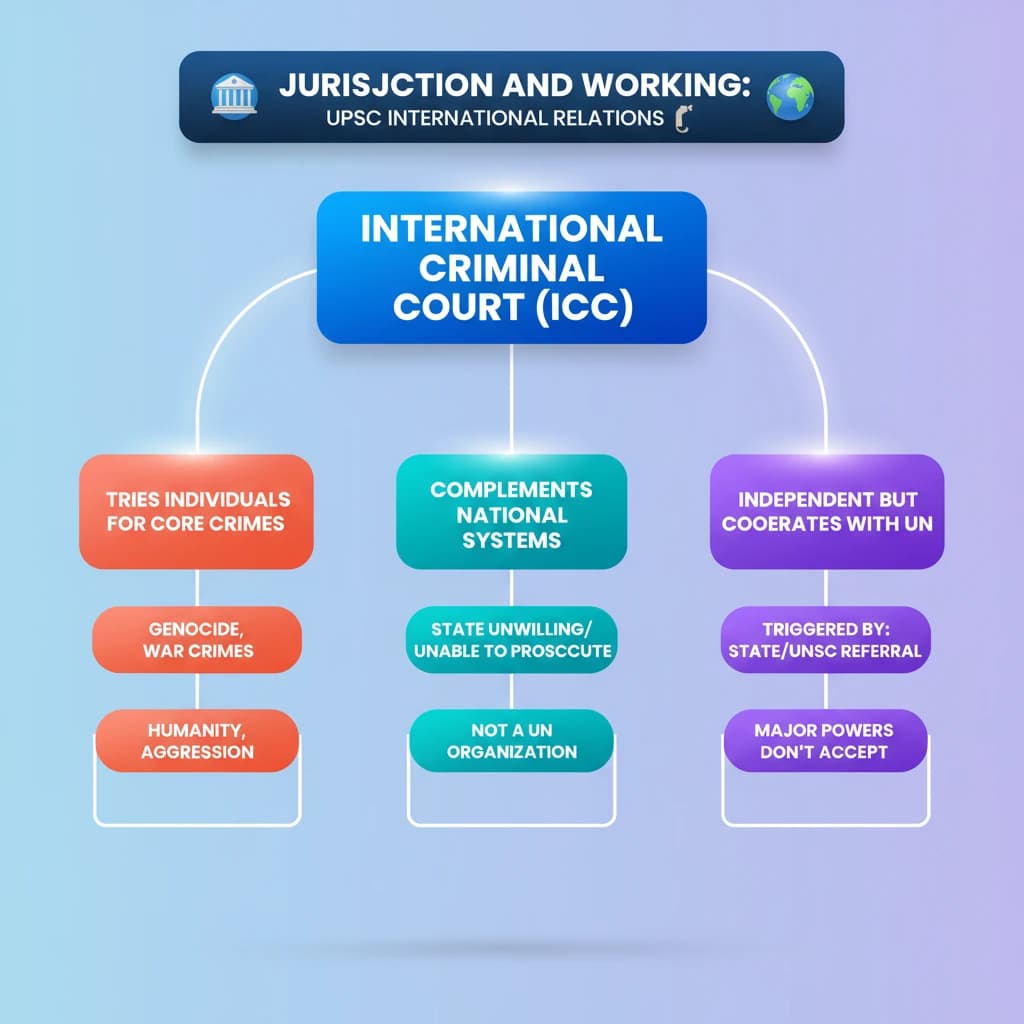
- •ICC investigates and tries individuals for genocide, war crimes, crimes against humanity, and crimes of aggression.
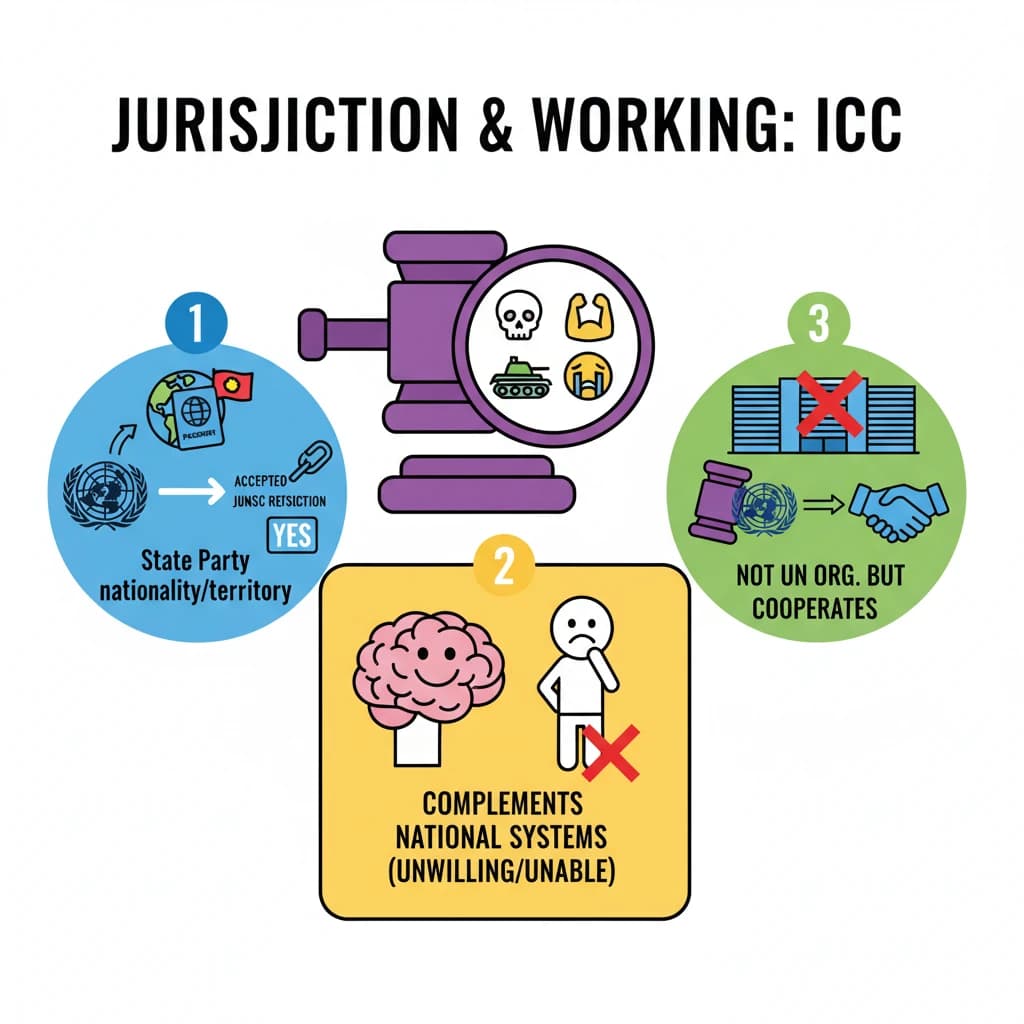
- •Jurisdiction is triggered by State Party nationality/territory, accepted jurisdiction, or UNSC referral.
- •ICC complements national systems, acting only when states are unwilling/unable to prosecute.
- •It is not a UN organization but cooperates with the UN.
- •Major powers like the US, Russia, China, and Israel do not accept its jurisdiction.
🧠 Memory Techniques
95% Verified Content
📚 Reference Sources
•Rome Statute of the International Criminal Court (Official Text)
•Official Website of the International Criminal Court (ICC.org)
•United Nations Charter (Chapter VII)