Loading page, please wait…
Regional Dialogue of Secretaries of Security Councils on Afghanistan - UPSC International Relations
What is Regional Dialogue of Secretaries of Security Councils on Afghanistan in UPSC International Relations?
Regional Dialogue of Secretaries of Security Councils on Afghanistan is a key topic under International Relations for UPSC Civil Services Examination. Key points include: The 6th Regional Dialogue on Afghanistan was held in Bishkek, Kyrgyzstan.. India emphasized a collective approach to combating terrorism, aligning with UNSCR 2593.. These dialogues are crucial for regional stability and addressing threats from Afghanistan.. Understanding this topic is essential for both UPSC Prelims and Mains preparation.
Why is Regional Dialogue of Secretaries of Security Councils on Afghanistan important for UPSC exam?
Regional Dialogue of Secretaries of Security Councils on Afghanistan is a Medium-level topic in UPSC International Relations. It is tested in both Prelims (factual MCQs) and Mains (analytical answer writing). Previous year UPSC questions have frequently covered aspects of Regional Dialogue of Secretaries of Security Councils on Afghanistan, making it essential for comprehensive IAS preparation.
How to prepare Regional Dialogue of Secretaries of Security Councils on Afghanistan for UPSC?
To prepare Regional Dialogue of Secretaries of Security Councils on Afghanistan for UPSC: (1) Study the comprehensive notes covering all key concepts on Vaidra. (2) Practice previous year questions on this topic. (3) Connect it with current affairs using daily updates. (4) Revise using key takeaways and mind maps available for International Relations. (5) Write practice answers linking Regional Dialogue of Secretaries of Security Councils on Afghanistan to related GS Paper topics.
Key takeaways of Regional Dialogue of Secretaries of Security Councils on Afghanistan for UPSC
- The 6th Regional Dialogue on Afghanistan was held in Bishkek, Kyrgyzstan.
- India emphasized a collective approach to combating terrorism, aligning with UNSCR 2593.
- These dialogues are crucial for regional stability and addressing threats from Afghanistan.
- UNSCR 2593 calls for Afghanistan not to be used as a base for terrorism.
- India's participation reflects its strategic interests and commitment to regional security.
Regional Dialogue of Secretaries of Security Councils on Afghanistan
Medium⏱️ 7 min read
international relations
📖 Introduction
Context of the Regional Dialogue
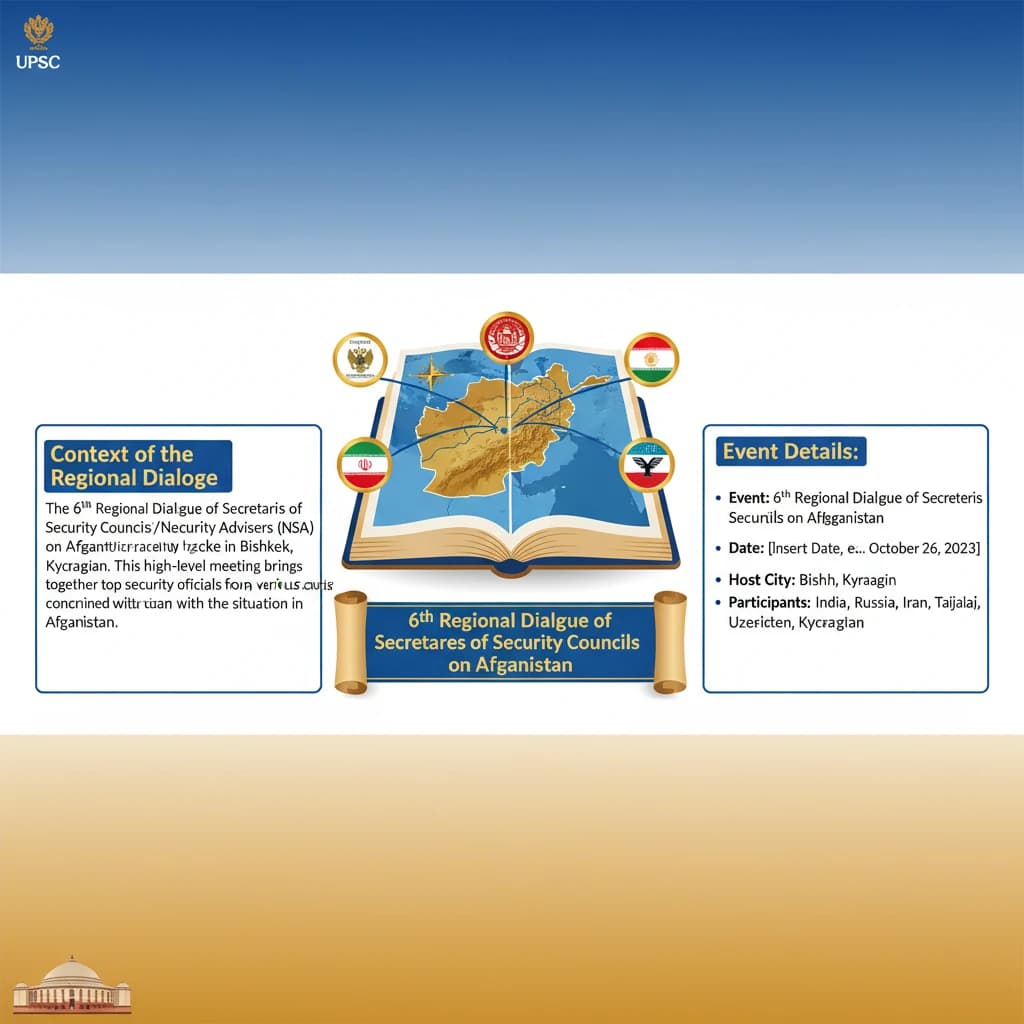
The 6th Regional Dialogue of Secretaries of Security Councils/National Security Advisers (NSA) on Afghanistan recently took place in Bishkek, Kyrgyzstan. This high-level meeting brings together top security officials from various countries concerned with the situation in Afghanistan.
Event Details:
- Event: 6th Regional Dialogue of Secretaries of Security Councils/National Security Advisers (NSA)
- Focus: Afghanistan
- Venue: Bishkek, Kyrgyzstan
Purpose of the Dialogue
These dialogues serve as crucial platforms for regional stakeholders to discuss the evolving security and humanitarian situation in Afghanistan. They aim to foster a collective understanding and coordinated response to the challenges emanating from the country.
Key Objective: To ensure regional stability and address threats such as terrorism, drug trafficking, and humanitarian crises originating from or impacting Afghanistan.
India's Stance and Contribution
During the dialogue, India strongly reiterated its commitment to a collective approach to combating terrorism. This approach aligns with the principles enshrined in United Nations Security Council Resolution (UNSCR) 2593.
UPSC Insight: India's consistent emphasis on UNSCR 2593 highlights its principled stand on counter-terrorism and its rejection of any support for terrorist entities operating from Afghan soil. This is vital for GS Paper 2 (International Relations) and GS Paper 3 (Internal Security).
Significance of UNSCR 2593
UNSCR 2593, adopted in August 2021, is a landmark resolution that addresses the situation in Afghanistan following the Taliban takeover. It specifically calls for the Taliban to prevent Afghan territory from being used to threaten or attack any country or to shelter or train terrorists.
Key Provisions of UNSCR 2593:
- Demands that Afghanistan not be used as a base for terrorism.
- Calls for humanitarian access and protection of human rights, including women and minorities.
- Emphasizes the need for an inclusive government.
💡 Key Takeaways
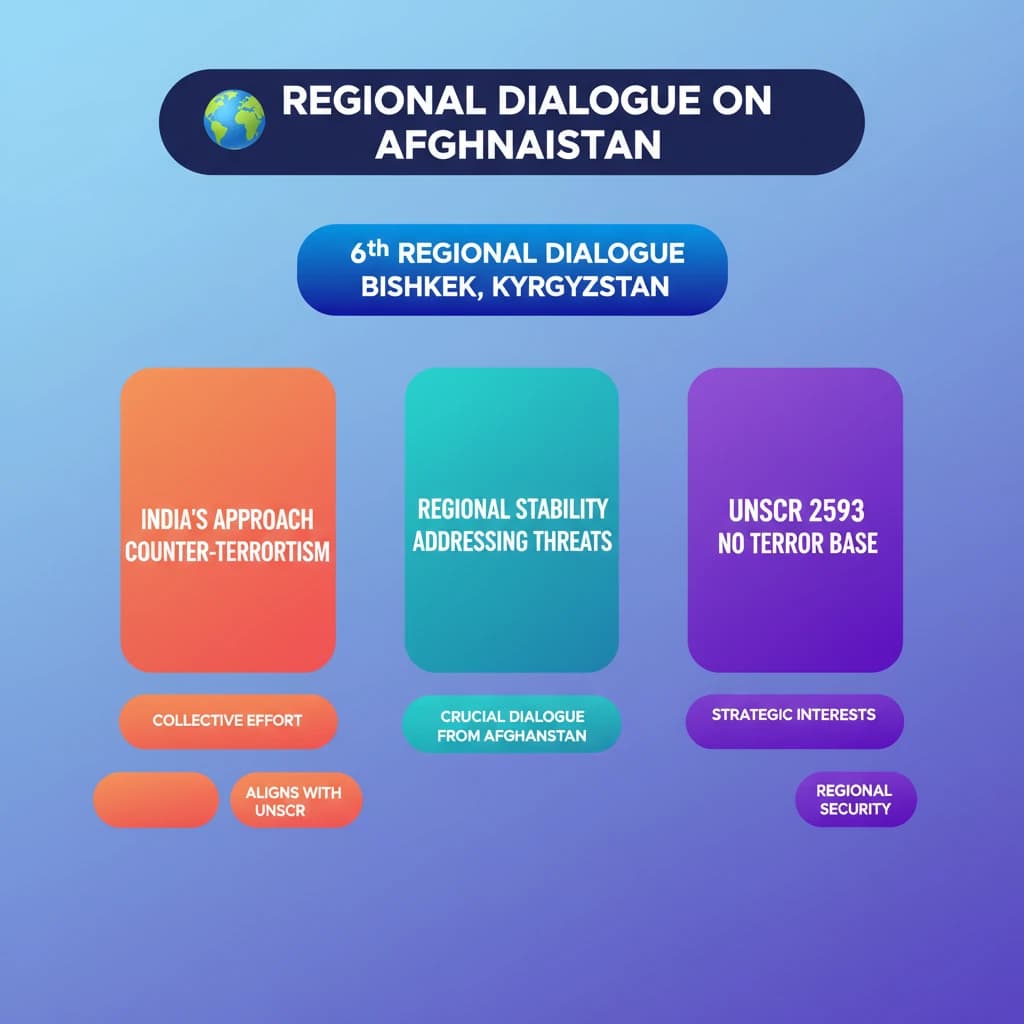
- •The 6th Regional Dialogue on Afghanistan was held in Bishkek, Kyrgyzstan.
- •India emphasized a collective approach to combating terrorism, aligning with UNSCR 2593.
- •These dialogues are crucial for regional stability and addressing threats from Afghanistan.
- •UNSCR 2593 calls for Afghanistan not to be used as a base for terrorism.
- •India's participation reflects its strategic interests and commitment to regional security.
🧠 Memory Techniques
95% Verified Content
📚 Reference Sources
•United Nations Security Council official website (for UNSCR 2593 and 1267 details)
•Ministry of External Affairs (India) press releases
•Reputable international news agencies