Loading page, please wait…
Related Events and Campaigns - UPSC International Relations
What is Related Events and Campaigns in UPSC International Relations?
Related Events and Campaigns is a key topic under International Relations for UPSC Civil Services Examination. Key points include: FSSAI leads India's food safety initiatives under the 'Eat Right India' movement.. World Food Safety Day (June 7) raises global awareness on food safety's importance.. Eat Right Station and Mela promote safe food environments and consumer awareness.. Understanding this topic is essential for both UPSC Prelims and Mains preparation.
Why is Related Events and Campaigns important for UPSC exam?
Related Events and Campaigns is a Medium-level topic in UPSC International Relations. It is tested in both Prelims (factual MCQs) and Mains (analytical answer writing). Previous year UPSC questions have frequently covered aspects of Related Events and Campaigns, making it essential for comprehensive IAS preparation.
How to prepare Related Events and Campaigns for UPSC?
To prepare Related Events and Campaigns for UPSC: (1) Study the comprehensive notes covering all key concepts on Vaidra. (2) Practice previous year questions on this topic. (3) Connect it with current affairs using daily updates. (4) Revise using key takeaways and mind maps available for International Relations. (5) Write practice answers linking Related Events and Campaigns to related GS Paper topics.
Key takeaways of Related Events and Campaigns for UPSC
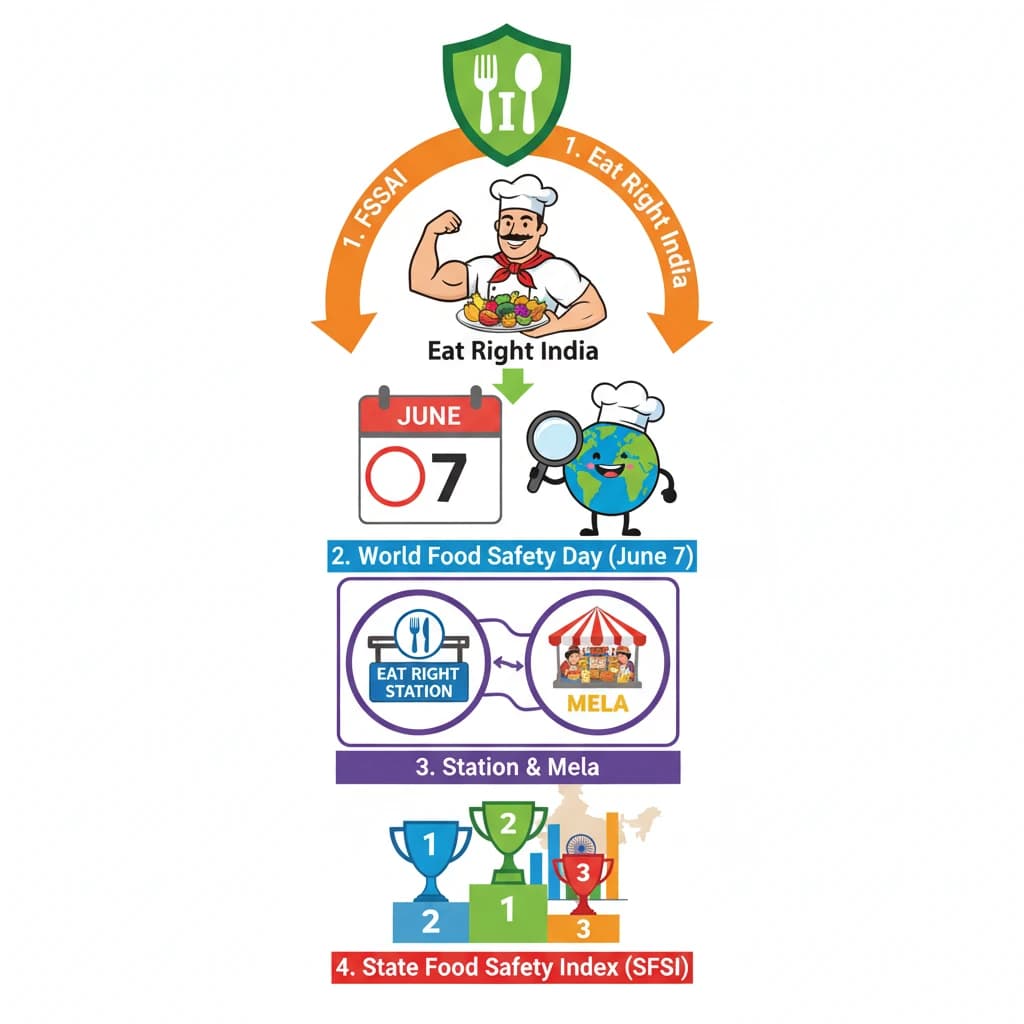
- FSSAI leads India's food safety initiatives under the 'Eat Right India' movement.
- World Food Safety Day (June 7) raises global awareness on food safety's importance.
- Eat Right Station and Mela promote safe food environments and consumer awareness.
- State Food Safety Index (SFSI) fosters competition among states for better food safety performance.
- RUCO converts used cooking oil into biodiesel, addressing health and environmental concerns.
- Food Safety Mitras assist businesses with compliance, strengthening the regulatory ecosystem.
- 100 Food Streets initiative aims to upgrade hygiene standards in street food vending.
Related Events and Campaigns
Medium⏱️ 7 min read
international relations
📖 Introduction
Introduction to Food Safety Initiatives in India
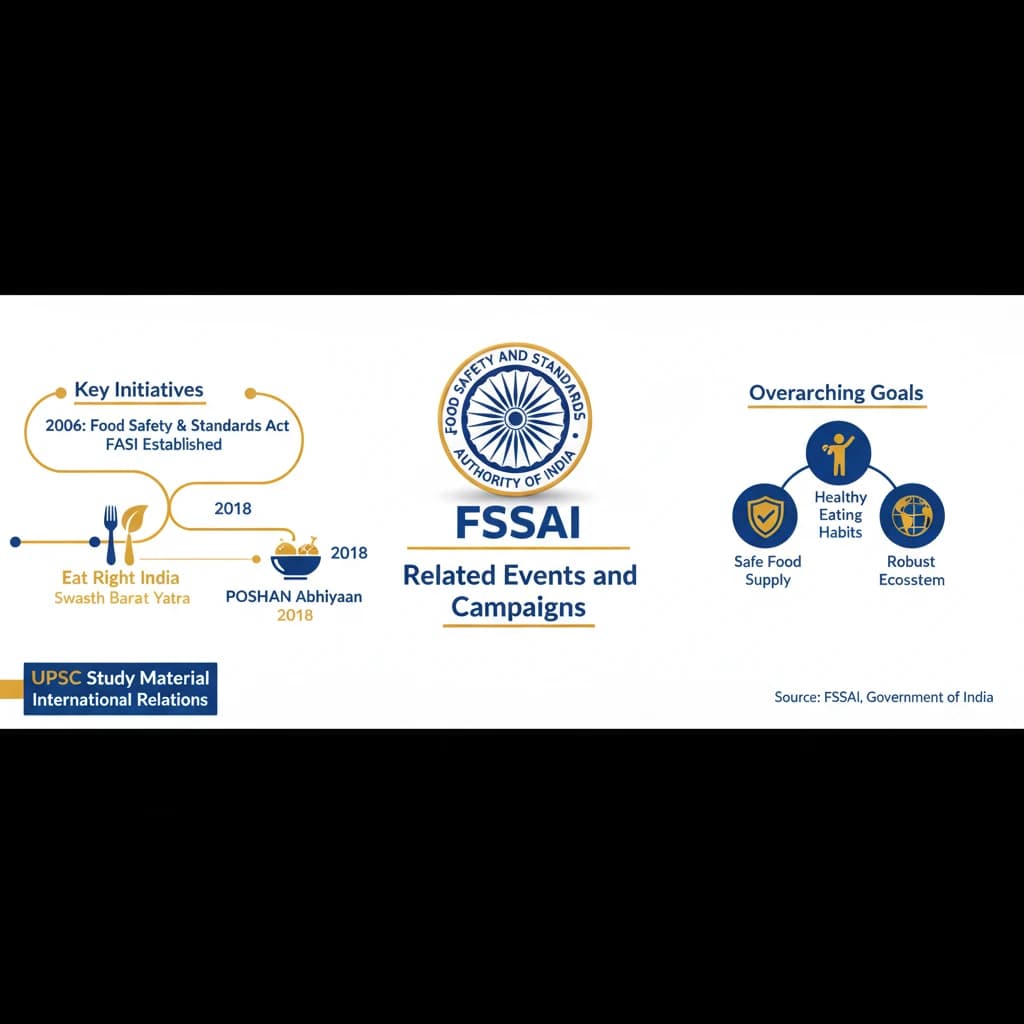
India has launched several significant campaigns and initiatives to ensure food safety and promote healthy eating habits among its citizens. These efforts are primarily spearheaded by the Food Safety and Standards Authority of India (FSSAI), an autonomous statutory body established under the Food Safety and Standards Act, 2006.
The overarching goal is to create a robust ecosystem that guarantees safe, nutritious, and wholesome food for everyone, addressing both public health and economic aspects.
UPSC Relevance: These initiatives are crucial for GS-II (Government Policies and Interventions) and GS-III (Food Processing, Public Health, Environment). Understanding their objectives and impact is vital for Mains answers.
World Food Safety Day
World Food Safety Day (WFSD) is observed annually to draw global attention to the importance of food safety. It highlights that safe food is essential for human health and well-being, as well as for economic prosperity.
Key Facts:
- Date: Celebrated every year on June 7.
- Initiated by: The United Nations General Assembly (UNGA) in 2018.
- Theme: Each year, a specific theme is chosen to focus on a particular aspect of food safety.
Objective: To inspire action to help prevent, detect, and manage foodborne risks, contributing to food security, human health, economic prosperity, agriculture, market access, tourism, and sustainable development.
Eat Right Station
The Eat Right Station certification is an initiative by FSSAI to ensure that railway stations provide safe, hygienic, and nutritious food to passengers. It is part of the broader 'Eat Right India' movement.
Stations are evaluated on various parameters including food handling, hygiene, waste management, and promotion of healthy food options. This helps in building consumer trust in food served at transit hubs.
Certification Process: Stations are audited by third-party agencies and awarded certification based on adherence to food safety and hygiene standards. The certification is typically valid for a specific period.
Eat Right Mela
The Eat Right Mela is a large-scale public outreach event organized by FSSAI to engage citizens and promote awareness about safe and healthy eating. These melas are often held in major cities across India.
They feature interactive activities, cooking demonstrations, health check-ups, and stalls offering nutritious food options. The aim is to make food safety and healthy eating a part of daily life.
Impact: Melas serve as platforms for direct engagement with the public, disseminating critical information on food adulteration, hygiene practices, and the benefits of a balanced diet.
State Food Safety Index (SFSI)
The State Food Safety Index (SFSI) is an annual assessment released by FSSAI to measure the performance of Indian states and Union Territories on various parameters of food safety. It encourages healthy competition among states to improve their food safety infrastructure.
Parameters: The index evaluates states based on five significant parameters:
- Human Resources and Institutional Data
- Compliance
- Food Testing Infrastructure and Surveillance
- Training and Capacity Building
- Consumer Empowerment
UPSC Insight: SFSI rankings can be cited in answers related to federalism, public administration, and health governance, showcasing how states are performing in implementing central policies.
RUCO (Repurpose Used Cooking Oil)
The RUCO (Repurpose Used Cooking Oil) initiative by FSSAI aims to collect and convert used cooking oil into biodiesel. This addresses both food safety concerns (as repeatedly used oil becomes unhealthy) and environmental sustainability.
FSSAI has set up an ecosystem for collection and conversion, involving various stakeholders from food businesses to biodiesel manufacturers. This initiative promotes a circular economy model.
Dual Benefit: It prevents the unhealthy practice of reusing cooking oil multiple times in food preparation and provides a sustainable source for biofuel production, reducing reliance on fossil fuels.
Food Safety Mitra
The Food Safety Mitra (FSM) scheme is a professional ecosystem created by FSSAI to support food businesses in complying with the Food Safety and Standards Act, Rules, and Regulations. FSMs are individuals trained and certified by FSSAI.
They assist food businesses with various services, including licensing, registration, hygiene ratings, and training. This initiative aims to strengthen the food safety ecosystem by creating a network of skilled professionals.
Categories of FSMs:
- Digital Mitra: Assists with online licensing and registration.
- Trainer Mitra: Conducts training programs for food handlers.
- Hygiene Mitra: Helps businesses improve hygiene standards and get hygiene ratings.
100 Food Streets
The 100 Food Streets initiative, launched by the Ministry of Health and Family Welfare in collaboration with FSSAI, aims to develop 100 hygienic food streets across the country. The objective is to ensure safe and healthy food options are available in popular street food hubs.
These food streets will adhere to specific standards for hygiene, waste management, and food quality, providing a safe environment for consumers to enjoy street food. This initiative also supports local vendors by upgrading their infrastructure and practices.
Significance: It formalizes and upgrades the unorganized street food sector, which is a significant part of India's food culture, ensuring public health protection while preserving livelihoods.
💡 Key Takeaways
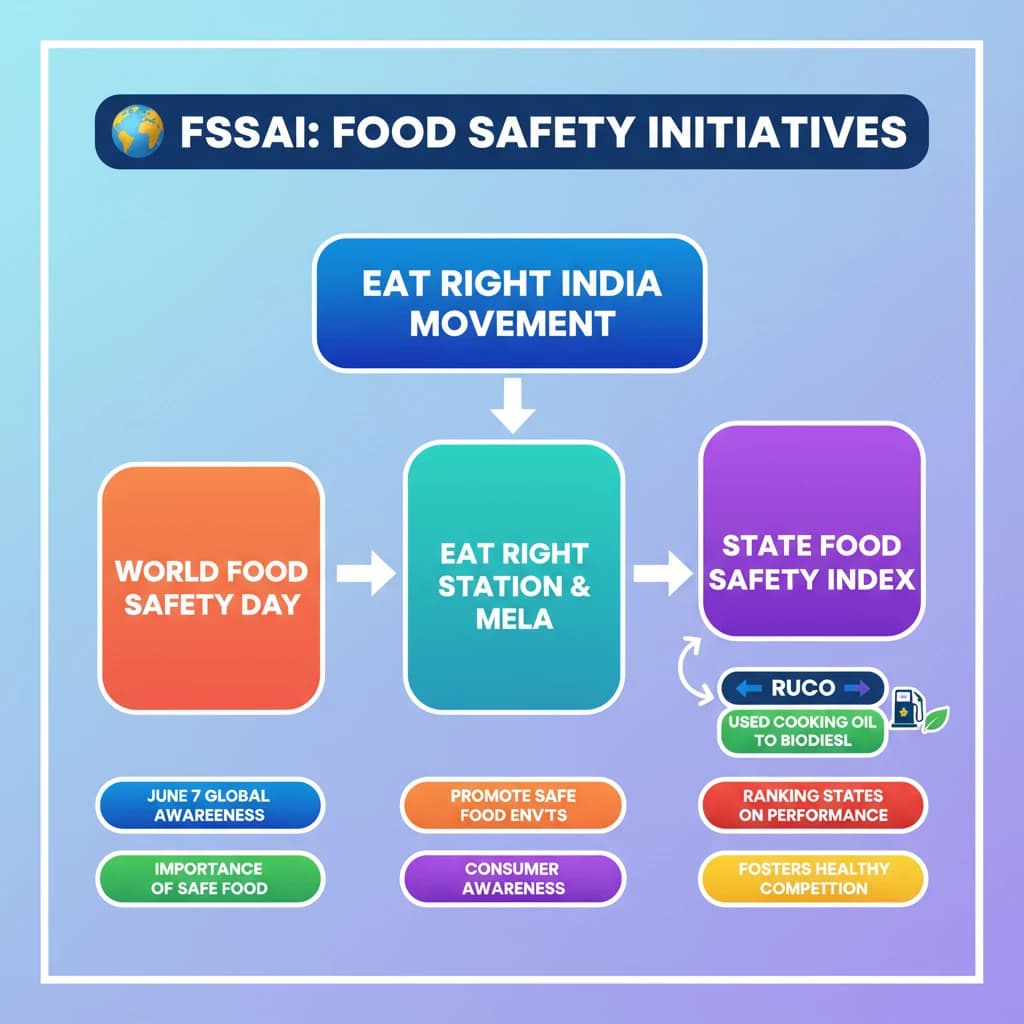
- •FSSAI leads India's food safety initiatives under the 'Eat Right India' movement.
- •World Food Safety Day (June 7) raises global awareness on food safety's importance.
- •Eat Right Station and Mela promote safe food environments and consumer awareness.
- •State Food Safety Index (SFSI) fosters competition among states for better food safety performance.
- •RUCO converts used cooking oil into biodiesel, addressing health and environmental concerns.
- •Food Safety Mitras assist businesses with compliance, strengthening the regulatory ecosystem.
- •100 Food Streets initiative aims to upgrade hygiene standards in street food vending.
🧠 Memory Techniques
98% Verified Content
📚 Reference Sources
•Ministry of Health & Family Welfare, Government of India publications
•United Nations General Assembly resolutions on World Food Safety Day
•Press Information Bureau (PIB) releases on FSSAI initiatives
•WHO and FAO reports on food safety