Loading page, please wait…
Support and Promotion to India-Middle East-Europe Economic Corridor (IMEC) - UPSC International Relations
What is Support and Promotion to India-Middle East-Europe Economic Corridor (IMEC) in UPSC International Relations?
Support and Promotion to India-Middle East-Europe Economic Corridor (IMEC) is a key topic under International Relations for UPSC Civil Services Examination. Key points include: IMEC is a multi-modal transport and economic corridor connecting India, the Middle East, and Europe.. It was signed at the G20 Summit in New Delhi in September 2023, with G7 nations committed to its promotion.. The corridor comprises rail, road, and sea routes, along with electricity, hydrogen, and high-speed data cables.. Understanding this topic is essential for both UPSC Prelims and Mains preparation.
Why is Support and Promotion to India-Middle East-Europe Economic Corridor (IMEC) important for UPSC exam?
Support and Promotion to India-Middle East-Europe Economic Corridor (IMEC) is a Medium-level topic in UPSC International Relations. It is tested in both Prelims (factual MCQs) and Mains (analytical answer writing). Previous year UPSC questions have frequently covered aspects of Support and Promotion to India-Middle East-Europe Economic Corridor (IMEC), making it essential for comprehensive IAS preparation.
How to prepare Support and Promotion to India-Middle East-Europe Economic Corridor (IMEC) for UPSC?
To prepare Support and Promotion to India-Middle East-Europe Economic Corridor (IMEC) for UPSC: (1) Study the comprehensive notes covering all key concepts on Vaidra. (2) Practice previous year questions on this topic. (3) Connect it with current affairs using daily updates. (4) Revise using key takeaways and mind maps available for International Relations. (5) Write practice answers linking Support and Promotion to India-Middle East-Europe Economic Corridor (IMEC) to related GS Paper topics.
Key takeaways of Support and Promotion to India-Middle East-Europe Economic Corridor (IMEC) for UPSC
- IMEC is a multi-modal transport and economic corridor connecting India, the Middle East, and Europe.
- It was signed at the G20 Summit in New Delhi in September 2023, with G7 nations committed to its promotion.
- The corridor comprises rail, road, and sea routes, along with electricity, hydrogen, and high-speed data cables.
- It consists of two main segments: an East Corridor (India to Arabian Gulf) and a Northern Corridor (Arabian Gulf to Europe).
- Key signatories include India, US, Saudi Arabia, UAE, EU, Italy, France, and Germany.
- IMEC is part of the G7's Partnership for Global Infrastructure and Investment (PGII), offering an alternative to China's BRI.
Support and Promotion to India-Middle East-Europe Economic Corridor (IMEC)
Medium⏱️ 8 min read
international relations
📖 Introduction
Introduction to IMEC
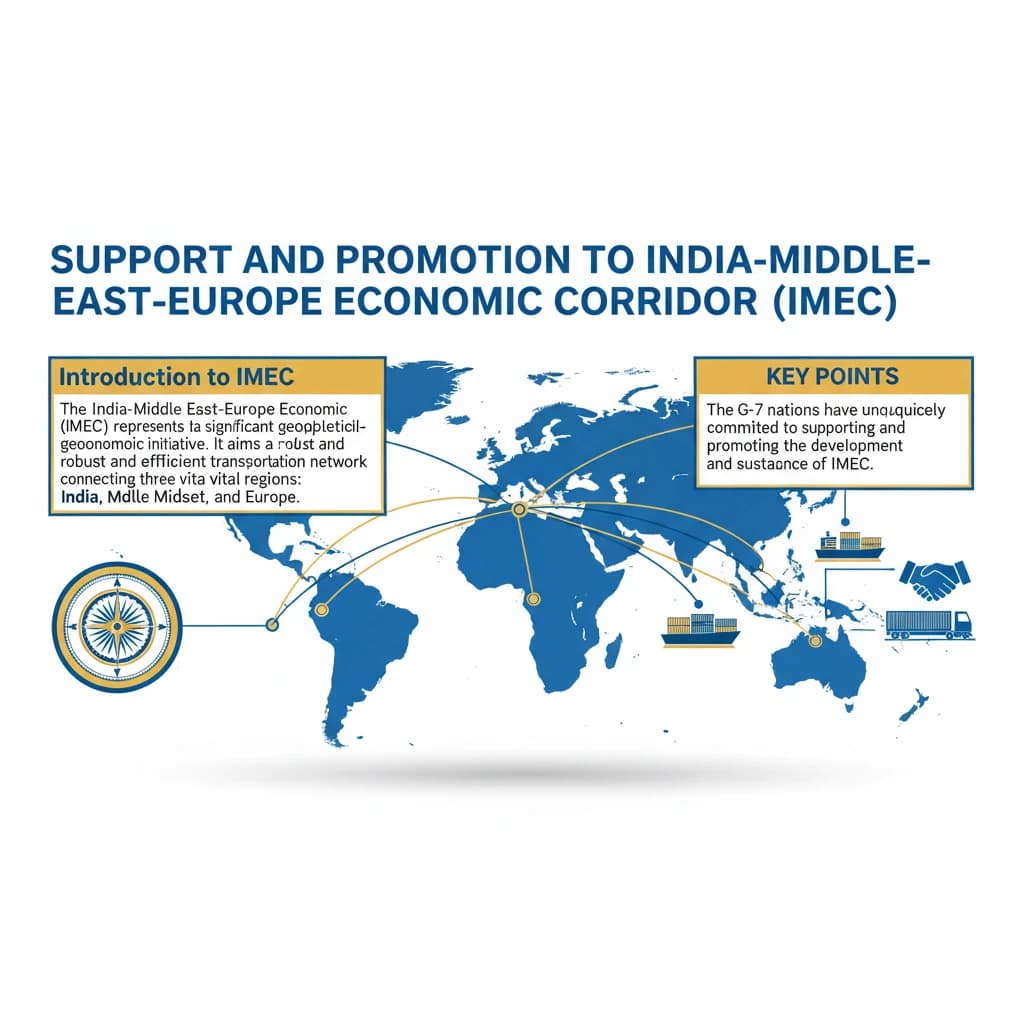
The India-Middle East-Europe Economic Corridor (IMEC) represents a significant geopolitical and geoeconomic initiative. It aims to establish a robust and efficient transportation network connecting three vital regions: India, the Middle East, and Europe.
The G-7 nations have unequivocally committed to supporting and promoting the development and successful implementation of the IMEC, underscoring its global strategic importance.
Core Objective and Components
The primary objective of IMEC is to create a comprehensive multi-modal transportation network. This network is designed to enhance connectivity, facilitate trade, and foster economic integration across the participating regions.
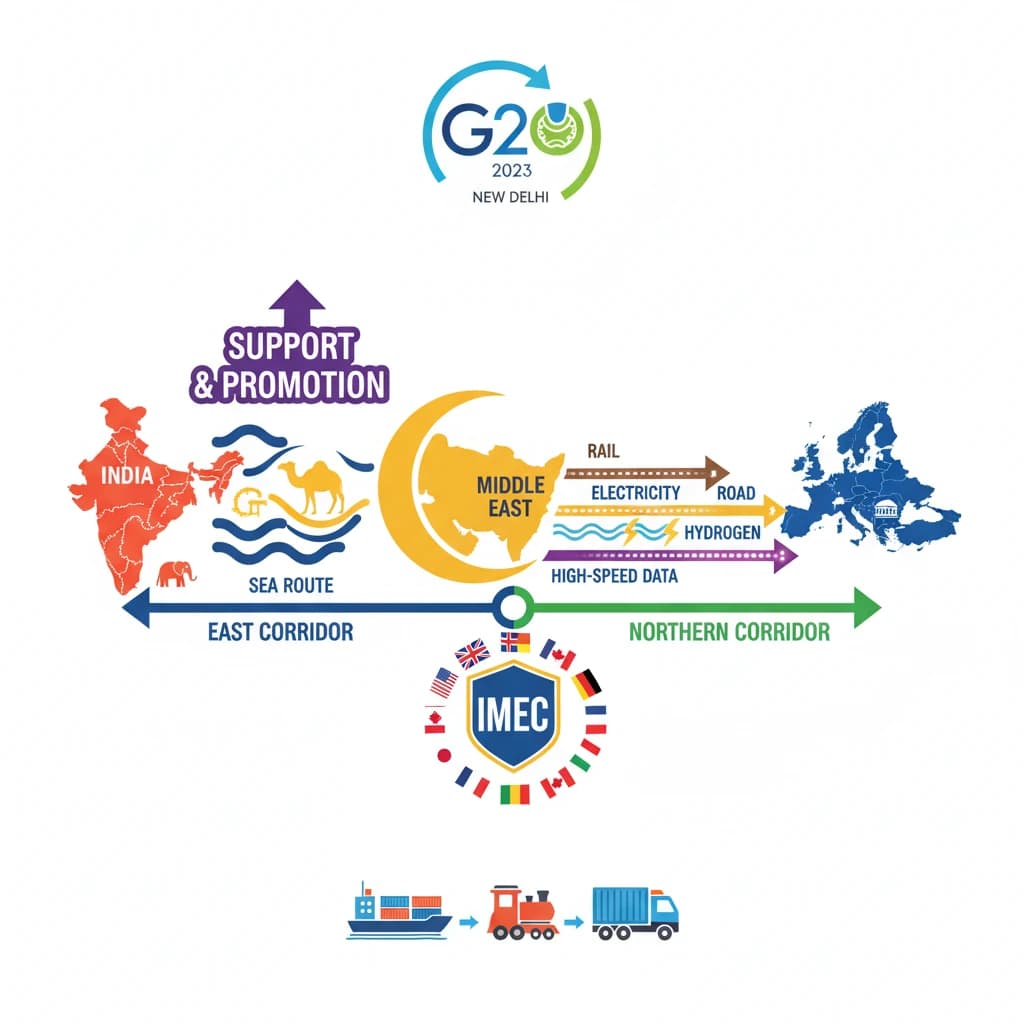
The corridor will integrate various modes of transport, including rail, road, and sea routes. Beyond traditional transport, it will also feature advanced infrastructure elements.
Key Infrastructure Components:
- Electricity cable: For energy transmission.
- Hydrogen pipeline: To support green energy initiatives.
- High-speed data cable: For digital connectivity and communication.
Corridor Structure
The proposed IMEC is structured into two distinct corridors, each serving a crucial segment of the overall route. These corridors are designed to optimize connectivity and logistics.
IMEC Corridors:
- East Corridor: This segment will connect India directly to the Arabian Gulf, establishing a vital maritime and land link.
- Northern Corridor: Extending from the Arabian Gulf, this corridor will provide a direct connection to Europe, completing the intercontinental route.
Signing and Participants
The formal agreement for the IMEC was a landmark event, signed during the G20 Summit in New Delhi in September 2023. This signing highlighted global consensus on the project's importance.
A diverse group of nations and entities are signatories to the IMEC agreement, reflecting its broad international support and collaborative nature.
Signatories of IMEC:
- India
- United States (US)
- Saudi Arabia
- United Arab Emirates (UAE)
- European Union (EU)
- Italy
- France
- Germany
Broader Context and Related Initiatives
The IMEC project is an integral part of the larger Partnership for Global Infrastructure and Investment (PGII) initiative. PGII is a G7-led effort to fund infrastructure projects globally, often seen as a counter to China's Belt and Road Initiative (BRI).
In addition to IMEC, the G7 has also extended its support to other significant infrastructure projects worldwide. This demonstrates a broader commitment to global connectivity and development.
UPSC Insight: Understanding IMEC's connection to PGII is crucial for analyzing global infrastructure competition and cooperation. Questions often link specific projects to broader strategic initiatives.
Other corridors receiving G7 support include the Lobito Corridor in Central Africa, the Luzon Corridor, and the Middle Corridor. These projects collectively aim to enhance regional and intercontinental trade routes.
💡 Key Takeaways
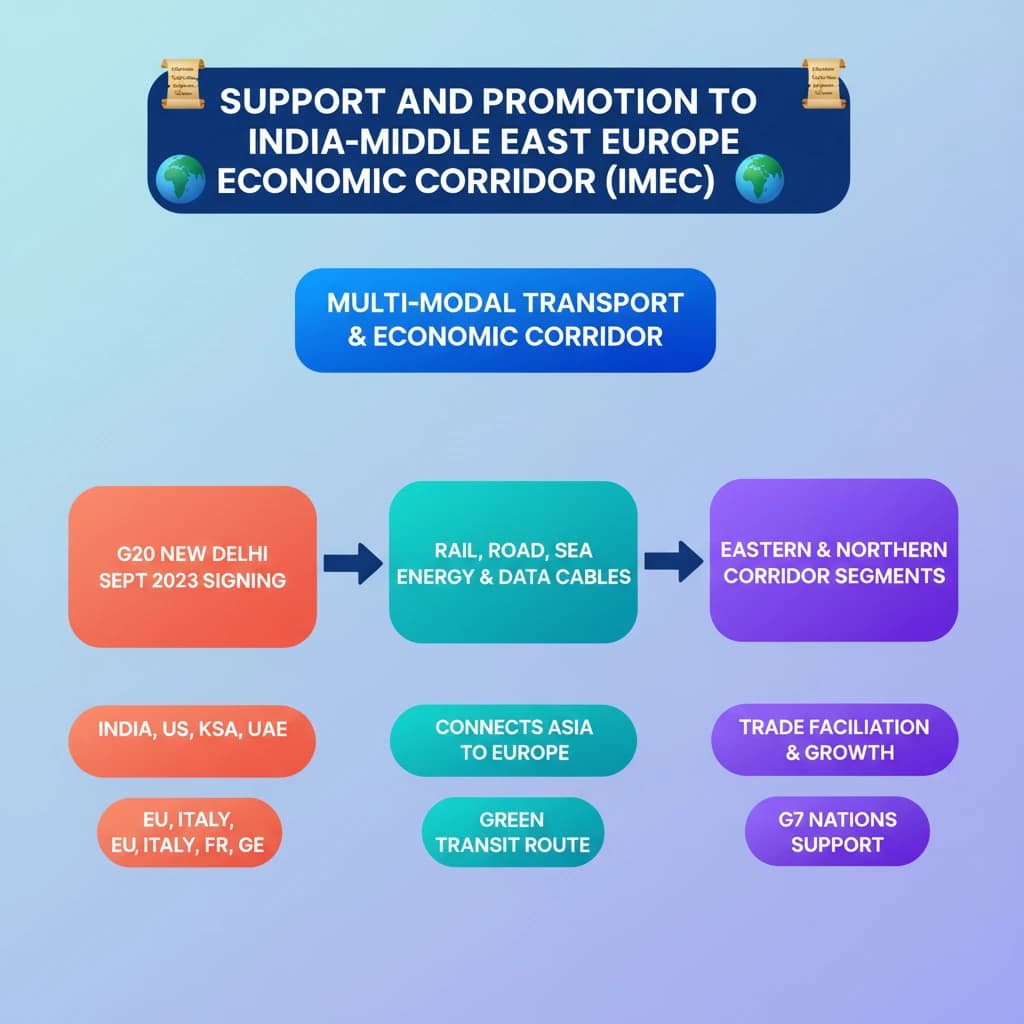
- •IMEC is a multi-modal transport and economic corridor connecting India, the Middle East, and Europe.
- •It was signed at the G20 Summit in New Delhi in September 2023, with G7 nations committed to its promotion.
- •The corridor comprises rail, road, and sea routes, along with electricity, hydrogen, and high-speed data cables.
- •It consists of two main segments: an East Corridor (India to Arabian Gulf) and a Northern Corridor (Arabian Gulf to Europe).
- •Key signatories include India, US, Saudi Arabia, UAE, EU, Italy, France, and Germany.
- •IMEC is part of the G7's Partnership for Global Infrastructure and Investment (PGII), offering an alternative to China's BRI.
🧠 Memory Techniques
95% Verified Content
📚 Reference Sources
•G20 New Delhi Leaders' Declaration, September 2023
•White House Fact Sheet: Partnership for Global Infrastructure and Investment (PGII) and India-Middle East-Europe Economic Corridor (IMEC)
•European Commission statements on IMEC
•Official statements from the Ministry of External Affairs, Government of India