Loading page, please wait…
What is Inland Water Transport (IWT)? - UPSC International Relations
What is What is Inland Water Transport (IWT)? in UPSC International Relations?
What is Inland Water Transport (IWT)? is a key topic under International Relations for UPSC Civil Services Examination. Key points include: IWT is a cost-effective mode for bulk cargo via navigable rivers, canals, and lakes.. The Inland Waterways Authority of India (IWAI) is the nodal agency for IWT development.. India aims to increase IWT's modal share from 2% to 5% by 2030 under Maritime India Vision (MIV)-2030.. Understanding this topic is essential for both UPSC Prelims and Mains preparation.
Why is What is Inland Water Transport (IWT)? important for UPSC exam?
What is Inland Water Transport (IWT)? is a Medium-level topic in UPSC International Relations. It is tested in both Prelims (factual MCQs) and Mains (analytical answer writing). Previous year UPSC questions have frequently covered aspects of What is Inland Water Transport (IWT)?, making it essential for comprehensive IAS preparation.
How to prepare What is Inland Water Transport (IWT)? for UPSC?
To prepare What is Inland Water Transport (IWT)? for UPSC: (1) Study the comprehensive notes covering all key concepts on Vaidra. (2) Practice previous year questions on this topic. (3) Connect it with current affairs using daily updates. (4) Revise using key takeaways and mind maps available for International Relations. (5) Write practice answers linking What is Inland Water Transport (IWT)? to related GS Paper topics.
Key takeaways of What is Inland Water Transport (IWT)? for UPSC
- IWT is a cost-effective mode for bulk cargo via navigable rivers, canals, and lakes.
- The Inland Waterways Authority of India (IWAI) is the nodal agency for IWT development.
- India aims to increase IWT's modal share from 2% to 5% by 2030 under Maritime India Vision (MIV)-2030.
- IWT plays a crucial role in enhancing connectivity and cooperation, notably with Bangladesh.
- IWAI has identified 25 new National Waterways (NWs) for future development to expand the network.
What is Inland Water Transport (IWT)?
Medium⏱️ 7 min read
international relations
📖 Introduction
Introduction to Inland Water Transport (IWT)
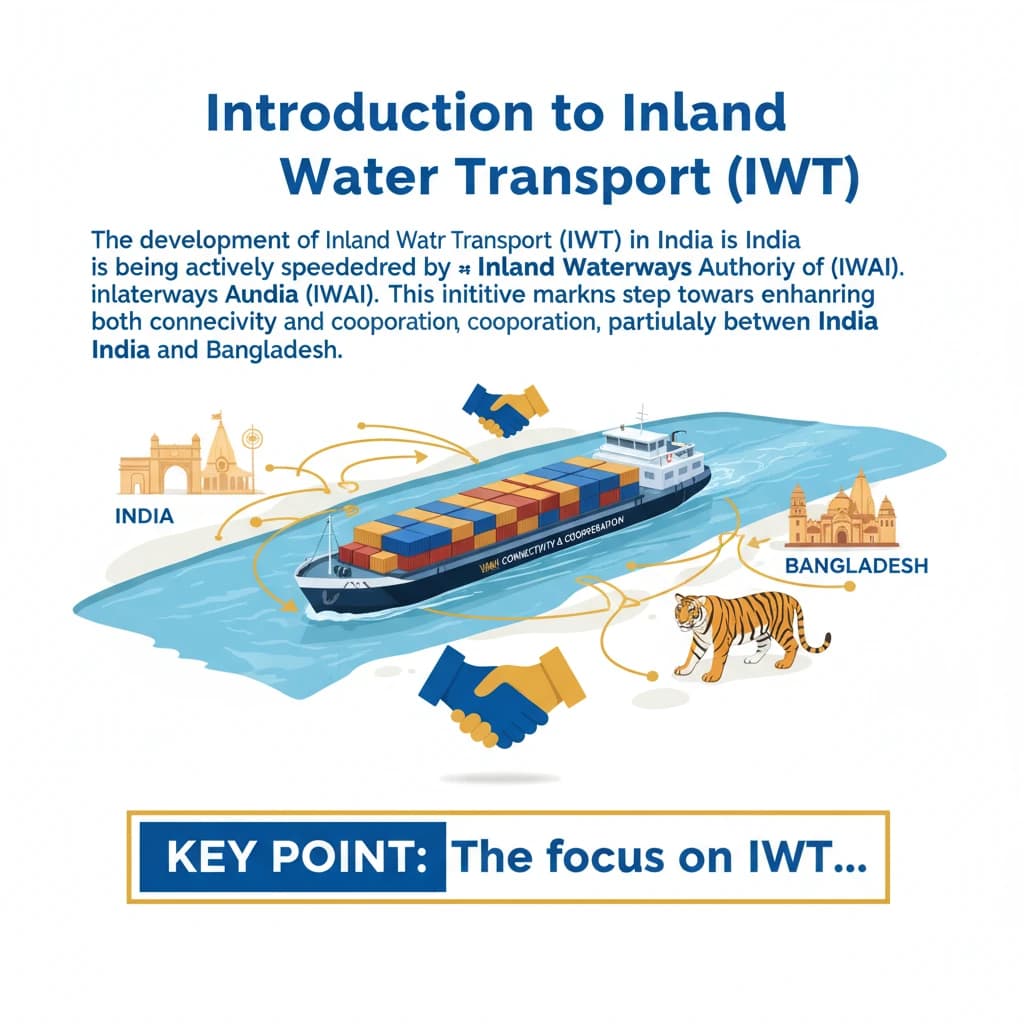
The development of Inland Water Transport (IWT) in India is being actively spearheaded by the Inland Waterways Authority of India (IWAI). This initiative marks a significant step towards enhancing both connectivity and cooperation, particularly between India and Bangladesh.
The focus on IWT is crucial for integrating regional economies and fostering stronger bilateral ties through efficient logistical networks.
Definition of Inland Water Transport
Inland Water Transport (IWT) refers to the movement of both goods and passengers across a nation's interior using its natural and artificial waterways. These navigable routes include rivers, canals, lakes, and other designated inland water bodies.
Definition: IWT is the transportation of cargo and people through a country's internal network of navigable rivers, canals, and lakes.
Key Features of IWT Operations
This mode of transportation primarily employs various types of watercraft, such as boats, barges, and larger ships. These vessels are utilized to transport both cargo and people efficiently within the country's interior regions.
The operational framework of IWT involves connecting various ports and terminals that are strategically located along these inland water routes, thereby creating a seamless network for internal trade and travel.
Significance and Advantages of IWT
IWT stands out as a highly cost-effective mode of transportation. This economic advantage is particularly pronounced for the movement of bulk cargo, which often involves large volumes of goods.
Common types of bulk cargo ideally suited for IWT include essential commodities such as coal, iron ore, cement, food grains, and various types of fertiliser. Its efficiency in handling such large consignments makes it an attractive option for industries.
Key Advantage: IWT offers significant cost savings, especially for transporting heavy and voluminous bulk cargo over long distances.
Current Status and Government Vision for IWT
Despite its inherent advantages, Inland Water Transport's current contribution to India's overall modal mix (the combination of different transport modes) remains relatively low, standing at only 2%.
The Indian government has set an ambitious target to significantly increase this share to 5% by the year 2030. This goal is a key component of the broader Maritime India Vision (MIV)-2030, which aims to revolutionize India's maritime sector.
UPSC Insight: Questions on infrastructure development (GS3) or government policies (GS2) often touch upon targets like the 5% IWT modal share by 2030 under MIV-2030. Understanding these targets is crucial.
Role of Inland Waterways Authority of India (IWAI)
To facilitate the achievement of this ambitious target, the Inland Waterways Authority of India (IWAI) plays a pivotal role. The IWAI has undertaken comprehensive feasibility studies to identify new potential routes.
As a result of these studies, IWAI has successfully identified 25 new National Waterways (NWs). The objective is to develop these waterways and make them navigable, thereby expanding the country's inland water transportation network.
💡 Key Takeaways
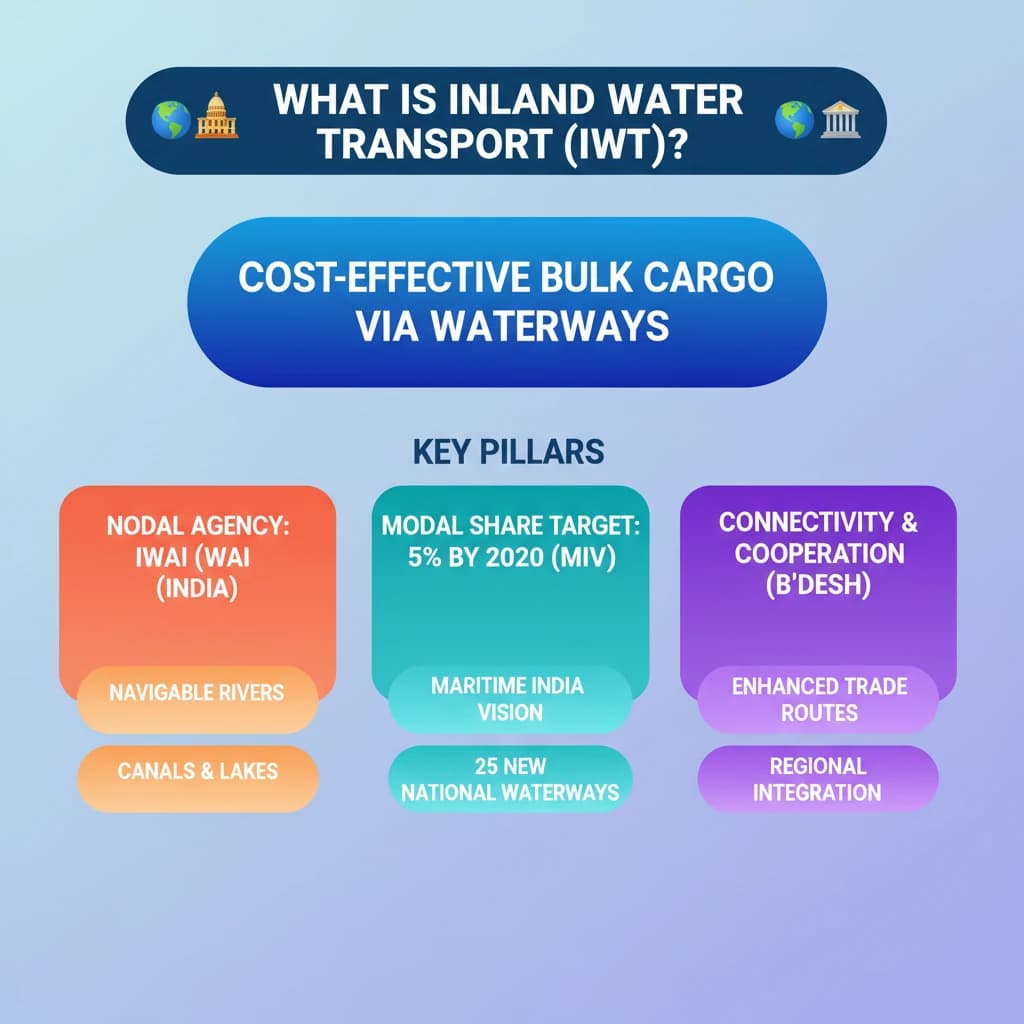
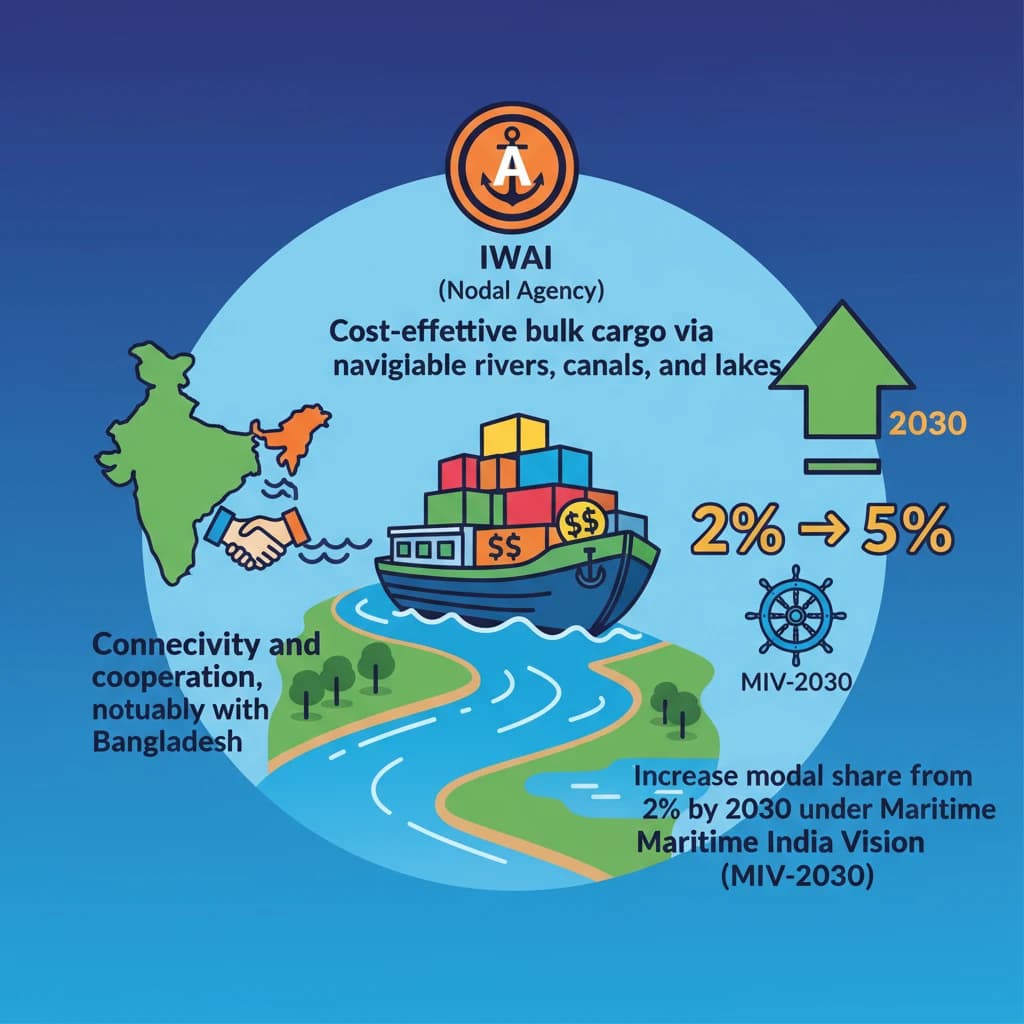
- •IWT is a cost-effective mode for bulk cargo via navigable rivers, canals, and lakes.
- •The Inland Waterways Authority of India (IWAI) is the nodal agency for IWT development.
- •India aims to increase IWT's modal share from 2% to 5% by 2030 under Maritime India Vision (MIV)-2030.
- •IWT plays a crucial role in enhancing connectivity and cooperation, notably with Bangladesh.
- •IWAI has identified 25 new National Waterways (NWs) for future development to expand the network.
🧠 Memory Techniques
95% Verified Content