Loading page, please wait…
Why International Cooperation is Needed in Promotion of Green Hydrogen? - UPSC International Relations
What is Why International Cooperation is Needed in Promotion of Green Hydrogen? in UPSC International Relations?
Why International Cooperation is Needed in Promotion of Green Hydrogen? is a key topic under International Relations for UPSC Civil Services Examination. Key points include: High production costs are the primary barrier for Green Hydrogen adoption.. International cooperation is crucial for cost reduction, R&D acceleration, and technology transfer.. Global supply chains and harmonized standards are vital for a thriving Green Hydrogen market.. Understanding this topic is essential for both UPSC Prelims and Mains preparation.
Why is Why International Cooperation is Needed in Promotion of Green Hydrogen? important for UPSC exam?
Why International Cooperation is Needed in Promotion of Green Hydrogen? is a Medium-level topic in UPSC International Relations. It is tested in both Prelims (factual MCQs) and Mains (analytical answer writing). Previous year UPSC questions have frequently covered aspects of Why International Cooperation is Needed in Promotion of Green Hydrogen?, making it essential for comprehensive IAS preparation.
How to prepare Why International Cooperation is Needed in Promotion of Green Hydrogen? for UPSC?
To prepare Why International Cooperation is Needed in Promotion of Green Hydrogen? for UPSC: (1) Study the comprehensive notes covering all key concepts on Vaidra. (2) Practice previous year questions on this topic. (3) Connect it with current affairs using daily updates. (4) Revise using key takeaways and mind maps available for International Relations. (5) Write practice answers linking Why International Cooperation is Needed in Promotion of Green Hydrogen? to related GS Paper topics.
Key takeaways of Why International Cooperation is Needed in Promotion of Green Hydrogen? for UPSC
- High production costs are the primary barrier for Green Hydrogen adoption.
- International cooperation is crucial for cost reduction, R&D acceleration, and technology transfer.
- Global supply chains and harmonized standards are vital for a thriving Green Hydrogen market.
- International financing and policy coordination are needed to mobilize investments.
- Green Hydrogen is key to achieving global climate goals and enhancing energy security.
- India's National Green Hydrogen Mission is a significant step towards becoming a global hub.

Why International Cooperation is Needed in Promotion of Green Hydrogen?
Medium⏱️ 7 min read
international relations
📖 Introduction
The Imperative of International Cooperation in Green Hydrogen
The global transition to a sustainable energy future critically depends on scaling up Green Hydrogen production and deployment. This clean energy carrier, produced via electrolysis using renewable electricity, holds immense promise for decarbonizing hard-to-abate sectors.
However, realizing its full potential requires concerted global efforts, making international cooperation absolutely essential across various fronts.
High Production Costs: A Global Challenge
One of the primary barriers to widespread adoption of Green Hydrogen is its significantly high production cost. This economic hurdle necessitates collaborative approaches to drive down expenses and make it competitive with fossil fuel-derived alternatives.
According to the International Energy Agency (IEA), the cost of producing Green Hydrogen currently ranges from USD 3 to USD 8 per kilogram. This figure is considerably higher than that of Grey Hydrogen, which is produced from fossil fuels like natural gas without carbon capture.
UPSC Mains (GS III: Economy, Environment): Understanding cost differentials and market barriers is crucial for analyzing energy policy questions. Mentioning IEA data adds credibility to your arguments.
Accelerating Research and Development (R&D)
International collaboration is vital for accelerating research and development in key areas. This includes improving electrolysis efficiency, developing advanced materials, and optimizing storage and transportation technologies for Green Hydrogen.
Sharing knowledge and resources among nations can prevent duplication of efforts and speed up technological breakthroughs, making Green Hydrogen more viable sooner.
Establishing Global Supply Chains
Developing robust and efficient global supply chains for Green Hydrogen and its derivatives (like green ammonia) requires international coordination. This involves identifying potential production hubs, establishing trade routes, and standardizing logistics.
Countries with abundant renewable energy resources can become exporters, while others can become importers, creating a global market that benefits all participants.
Harmonizing Standards and Regulations
For Green Hydrogen to become a globally traded commodity, there is an urgent need for harmonized international standards and regulations. This includes certification schemes for 'green' origin, safety protocols, and technical specifications for infrastructure.
Such harmonization reduces trade barriers, builds investor confidence, and ensures interoperability across different national systems.
Mobilizing Investment and Financing
The massive upfront capital investment required for Green Hydrogen projects necessitates international financial mechanisms and investment flows. Multilateral development banks, climate funds, and cross-border private investments play a crucial role.
International cooperation can facilitate blended finance models, risk-sharing mechanisms, and attract the necessary capital to scale up projects globally.
Policy Coordination and Market Creation
Coordinated policy frameworks among nations can create a stronger global market for Green Hydrogen. This includes aligning incentives, subsidies, and carbon pricing mechanisms to support its adoption.
International dialogues help in sharing best practices and developing supportive regulatory environments that foster demand and supply for this emerging energy source.
Addressing Climate Change Goals
Ultimately, Green Hydrogen is a critical tool in the fight against climate change. International cooperation is indispensable to collectively achieve ambitious net-zero emissions targets and limit global warming.
By working together, countries can ensure a faster, more equitable, and effective transition away from fossil fuels, leveraging Green Hydrogen's potential across diverse sectors.
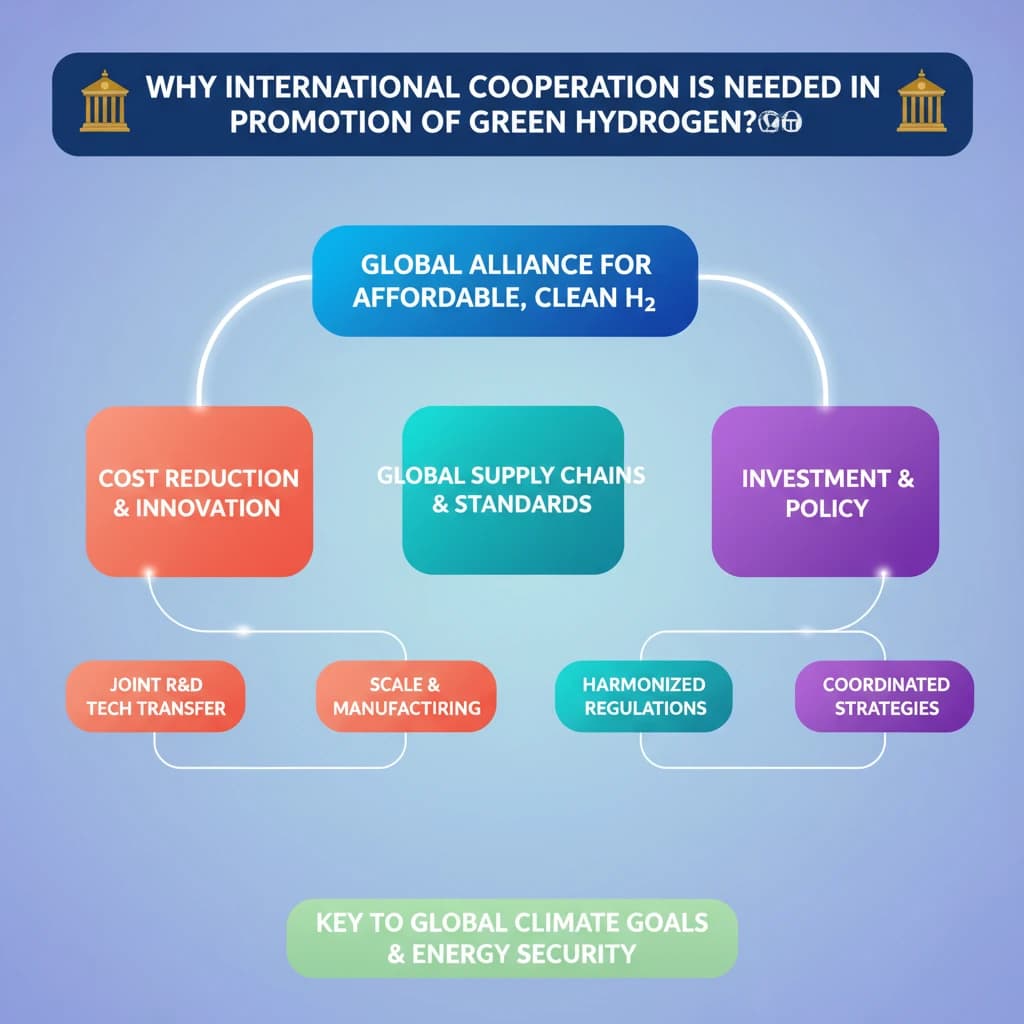
💡 Key Takeaways
- •High production costs are the primary barrier for Green Hydrogen adoption.
- •International cooperation is crucial for cost reduction, R&D acceleration, and technology transfer.
- •Global supply chains and harmonized standards are vital for a thriving Green Hydrogen market.
- •International financing and policy coordination are needed to mobilize investments.
- •Green Hydrogen is key to achieving global climate goals and enhancing energy security.
- •India's National Green Hydrogen Mission is a significant step towards becoming a global hub.
🧠 Memory Techniques
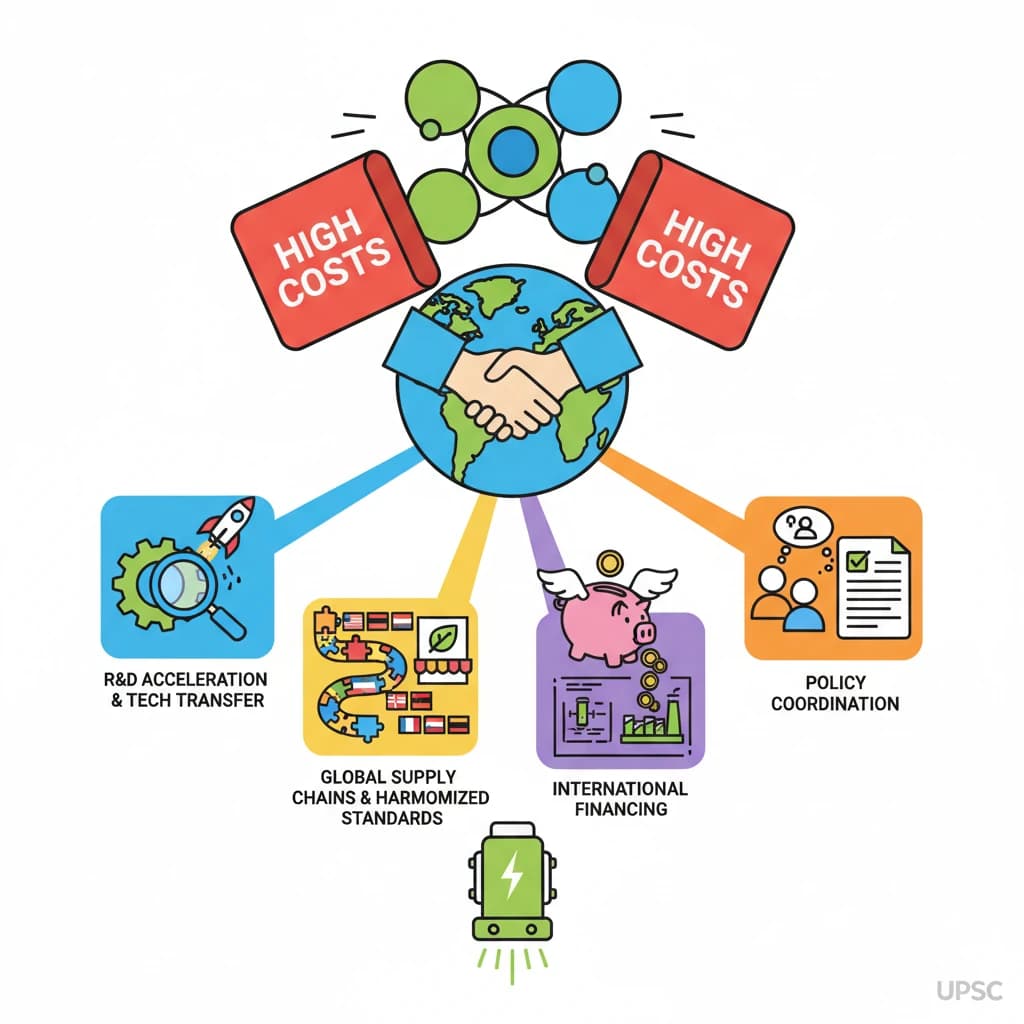
95% Verified Content
📚 Reference Sources
•International Energy Agency (IEA) reports on Hydrogen
•Ministry of New and Renewable Energy (MNRE), Government of India - National Green Hydrogen Mission documents
•European Commission - EU Hydrogen Strategy documents
•News articles and official statements regarding India-Germany Green Hydrogen Task Force