Loading page, please wait…
HomeCurrent AffairsEditorialsGovt SchemesLearning ResourcesUPSC SyllabusPricingAboutBest UPSC AIUPSC AI ToolAI for UPSCUPSC ChatGPT

© 2026 Vaidra. All rights reserved.

PrivacyTerms
Vaidra Logo
Vaidra

Top 4 items + smart groups

UPSC GPT
New
Current Affairs
Daily Solutions
Daily Puzzle
Mains Evaluator

Version 2.0.0 • Built with ❤️ for UPSC aspirants

BioE3 Policy Drives Biofoundry and Carbon Capture Projects in India's North Eastern Region — UPSC Current Affairs | April 2, 2026
BioE3 Policy Drives Biofoundry and Carbon Capture Projects in India's North Eastern Region
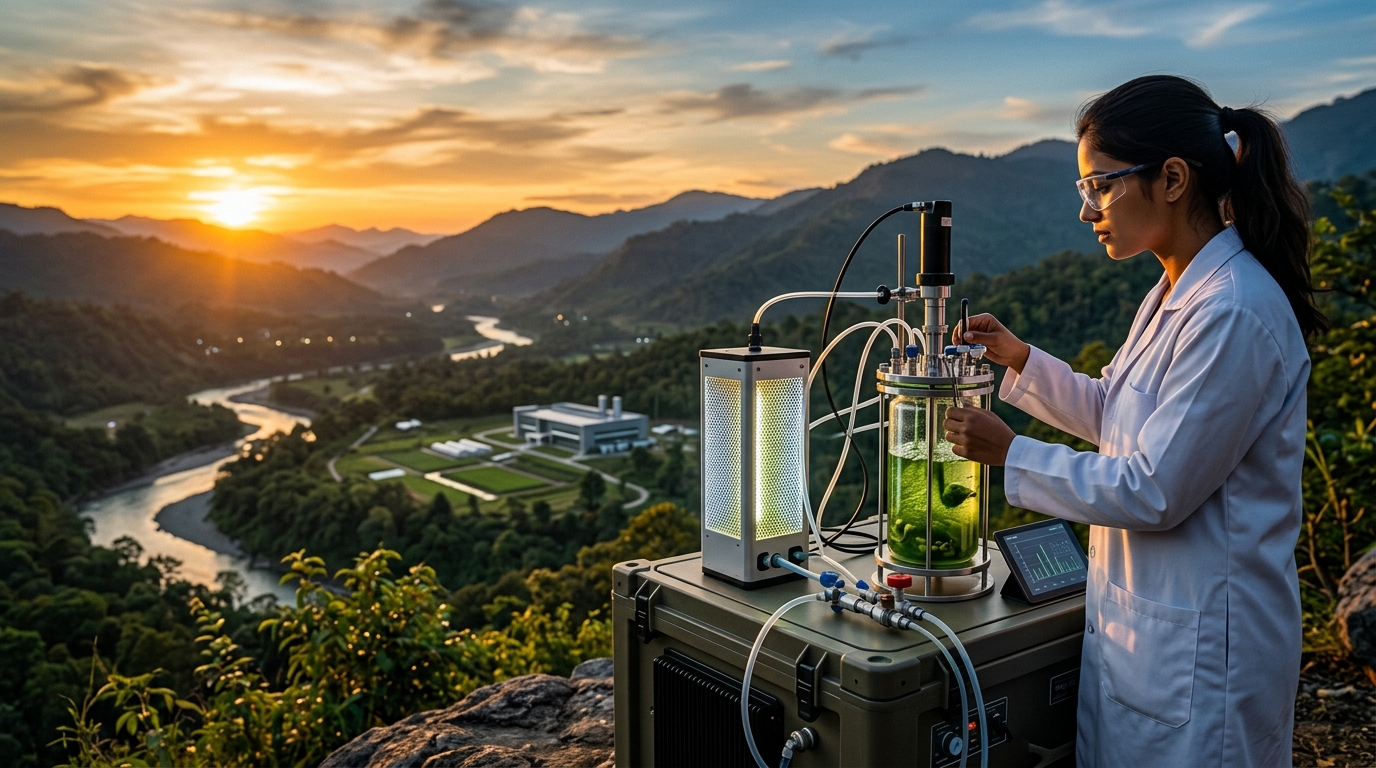
The Government's BioE3 policy, implemented by the Ministry of Science & Technology and BIRAC, has launched bio‑foundry and carbon‑capture projects across the North Eastern Region, allocating 10% of the budget to build a regional biomanufacturing ecosystem. Ten multi‑institutional projects—ranging from millet‑based carbon sequestration to micro‑algae fuel production—demonstrate India's push for climate‑resilient agriculture, clean energy and balanced regional development, a key focus area for UPSC aspirants.
Overview The BioE3 policy is being operationalised in the NER through a series of bio‑foundry and carbon‑capture projects. The Ministry of Science & Technology, in partnership with the Department of Biotechnology (DBT) and its public‑sector undertaking BIRAC , has earmarked 10% of the budget for these initiatives. Key Developments Establishment of Biofoundries and BioEnablers across the country, with a dedicated 10% share for the NER. Open calls for proposals under two categories – Discovery‑oriented Integrated Network Research and Bridging the Gap for Scale‑up – are being processed on a Mission Mode basis. State‑level BioE3 Cells have been notified in Assam and Sikkim. A collaborative network involving iBRIC institutes and the Sikkim government is testing bio‑based solutions for large‑cardamom pest management and disease‑tolerant varieties. Ten projects covering carbon capture, micro‑algae bio‑fuel, and sustainable cardamom cultivation are underway in Arunachal Pradesh, Meghalaya, Assam and Sikkim (see Annexure‑I). Important Facts Selected projects include: Exploring Carbon Capture and Utilization in Millet‑Based Agroforestry – Central Agricultural University, Arunachal Pradesh. Carbon Sequestration through Afforestation & Bio‑engineered Plant Systems – Bio‑Resources Development Centre, Meghalaya. Microalgae‑based CO₂ capture for Sustainable Aviation Fuel and Biopesticide – IIT Guwahati and MNIT Jaipur, Assam. Genetically Engineered Microalgae & Photobioreactors for Bio‑char Production – NIT Silchar, Assam. Integrated Biotechnological & Geochemical CCUS of Wasted Drill Cuttings – IIT Guwahati and Dibrugarh University, Assam. Biotechnological interventions for large Cardamom cultivation – Sikkim State Council of Science & Technology and Institute of Bioresources, Imphal. UPSC Relevance These initiatives illustrate the Government’s push for Carbon Capture and Utilization (CCU) and bio‑manufacturing to achieve climate‑resilient agriculture, clean energy and industrial diversification. Aspirants should link this to: India’s commitments under the Paris Agreement and the Nationally Determined Contributions (NDCs). Policy frameworks such as the BioE3 strategy, the National Biotechnology Development Strategy and the NEP‑2026 focus on regional equity. Inter‑ministerial coordination (Science & Technology, Agriculture, Environment) – a case study for governance and implementation challenges. Way Forward To maximise impact, the government may consider: Strengthening Centre‑State mechanisms to ensure timely fund disbursement and capacity building in remote NER districts. Creating a unified data‑platform for monitoring CCU and bio‑manufacturing outcomes, facilitating evidence‑based policy revisions. Encouraging private‑sector participation through fiscal incentives, thereby scaling up commercial viability of bio‑fuels and bio‑pesticides. Integrating these projects with broader NE‑India development plans such as the Act East Policy and the Himalayan Eco‑Region Initiative. Overall, the BioE3‑driven bio‑foundry ecosystem aims to transform the NER into a hub for sustainable biotechnology, climate mitigation and inclusive growth.
  1. Home
  2. Prepare
  3. Current Affairs
  4. BioE3 Policy Drives Biofoundry and Carbon Capture Projects in India's North Eastern Region
Login to bookmark articles
Login to mark articles as complete

Overview

BioE3 drives bio‑foundries & carbon capture in NER, boosting green tech & regional equity

Key Facts

  1. BioE3 policy earmarks 10% of its budget for bio‑foundry and carbon‑capture projects in the North Eastern Region (NER).
  2. State‑level BioE3 Cells have been notified in Assam and Sikkim to coordinate biomanufacturing activities.
  3. Ten pilot projects covering carbon capture, micro‑algae bio‑fuel, and sustainable cardamom cultivation are underway in Arunachal Pradesh, Meghalaya, Assam and Sikkim.
  4. Key projects include millet‑based agroforestry carbon capture (CAU, Arunachal), microalgae CO₂ capture for sustainable aviation fuel (IIT Guwahati & MNIT Jaipur, Assam), and genetically engineered microalgae for bio‑char (NIT Silchar, Assam).
  5. The Ministry of Science & Technology partners with the Department of Biotechnology (DBT) and BIRAC, which funds biotech R&D, start‑ups and industry collaborations.
  6. Open calls for proposals under ‘Discovery‑oriented Integrated Network Research’ and ‘Bridging the Gap for Scale‑up’ are being processed on a Mission Mode basis.
  7. The initiative aligns with India’s Nationally Determined Contributions under the Paris Agreement and complements NE‑India development plans such as the Act East Policy.

Background & Context

BioE3 is a Government of India strategic framework for high‑performance biomanufacturing across six thematic verticals, linking biotechnology with climate mitigation and inclusive growth. By fostering bio‑foundries and carbon‑capture units in the NER, the policy integrates science‑technology, environmental sustainability and regional equity, illustrating inter‑ministerial coordination (Science & Technology, Agriculture, Environment).

UPSC Syllabus Connections

GS3•Developments in science and technology and their applicationsEssay•Economy, Development and InequalityGS2•Functions and responsibilities of Union and StatesPrelims_GS•Constitution and Political SystemEssay•Science, Technology and SocietyPrelims_GS•National Current AffairsGS2•Government policies and interventions for developmentGS3•IT, Space, Computers, Robotics, Nano-technology, Bio-technology and IPREssay•Environment and SustainabilityGS3•Government Budgeting

Mains Answer Angle

GS3 (Science & Technology/Economy) – Evaluate how BioE3‑driven bio‑foundries and CCU projects can accelerate climate‑resilient industrialisation and balanced development in the North‑Eastern Region.

Full Article

Read Original on pib

Analysis

Practice Questions

GS3
Easy
Prelims MCQ

Bio‑manufacturing initiatives under BioE3 policy

1 marks
4 keywords
GS3
Medium
Mains Short Answer

Governance and Policy Themes – Development and Inequality

5 marks
4 keywords
GS3
Hard
Mains Essay

Energy transition and regional development; Integration of renewable hydrogen with biotech

20 marks
7 keywords
Related:Daily•Weekly

Loading related articles...

Loading related articles...

Tip: Click articles above to read more from the same date, or use the back button to see all articles.

Explore:Current Affairs·Editorial Analysis·Govt Schemes·Study Materials·Previous Year Questions·UPSC GPT