Loading page, please wait…
Bombay HC Strikes Down IT Rules 2023 - UPSC Polity And Governance
What is Bombay HC Strikes Down IT Rules 2023 in UPSC Polity And Governance?
Bombay HC Strikes Down IT Rules 2023 is a key topic under Polity And Governance for UPSC Civil Services Examination. Key points include: Bombay HC struck down IT Rules 2023 empowering government's Fact Check Unit (FCU).. FCU aimed to identify 'fake, false, misleading' information about the government on social media.. Ruling emphasizes protection of freedom of speech and expression (Article 19(1)(a)).. Understanding this topic is essential for both UPSC Prelims and Mains preparation.
Why is Bombay HC Strikes Down IT Rules 2023 important for UPSC exam?
Bombay HC Strikes Down IT Rules 2023 is a Medium-level topic in UPSC Polity And Governance. It is tested in both Prelims (factual MCQs) and Mains (analytical answer writing). Previous year UPSC questions have frequently covered aspects of Bombay HC Strikes Down IT Rules 2023, making it essential for comprehensive IAS preparation.
How to prepare Bombay HC Strikes Down IT Rules 2023 for UPSC?
To prepare Bombay HC Strikes Down IT Rules 2023 for UPSC: (1) Study the comprehensive notes covering all key concepts on Vaidra. (2) Practice previous year questions on this topic. (3) Connect it with current affairs using daily updates. (4) Revise using key takeaways and mind maps available for Polity And Governance. (5) Write practice answers linking Bombay HC Strikes Down IT Rules 2023 to related GS Paper topics.
Key takeaways of Bombay HC Strikes Down IT Rules 2023 for UPSC
- Bombay HC struck down IT Rules 2023 empowering government's Fact Check Unit (FCU).
- FCU aimed to identify 'fake, false, misleading' information about the government on social media.
- Ruling emphasizes protection of freedom of speech and expression (Article 19(1)(a)).
- Highlights judiciary's role in preventing arbitrary government censorship online.
- Prompts re-evaluation of methods to combat misinformation without infringing on fundamental rights.
Bombay HC Strikes Down IT Rules 2023
Medium⏱️ 7 min read
polity and governance
📖 Introduction
Introduction to the Ruling
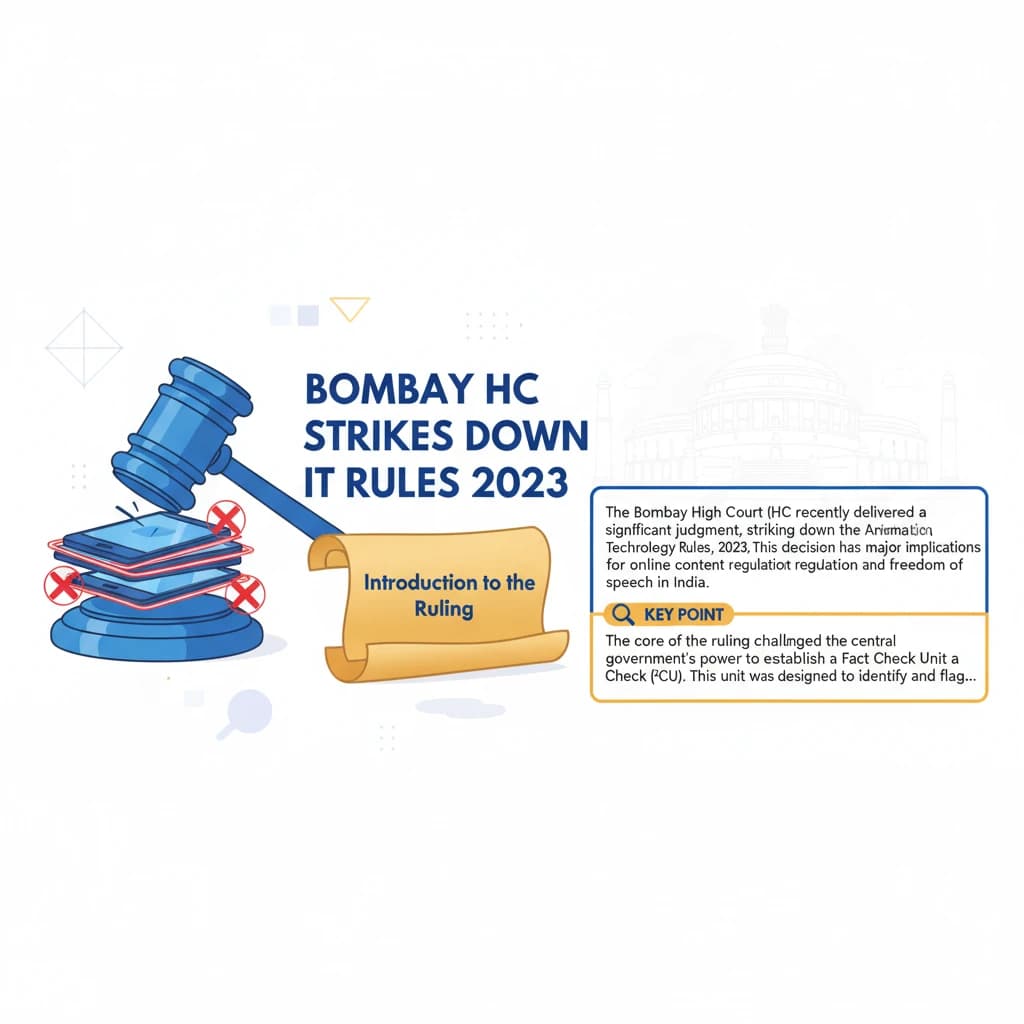
The Bombay High Court (HC) recently delivered a significant judgment, striking down the Amended Information Technology Rules, 2023. This decision has major implications for online content regulation and freedom of speech in India.
The core of the ruling challenged the central government's power to establish a Fact Check Unit (FCU). This unit was designed to identify and flag certain types of information online.
The Mandate of the Fact Check Unit (FCU)
The FCU was envisioned with a specific role: to identify fake, false, and misleading information. Its primary target was content related to the government's business on various social media platforms.
The unit's objective was to combat misinformation, particularly that which could potentially harm public trust or government operations. However, its powers raised concerns regarding censorship and free expression.
Reasons for Striking Down the Rules
While the detailed reasoning of the Bombay HC is extensive, the fundamental concern revolved around the potential for arbitrary censorship. Critics argued that empowering the government to be the sole arbiter of truth could stifle legitimate dissent and critical commentary.
UPSC aspirants should note this case highlights the delicate balance between combating misinformation and upholding freedom of speech and expression (Article 19(1)(a)). It's a prime example of judicial review in action.
💡 Key Takeaways
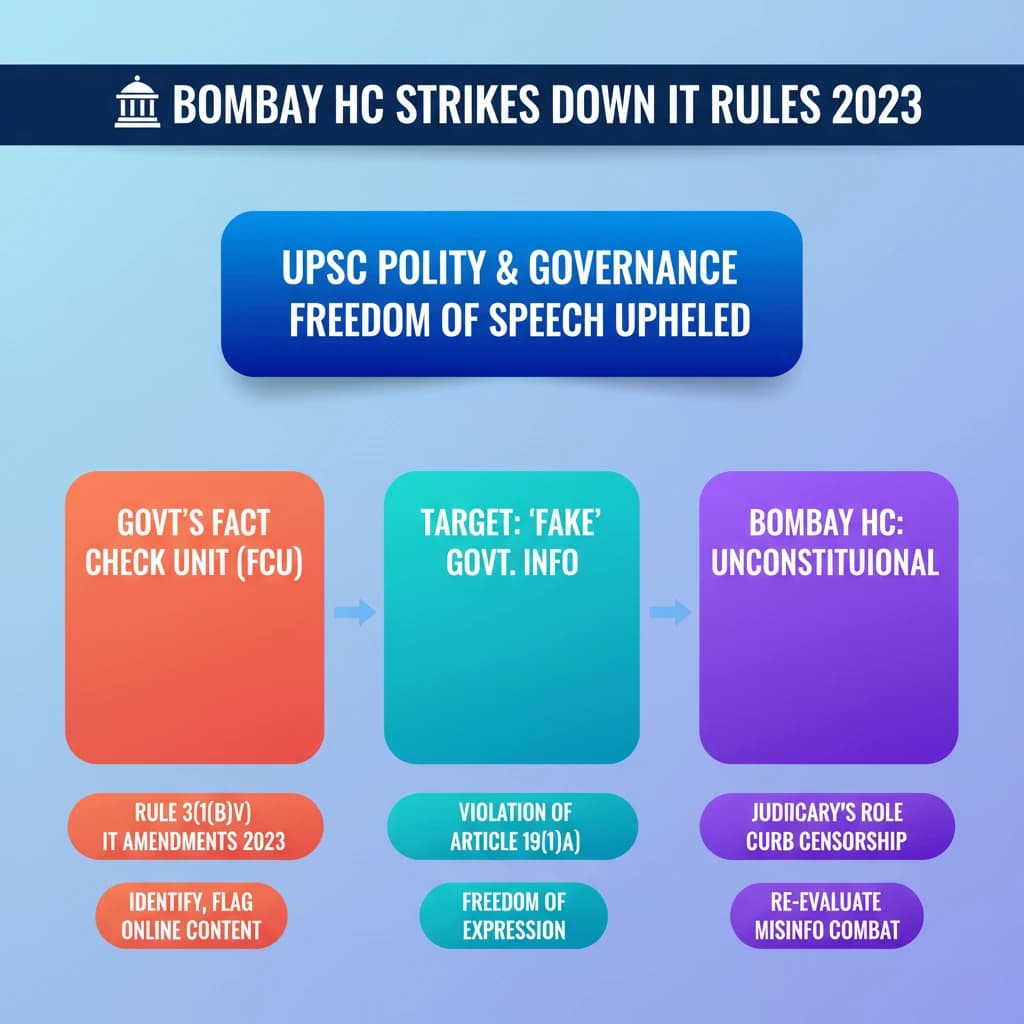
- •Bombay HC struck down IT Rules 2023 empowering government's Fact Check Unit (FCU).
- •FCU aimed to identify 'fake, false, misleading' information about the government on social media.
- •Ruling emphasizes protection of freedom of speech and expression (Article 19(1)(a)).
- •Highlights judiciary's role in preventing arbitrary government censorship online.
- •Prompts re-evaluation of methods to combat misinformation without infringing on fundamental rights.
🧠 Memory Techniques
95% Verified Content
📚 Reference Sources
•General knowledge of Indian Constitution and IT Act, 2000
•Public domain news reports on the Bombay High Court ruling