Loading page, please wait…
Inquiry Wing of Lokpal - UPSC Polity And Governance
What is Inquiry Wing of Lokpal in UPSC Polity And Governance?
Inquiry Wing of Lokpal is a key topic under Polity And Governance for UPSC Civil Services Examination. Key points include: Lokpal's Inquiry Wing is mandated by Section 11 of the Lokpal and Lokayuktas Act, 2013.. It conducts preliminary inquiries into corruption allegations against public servants under the Prevention of Corruption Act, 1988.. Headed by a Director of Inquiry, supported by specialized SPs (general, economic & banking, cyber).. Understanding this topic is essential for both UPSC Prelims and Mains preparation.
Why is Inquiry Wing of Lokpal important for UPSC exam?
Inquiry Wing of Lokpal is a Medium-level topic in UPSC Polity And Governance. It is tested in both Prelims (factual MCQs) and Mains (analytical answer writing). Previous year UPSC questions have frequently covered aspects of Inquiry Wing of Lokpal, making it essential for comprehensive IAS preparation.
How to prepare Inquiry Wing of Lokpal for UPSC?
To prepare Inquiry Wing of Lokpal for UPSC: (1) Study the comprehensive notes covering all key concepts on Vaidra. (2) Practice previous year questions on this topic. (3) Connect it with current affairs using daily updates. (4) Revise using key takeaways and mind maps available for Polity And Governance. (5) Write practice answers linking Inquiry Wing of Lokpal to related GS Paper topics.
Key takeaways of Inquiry Wing of Lokpal for UPSC
- Lokpal's Inquiry Wing is mandated by Section 11 of the Lokpal and Lokayuktas Act, 2013.
- It conducts preliminary inquiries into corruption allegations against public servants under the Prevention of Corruption Act, 1988.
- Headed by a Director of Inquiry, supported by specialized SPs (general, economic & banking, cyber).
- Preliminary inquiry reports must be submitted to Lokpal within 60 days, including feedback from the public servant.
- Lokpal acts as an ombudsman, investigating corruption against a wide range of public functionaries, including the PM, MPs, and various government officials.
Inquiry Wing of Lokpal
Medium⏱️ 8 min read
polity and governance
📖 Introduction
Introduction to Lokpal's Inquiry Wing
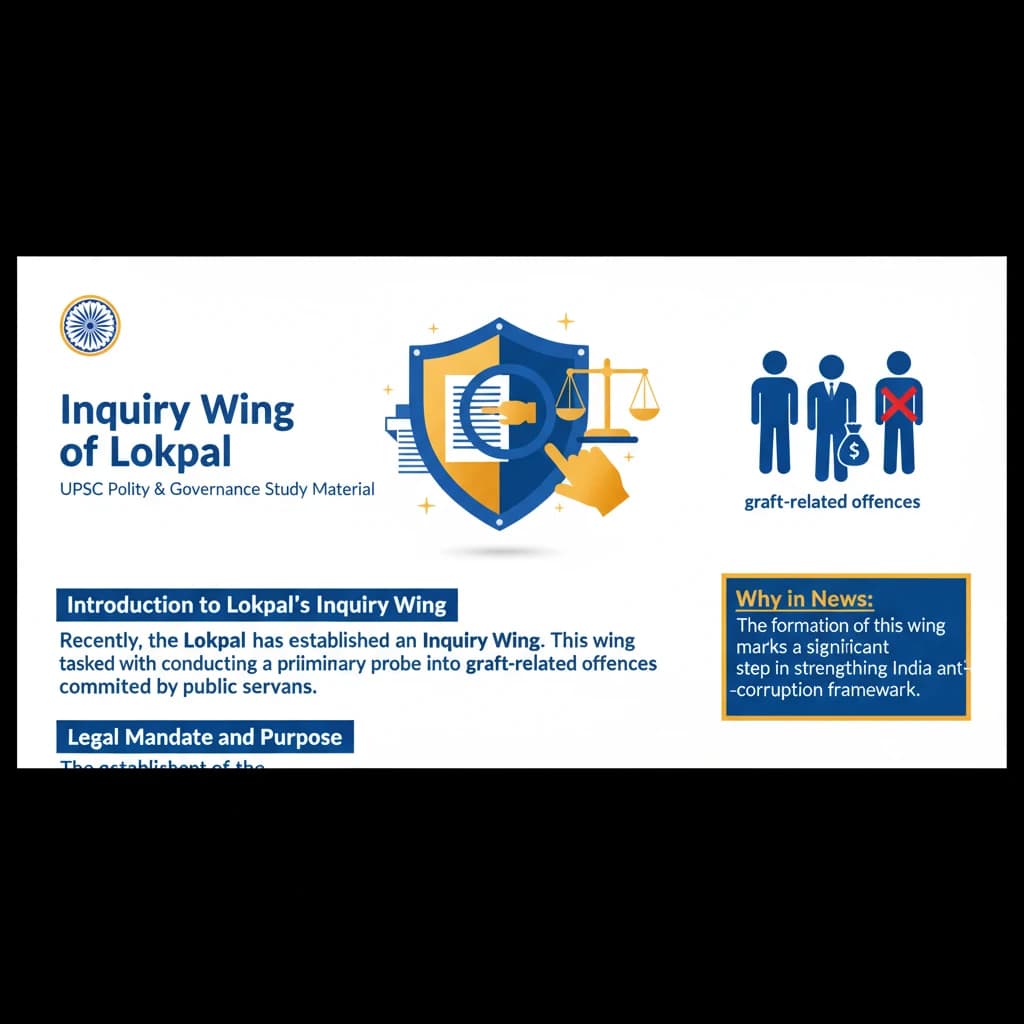
Recently, the Lokpal has established an Inquiry Wing. This wing is tasked with conducting a preliminary probe into graft-related offences committed by public servants.
Why in News: The formation of this wing marks a significant step in strengthening India's anti-corruption framework.
Legal Mandate and Purpose
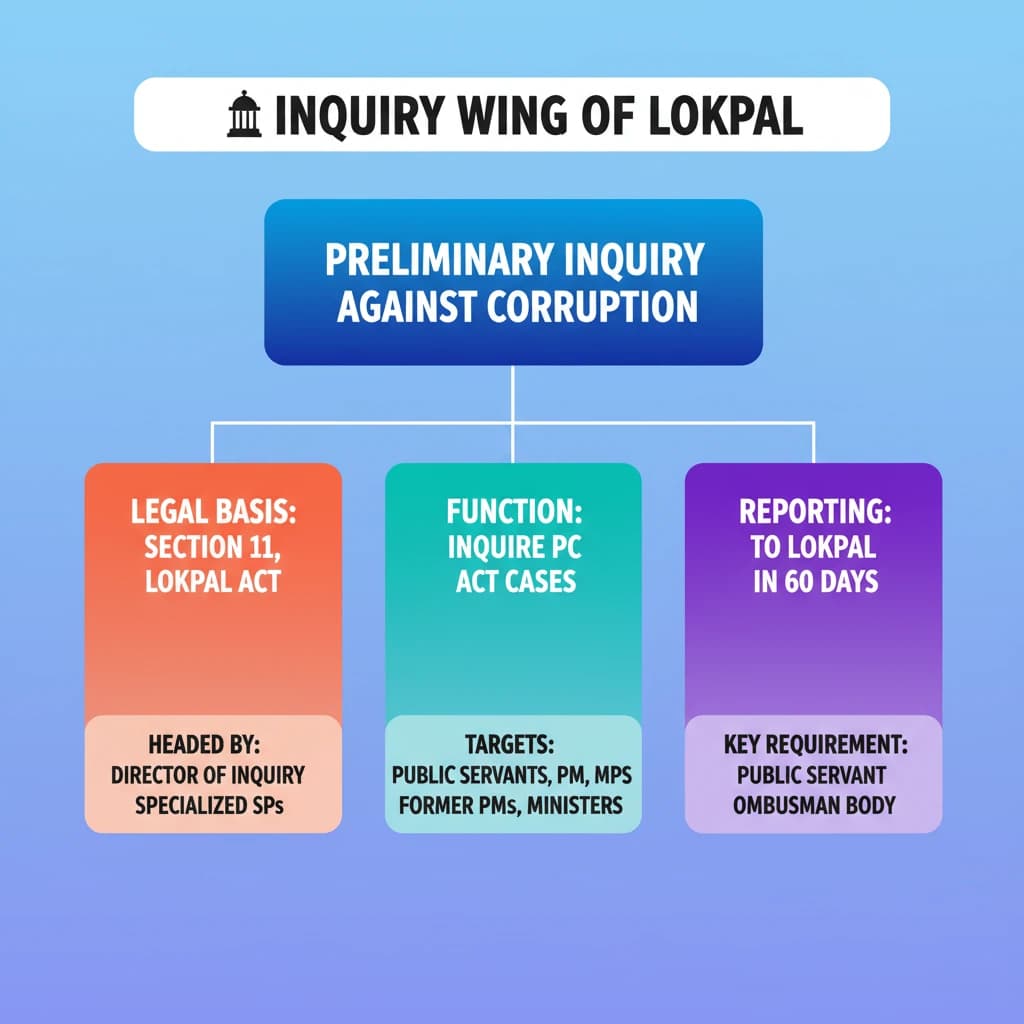
The establishment of the Inquiry Wing is mandated by Section 11 of the Lokpal and Lokayuktas Act, 2013. This legal backing ensures its operational legitimacy and authority.
Its primary responsibility is to conduct preliminary inquiries into offences falling under the Prevention of Corruption Act, 1988. These allegations are specifically against specified public servants and functionaries.
The wing focuses on initial investigations, laying the groundwork for potential further action by the Lokpal.
Organizational Structure of the Inquiry Wing
The Inquiry Wing is headed by a Director of Inquiry, who reports directly to the Lokpal Chairperson. This ensures direct oversight and accountability.
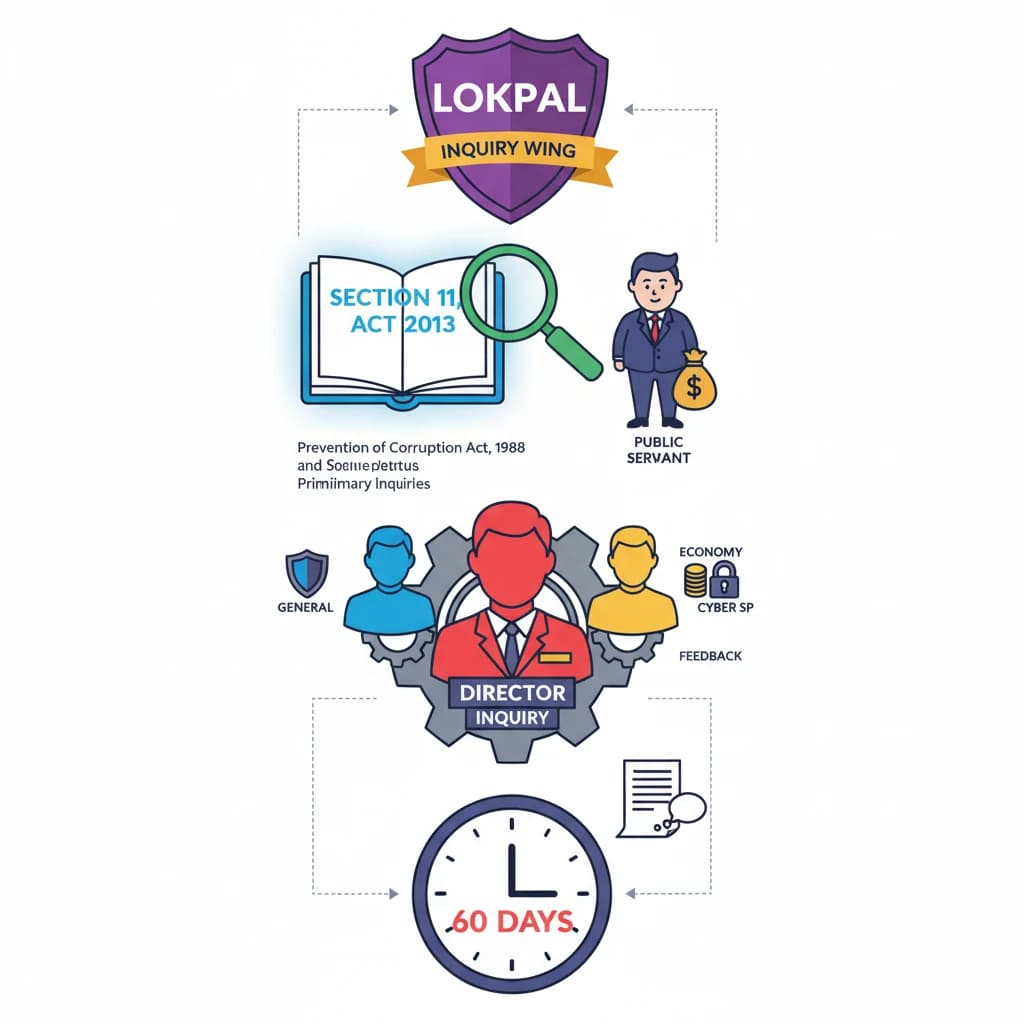
The Director is supported by three Superintendents of Police (SPs), each specializing in different areas:
- SP (general): Handles a broad range of corruption cases.
- SP (economic and banking): Focuses on financial and banking-related irregularities.
- SP (cyber): Deals with cyber-related corruption and digital fraud.
Each SP is further assisted by dedicated inquiry officers and other essential staff, forming a comprehensive investigative team.
Preliminary Inquiry Timeline and Reporting
The Inquiry Wing operates under a strict deadline. It must finalize its preliminary inquiry and submit a detailed report to the Lokpal within 60 days of receiving a complaint.
This report is crucial and must incorporate feedback from both the public servant against whom the allegations are made and the designated competent authority for that category of public servant.
The 60-day timeline highlights the emphasis on swift and time-bound investigations, a key aspect of good governance often tested in UPSC Mains (GS-II).
Key Facts about Lokpal: An Overview
The Lokpal is a landmark institution in independent India, specifically created to combat corruption among public functionaries. It represents a significant step towards greater accountability.
Establishment: The Lokpal was established under the Lokpal and Lokayuktas Act, 2013. Its mandate is to investigate corruption allegations against individuals within its specified scope.
Composition of the Lokpal
The Lokpal body comprises a Chairperson and up to eight Members. A critical provision is that at least 50% of these members must be Judicial Members.
Both the Chairperson and Members are appointed by the President of India. They serve for a term of five years or until they reach the age of 70 years, whichever occurs earlier.
Remuneration: The Chairperson's salary and allowances are equivalent to those of the Chief Justice of India. Members receive benefits similar to those of a Judge of the Supreme Court.
Organizational Structure of Lokpal (Broader)
Beyond the Inquiry Wing, the Lokpal operates through two primary branches to manage its extensive functions:
- Administrative Branch: Headed by an officer of the rank of Secretary to the Government of India, managing operational and logistical aspects.
- Judicial Branch: Led by a Judicial Officer of an appropriate level, overseeing legal and adjudicatory processes.
Note on Prosecution Wing: The Lokpal and Lokayuktas Act, 2013 also includes a provision for a Prosecution Wing, to be headed by a Director of Prosecution. This wing, intended for prosecuting public servants, is yet to be constituted.
Jurisdiction of Lokpal
The Lokpal possesses broad authority to investigate corruption allegations across various levels of public functionaries. Its reach is extensive to ensure comprehensive oversight.
Key individuals and groups under its purview include:
- The Prime Minister
- Union Ministers
- Members of Parliament (MPs)
- Officials in Groups A, B, C, and D of the Union Government
Furthermore, its jurisdiction extends to chairpersons, members, officers, and directors of any board, corporation, society, trust, or autonomous body. This includes entities established by an Act of Parliament or those significantly funded by the Union or State Government.
Proceeding of Lokpal
Upon receiving a complaint, the Lokpal has several avenues for action. It may directly order a preliminary inquiry through its newly constituted Inquiry Wing.
Alternatively, the Lokpal can refer the matter to other specialized agencies, such as the Central Bureau of Investigation (CBI) or the Central Vigilance Commission (CVC), depending on the nature and scope of the allegations.
For officials in Groups A and B, the CVC sends a detailed report back to the Lokpal after its investigation. For officials in Groups C and D, the CVC takes direct action under the provisions of the CVC Act, 2003.
Functions of Lokpal: The Ombudsman Role
The Lokpal performs the vital function of an "ombudsman". It inquires into allegations of corruption against specific public functionaries and addresses related matters.
Definition of Ombudsman: An ombudsman is an official who investigates complaints, typically lodged by private citizens, against businesses, public entities, or officials. This role ensures an independent channel for grievance redressal.
Understanding the ombudsman concept is crucial for UPSC GS-II (Governance) and GS-IV (Ethics), as it reflects principles of accountability and transparency.
💡 Key Takeaways
- •Lokpal's Inquiry Wing is mandated by Section 11 of the Lokpal and Lokayuktas Act, 2013.
- •It conducts preliminary inquiries into corruption allegations against public servants under the Prevention of Corruption Act, 1988.
- •Headed by a Director of Inquiry, supported by specialized SPs (general, economic & banking, cyber).
- •Preliminary inquiry reports must be submitted to Lokpal within 60 days, including feedback from the public servant.
- •Lokpal acts as an ombudsman, investigating corruption against a wide range of public functionaries, including the PM, MPs, and various government officials.
🧠 Memory Techniques
95% Verified Content
📚 Reference Sources
•The Lokpal and Lokayuktas Act, 2013
•Prevention of Corruption Act, 1988