Loading page, please wait…
Motion of Thanks - UPSC Polity And Governance
What is Motion of Thanks in UPSC Polity And Governance?
Motion of Thanks is a key topic under Polity And Governance for UPSC Civil Services Examination. Key points include: Motion of Thanks is a formal parliamentary procedure to express gratitude for the President's Address.. The President's Address (under Article 87) outlines the government's past achievements and future policies.. It is delivered at the start of the first session after general elections and the first session of each year.. Understanding this topic is essential for both UPSC Prelims and Mains preparation.
Why is Motion of Thanks important for UPSC exam?
Motion of Thanks is a Medium-level topic in UPSC Polity And Governance. It is tested in both Prelims (factual MCQs) and Mains (analytical answer writing). Previous year UPSC questions have frequently covered aspects of Motion of Thanks, making it essential for comprehensive IAS preparation.
How to prepare Motion of Thanks for UPSC?
To prepare Motion of Thanks for UPSC: (1) Study the comprehensive notes covering all key concepts on Vaidra. (2) Practice previous year questions on this topic. (3) Connect it with current affairs using daily updates. (4) Revise using key takeaways and mind maps available for Polity And Governance. (5) Write practice answers linking Motion of Thanks to related GS Paper topics.
Key takeaways of Motion of Thanks for UPSC
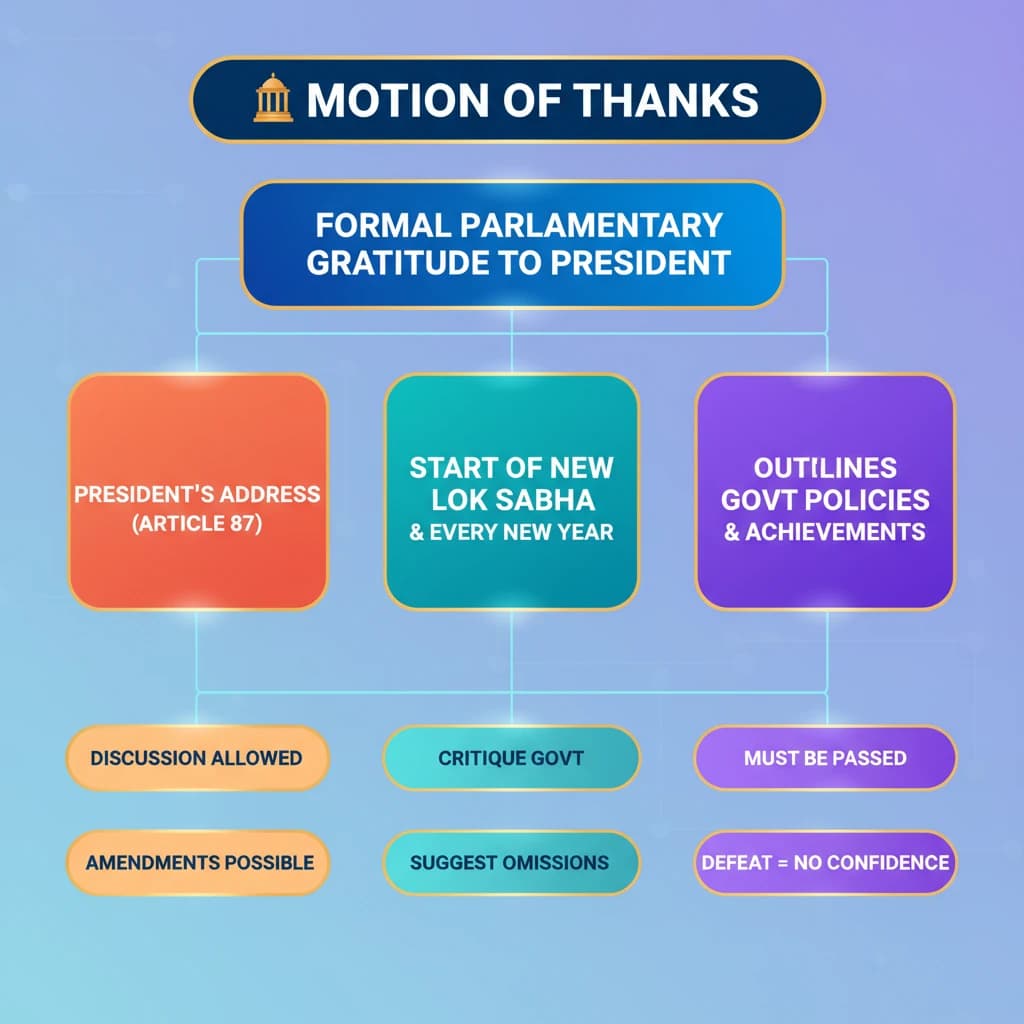
- Motion of Thanks is a formal parliamentary procedure to express gratitude for the President's Address.
- The President's Address (under Article 87) outlines the government's past achievements and future policies.
- It is delivered at the start of the first session after general elections and the first session of each year.
- Discussion allows for amendments, which can critique government policies or omissions.
- The Motion of Thanks MUST be passed; its defeat implies a lack of confidence in the government.
- Limitations include not referring to state matters or mentioning the President's name in debate.
Motion of Thanks
Medium⏱️ 8 min read
polity and governance
📖 Introduction
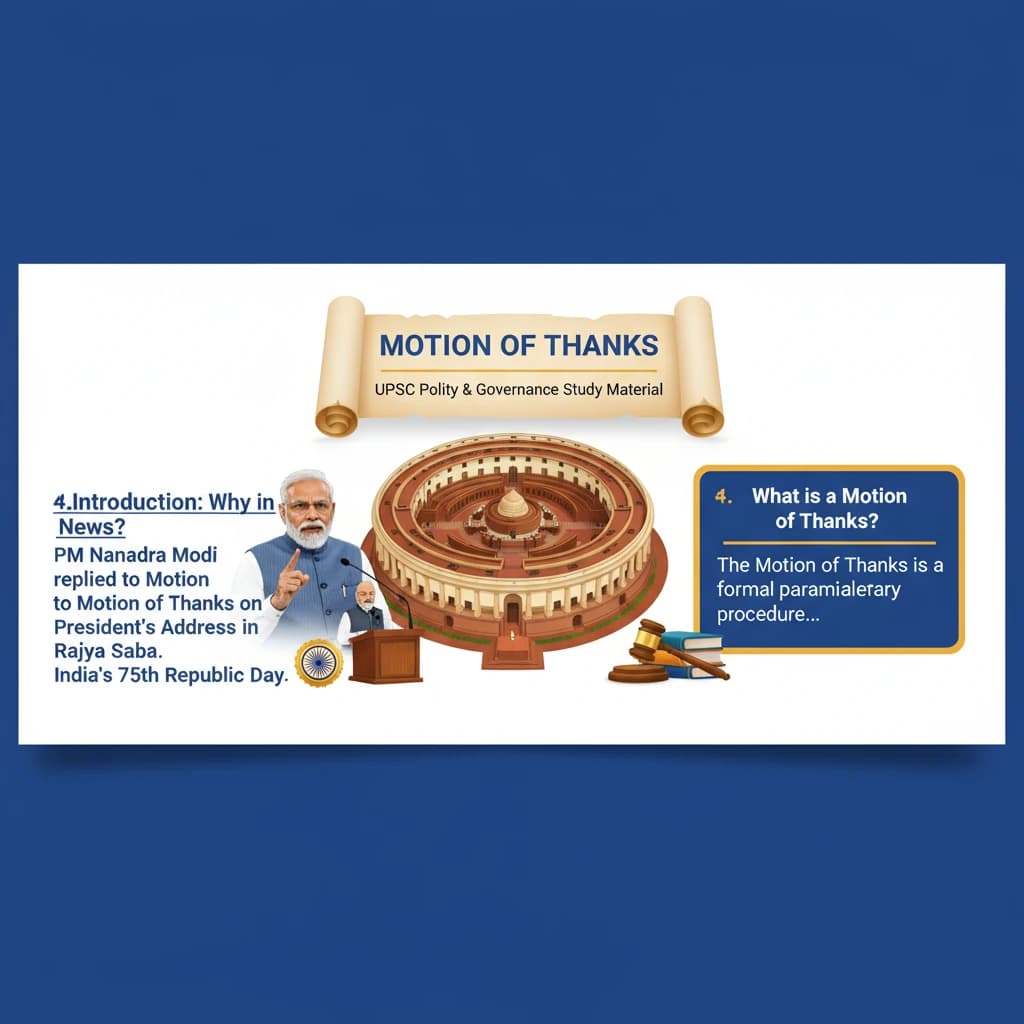
Introduction: Why in News?
Recently, Prime Minister Narendra Modi replied to the Motion of Thanks on the President’s Address to Parliament in the Rajya Sabha. This event highlighted significant milestones in India’s journey towards the 75th Republic Day.
What is a Motion of Thanks?
The Motion of Thanks is a formal parliamentary procedure used to express gratitude or appreciation for the President’s Address to both Houses of Parliament. It is a crucial part of India's parliamentary tradition.
This motion serves as a mechanism for Parliament to discuss and respond to the government's policy statement.
The President's Address: A Government Policy Statement
The President’s Address is essentially a statement of policy of the incumbent Government. As such, it is drafted by the Government itself, reflecting its agenda and achievements.
It provides a comprehensive review of various activities and achievements of the Government during the preceding year. Furthermore, it outlines the policy, projects, and programmes that the Government intends to pursue concerning important national and international issues.
Constitutional Basis: Article 87
Article 87 of the Constitution of India mandates that the President must address both Houses of Parliament at two specific junctures:
- At the beginning of the first session after each general election.
- At the beginning of the first session of each year.
The President also informs Parliament of the reasons for its summons during this address.
This address is often referred to as a ‘special address’ and is an annual feature of the parliamentary calendar.
Discussion and Amendments
The President's Address is discussed in both Houses of Parliament through the Motion of Thanks. This procedure is akin to the ‘speech from the Throne’ in Britain, signifying its historical roots and parliamentary significance.
During the discussion, members of Parliament can propose amendments to the Motion of Thanks. These amendments can refer to matters contained within the Address itself.
Alternatively, amendments can highlight matters which, in the opinion of a member, the Address has failed to mention, thus allowing for a broader critique of government policy.
Voting and Adoption
At the conclusion of the discussion, the Motion of Thanks is put to a vote. The debate is typically concluded by a reply from the Prime Minister or another designated Minister, addressing the points raised by members.
Immediately after the ministerial reply, any proposed amendments are disposed of, either by being passed or rejected. Following this, the main Motion of Thanks is put to vote and adopted.
Consequences of Defeat
It is imperative that the Motion of Thanks is passed in the House. If it fails to pass, it amounts to the defeat of the government on the floor of the House.
This outcome is considered a significant blow and can be interpreted as an expression of lack of confidence in the government, particularly in the Lok Sabha.
UPSC Insight: The defeat of the Motion of Thanks is a rare but potent tool for the opposition to demonstrate a lack of confidence. It's crucial to understand its implications, similar to a no-confidence motion.
Limitations of the Motion of Thanks
There are specific limitations governing the debate on the Motion of Thanks:
- Members cannot refer to matters that are not under the direct responsibility of the Central Government. This ensures the debate focuses on the Union government's policies.
- Members are also prohibited from mentioning the name of the President in the debate. This upholds the constitutional position of the President as the head of state, above political debate.
💡 Key Takeaways
- •Motion of Thanks is a formal parliamentary procedure to express gratitude for the President's Address.
- •The President's Address (under Article 87) outlines the government's past achievements and future policies.
- •It is delivered at the start of the first session after general elections and the first session of each year.
- •Discussion allows for amendments, which can critique government policies or omissions.
- •The Motion of Thanks MUST be passed; its defeat implies a lack of confidence in the government.
- •Limitations include not referring to state matters or mentioning the President's name in debate.
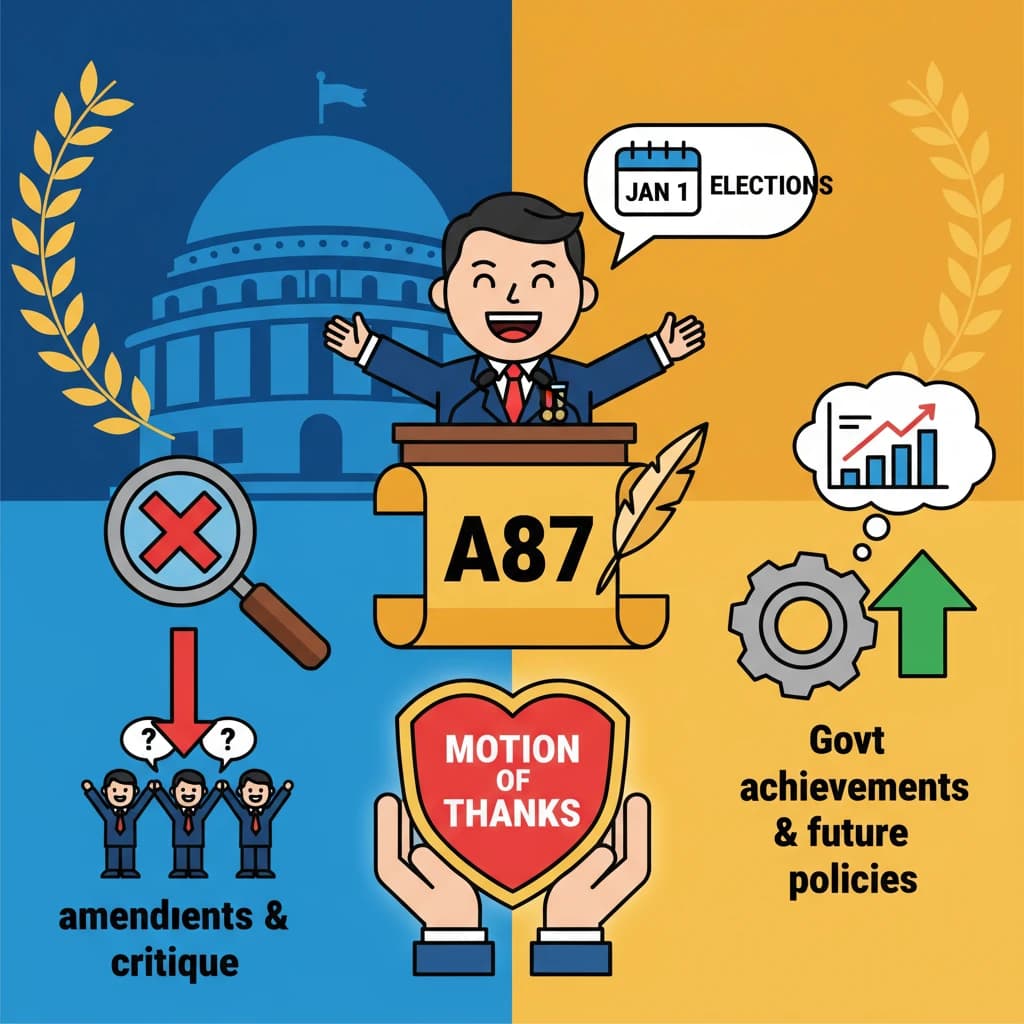
🧠 Memory Techniques
95% Verified Content
📚 Reference Sources
•The Constitution of India (Article 87)
•Parliament of India website (Lok Sabha and Rajya Sabha procedures)