Loading page, please wait…
Regulatory Bodies in India: SEBI & TRAI - Structure, Role & Functions - UPSC Polity And Governance
What is Regulatory Bodies in India: SEBI & TRAI - Structure, Role & Functions in UPSC Polity And Governance?
Regulatory Bodies in India: SEBI & TRAI - Structure, Role & Functions is a key topic under Polity And Governance for UPSC Civil Services Examination. Key points include: Regulatory bodies are autonomous institutions overseeing specific economic sectors.. They possess quasi-legislative, quasi-executive, and quasi-judicial powers.. SEBI regulates securities markets, protecting investors and ensuring market integrity.. Understanding this topic is essential for both UPSC Prelims and Mains preparation.
Why is Regulatory Bodies in India: SEBI & TRAI - Structure, Role & Functions important for UPSC exam?
Regulatory Bodies in India: SEBI & TRAI - Structure, Role & Functions is a Medium-level topic in UPSC Polity And Governance. It is tested in both Prelims (factual MCQs) and Mains (analytical answer writing). Previous year UPSC questions have frequently covered aspects of Regulatory Bodies in India: SEBI & TRAI - Structure, Role & Functions, making it essential for comprehensive IAS preparation.
How to prepare Regulatory Bodies in India: SEBI & TRAI - Structure, Role & Functions for UPSC?
To prepare Regulatory Bodies in India: SEBI & TRAI - Structure, Role & Functions for UPSC: (1) Study the comprehensive notes covering all key concepts on Vaidra. (2) Practice previous year questions on this topic. (3) Connect it with current affairs using daily updates. (4) Revise using key takeaways and mind maps available for Polity And Governance. (5) Write practice answers linking Regulatory Bodies in India: SEBI & TRAI - Structure, Role & Functions to related GS Paper topics.
Key takeaways of Regulatory Bodies in India: SEBI & TRAI - Structure, Role & Functions for UPSC
- Regulatory bodies are autonomous institutions overseeing specific economic sectors.
- They possess quasi-legislative, quasi-executive, and quasi-judicial powers.
- SEBI regulates securities markets, protecting investors and ensuring market integrity.
- TRAI regulates telecom services, ensuring quality, fair tariffs, and advising policy.
- Their establishment post-1991 reforms was crucial for market liberalization and growth.
- They are vital for market stability, consumer protection, fair competition, and effective policy implementation.
- Challenges include maintaining autonomy, avoiding regulatory capture, and adapting to technological changes.
Regulatory Bodies in India: SEBI & TRAI - Structure, Role & Functions
Medium⏱️ 7 min read
polity and governance
📖 Introduction
Understanding Regulatory Bodies in India
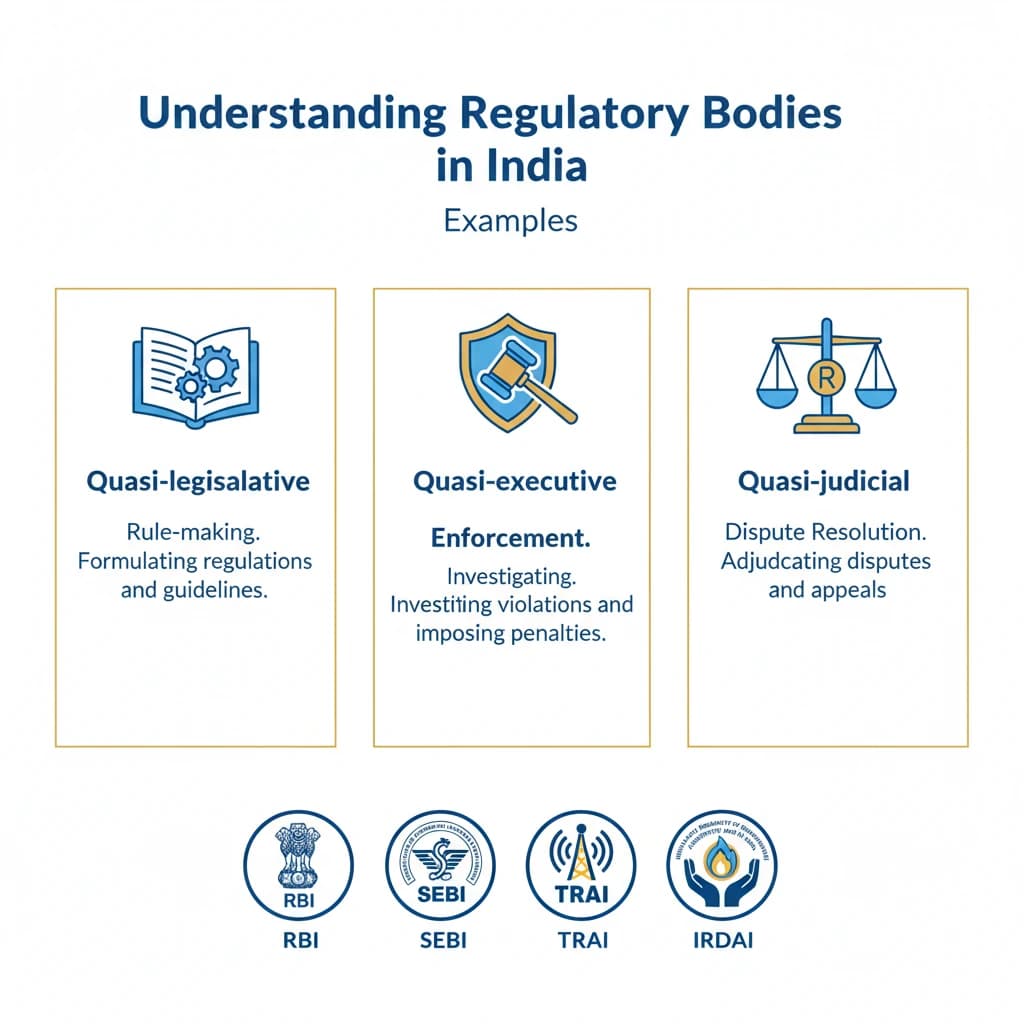
Regulatory bodies are essential institutions established by the government to oversee specific sectors of the economy. Their primary goal is to ensure fair practices, protect consumer interests, promote healthy competition, and maintain market stability.
These bodies often possess quasi-legislative (rule-making), quasi-executive (enforcement), and quasi-judicial (dispute resolution) powers, allowing them to function with a degree of autonomy.
Securities and Exchange Board of India (SEBI)
The Securities and Exchange Board of India (SEBI) is the primary regulator for the securities market in India. It was initially established in 1988 as a non-statutory body and granted statutory powers on January 30, 1992, through the SEBI Act, 1992.
- Established: 1992 (statutory status)
- Headquarters: Mumbai
- Role: Regulates securities markets, protects investors, and ensures market integrity.
SEBI's structure includes a board comprising a Chairman, several whole-time members, and part-time members. This composition ensures a broad range of expertise in its decision-making processes.
Appeals against SEBI's decisions are first heard by the Securities Appellate Tribunal (SAT). Further appeals can be made directly to the Supreme Court of India, ensuring a robust judicial review mechanism.
Key functions of SEBI involve drafting comprehensive regulations, conducting thorough inquiries into market malpractices, and imposing penalties on non-compliant entities. It plays a crucial role in maintaining investor confidence.
- Oversees venture capital funds and mutual funds.
- Addresses and prevents fraudulent practices in the securities market.
- Promotes the development and regulation of the stock exchanges and other securities markets.
Telecom Regulatory Authority of India (TRAI)
The Telecom Regulatory Authority of India (TRAI) is the independent regulator for the telecommunications sector in India. It was established to provide a level playing field and promote growth in the rapidly expanding telecom industry.
- Established: 1997, under the TRAI Act, 1997
- Headquarters: New Delhi
- Role: Regulates telecom services, revises tariffs, ensures service quality, and advises the government on telecom policy.
TRAI's structure typically includes a Chairperson and up to two whole-time members and two part-time members. This structure allows for both continuous oversight and diverse perspectives.
The Telecommunications Dispute Settlement and Appellate Tribunal (TDSAT) was established in 2000 to handle disputes and appeals against TRAI's decisions. This ensures an independent and specialized forum for resolving telecom-related grievances.
Other Important Regulatory Bodies
India's regulatory landscape extends beyond SEBI and TRAI, encompassing various sectors critical to the nation's economy and public welfare. These bodies ensure specialized oversight and enforcement.
- Reserve Bank of India (RBI): Central banking institution, regulates monetary policy.
- National Bank for Agriculture and Rural Development (NABARD): Apex development bank for agriculture and rural development.
- Small Industries Development Bank of India (SIDBI): Provides financial assistance to Micro, Small and Medium Enterprises (MSMEs).
- Food Safety and Standards Authority of India (FSSAI): Ensures food safety standards across the country.
- Central Drugs Standard Control Organisation (CDSCO): Regulates drugs and medical devices.
- Competition Commission of India (CCI): Promotes competition and prevents anti-competitive practices.
💡 Key Takeaways
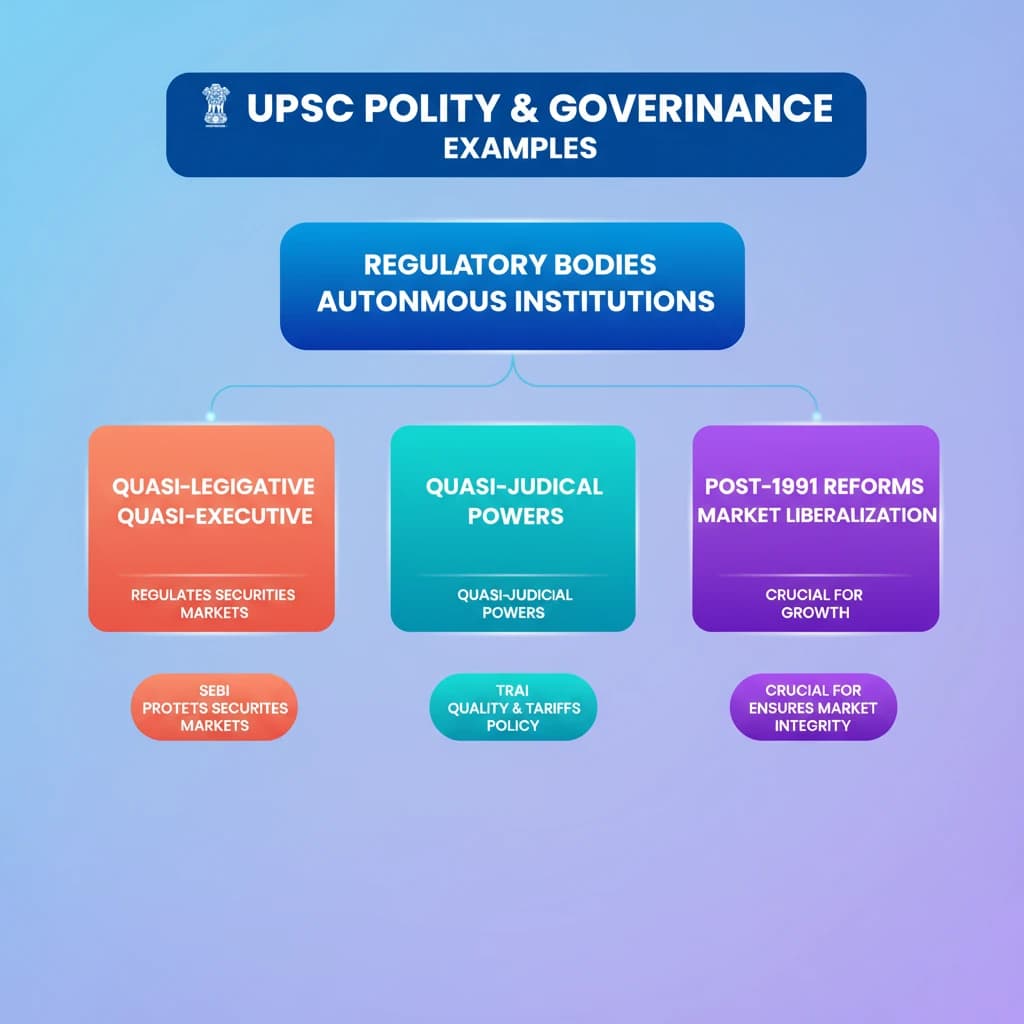
- •Regulatory bodies are autonomous institutions overseeing specific economic sectors.
- •They possess quasi-legislative, quasi-executive, and quasi-judicial powers.
- •SEBI regulates securities markets, protecting investors and ensuring market integrity.
- •TRAI regulates telecom services, ensuring quality, fair tariffs, and advising policy.
- •Their establishment post-1991 reforms was crucial for market liberalization and growth.
- •They are vital for market stability, consumer protection, fair competition, and effective policy implementation.
- •Challenges include maintaining autonomy, avoiding regulatory capture, and adapting to technological changes.
🧠 Memory Techniques
98% Verified Content
📚 Reference Sources
•Securities and Exchange Board of India (SEBI) Official Website
•Telecom Regulatory Authority of India (TRAI) Official Website
•Food Safety and Standards Authority of India (FSSAI) Official Website
•The SEBI Act, 1992
•The TRAI Act, 1997
•The Food Safety and Standards Act, 2006