Loading page, please wait…
Third-Party Audits for Smart Cities Mission - UPSC Polity And Governance
What is Third-Party Audits for Smart Cities Mission in UPSC Polity And Governance?
Third-Party Audits for Smart Cities Mission is a key topic under Polity And Governance for UPSC Civil Services Examination. Key points include: Parliamentary Committee advocates for third-party audits of Smart Cities Mission (SCM) projects to address implementation gaps.. SCM, launched in June 2015, aims to transform 100 cities through core infrastructure and smart solutions, operating as a Centrally Sponsored Scheme.. SCM components include Area-Based Development (Redevelopment, Retrofitting, Greenfield) and Pan-City Solutions, implemented via SPVs under a PPP model.. Understanding this topic is essential for both UPSC Prelims and Mains preparation.
Why is Third-Party Audits for Smart Cities Mission important for UPSC exam?
Third-Party Audits for Smart Cities Mission is a Medium-level topic in UPSC Polity And Governance. It is tested in both Prelims (factual MCQs) and Mains (analytical answer writing). Previous year UPSC questions have frequently covered aspects of Third-Party Audits for Smart Cities Mission, making it essential for comprehensive IAS preparation.
How to prepare Third-Party Audits for Smart Cities Mission for UPSC?
To prepare Third-Party Audits for Smart Cities Mission for UPSC: (1) Study the comprehensive notes covering all key concepts on Vaidra. (2) Practice previous year questions on this topic. (3) Connect it with current affairs using daily updates. (4) Revise using key takeaways and mind maps available for Polity And Governance. (5) Write practice answers linking Third-Party Audits for Smart Cities Mission to related GS Paper topics.
Key takeaways of Third-Party Audits for Smart Cities Mission for UPSC
- Parliamentary Committee advocates for third-party audits of Smart Cities Mission (SCM) projects to address implementation gaps.
- SCM, launched in June 2015, aims to transform 100 cities through core infrastructure and smart solutions, operating as a Centrally Sponsored Scheme.
- SCM components include Area-Based Development (Redevelopment, Retrofitting, Greenfield) and Pan-City Solutions, implemented via SPVs under a PPP model.
- UJALA Scheme (Jan 2015) promotes energy efficiency by replacing traditional bulbs with affordable LEDs, saving electricity and reducing CO2.
- UJALA's success hinges on a demand aggregation-price crash model, making LEDs accessible and affordable.
Third-Party Audits for Smart Cities Mission
Medium⏱️ 7 min read
polity and governance
📖 Introduction
Context: Third-Party Audits for Smart Cities Mission
A Parliamentary Standing Committee on housing and urban affairs recently called for third-party assessments of projects under the Smart Cities Mission (SCM).
This initiative aims to address existing gaps in implementation, particularly within smaller cities. The recommendation highlights the need for enhanced accountability and efficiency in urban development projects.
About the Smart Cities Mission (SCM)
The Smart Cities Mission (SCM) is a Centrally Sponsored Scheme launched in June 2015.
Its primary goal is to transform 100 cities across India by providing them with essential core infrastructure. The mission also seeks to foster a clean and sustainable environment in cities, ensuring a decent quality of life for citizens through "Smart Solutions."
Centrally Sponsored Scheme: A scheme where a certain percentage of funding is provided by the Central Government, and the remaining by State Governments.
Objectives of SCM
The SCM is designed with multiple key objectives to enhance urban living and governance.
It promotes the efficient use of resources, development of green spaces, and overall environmental sustainability. The mission ensures access to fundamental services like clean water, electricity, sanitation, healthcare, and various public amenities.
Governance is enhanced through the application of digital platforms, e-governance, and active citizen participation. It also focuses on providing affordable housing solutions, specifically catering to economically weaker sections.
Improvements in public transport systems and reduction of congestion are targeted through smart traffic management. Citizen safety, especially for vulnerable groups, is prioritized via surveillance and robust emergency services.
The mission aims to create a strong IT infrastructure for seamless access to services and information. Ultimately, SCM seeks to develop model cities that can showcase best practices for other urban centers to emulate.
Key Components of SCM
The Smart Cities Mission employs a dual approach for urban development. It includes Area-Based Development and Pan-City Solutions.
Area-Based Development: Focuses on specific geographic areas within cities for comprehensive transformation.
Types of Area-Based Development:
- Redevelopment: Involves upgrading and transforming existing urban areas with enhanced infrastructure. An example is the Bhendi Bazaar project in Mumbai.
- Retrofitting: Modernizing and improving infrastructure in existing localities to make them 'smart'. Ahmedabad's Local Area Development serves as a key example.
- Greenfield Development: Entails building entirely new, sustainable urban spaces from scratch. New Town Kolkata and GIFT City are prominent examples.
Pan-City Solutions: Involves the adoption of Information and Communication Technology (ICT) solutions across various city-wide sectors.
These solutions cover areas such as e-governance, waste and water management, urban mobility, and energy efficiency.
Governance Structure of SCM
The implementation of SCM projects is carried out through Special Purpose Vehicles (SPVs).
These SPVs are established under the Companies Act, 2013, and are typically led by bureaucrats or industry representatives. There is a strong emphasis on a Public-Private Partnership (PPP) model for funding and execution of projects.
Connection to Street Lighting National Programme (SLNP)
The Street Lighting National Programme (SLNP) was launched in conjunction with the UJALA scheme.
Its objective is to replace conventional streetlights with energy-efficient Light Emitting Diodes (LEDs). This initiative contributes to the broader goal of energy conservation and sustainability within urban areas.
About the UJALA Scheme
The UJALA Scheme was launched in January 2015.
It aims to promote energy efficiency by replacing traditional lighting systems, such as incandescent lamps (ICLs) and Compact Fluorescent Lamps (CFLs), with energy-saving LED bulbs. The scheme is a collaborative project involving the Government of India's Public Sector Undertakings, the Union Ministry of Power's Energy Efficiency Services Limited (EESL), and various DISCOMs (Distribution Companies).
Objectives of UJALA
The UJALA Scheme targets significant energy savings and emission reductions.
It aims to save 85 lakh kWh of electricity and reduce 15,000 tonnes of Carbon dioxide (CO₂). This is achieved by replacing 77 crore traditional bulbs and 3.5 crore street lights with LEDs.
Need for UJALA
Lighting constitutes a substantial portion of residential electricity consumption in India, approximately 18-27%.
In 2011, Indian households utilized about one billion lighting points. At that time, the majority relied on CFLs (46%) and tube lights (41%), with only 0.4% using LED bulbs. This highlighted a significant opportunity for energy efficiency improvements.
Efficiency of LEDs
LEDs offer superior energy savings compared to conventional lighting.
They save up to 90% energy compared to incandescent lamps (ICLs) and 50% compared to Compact Fluorescent Lamps (CFLs). LED bulbs consume 75% less energy and last 25 times longer than incandescent bulbs. The main barrier to their widespread adoption was their high upfront cost.
Key Features of UJALA
Subsidized LED Bulbs: The scheme dramatically reduced the cost of LED bulbs.
The price was brought down to Rs 70 per LED bulb, a significant decrease from Rs 450 in 2014. Distribution Mechanism: UJALA utilized a demand aggregation-price crash model. This involved bulk buying to significantly reduce procurement prices.
In 2015, EESL invited open bids for large-scale LED lamp procurement and partnered with state governments to establish an effective distribution network.
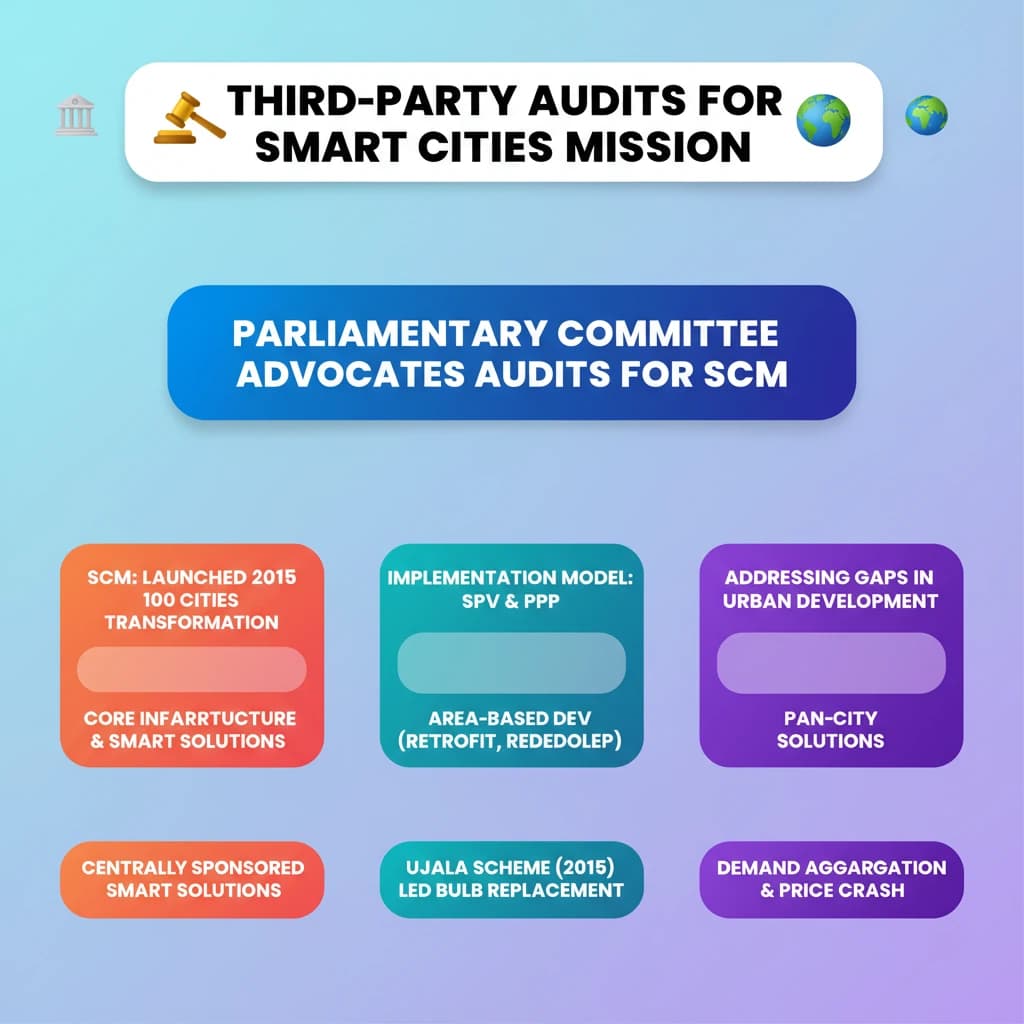
💡 Key Takeaways
- •Parliamentary Committee advocates for third-party audits of Smart Cities Mission (SCM) projects to address implementation gaps.
- •SCM, launched in June 2015, aims to transform 100 cities through core infrastructure and smart solutions, operating as a Centrally Sponsored Scheme.
- •SCM components include Area-Based Development (Redevelopment, Retrofitting, Greenfield) and Pan-City Solutions, implemented via SPVs under a PPP model.
- •UJALA Scheme (Jan 2015) promotes energy efficiency by replacing traditional bulbs with affordable LEDs, saving electricity and reducing CO2.
- •UJALA's success hinges on a demand aggregation-price crash model, making LEDs accessible and affordable.
🧠 Memory Techniques

95% Verified Content
📚 Reference Sources
•Ministry of Housing and Urban Affairs (MoHUA) official website
•Energy Efficiency Services Limited (EESL) official website
•Parliamentary Standing Committee reports (general knowledge of such calls)