Loading page, please wait…
Vaidra Logo
Vaidra

Top 4 items + smart groups

UPSC GPT
New
Current Affairs
Daily Solutions
Daily Puzzle
Mains Evaluator

Version 2.0.0 • Built with ❤️ for UPSC aspirants

Loading...
Loading...
Loading...
Loading...
Loading...
Loading...
Loading...
Loading...
Loading...
Loading...
Loading...
Loading...
Loading...
Back
All Subjects

Topics

0 topics • 0 completed

Loading topics...
Loading...
Loading...
Loading...
Loading...
Loading...
Overall Progress0%

What is India’s FBR Programme? - UPSC Science And Technology

What is What is India’s FBR Programme? in UPSC Science And Technology?

What is India’s FBR Programme? is a key topic under Science And Technology for UPSC Civil Services Examination. Key points include: India's FBR Programme aims for energy independence by maximizing nuclear fuel utilization.. FBRs 'breed' fuel, generating more fissile material than they consume, primarily from Uranium-238.. BHAVINI was incorporated in 2003 to build and operate the Prototype Fast Breeder Reactor (PFBR).. Understanding this topic is essential for both UPSC Prelims and Mains preparation.

Why is What is India’s FBR Programme? important for UPSC exam?

What is India’s FBR Programme? is a Medium-level topic in UPSC Science And Technology. It is tested in both Prelims (factual MCQs) and Mains (analytical answer writing). Previous year UPSC questions have frequently covered aspects of What is India’s FBR Programme?, making it essential for comprehensive IAS preparation.

How to prepare What is India’s FBR Programme? for UPSC?

To prepare What is India’s FBR Programme? for UPSC: (1) Study the comprehensive notes covering all key concepts on Vaidra. (2) Practice previous year questions on this topic. (3) Connect it with current affairs using daily updates. (4) Revise using key takeaways and mind maps available for Science And Technology. (5) Write practice answers linking What is India’s FBR Programme? to related GS Paper topics.

Key takeaways of What is India’s FBR Programme? for UPSC

  • India's FBR Programme aims for energy independence by maximizing nuclear fuel utilization.
  • FBRs 'breed' fuel, generating more fissile material than they consume, primarily from Uranium-238.
  • BHAVINI was incorporated in 2003 to build and operate the Prototype Fast Breeder Reactor (PFBR).
  • The DAE targets 22,400 MWe nuclear power by 2032, supported by FBRs and new PHWRs in 'fleet mode'.
  • India is set to become the second country after Russia with a commercial operating FBR, enhancing global standing.
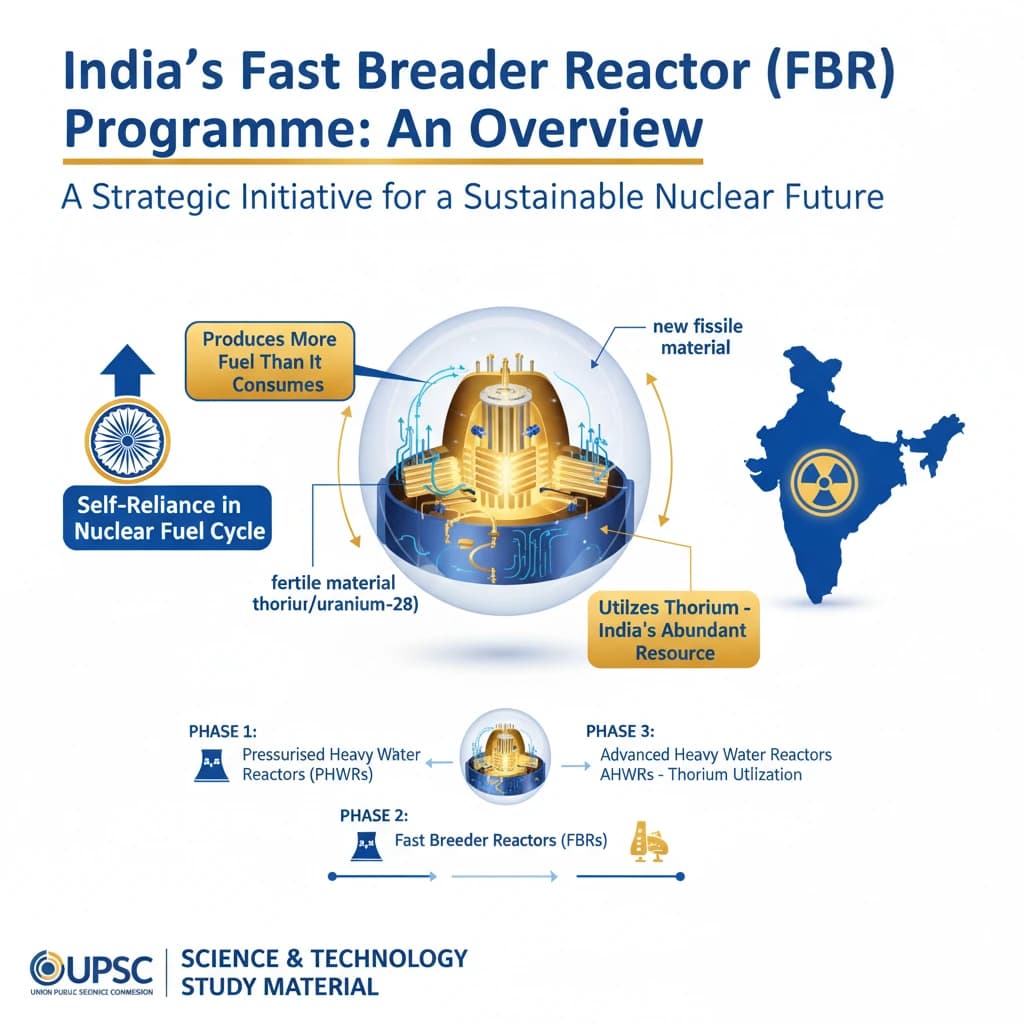
What is India’s FBR Programme?

What is India’s FBR Programme?

Medium⏱️ 6 min read✓ 95% Verified
science and technology

📖 Introduction

<h4>India's Fast Breeder Reactor (FBR) Programme: An Overview</h4><p>India's <strong>Fast Breeder Reactor (FBR) Programme</strong> is a crucial strategic initiative in the nation's pursuit of comprehensive nuclear energy capabilities. It aims to establish a self-reliant and sustainable nuclear fuel cycle.</p><p>The program involves the development and operation of <strong>Fast Breeder Reactors (FBRs)</strong>, which are advanced nuclear reactors designed to produce more fissile material than they consume.</p><div class='key-point-box'><p>The core objective is to ensure <strong>long-term energy security</strong> for India by efficiently utilizing its vast thorium reserves and optimizing uranium resources.</p></div><h4>Understanding Fast Breeder Reactors (FBRs)</h4><p>Unlike conventional nuclear reactors (like <strong>Pressurised Heavy Water Reactors - PHWRs</strong>), <strong>FBRs</strong> have a unique characteristic: they "breed" fuel.</p><p>This means they generate more new <strong>fissile material</strong> (e.g., Plutonium-239) from <strong>fertile isotopes</strong> (e.g., Uranium-238 or Thorium-232) than the fissile material they initially consume.</p><div class='info-box'><ul><li><strong>Fissile Material:</strong> Can sustain a nuclear chain reaction (e.g., <strong>Uranium-235</strong>, <strong>Plutonium-239</strong>).</li><li><strong>Fertile Material:</strong> Can be converted into fissile material by neutron absorption (e.g., <strong>Uranium-238</strong>, <strong>Thorium-232</strong>).</li></ul></div><div class='exam-tip-box'><p><strong>UPSC Mains (GS-III):</strong> Understanding the difference between <strong>fissile</strong> and <strong>fertile</strong> materials, and the concept of 'breeding' fuel, is vital for questions on nuclear technology.</p></div><h4>Historical Development and Key Institutions</h4><p>Efforts to build an <strong>FBR</strong> in India were initiated over <strong>two decades ago</strong>, marking a significant commitment to advanced nuclear technology.</p><p>A pivotal step was the incorporation of <strong>Bharatiya Nabhikiya Vidyut Nigam Ltd (BHAVINI)</strong> in <strong>2003</strong>.</p><div class='info-box'><p><strong>BHAVINI's Mandate:</strong> To build and operate India’s most advanced nuclear reactor, the <strong>Prototype Fast Breeder Reactor (PFBR)</strong>, located at <strong>Kalpakkam, Tamil Nadu</strong>.</p></div><h4>Strategic Goals and Future Outlook</h4><p>The <strong>Department of Atomic Energy (DAE)</strong> has ambitious targets for India's nuclear power sector. It aims to significantly increase the share of nuclear power in the national energy mix.</p><p>By <strong>2032</strong>, the <strong>DAE</strong> targets producing <strong>22,400 MWe</strong> (Megawatts electric) from its nuclear power plants.</p><p>To achieve this, the <strong>DAE</strong> has approved the construction of <strong>10 new Pressurised Heavy Water Reactors (PHWRs)</strong> in a <strong>‘fleet mode’</strong>.</p><div class='key-point-box'><p><strong>Fleet Mode Construction:</strong> This approach aims to accelerate project timelines, with each plant expected to be built in approximately <strong>five years</strong> from the first pouring of concrete.</p></div><p>Once the <strong>PFBR</strong> is commissioned and commercially operational, India will achieve a significant global milestone. It will become the <strong>second country after Russia</strong> to have a commercial operating <strong>FBR</strong>.</p><div class='exam-tip-box'><p><strong>UPSC Prelims:</strong> Remember the target year (<strong>2032</strong>), the MWe target (<strong>22,400 MWe</strong>), and India's potential global ranking (<strong>second after Russia</strong>) in FBR operation.</p></div>
Concept Diagram

💡 Key Takeaways

  • •India's FBR Programme aims for energy independence by maximizing nuclear fuel utilization.
  • •FBRs 'breed' fuel, generating more fissile material than they consume, primarily from Uranium-238.
  • •BHAVINI was incorporated in 2003 to build and operate the Prototype Fast Breeder Reactor (PFBR).
  • •The DAE targets 22,400 MWe nuclear power by 2032, supported by FBRs and new PHWRs in 'fleet mode'.
  • •India is set to become the second country after Russia with a commercial operating FBR, enhancing global standing.

🧠 Memory Techniques

Memory Aid
95% Verified Content

📚 Reference Sources

•Department of Atomic Energy (DAE) official reports
•Press Information Bureau (PIB) releases

Related Topics

Loading related topics...
Explore:Science And Technology Topics·All Subjects·Daily Current Affairs·Editorial Analysis·Previous Year Questions·UPSC GPT
What is India’s FBR Programme? - UPSC Science And Technology